

Why Is Ronin (RON) Price Up Today? Ethereum L2 Migration and Tokenomics Overhaul Drive Rally on May 19, 2026
2026/05/19 18:41:00
Introduction
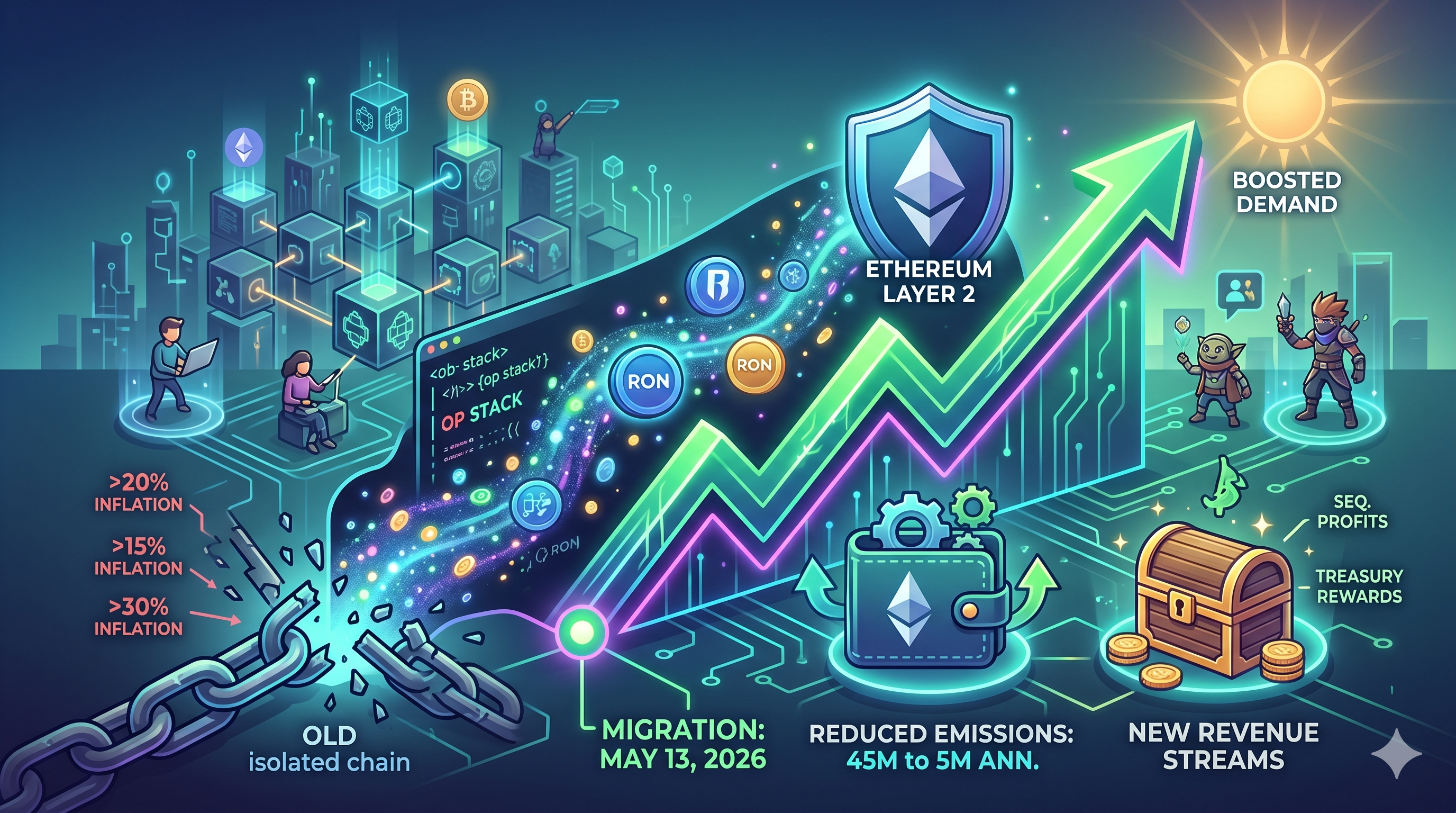
Ronin (RON) surged after completing one of the biggest structural changes in its history — its migration into an Ethereum Layer 2 network built on the OP Stack. According to recent announcements from Ronin Network on May 13, 2026, the network officially transitioned into an Ethereum-aligned Layer 2 ecosystem while dramatically reducing token inflation from over 20% annually to roughly 1.2%.
The market reaction was immediate because the upgrade fundamentally changed Ronin’s economic model, security profile, and long-term value proposition. Instead of relying heavily on token emissions, Ronin is now shifting toward treasury-based incentives, sequencer revenue, and ecosystem-driven distribution mechanisms.
This article explains exactly why Ronin price is up today, what the Ethereum Layer 2 migration means for the ecosystem, how the new tokenomics reduce sell pressure, and whether RON could continue gaining momentum in the coming months.
What Is Driving Ronin Price Higher Today?
Ronin price is rising because investors are repricing the network after its transition into an Ethereum Layer 2 ecosystem with significantly lower inflation.
The biggest catalyst came on May 13, 2026, when Ronin Network confirmed the successful migration to an OP Stack-based Ethereum Layer 2 architecture. According to the announcement, the migration preserved RON as the native gas token while introducing Ethereum-level interoperability and security alignment.
The market viewed the upgrade as bullish for four major reasons:
-
Inflation dropped from over 20% to about 1.2%
-
Token emissions were reduced by nearly 90%
-
Ronin gained deeper integration with Ethereum liquidity and infrastructure
-
Treasury and sequencer revenues created sustainable value capture mechanisms
These developments directly addressed one of the largest long-term concerns surrounding Ronin — excessive token inflation and ecosystem dependency on reward emissions.
Based on recent crypto market discussions and trading activity across major exchanges including KuCoin, traders increasingly see Ronin as evolving from a gaming-focused sidechain into a more sustainable Ethereum gaming Layer 2.
Why Does the Ethereum Layer 2 Migration Matter for Ronin?
The Ethereum Layer 2 migration matters because it significantly upgrades Ronin’s security, scalability, and ecosystem compatibility.
Previously, Ronin operated as a more isolated gaming-focused blockchain ecosystem primarily associated with the Axie Infinity economy. While that model enabled fast and low-cost gaming transactions, it also limited liquidity access and ecosystem interoperability compared with Ethereum-native Layer 2 networks.
By migrating to the OP Stack framework, Ronin now joins the broader Ethereum Layer 2 ecosystem alongside networks using similar modular infrastructure.
How Does OP Stack Integration Benefit Ronin?
The OP Stack integration improves Ronin in several important ways:
| Benefit | Impact on Ronin |
| Ethereum alignment | Stronger ecosystem compatibility |
| Shared infrastructure | Easier developer onboarding |
| Improved security assumptions | Higher institutional confidence |
| Better liquidity access | Potentially larger DeFi ecosystem |
| Cross-chain interoperability | Easier asset movement |
The migration also strengthens Ronin’s positioning in Web3 gaming, which remains one of crypto’s most active consumer sectors.
According to statements from Ronin Network, the goal is to reconnect millions of blockchain gaming users with Ethereum-native liquidity and applications while preserving Ronin’s gaming-focused user experience.
That narrative resonates strongly with investors because Ethereum Layer 2 ecosystems have become one of the dominant growth sectors in crypto during the past two years.
Why Is Ronin’s New Tokenomics Model Bullish for RON Price?
Ronin’s new tokenomics model is bullish because it sharply reduces inflation and lowers long-term sell pressure.
The most important economic change is the reduction in annual RON token issuance. According to Ronin’s recent announcement, yearly token emissions fell from 45 million RON to only 5 million RON.
That represents roughly a 9x decrease in new token supply entering the market.
Why Does Lower Inflation Matter?
Lower inflation generally benefits crypto assets because fewer newly minted tokens are available to dilute existing holders.
For Ronin, this change is especially important because previous emission-heavy models created persistent selling pressure from staking rewards and ecosystem incentives.
The new annual inflation rate is approximately 1.2%, which is dramatically lower than the prior 20%+ range.
This fundamentally changes how investors evaluate the token.
Instead of viewing RON as a high-emission gaming asset, the market may begin pricing it more like a utility and ecosystem value-capture token.
How Is Ronin Replacing Inflationary Rewards?
Ronin is replacing inflation-heavy incentives with treasury-backed and ecosystem-based rewards.
The network introduced a new “Proof of Distribution” model that allocates rewards directly to ecosystem contributors and builders rather than relying on broad token emissions.
This approach aligns incentives more closely with actual network growth.
The treasury also gains three new revenue streams:
| New Treasury Revenue Source | Details |
| Remaining staking rewards | 90 million RON allocated |
| Sequencer net profits | Revenue from network operations |
| Marketplace fees | 1.25% fee structure |
The increase in marketplace fees from 0.5% to 1.25% further strengthens treasury sustainability.
Investors often respond positively when blockchain ecosystems transition from inflationary subsidy models toward real revenue generation because it improves long-term economic durability.
How Does Ethereum Security Improve Ronin’s Investment Narrative?
Ethereum alignment improves Ronin’s credibility because Ethereum remains the dominant smart contract ecosystem in crypto.
Security concerns previously affected Ronin’s reputation after earlier bridge-related incidents in past market cycles. By integrating more deeply with Ethereum infrastructure and adopting OP Stack architecture, Ronin can now leverage stronger ecosystem trust assumptions.
This matters because institutional and large-scale crypto investors increasingly prioritize:
-
Security guarantees
-
Ecosystem composability
-
Liquidity access
-
Proven infrastructure standards
Ethereum Layer 2 ecosystems benefit from Ethereum’s broader network effects, developer base, and capital flows.
Ronin’s migration therefore changes investor perception from a relatively isolated gaming chain into a more integrated Ethereum-native ecosystem.
Is Ronin Becoming More Competitive Against Other Ethereum Layer 2 Networks?
Ronin is becoming more competitive because its gaming specialization differentiates it from general-purpose Ethereum Layer 2s.
Most major Ethereum Layer 2 ecosystems focus broadly on DeFi, AI, or general application infrastructure. Ronin, however, retains a strong gaming identity while now gaining Ethereum compatibility advantages.
This hybrid positioning could become important as blockchain gaming adoption grows.
What Makes Ronin Different From Other Gaming Chains?
Ronin differs from many gaming chains because it already has an established ecosystem and recognizable intellectual property connections.
Key differentiators include:
| Ronin Strength | Why It Matters |
| Existing gaming community | Higher user retention potential |
| Ethereum compatibility | Easier liquidity integration |
| OP Stack architecture | Scalable modular infrastructure |
| Reduced inflation | Stronger long-term token economics |
| Treasury revenue model | More sustainable incentives |
The market often rewards ecosystems that demonstrate both active users and improving fundamentals simultaneously.
That is one reason why RON price momentum accelerated following the migration announcement.
Could Reduced Token Emissions Create a Supply Shock for RON?
Reduced emissions could contribute to a supply shock if demand continues increasing while new supply sharply declines.
Crypto markets frequently react strongly to sudden supply-side changes because token pricing is highly sensitive to circulating supply growth.
Ronin’s emission reduction from 45 million to 5 million annual tokens significantly changes future supply dynamics.
Why Does Supply Reduction Affect Price?
Supply reduction matters because fewer tokens entering circulation can amplify buying pressure during periods of rising demand.
This mechanism resembles Bitcoin halving narratives where reduced issuance changes market psychology and token availability.
For Ronin, the new economic model may create:
-
Lower daily sell pressure
-
Higher staking attractiveness
-
Increased scarcity perception
-
Longer investor holding behavior
If ecosystem activity expands simultaneously, the reduced supply growth could support higher long-term valuations.
Conclusion
Ronin price is up today because the network completed a transformational shift into an Ethereum Layer 2 ecosystem while dramatically improving its tokenomics structure. The migration to an OP Stack-based architecture strengthened Ronin’s security profile, ecosystem compatibility, and liquidity access, while the reduction in annual token emissions from 45 million to 5 million RON significantly lowered inflationary pressure.
Investors responded positively because the upgrade changes Ronin’s long-term economic narrative. Instead of relying primarily on inflation-driven incentives, the ecosystem is now moving toward treasury revenues, sequencer profits, and builder-focused reward distribution. That model appears substantially more sustainable than the previous high-emission structure.
The market also views Ronin as uniquely positioned within blockchain gaming due to its existing user base and stronger integration with Ethereum infrastructure. However, competition among Layer 2 networks remains intense, and Ronin must continue expanding adoption to justify continued bullish momentum.
For now, the Ethereum migration and tokenomics overhaul represent one of the strongest fundamental catalysts Ronin has seen in years.
FAQs
Why did Ronin migrate to Ethereum Layer 2?
Ronin migrated to Ethereum Layer 2 to improve security, interoperability, liquidity access, and scalability while maintaining low-cost gaming transactions.
What is Ronin’s new inflation rate?
Ronin’s new annual inflation rate is approximately 1.2%, according to the network’s May 2026 tokenomics announcement.
What is Proof of Distribution on Ronin?
Proof of Distribution is Ronin’s new reward mechanism that allocates incentives directly to ecosystem builders and contributors instead of relying heavily on token inflation.
Is Ronin still focused on blockchain gaming?
Yes. Ronin remains heavily focused on Web3 gaming, but it now operates with deeper Ethereum ecosystem integration through its OP Stack-based Layer 2 infrastructure.
Can RON price continue rising after this rally?
RON could continue rising if ecosystem adoption, gaming activity, and treasury revenues expand following the Ethereum Layer 2 migration, although crypto market volatility remains high.