

Choice vs. Obligation: A Comprehensive Analysis of Options and Futures in 2026
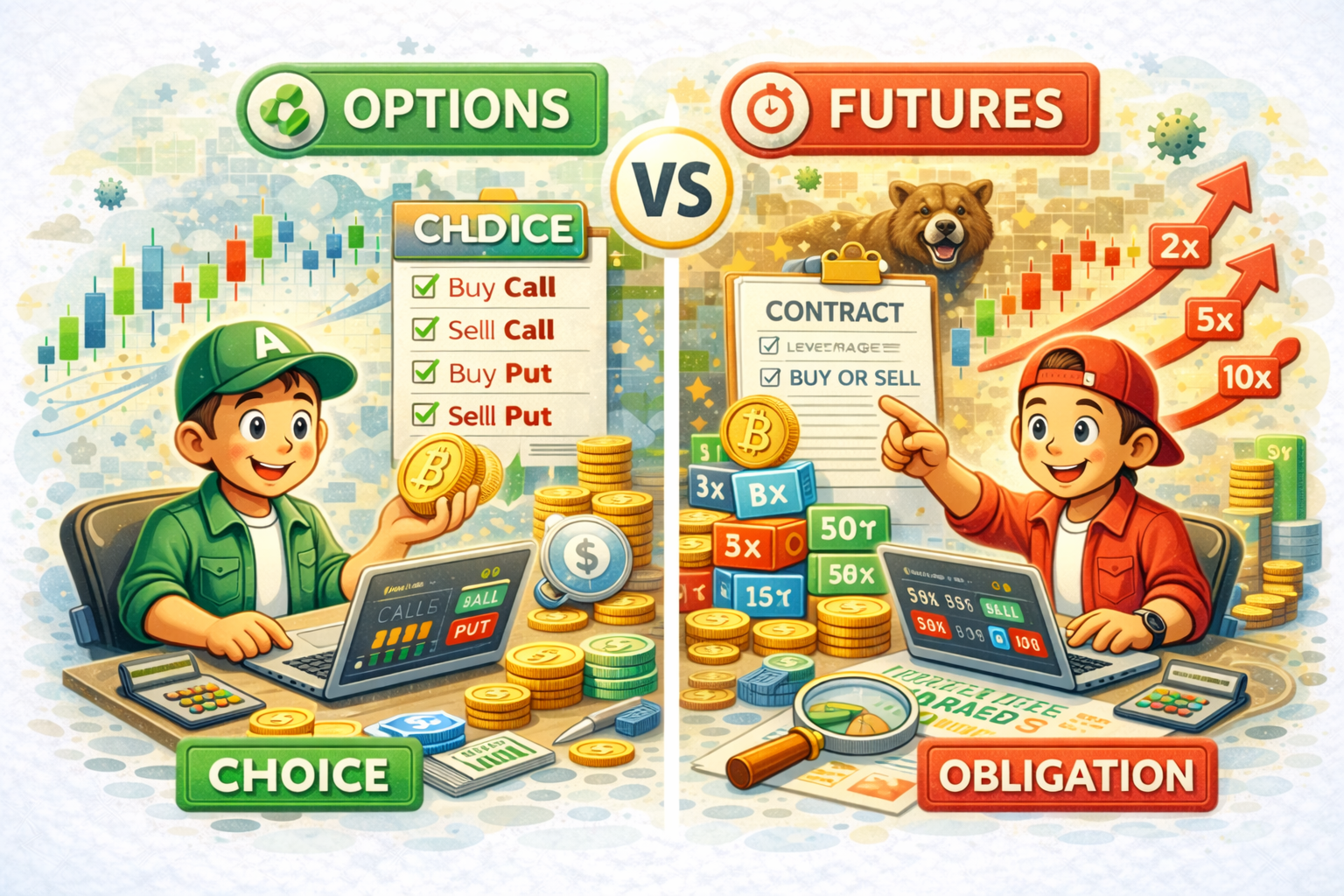
The global financial ecosystem in March 2026 is navigating a paradigm shift characterized by heightened geopolitical friction and a higher-for-longer interest rate environment. As the Federal Reserve maintains benchmark rates between 3.5% and 3.75%, the cost of capital has fundamentally altered how both retail and institutional investors approach market speculation and risk mitigation.
In this climate, traditional buy-and-hold strategies are frequently supplemented, or replaced, by derivative instruments that allow for capital efficiency and strategic hedging. Specifically, the interplay between options and futures has become the focal point for sophisticated portfolio management. While both instruments allow traders to gain exposure to price movements in equities, commodities, and indices without owning the underlying asset, they operate on entirely different mechanical principles. .
Understanding whether an investor is seeking the flexibility of a choice or the rigidity of an obligation is the first step in surviving the volatile market cycles of 2026. This guide provides an exhaustive deep dive into the mechanics, risks, and strategic applications of these two powerful financial tools.
What Are Options? (The Architecture of Financial Choice)
An options contract is a derivative agreement that grants the holder the right, but not the legal obligation, to buy or sell an underlying asset at a specific price, known as the "strike price," on or before a predetermined expiration date. To acquire this right, the buyer pays an upfront, non-refundable fee called a premium to the seller (the "writer") of the option. In the high-volatility environment of March 2026, options are prized for their "asymmetric" risk profile; the buyer's potential loss is strictly capped at the premium paid, while the potential for profit can be significantly higher depending on the magnitude of the asset's price movement.
There are two fundamental building blocks in the options market:
Call Options: These represent a "bullish" bet. A call buyer pays a premium for the right to purchase an asset at the strike price. If the market price of the asset rises significantly above the strike price, the buyer can "exercise" the option to buy the asset at a discount and sell it at the current market rate for a profit.
Put Options: These represent a "bearish" or "protective" bet. A put buyer pays a premium for the right to sell an asset at the strike price. In March 2026, as industrial indices faced pressure from surging energy costs, professional traders utilized put options as a form of "portfolio insurance" to lock in exit prices and protect against a catastrophic market downturn.
Options are further categorized by their "moneyness", whether they are In-the-Money (ITM), At-the-Money (ATM), or Out-of-the-Money (OTM). Institutional demand has shifted toward "Short-Dated" or "Zero Days to Expiration" (0DTE) options, which allow traders to speculate on intraday volatility with very low premium costs, though these carry extreme risks due to rapid time decay.
What Are Futures? (The Mechanics of Mandatory Exchange)
A futures contract is a legally binding agreement to buy or sell an underlying asset at a predetermined price on a specific future date. In this arrangement, both the buyer (long position) and the seller (short position) are obligated to fulfill the terms of the contract.
There is no "walking away" if the trade goes poorly; the contract must be settled, either through physical delivery of the asset or, more commonly in modern finance, through a cash settlement that reflects the price difference.
Futures do not require an upfront premium. Instead, they operate on a system of margin. A trader only needs to deposit a fraction of the total contract value, often between 5% and 15%, as collateral to open a position. This creates immense leverage, allowing a trader to control a large amount of a commodity, such as Brent crude oil which hit $119 per barrel in mid-March 2026, with relatively little capital. However, this leverage is a double-edged sword. Because futures are "marked-to-market" daily, any price movement against the trader results in an immediate deduction from their margin account. If the balance falls below the "maintenance margin" level, the trader faces a margin call, requiring an immediate cash injection to avoid forced liquidation.
Professional entities, such as airlines or manufacturing firms, favor futures for "price certainty." By locking in the cost of raw materials months in advance, they can stabilize their balance sheets against the unpredictable price shocks currently seen in the 2026 energy and logistics sectors.
Structural Divergence: Options vs. Futures
While both instruments are derivatives used for speculation and hedging, the 2026 market highlights four critical areas where they diverge.
Obligation and Flexibility
The most significant difference lies in the legal requirement of the contract. An options buyer holds all the power; they only exercise the contract if it is profitable to do so. A futures contract removes this power, forcing the transaction regardless of market conditions. This makes futures a "symmetrical" instrument where profit and loss move linearly with the price, whereas options are asymmetrical.
Cost Dynamics: Premium vs. Margin
The financial barrier to entry differs greatly. An option requires a sunk cost, the premium. Once paid, that money is gone, but the buyer's risk is ended there. A futures contract has no sunk cost at entry, but it requires active capital. The margin must be maintained throughout the life of the trade, making futures a more capital-intensive and stressful instrument to manage during the extreme volatility spikes seen in March 2026.
The Impact of Time (Theta)
In the options world, time is a decaying asset. Every day that passes reduces the value of an option because there is less time for the underlying asset to move to a favorable price. This is known as Theta. Futures do not experience Theta decay; a futures contract for December delivery is worth the same relative to the underlying price today as it will be in three months, assuming the price of the asset doesn't move.
Risk Magnitude
Because futures are mandatory and leveraged, the potential for loss is theoretically unlimited for the buyer and the seller. An option buyer, however, knows their "worst-case scenario" the moment they enter the trade: they can only lose what they paid for the option.
Professional Applications in the 2026 Market
Institutional desks at major banks and hedge funds use these tools with surgical precision based on current macro signals.
|
Strategic Goal |
Preferred Derivatives |
2026 Contextual Reason |
|
Put Options |
Put Options |
Protects portfolios against the 2026 war shock in energy markets with a fixed price |
|
Commodity Hedging |
Futures |
Ensures manufacturing firms can source materials at a locked in price despite supply chain disruptions |
|
Yield Enhancement |
Covered Calls |
Professional traders sell call options on assets they already own to collect premiums and generate income during sideways markets. |
|
Directional Speculation |
Futures |
Provides the highest leverage for traders betting on a sharp rebound in the S&P 500 after its recent technical breakdown. |
As of March 22, 2026, we have observed a significant migration of capital into protective puts on the S&P 500 as it tested the 200-day moving average. Simultaneously, futures volume in the agricultural sector has surged as traders attempt to lock in prices amid fears of 2026 crop failures due to extreme weather patterns.
Risk Management and Security Best Practices
Regardless of the chosen instrument, the 2026 market is unforgiving to those who ignore risk management. Professional-grade platforms like KuCoin emphasize that traders should never risk more than 1–2% of their total portfolio on a single derivative trade. In the futures market, maintaining a "buffer" well above the maintenance margin is essential to survive the intraday "liquidity gaps" that have characterized 2026.
For those new to these concepts, KuCoin Learn offers simulated environments where traders can practice with "paper money" to understand how margin calls and premium decay affect their balance before risking real capital. In an era where a single geopolitical headline can move markets by 5% in minutes, the ability to use options to cap your downside or futures to hedge your costs is no longer a luxury, it is a requirement for financial survival.
Best Platforms Traders Leverage
Professional traders increasingly gravitate toward KuCoin for their derivatives needs due to the platform’s high-performance infrastructure, which is specifically engineered to handle the sub-millisecond execution required for complex options and futures strategies in a volatile 2026 market. By offering Level 3 Data feeds, KuCoin provides a granular view of the order book that is often reserved for institutional players, allowing retail users to identify liquidity trends and hidden buy/sell walls with professional precision.
Beyond execution speed, the ecosystem is designed for holistic risk management; users can seamlessly transition between High-Leverage Futures for directional plays and Simplified Options for defined-risk hedging, all while utilizing KuCoin Earn to generate passive yield on their collateral. With some of the most competitive fee structures in the industry and robust security protocols, including advanced encryption and extensive proof-of-reserves, KuCoin provides the rare combination of institutional-grade power and user-centric accessibility required to navigate the modern financial space.
Delta-Neutral Strategies and the Pursuit of Market-Agnostic Returns
Delta is the most watched metric for institutional traders. Delta measures how much a derivative’s price changes for every $1 move in the underlying asset. A Delta-Neutral strategy involves balancing multiple positions so that the overall portfolio’s delta is zero. For example, if a trader holds 100 shares of an index-tracking stock (Delta = +100), they might buy "Put" options with a collective delta of -100. The result? If the market crashes, the gains on the Puts perfectly offset the losses on the stocks. If the market rallies, the stock gains offset the cost of the Puts.
Professional traders on KuCoin favor this approach because it shifts the goal from predicting the price to capturing volatility or earning yield. With the S&P 500 and various industrial indices showing lower realized volatility but high implied volatility due to geopolitical fears, professionals are selling Vega (volatility) through delta-neutral straddles to collect high premiums while staying protected against a sudden breakout in either direction.
The Mechanics of Basis Trading and "Cash and Carry
Another dominant strategy in the 2026 derivatives market is Basis Trading. "Basis" refers to the price difference between the spot market (current price) and the futures market (future price). In a Cash and Carry trade, a professional will:
-
Buy the Asset in the spot market.
-
Short a Futures Contract for the same amount.
With futures often trading at a premium (contango), this strategy allows traders to "lock in" the difference between the two prices. As the futures contract approaches its expiration date, its price will naturally converge with the spot price. The trader captures that difference as pure profit, essentially earning a "risk-free" interest rate.
On KuCoin, this is often executed using Perpetual Futures, where traders earn the Funding Rate, a periodic payment between long and short positions that keeps the perpetual price anchored to the spot price.
Why These Strategies Are Essential for the 2026 Investor
As we navigate a year defined by "liquidity cascades" and "gamma squeezes," these advanced methods provide a structural advantage that simple spot trading cannot match.
Capital Efficiency: Using KuCoin’s Cross-Margin feature, traders can use their existing holdings (like Gold-backed tokens or stablecoins) as collateral for their delta-neutral hedges, maximizing the utility of every dollar in their account.
Risk Insulation: By neutralizing delta, traders are no longer victims of "Black Swan" events. While a manual trader might lose 20% in a flash crash, a delta-neutral trader remains relatively unaffected, often even profiting from the surge in volatility.
Automated Execution: In 2026, you don't need to manually calculate these ratios every hour. KuCoin’s Smart Rebalance and DCA Bots can be configured to maintain a delta-neutral state or capture basis yield automatically, allowing the "ordinary investor" to operate with the same mechanical discipline as a hedge fund desk.
The 2026 market has proven that the "most interesting" way to trade isn't by chasing the highest green candle, but by building a mathematical "shield" that generates income while the rest of the market panics.
Conclusion: Crafting a Balanced 2026 Portfolio
The choice between options and futures depends entirely on your objective: do you need an insurance policy or a price lock? Options provide the strategic flexibility to navigate the 2026 "war-and-inflation" narrative with defined risk, while futures offer the raw power and price certainty needed for high-conviction directional moves.
As we look toward the second quarter of 2026, the complexity of global markets will only increase.
By mastering these derivatives on secure platforms like KuCoin, investors can move from being passive victims of market volatility to being active participants who can profit, or at least protect themselves, in any environment. Always perform deep due diligence, stay informed of the daily "mark-to-market" changes, and remember that in 2026, the most valuable asset is information.
FAQ
1. Is it safer to buy an option or trade a future?
Generally, buying an option is "safer" because your maximum potential loss is limited to the premium paid upfront. In futures trading, you can lose more than your initial margin deposit if the market moves violently.
2. What happens if I don't close my futures contract before it expires?
You will be required to settle the contract, either through a cash payment of the price difference or, in some cases, by taking physical delivery of the underlying asset (though most retail traders settle in cash).
3. Why would someone sell an option instead of buying it?
Sellers (writers) collect the premium upfront. They profit if the option expires worthless (OTM), which happens frequently. However, they take on much higher risk than the buyer.
4. Can I lose my entire margin in one day?
Yes. Because futures are leveraged, a small percentage move in the underlying asset can result in a large percentage move in your margin account. This is why stop-loss orders are mandatory for professional traders in 2026.
5. What is "Theta" and why should I care?
Theta is the rate at which an option's value decreases as it gets closer to its expiration date. If you buy an option and the market stays flat, you will lose money every day due to Theta.
6. Are these instruments available on KuCoin?
Yes. KuCoin provides a professional-grade Futures platform for high-leverage trading and Simplified Options products for those seeking to hedge with capped risk.
7. What is a margin call? A margin call occurs when your account equity falls below the maintenance margin level. You must either deposit more funds or close your position to prevent the exchange from liquidating it automatically.
8. Can I trade options on gold and oil? Yes, derivatives markets for major commodities like gold ($4,495/oz) and oil ($119/bbl) are extremely liquid and widely traded in 2026.