

Who Owns the Most Bitcoin in 2026? The Complete BTC Holder Breakdown
Introduction
Bitcoin's journey from a cryptography experiment to a $2.48 trillion asset class has created an ownership landscape that few could have predicted. Satoshi Nakamoto, the pseudonymous creator, remains the largest individual holder with nearly 1.1 million BTC. Yet collectively, institutions—exchanges, ETF issuers, and public companies—now control significantly more of the supply than any single person ever could.
This article breaks down who holds the most Bitcoin in 2026, from dormant creator wallets to government seizures and corporate treasuries, using verified on-chain data and public disclosures.
Who Is the Largest Bitcoin Holder in 2026?
Satoshi Nakamoto is the largest Bitcoin holder by a wide margin, controlling approximately 1.096 million BTC worth around $89 billion, representing 5.5% of the total 21 million supply, according to Arkham Intelligence data from May 2026. These holdings were acquired through mining roughly 22,000 blocks in Bitcoin's earliest days, identified via the distinctive "Patoshi" mining pattern that differs from all other early miners.
The significance of Satoshi's stash extends beyond its dollar value. These coins have remained completely dormant since mid-2010, with zero outbound transactions from the vast majority of addresses. The few spent coins were early test transactions, suggesting Satoshi either lost access to the private keys or made a deliberate choice never to sell.
This dormancy effectively removes 5.5% of Bitcoin's supply from circulation permanently. When combined with an estimated 3.7 million BTC lost in inaccessible wallets, the actual tradeable supply is far lower than the theoretical 21 million cap. Genesis block donations have become symbolic gestures—on February 7, 2026, an anonymous user sent 2.565 BTC (worth approximately $181,000) to the original Genesis address, permanently burning the supply since the Genesis block reward is technically unspendable.
For investors, Satoshi's holdings represent both a ceiling and a floor. If those coins ever moved, markets would panic. But their permanence also guarantees that no single entity can ever truly "own" more than 5.5% of Bitcoin, providing a decentralization backstop that no institution has yet breached.
Which Institutions Hold the Most Bitcoin?
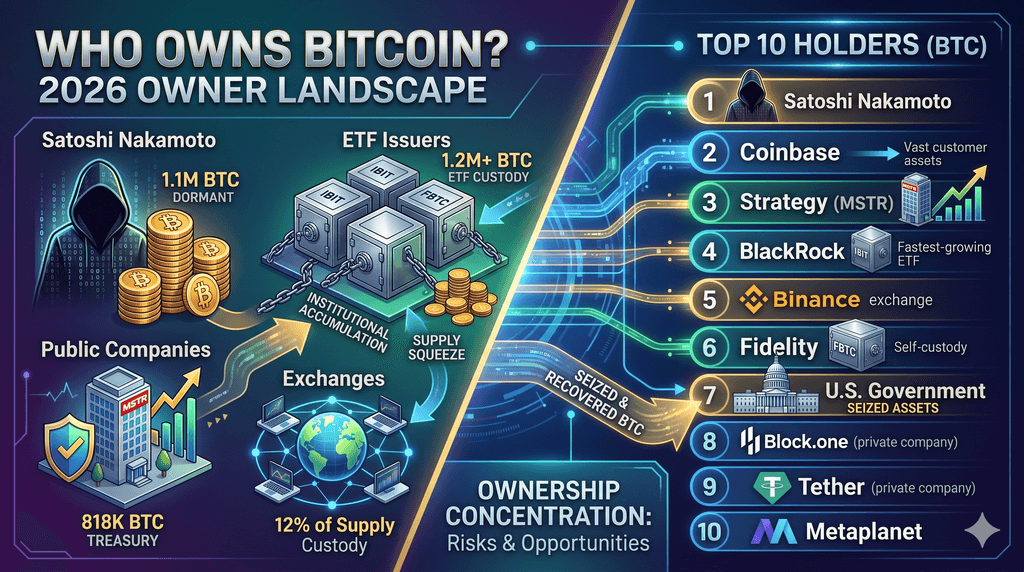
Institutions have overtaken individual holders as the dominant Bitcoin owners. The top ten entities by BTC holdings collectively control over 25% of the total 21 million supply, according to Arkham Intelligence data from May 2026. U.S. spot Bitcoin ETFs alone hold over 1.2 million BTC—more than Satoshi Nakamoto's stash.
Table
| Rank | Entity | Type | BTC Held | USD Value | Supply % |
| 1 | Satoshi Nakamoto | Individual | 1.096M | $89B | 5.50% |
| 2 | Coinbase | Exchange | 958K | $78B | 5.00% |
| 3 | Strategy (MSTR) | Public Company | 818K | $66B | 4.00% |
| 4 | BlackRock (IBIT) | ETF Issuer | 814K | $66B | 4.00% |
| 5 | Binance | Exchange | 634K | ~$52B | 3.20% |
| 6 | Fidelity (FBTC) | ETF Issuer | 452K | ~$37B | 2.30% |
| 7 | U.S. Government | Government | 328K | $27B | 1.60% |
| 8 | Block.one | Private Company | 164K | ~$13B | 0.80% |
| 9 | Tether | Private Company | 97K | $8B | 0.50% |
| 10 | Metaplanet | Public Company | 40K | ~$3.3B | 0.20% |
The dominance of this list is striking. The top four entities alone control over 18% of all Bitcoin. Add in the next six, and roughly one-quarter of the entire supply sits in the hands of ten players. For an asset marketed as decentralized, this concentration is either a vulnerability or a validation—depending on whether you view institutional adoption as legitimization or centralization by another name.
Coinbase sits at the top of the institutional hierarchy with 958,000 BTC. However, this figure demands nuance. The vast majority belongs to customers custodying assets on the exchange or through Coinbase Prime, which serves as the custodian for multiple ETFs. Coinbase's own corporate treasury holds a separate, smaller position of 14,548 BTC.
BlackRock's iShares Bitcoin Trust (IBIT) holds 814,000 BTC, making it the largest dedicated Bitcoin investment vehicle in the world. Launched in January 2024, IBIT became the fastest-growing ETF in history. BlackRock's scale creates a structural supply shock: consistent inflows effectively remove Bitcoin from retail exchange circulation, concentrating holdings within institutional-grade custody infrastructure.
Fidelity's Wise Origin Bitcoin Fund (FBTC) controls 452,000 BTC. Unlike competitors relying on third-party custodians, Fidelity self-custodies through its Fidelity Digital Assets division, eliminating counterparty risk for pension funds and 401(k) providers seeking Bitcoin exposure.
Strategy (formerly MicroStrategy) holds 818,000 BTC total, though Arkham has verified approximately 83% of these holdings on-chain. Roughly 184,000 BTC sits with Fidelity Custody on Strategy's behalf. Executive Chairman Michael Saylor has transformed the company into the world's first "Bitcoin Treasury Company," accumulating since August 2020 through debt and equity raises. Strategy's average purchase price sits at approximately $76,056 per BTC, leaving the firm with a substantial unrealized position relative to current market prices.
Grayscale distributes its holdings across more than 1,750 separate addresses, with no single wallet containing more than 1,000 BTC. Arkham Intelligence identified these on-chain locations after Grayscale initially refused to disclose them, according to a January 2026 announcement.
Why Are Institutions Accumulating So Aggressively?
The institutional accumulation is structural, not speculative. Bitcoin spot ETFs remove Bitcoin from exchange order books and place it into long-term custodial storage. BlackRock and Fidelity alone have absorbed over 1.2 million BTC since January 2024, creating a supply squeeze that tightens with each trading day. When combined with Strategy's perpetual accumulation and Tether's quarterly profit reinvestment, institutional buying has become a one-way ratchet on available supply.
Which Governments Own Bitcoin?
Governments hold approximately 305,000 BTC collectively, representing 1.5% of total supply, according to Arkham Intelligence data from May 2026. Unlike institutional holders who buy as an investment, most government holdings originate from criminal seizures and asset forfeitures.
The United States Government is the largest national holder with 328,000 BTC, valued at approximately $27 billion. The FBI recovered these holdings from multiple high-profile cases: the Silk Road marketplace shutdown, the Bitfinex hack recovery, and a 127,000 BTC seizure from the LuBian Hacker address in October 2025. The U.S. Marshals Service occasionally auctions seized Bitcoin, creating periodic supply shocks that can trigger double-digit volatility across global markets.
The United Kingdom holds 61,245 BTC, seized by the Metropolitan Police from Jian Wen and Zhimin Qian in 2018. The UK gained access to the seized assets in July 2021 after a prolonged legal process, and these holdings remain under government control without a public liquidation schedule.
China controls an estimated 194,000 BTC from the PlusToken Ponzi scheme confiscation in 2019-2020. Unlike the U.S., China provides no transparent reporting on the status of these assets. On-chain analysts periodically flag movements from PlusToken-linked addresses to exchanges like Huobi, fueling speculation that Beijing may be quietly liquidating reserves to fund state initiatives. China's official stance maintains a blanket ban on cryptocurrency trading and mining, making these holdings a significant geopolitical variable.
El Salvador is the only country that acquired Bitcoin through purchase rather than seizure. The nation famously adopted Bitcoin as legal tender and maintains a daily purchase program of 1 BTC per day, in addition to an initial acquisition of 2,546 BTC at a cost of $108 million. Current holdings stand at 7,600 BTC, according to Arkham data from May 2026.
Bhutan has mined Bitcoin since 2019 through its sovereign wealth fund, Druk Holding and Investments. A $500 million partnership with Bitdeer, announced in May 2023, leverages Bhutan's abundant hydroelectric power for mining operations. Bhutan's BTC stack declined from 6,000 to 3,200 in 2026, suggesting partial liquidation to fund national development projects.
The United Arab Emirates holds 6,800 BTC through Citadel Mining, a public mining company majority-owned by the UAE Royal Group through IHC (International Holding Company). Arkham Intelligence uncovered these significant mining operations in a March 2026 research report, positioning the UAE as an emerging crypto hub.
How Do Government Holdings Impact the Market?
Government holdings create a unique risk profile. Unlike corporate treasuries or ETF issuers with predictable investment horizons, seized assets can hit the market without warning through auctions or court-ordered liquidations. The German government's July 2024 sale of 50,000 BTC—seized from the Movie2k piracy site—provides a recent example of how government disposals can temporarily depress prices despite strong underlying demand.
What Does BTC Ownership Concentration Mean for Investors?
Bitcoin ownership is highly concentrated, and this concentration carries both opportunities and risks that every investor must understand. The top 1,000 Bitcoin addresses control over 3 million BTC—more than 15% of the total supply—while exchanges custody approximately 12% of all Bitcoin on behalf of clients, according to Arkham Intelligence and River Financial data from May 2026.
The Decentralization Paradox
Bitcoin's protocol remains decentralized. No single entity can alter the 21 million supply cap, reverse transactions, or censor wallet addresses without network consensus. However, ownership distribution tells a different story. A handful of institutions, governments, and early adopters control a disproportionate share of the asset. This creates a paradox: decentralized money with centralized wealth.
The risk is behavioral. If BlackRock's IBIT experiences massive outflows, the custodial Bitcoin must be sold into the market, creating selling pressure that affects all holders regardless of their ETF exposure. If the U.S. government announces an auction of seized Silk Road coins, prices can drop 10-20% in hours based on supply shock fears alone.
Why Concentration Also Validates Bitcoin
Institutional ownership is simultaneously Bitcoin's greatest validation. When BlackRock, Fidelity, and sovereign wealth funds allocate capital to BTC, they signal that Bitcoin has graduated from a speculative experiment to an investable asset class. Strategy's $66 billion treasury position and Metaplanet's yen-hedge strategy demonstrate that Bitcoin now serves functional purposes in corporate finance.
The supply dynamics also favor long-term holders. Every Bitcoin that moves into cold storage, ETF custody, or government seizure reduces the liquid float available for trading. With approximately 3.7 million BTC permanently lost and another 1.1 million in Satoshi's dormant wallets, the effective circulating supply is far smaller than the headline 21 million figure.
What Should Investors Monitor?
Watch on-chain movements from whale wallets and government addresses. Arkham Intelligence and similar platforms track entity-level flows, providing early warning when large holders begin repositioning. Pay attention to ETF flow data, which publishes daily and offers a real-time read on institutional sentiment. And recognize that Bitcoin's price increasingly reflects institutional behavior rather than retail speculation—understanding who holds the coins is now as important as understanding the technology itself.
How to Buy and Trade Bitcoin on KuCoin?
KuCoin offers comprehensive Bitcoin trading infrastructure for investors seeking exposure to the world's largest cryptocurrency. The platform lists BTC/USDT, and multiple fiat trading pairs with deep order book liquidity.
To begin, create a KuCoin account and complete identity verification. Deposit USDT from an external wallet or purchase crypto directly through the Buy Crypto feature using credit cards, bank transfers, or third-party payment providers. Navigate to Spot Trading, select BTC/USDT, and choose your execution method.
Market orders fill immediately at the best available price, suitable for traders prioritizing speed over precision. Limit orders allow you to set a specific entry price and wait for the market to reach your level—particularly useful in volatile conditions where Bitcoin can move 5-10% intraday. For advanced traders, KuCoin offers margin trading and futures contracts with leverage options, though these instruments carry substantial liquidation risk and are not recommended for beginners.
KuCoin Earn provides passive income opportunities for long-term Bitcoin holders through staking and savings products. Check the Earn tab for current APY rates, lock-up periods, and minimum requirements. For security, enable two-factor authentication and consider transferring large holdings to a hardware wallet if you are not actively trading.
Bitcoin remains a volatile asset capable of 30-50% drawdowns even during bull markets. Position sizing should reflect this reality—allocate no more than 5-10% of a diversified portfolio to Bitcoin, use stop-losses for active positions, and avoid leverage unless you fully understand the mechanics of margin calls and liquidation.
Conclusion
Bitcoin ownership in 2026 reveals an asset class that has outgrown its cypherpunk origins. Satoshi Nakamoto's 1.096 million BTC remains the largest single position, but institutions now control the narrative. Coinbase, BlackRock, and Fidelity collectively custody over 2.2 million BTC. Strategy's corporate treasury holds 818,000. Governments from the United States to Bhutan have accumulated hundreds of thousands more through seizures and strategic purchases.
This concentration creates a dual reality. Bitcoin's protocol is decentralized, but its ownership is not. Whale movements, government auctions, and ETF flows now drive price action more than grassroots adoption. For investors, this means monitoring institutional behavior is as critical as monitoring network fundamentals.
The structural supply squeeze from ETF accumulation, corporate treasury strategies, and lost coins suggests that Bitcoin's scarcity is intensifying even as its ownership becomes more concentrated. Whether this concentration ultimately threatens Bitcoin's decentralization ethos or validates its mainstream acceptance remains the defining question for the next cycle.
For now, the data is clear: the largest holders are not individual libertarians or early miners. They are the very institutions Bitcoin was designed to circumvent.
FAQs
Who owns the most Bitcoin in 2026?
Satoshi Nakamoto owns the most Bitcoin, with approximately 1.096 million BTC worth around $89 billion, representing 5.5% of the total supply. These coins were mined in Bitcoin's earliest days and have remained completely dormant since mid-2010, according to Arkham Intelligence data from May 2026.
How much Bitcoin does the U.S. government own?
The U.S. government holds 328,000 BTC, valued at approximately $27 billion. These holdings come entirely from criminal seizures, including the Silk Road marketplace, the Bitfinex hack recovery, and a 127,000 BTC confiscation from the LuBian Hacker address in October 2025.
Do Bitcoin ETFs own more BTC than Satoshi Nakamoto?
Yes. U.S. spot Bitcoin ETFs collectively hold over 1.2 million BTC—more than Satoshi's 1.096 million. BlackRock's IBIT alone holds 814,000 BTC, while Fidelity's FBTC controls 452,000 BTC, according to Arkham Intelligence data from May 2026.
Can a single Bitcoin whale crash the market?
A single whale selling all holdings at once would cause a significant but temporary price drop. However, Bitcoin's daily trading volume—often exceeding $50 billion across all exchanges—can absorb even large sales over time. The greater risk comes from coordinated institutional outflows or unexpected government liquidations, which can create sustained selling pressure.
How can I verify who owns a specific Bitcoin wallet?
Blockchain explorers like Arkham Intelligence, Glassnode, and mempool.space allow users to view wallet balances and transaction history. Arkham's entity clustering technology groups related addresses under verified labels (e.g., "Coinbase," "BlackRock," "U.S. Government"), providing a more complete picture than examining individual addresses alone. However, many wallets remain unattributed, and privacy-conscious holders intentionally obscure their identities through multiple addresses and mixing services.