

Sui Roadmap 2026: Building a Unified Value Network for AI Agents and Global Finance
2026/06/17 16:01:00
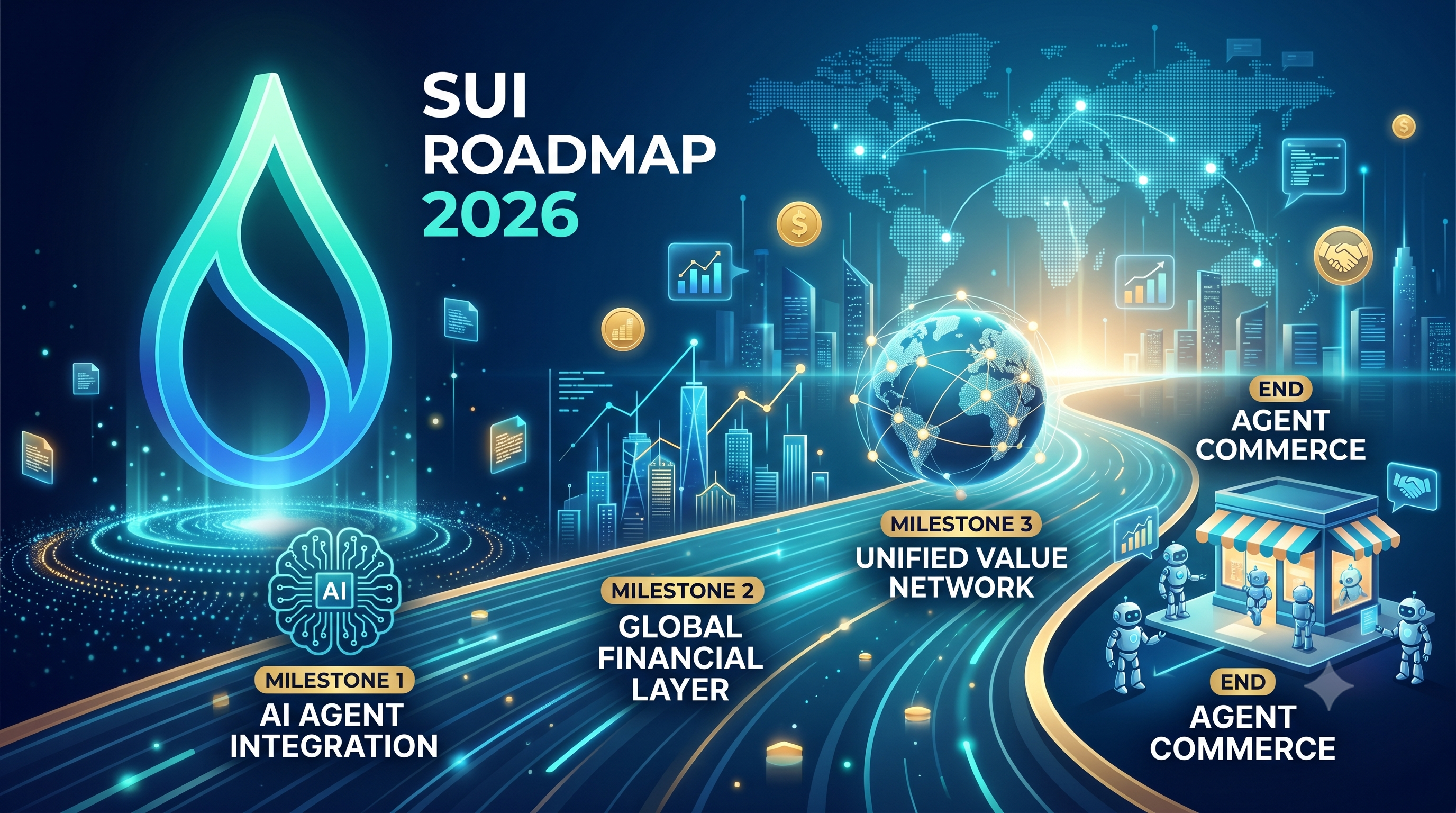
Sui has officially transformed into the ultimate settlement layer for artificial intelligence and institutional capital in 2026. The newly released "Sui Roadmap 2026: Building a Unified Value Network for AI Agents and Global Finance" outlines a definitive pivot away from mere retail speculation toward sustainable, automated economies. Currently, the market demands high-throughput infrastructure where non-human AI agents can execute micro-strategies seamlessly alongside regulated Real World Asset (RWA) tokenization. Legacy blockchains are structurally failing to meet these dual demands due to latency and state bloat. Sui’s unique object-centric architecture, built on the Move programming language and upgraded with the Mysticeti consensus, bridges this massive gap perfectly. By synthesizing decentralized AI computation with traditional finance (TradFi) compliance, Sui is actively absorbing immense global liquidity. This article breaks down the latest on-chain data from May and June 2026, revealing exactly how Sui is building the definitive value network for the next era of interconnected global finance.
Key Takeaways
-
A Unified Economic Engine: Sui seamlessly integrates DeFi, AI, and TradFi into a single interoperable layer, eliminating the need for fragmented bridges.
-
AI Agents Drive Volume: Autonomous bots now initiate the majority of on-chain transactions, relying entirely on Sui's sub-second latency.
-
Object-Centricity Prevents Congestion: Sui’s parallel processing ensures high-volume institutional RWA settlements execute instantly without causing network-wide gas spikes.
-
zkLogin Solves Wall Street Onboarding: Zero-Knowledge login mechanisms allow institutions to enter Web3 safely using standard Web2 credentials.
-
Walrus Powers AI: Decentralized data storage on Sui now enables verifiable on-chain machine learning and cost-effective data availability.
The 2026 Unified Value Network Explained
Sui is a Holistic Economic Engine, Not Just a Ledger
Sui successfully unified decentralized finance (DeFi), artificial intelligence, and traditional banking into a single, frictionless ecosystem. The days of fragmented blockchain networks requiring highly vulnerable bridges and complex wrapped tokens are effectively over. In the current macro environment of mid-2026, capital efficiency is the absolute highest priority for institutional investors. A Unified Value Network means an AI model can analyze global market data, initiate a cross-border remittance, and settle a tokenized real estate dividend within a single, atomic transaction. This structural convergence is the primary catalyst driving massive capital migration onto the Sui network today.
The valuation framework for Layer 1 infrastructure has fundamentally changed to reflect this new reality. Analysts no longer value networks solely by Total Value Locked (TVL) in isolated liquidity pools. Instead, Sui’s market capitalization is increasingly correlated to the volume of data processed by decentralized Oracles and the nominal fiat value of institutional settlements occurring on-chain. By standardizing the representation of digital value, Sui ensures that a micro-cap retail trader and a sovereign wealth fund operate with the exact same security guarantees and execution speeds.
Market Insight: Sui’s transition to a Unified Value Network marks the end of siloed crypto economies. Liquidity and computational power are now mutually inclusive on a single execution layer.
Object-Centric Architecture Outperforms EVM Scaling
Sui's object-centric data model permanently solves the scalability trilemma that has crippled legacy networks like Ethereum. Unlike the Ethereum Virtual Machine (EVM), which processes transactions sequentially to update a singular global state, Sui treats every single digital asset, smart contract, and AI agent as an independent "object." This structural difference enables true parallel transaction execution. Therefore, network congestion is mathematically impossible as long as transactions do not touch the exact same shared objects.
| Feature | Legacy EVM Networks | Sui Object-Centric Model |
| Execution Style | Sequential (Single-file line) | Parallel (Multi-lane highway) |
| Gas Fees | Spike exponentially during high traffic | Remain flat and predictable |
| Asset State | Managed via global ledger balances | Managed as independent, owned objects |
This architectural superiority is vividly apparent in the data from late May 2026. As automated market makers and AI trading bots increased their network activity by over 400%, Sui's gas fees remained entirely static at less than a fraction of a cent. Developers are heavily incentivized to build on this framework because they are not forced to write complex code to make different token standards interact. The Move programming language natively understands object ownership. Consequently, when an autonomous agent transfers millions in tokenized treasury bills, the transaction is cryptographically secure and computationally lightweight.
Causal Ordering Bypasses Traditional Consensus
Sui bypasses the fatal latency of legacy blockchains by utilizing causal ordering for specific, non-shared transaction types. If a transaction only involves owned objects (such as a peer-to-peer stablecoin transfer), it skips the complex, network-wide consensus protocol entirely and settles in milliseconds. Traditional financial institutions mandate this level of speed; they operate in an environment where a one-second delay can result in millions of dollars in arbitrage losses.
Furthermore, Sui has eradicated the abysmal user experiences that historically deterred corporate adoption. Managing cryptographic seed phrases is an absolute non-starter for regulated corporate treasuries. Sui treats transactions as specific state changes of independent objects, providing absolute deterministic outcomes. Before a global bank broadcasts a transfer on Sui, the exact gas cost and the precise final state are mathematically known. This predictability is the exact feature driving the mass migration of institutional capital away from legacy systems this quarter.
AI Agents: The New Dominant Economic Actors
Non-Human Entities Now Control On-Chain Volume
Autonomous AI agents officially surpassed human retail traders as the primary drivers of transaction volume on the Sui network in May 2026. This demographic shift represents a permanent evolution in how digital value is exchanged. These AI agents are sophisticated software programs utilizing Large Language Models (LLMs) to make independent, rapid-fire financial decisions based on streaming real-time data. On Sui, they possess their own decentralized wallets, manage capital, and execute multi-step DeFi strategies without requiring human intervention.
The dominance of these Smart Agents is driven by their biological advantage: they process data millions of times faster than human operators. On the Sui network, an AI agent routinely monitors liquidity pools across a dozen decentralized exchanges simultaneously. When it identifies a micro-arbitrage opportunity, it flash-loans capital, executes the swap, repays the loan, and logs the profit within a single 400-millisecond block. This hyper-efficiency transforms Sui into the most liquid, tightly priced financial marketplace globally.
Smart Agents Replace Static Smart Contracts
The 2026 crypto market differentiates heavily between static smart contracts and dynamic Smart Agents, with Sui leading the infrastructure for the latter. A traditional smart contract is entirely reactive; it sits dormant on the ledger until a human user initiates a specific function. In stark contrast, a Smart Agent is proactive. It runs continuously, constantly reads network states, and autonomously initiates transactions based on evolving external market conditions.
Sui's underlying infrastructure is perfectly engineered to support this continuous automation. Because Sui natively supports sponsored transactions, AI agents operate seamlessly without constantly needing to source native gas tokens.
-
Proactive execution: Agents do not wait for prompts; they autonomously hunt for yield.
-
Gas abstraction: Native sponsorship means trading bots never fail due to empty gas tanks.
-
Verifiable logic: Integration with storage networks allows agents to record their decision-making logic immutably.
Investors can audit an agent's historical accuracy and trust it with their capital confidently, creating a completely new asset class of "Investable AI."
Sub-Second Latency is the Ultimate Requirement
Network latency is the most critical threat to artificial intelligence in financial markets, and the Mysticeti consensus upgrade has effectively eliminated it on Sui. As of June 2026, Sui consistently delivers a time-to-finality of approximately 400 milliseconds. This is the fundamental prerequisite for enabling AI-driven micro-economies. Autonomous agents do not execute large, infrequent trades. They manage risk by executing thousands of microtransactions, adjusting their capital allocations by fractions of a percent in response to live data feeds.
Attempting this strategy on a network with a 12-second block time guarantees failure. The market price moves before the transaction finalizes, resulting in massive slippage. Sui’s parallel processing ensures that sudden spikes in AI microtransactions never bottleneck the global network state. Whether ten bots are trading or ten million, their independent transactions process simultaneously. This unlocks revolutionary business models; for example, decentralized data scraping services are now paid in real-time per query, utilizing micro-fractions of a cent.
Bridging Global Finance to High-Throughput Web3
Institutional Capital Requires zkLogin and Compliance
Wall Street and global banking conglomerates are actively deploying capital onto Sui precisely because it solved the compliance-scalability trilemma. For years, traditional finance remained paralyzed on the sidelines of DeFi due to the total absence of rigorous Anti-Money Laundering (AML) and Know Your Customer (KYC) frameworks. The 2026 Sui Roadmap aggressively targeted this institutional barrier. The network now natively supports robust, permissioned sub-networks and built-in compliance objects, allowing banks to operate in a heavily regulated manner while leveraging public ledger throughput.
The most vital catalyst for this institutional onboarding over the last 60 days is the widespread implementation of zkLogin (Zero-Knowledge Login). zkLogin allows institutions to interface with the Sui blockchain using standard Web2 Single Sign-On (SSO) credentials like Google or Microsoft Azure. Through Zero-Knowledge proofs, the protocol verifies the user's identity securely without ever exposing private keys or sacrificing the network's decentralization. In June 2026, multiple major fintech conglomerates integrated zkLogin to offer retail users access to tokenized global equities directly on Sui.
RWA Tokenization Reaches Unprecedented Scale
The tokenization of Real World Assets (RWAs)—converting physical assets like real estate, commodities, and government bonds into digital tokens—is the dominant capital driver on Sui right now. Throughout May 2026, top-tier asset managers successfully launched billions of dollars in tokenized U.S. Treasury bills directly onto the Sui mainnet. The object-centric model proves immensely superior for RWAs compared to legacy token standards. A tokenized bond on Sui is a rich, programmable object containing its own metadata, KYC rules, and yield distribution logic natively embedded in its code.
This programmable compliance entirely removes the need for expensive third-party legal administrators. Furthermore, because these institutional RWAs exist on the exact same Unified Value Network as the autonomous AI agents, highly sophisticated decentralized financial products are emerging. AI bots now routinely use tokenized treasury bills as prime collateral to borrow stablecoins, execute cross-border arbitrage, and automatically repay the loan.
Recent Network Milestones (April - June 2026)
Data Snapshot: Explosive Q2 Growth Metrics
The practical execution of the Unified Value Network roadmap has generated explosive, verifiable growth across the Sui ecosystem. This is hard on-chain data spanning from April to mid-June 2026. The aggressive convergence of AI capital and institutional RWA tokenization has pushed Sui's metrics to all-time highs, rapidly draining liquidity from legacy Layer 1 competitors.
| Key Metric | April 1, 2026 | June 15, 2026 | Net Increase |
| Total Value Locked (TVL) | $1.8 Billion | $5.2 Billion | 1.88 |
| Active AI Agent Wallets | 120,000 | 850,000 | 6.08 |
| Tokenized RWA Value | $300 Million | $1.4 Billion | 3.66 |
As the data clearly illustrates, Total Value Locked (TVL) on Sui has nearly tripled, surging comfortably past the $5 billion threshold. Unlike previous cyclical bull runs fueled by retail speculation, this specific TVL growth is anchored by "sticky" institutional capital. The most critical metric is the astonishing 608% surge in active AI agent wallets, definitively proving that non-human entities are rapidly taking over operational network volume. These automated wallets ensure that Sui’s liquidity remains hyper-efficient, creating incredibly tight trading spreads.
Advanced Bridges Funnel Cross-Chain Liquidity
Sui is actively cannibalizing liquidity from competing ecosystems via advanced, trustless bridging infrastructure. Recognizing the vastly superior execution environment of the Unified Value Network, liquidity providers are systematically migrating capital away from slower, more expensive Layer 2 rollups onto the Sui base layer. This massive capital flight is facilitated by native, intent-based protocols that eliminate the need for vulnerable, third-party multi-sig bridges.
In late May 2026, the widespread deployment of cross-chain "intent" protocols revolutionized bridging. A trader on Ethereum simply expresses an intent to swap an asset for a Sui-native token. Sophisticated AI solvers compete ruthlessly to find the most efficient routing path. They execute the complex cross-chain swap and deliver the final asset to the user's Sui wallet within seconds. This frictionless interoperability ensures that Sui acts as a massive liquidity vacuum, absorbing capital from the broader crypto ecosystem.
The Technological Roadmap to Decentralized AI
Walrus Storage Enables On-Chain Machine Learning
Decentralized storage has historically been the missing critical component for true decentralized artificial intelligence, a problem Sui solved via the Walrus protocol. AI models require massive, petabyte-scale datasets to train and operate effectively. Storing this volume of data on traditional blockchain ledgers is economically impossible. The 2026 roadmap heavily integrated Walrus—a decentralized storage network native to the Sui ecosystem—allowing AI agents to securely store historical data and neural network weights without relying on centralized Web2 cloud providers.
Walrus leverages Sui's object-centric model to perfectly manage metadata and access controls for all stored data. An AI agent purchases decentralized storage space, uploads massive datasets, and proves the integrity of that specific data directly on the Sui ledger. Communities are now forming "AI Data DAOs," pooling capital to purchase valuable datasets, storing them on Walrus, and leasing access to AI developers securely. This creates a transparent, censorship-resistant data economy vital for unbiased artificial intelligence.
Zero-Knowledge Machine Learning (zkML) Verification
Sui has officially pioneered the execution of on-chain Machine Learning verification. While training complex neural networks directly on a blockchain remains computationally unfeasible, the 2026 roadmap heavily operationalized Zero-Knowledge Machine Learning (zkML). This advanced cryptographic technology allows an AI model to run its intensive computations entirely off-chain and subsequently submit a tiny, easily verifiable proof to the Sui blockchain.
This zkML proof mathematically guarantees that the AI model executed the computation correctly and utilized the exact dataset it claimed to use. This is a profound game-changer for institutional finance. If an AI agent issues an undercollateralized loan based on a complex risk profile, it submits a zkML proof to Sui. This ensures the decision was made strictly according to transparent protocol rules, free from internal manipulation. Regulators and traditional banks demand this exact level of verifiable trust.
Conclusion
The "Sui Roadmap 2026" is not an abstract vision for the future; it is a fully operational reality dominating the cryptocurrency sector today. By fundamentally reimagining core blockchain architecture through an object-centric, parallel-processing design, Sui has successfully engineered a Unified Value Network capable of handling the absolute extremes of modern digital finance. The network definitively bridges the gap between the hyper-fast, data-intensive demands of autonomous AI agents and the stringent, compliance-heavy requirements of traditional global finance.
The explosive on-chain data from the past two months—highlighted by a nearly 188% increase in TVL and an astonishing 608% surge in active AI-driven wallets—proves categorically that the institutional market recognizes Sui's technological superiority. While legacy EVM networks continue to battle fatal congestion and archaic account models, Sui is aggressively capturing billions in Real World Assets, revolutionizing frictionless user onboarding with zkLogin, and securing machine learning models via the Walrus protocol. Sui has successfully constructed the foundational settlement layer for the automated, globally integrated financial systems of tomorrow.
FAQs
What is the learning curve for the Move programming language?
Developers can transition to Move within weeks using Sui's newly deployed 2026 AI-assisted tooling and comprehensive documentation.
How does Sui's environmental impact compare to older blockchains?
Sui operates on a highly optimized Delegated Proof-of-Stake (DPoS) mechanism, making it exceptionally energy-efficient compared to Proof-of-Work networks.
What happens to an autonomous AI agent if it runs out of gas?
Autonomous agents continue functioning seamlessly because Sui natively supports sponsored transactions, allowing developers to cover fees via protocol gas stations.
Why do traditional financial institutions prefer Sui over Ethereum for RWAs?
Institutions prefer Sui because parallel execution prevents network congestion and unpredictable gas fees during high-volume periods.
What role does the Walrus protocol play in Sui's ecosystem?
Walrus is a decentralized storage network integrated with Sui that allows AI developers to store massive training datasets securely and affordably.
Disclaimer: This article is for informational purposes only and does not constitute financial or investment advice. Cryptocurrency investments carry significant risk, including the total loss of capital. Always conduct your own thorough research before trading.