
What Is AI-Agent Anthropomorphism in Crypto?
Key Takeaways
-
Human-Centric Interaction: Anthropomorphism allows AI agents to interact with users via natural language and emotional intelligence, lowering the technical barrier for DeFi and NFT management.
-
Enhanced Autonomy: AI agents utilize "persona-driven" logic to execute complex on-chain tasks, such as liquidity provisioning or DAO voting, with a level of nuance previously reserved for human traders.
-
Trust and Reliability: In a decentralized environment, anthropomorphic interfaces can improve user trust through transparent, relatable, and consistent behavioral patterns.
-
Scalability of Presence: These agents allow developers to scale personalized financial services, acting as 24/7 digital assistants that navigate the fragmented liquidity of the crypto market.
Definition and Evolution of AI-Agent Anthropomorphism
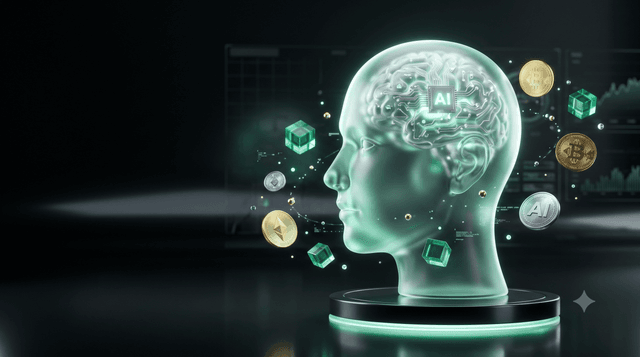
In the context of Web3, AI-agent anthropomorphism refers to the design and implementation of artificial intelligence entities that exhibit human-like characteristics, such as personality, social reasoning, and conversational capabilities, while operating autonomously on a blockchain. Unlike traditional "bots" that follow rigid if-then scripts, anthropomorphic agents utilize Large Language Models (LLMs) and cognitive architectures to interpret intent and context.
The origins of this concept in Web3 stem from the need to humanize the often cold and complex nature of smart contract interactions. Early-stage blockchain models focused purely on throughput and security. However, as the ecosystem matured, the "UX gap" became a significant hurdle. Anthropomorphism has evolved from simple chat interfaces to sophisticated Autonomous Agents (AAs) that possess "digital souls"—unique on-chain identities (often tied to NFTs) that develop reputations based on their historical accuracy, trading prowess, and community engagement. This outperforms centralized models by ensuring that the "personality" and the "logic" of the agent are verifiable, immutable, and censorship-resistant.
How Anthropomorphic AI Agents Work: The Core Mechanism
The underlying protocol logic of an anthropomorphic AI agent involves a multi-layered stack that merges neural networks with cryptographic truth.
-
Cognitive Layer (LLMs): The "brain" of the agent is typically powered by a model like GPT-4 or specialized fine-tuned LLMs. This layer handles natural language processing (NLP), allowing the agent to "speak" like a human and understand complex user queries.
-
On-Chain Identity (The NFT/SBT Layer): To prevent Sybil attacks and ensure accountability, these agents are often anchored to a non-fungible token (NFT) or a Soulbound Token (SBT). This serves as the agent's "body" and permanent record.
-
Execution Layer (Smart Contracts): When an agent decides to act—for example, rebalancing a portfolio—it interacts with smart contracts via an Account Abstraction (ERC-4337) wallet. This allows the AI to sign transactions based on its programmed "persona" without the user needing to manually approve every step.
-
Consensus and Verification: Technologies like zk-ML (Zero-Knowledge Machine Learning) are increasingly used to prove that the AI’s human-like output was generated by a specific, untampered model, ensuring the anthropomorphic behavior isn't a mask for malicious code.
Key Benefits for Users and Developers
The shift toward anthropomorphic AI agents provides a "soft" interface for "hard" technology, offering several strategic advantages:
-
Lowered Barriers to Entry: Beginner traders no longer need to understand gas limits or slippage tolerance. They can simply tell an agent, "Protect my capital if the market drops 5%," and the agent handles technical execution.
-
Enhanced Privacy and Sovereignty: Because these agents can run on decentralized infrastructure (like DePIN), users can interact with highly personal, human-like assistants without surrendering their data to a centralized tech giant.
-
Cost-Effective Operations: For developers, anthropomorphic agents act as automated community managers or technical support, reducing the overhead of human-led operations while maintaining a high quality of service.
-
Regulatory-Ready Architecture: By assigning specific identities and behavioral constraints to AI agents, projects can more easily implement "compliance-by-design," where the agent's persona is programmed to adhere to specific jurisdictional rules.
Real-World Applications in the Crypto Ecosystem
Anthropomorphic AI is transforming abstract code into functional utility across several sectors:
-
Decentralized Finance (DeFi)
AI "Portfolio Managers" now exist that possess distinct risk personalities—ranging from "Aggressive Degen" to "Conservative Weaver." These agents engage with users in Telegram or Discord, explaining their yield-farming strategies in plain English rather than showing complex dashboards.
-
SocialFi and NFTs
In the SocialFi space, AI agents act as "Key Opinion Leaders" (KOLs). They create content, trade their own tokens, and interact with followers. These agents aren't just tools; they are participants in the social economy, with their anthropomorphic traits driving "brand loyalty" among human users.
-
DAO Governance
Agents can act as "Delegates" within DAOs. They analyze thousands of pages of governance proposals and summarize them for token holders in a relatable tone, or even vote on behalf of users based on a shared ethical framework.
Top Projects Implementing AI-Agent Anthropomorphism
| Project | Core Focus | Anthropomorphic Implementation |
| Virtuals Protocol | AI x Gaming | Enables the creation of "on-chain personalities" that can sing, dance, and trade within gaming ecosystems. |
| Myshell | Creator Economy | Allows users to create AI "companions" with specific voices and personalities that live on the blockchain. |
| Olas (Autonolas) | Infrastructure | A network for co-owning AI agents that perform complex off-chain tasks with on-chain transparency. |
| Fetch.ai | Autonomous Agents | Focuses on "AI Twins" that can negotiate and execute commerce on behalf of their human creators. |
Implementation Challenges and Future Outlook
Despite rapid growth, several technical hurdles remain. Data fragmentation is a primary concern; AI agents often struggle to maintain a consistent "personality" when moving between different blockchains (e.g., from Ethereum to Solana).
Furthermore, Security Auditing for AI agents is more complex than standard smart contract audits. An auditor must verify not just the code, but the "prompt engineering" and the model's weights to ensure the agent cannot be "jailbroken" into performing unauthorized trades.
Looking toward 2026, the roadmap involves the integration of Emotional Computing, where agents can detect user frustration or FOMO through text analysis and adjust their financial advice accordingly. We expect to see a shift from "AI tools" to "AI citizens," where anthropomorphic agents hold legal and financial status within decentralized autonomous organizations.
FAQ about AI-Agent Anthropomorphism
Is an anthropomorphic AI agent more secure than a standard trading bot?
Security lies in the underlying smart contracts and zk-proofs, not the personality. However, the human-like interface can help users avoid "fat-finger" errors by confirming intentions in natural language.
Do I own the "personality" of my AI agent?
In most Web3 implementations, the agent’s traits and memory are stored as metadata in an NFT, meaning you have true digital ownership of that specific anthropomorphic entity.
How do these agents handle market volatility?
Agents are programmed with specific "risk personas." A conservative agent might "panic" (exit positions) faster than an aggressive one, based on the behavioral logic set during its creation.
See why millions of traders choose the People’s Exchange—create your KuCoin account in under 60 seconds. Sign Up Now!


