

LI.FI Intents Launches Intent-Based Architecture for Stablecoin Payments and RWA Tokenization
2026/05/28 17:58:00
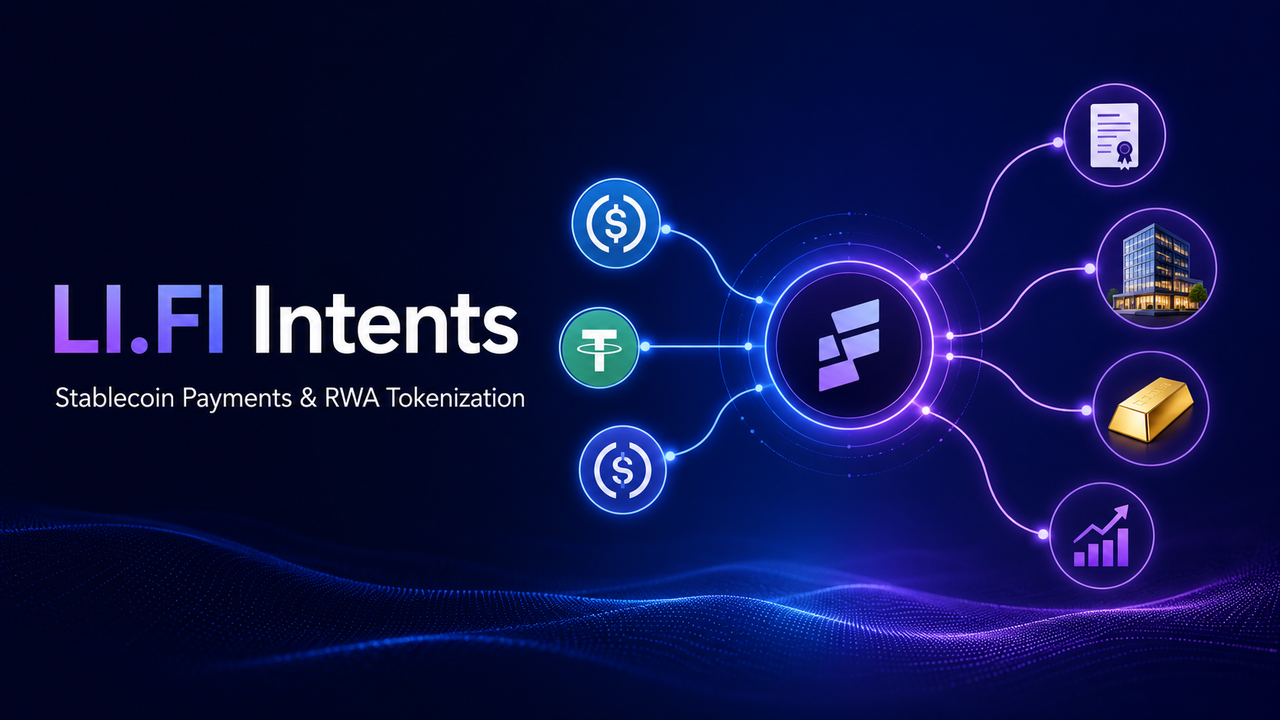
LI.FI has launched LI.FI Intents, an intent-based execution architecture designed to support the next phase of stablecoin payments, real-world asset tokenization, and enterprise-grade on-chain finance. The new infrastructure aims to simplify cross-chain transactions by allowing users and applications to define their desired outcome while LI.FI’s execution layer handles the complex process behind the scenes.
The launch comes as stablecoins and tokenized real-world assets are becoming key areas of growth in the digital asset market. Fintech companies, wallets, exchanges, neobanks, and regulated institutions are increasingly looking for infrastructure that can support faster payments, better liquidity access, and simplified blockchain settlement.
With LI.FI Intents, the company is expanding beyond traditional bridge and swap aggregation into a broader execution layer for Web3 payments infrastructure, RWA tokenization, and cross-chain financial applications.
Why This Launch Matters
The launch of LI.FI Intents is important because it addresses one of the biggest challenges in Web3 finance: transaction complexity. By combining intent-based architecture, stablecoin payments, RWA tokenization, and cross-chain execution, LI.FI is building infrastructure that can help fintechs, wallets, exchanges, and institutions offer faster and simpler on-chain financial services.
LI.FI Intents Introduces Intent-Based Infrastructure for On-Chain Finance
LI.FI Intents represents a major step forward in intent-based infrastructure for on-chain finance, giving applications a simpler way to execute transactions across multiple blockchain networks. Instead of forcing users to manually choose bridges, manage gas tokens, compare swap routes, or interact with several chains, LI.FI Intents allows users and applications to define the desired outcome while the execution happens in the background.
Intent-Based Architecture Simplifies Blockchain Transactions
The core idea behind intent-based architecture is to make blockchain transactions more outcome-focused. Users no longer need to manage every technical step of a cross-chain transfer. They simply specify what they want to achieve, such as sending stablecoins, swapping assets, or accessing tokenized real-world assets.
LI.FI’s infrastructure then handles the execution process, including routing, liquidity sourcing, and transaction settlement.
Key benefits include:
-
Simplified cross-chain execution
-
Reduced need for users to manage gas tokens
-
More predictable transaction outcomes
-
Better user experience for wallets, fintech apps, and exchanges
Unified Execution Layer for Web3 Applications
For developers and enterprises, LI.FI Intents provides a unified execution layer that can support multiple blockchain networks through one integration. This is especially important for fintech platforms, neobanks, wallets, and exchanges that want to offer on-chain services without exposing users to complex blockchain operations.
By abstracting the technical steps behind stablecoin transfers and asset swaps, LI.FI Intents helps applications deliver smoother crypto payment and on-chain finance experiences.
Supporting the Future of On-Chain Finance
The launch reflects a broader shift in Web3 infrastructure toward outcome-based execution. As stablecoin payments, RWA tokenization, and blockchain-based financial services gain adoption, users need faster and simpler ways to move value across chains.
LI.FI Intents is designed to support this transition by making on-chain transactions more accessible, reliable, and scalable for both crypto-native platforms and regulated financial applications.
Stablecoin Payments and RWA Tokenization Drive New Enterprise Use Cases
The launch of LI.FI Intents comes as stablecoin payments and RWA tokenization are becoming two of the most important growth areas in on-chain finance. Enterprises, fintech companies, neobanks, wallets, and exchanges are increasingly exploring blockchain infrastructure to support faster payments, tokenized asset access, and cross-chain liquidity.
Stablecoin Payments Gain Enterprise Momentum
Stablecoins are becoming a key tool for digital payments, cross-border transfers, and on-chain settlement. However, many stablecoin transactions still require users to manage gas fees, bridges, network selection, and swap routes.
LI.FI Intents helps simplify this process by allowing applications to offer stablecoin transfers where users focus on the final payment outcome instead of the technical steps behind it. The architecture can support precise cross-chain swaps between stablecoins such as USDC and USDT, while reducing the need for users to manage gas tokens.
Key use cases include:
-
Cross-border stablecoin payments
-
Wallet-to-wallet transfers
-
Fintech payment infrastructure
-
Neobank crypto payment services
-
Exchange and wallet stablecoin swaps
RWA Tokenization Opens Access to On-Chain Assets
Real-world asset tokenization is another major enterprise use case supported by LI.FI Intents. Tokenized assets such as Treasuries, equities, commodities, and other financial instruments are gaining attention from institutions looking to bring traditional finance on-chain.
By supporting RWA tokenization, LI.FI Intents can help applications provide access to tokenized assets across different blockchain networks and liquidity venues. This reduces fragmentation and makes it easier for businesses to integrate real-world assets into their platforms.
RWA Tokenization Expands On-Chain Asset Access
RWA tokenization is becoming a major growth area in on-chain finance as institutions explore ways to bring real-world assets such as Treasuries, equities, commodities, and funds onto blockchain networks. For platforms building around stablecoin payments and cross-chain execution, tokenized real-world assets create new opportunities for faster settlement, broader liquidity access, and more efficient financial products.
LI.FI Intents can support this shift by helping applications connect users to tokenized assets across different blockchain ecosystems. By combining intent-based architecture, solver network execution, and liquidity routing, LI.FI Intents helps reduce fragmentation in the RWA tokenization market and makes it easier for fintechs, wallets, exchanges, and regulated institutions to integrate real-world assets into Web3 financial services.
Enterprise Adoption Requires Simpler Infrastructure
For enterprise adoption to grow, blockchain infrastructure needs to become easier to use, more reliable, and more predictable. Businesses cannot rely on complex user flows that require manual bridging, gas management, or fragmented liquidity routing.
LI.FI Intents addresses these challenges by supporting:
-
Simplified cross-chain stablecoin execution
-
Access to tokenized real-world assets
-
Better liquidity routing across networks
-
Reduced transaction complexity for end users
-
Scalable infrastructure for fintechs, wallets, and institutions
As stablecoins and RWAs continue moving toward mainstream adoption, LI.FI Intents positions itself as a key execution layer for enterprise-grade on-chain finance.
Solver Networks and Compliant Liquidity Power Cross-Chain Execution
LI.FI Intents uses solver networks and compliant liquidity to make cross-chain execution faster, simpler, and more reliable for users, developers, and enterprise applications. Instead of depending only on traditional bridge routes or fragmented on-chain liquidity, LI.FI’s intent-based architecture allows solvers to find the most efficient path to complete a transaction.
Solver Networks Improve Transaction Execution
A solver network is a group of professional execution providers that compete to fulfill user intents. When a user wants to send stablecoins, swap assets, or access tokenized real-world assets, solvers handle the technical process behind the transaction.
This can include finding liquidity, managing routing, handling gas requirements, and completing settlement across supported blockchain networks. By using solver network execution, LI.FI Intents aims to provide market-maker-level execution for cross-chain stablecoin swaps and other on-chain financial transactions.
Key benefits of solver networks include:
-
Faster cross-chain transactions
-
More reliable execution paths
-
Better pricing and tighter spreads
-
Reduced failed transactions
-
Simplified user experience for wallets and fintech apps
Compliant Liquidity Supports Enterprise Adoption
For regulated businesses, compliant liquidity is essential. Enterprises, exchanges, fintech platforms, and financial institutions need infrastructure that supports safer transaction flows and aligns with compliance expectations.
LI.FI Intents is designed to support this requirement by giving applications access to liquidity sources that can be screened, structured, and managed for enterprise-grade use cases. This makes the architecture more suitable for companies building stablecoin payment products, RWA platforms, and cross-chain financial services.
Cross-Chain Execution Becomes More Scalable
As blockchain ecosystems continue to expand, liquidity is spread across many networks, bridges, exchanges, and asset issuers. This fragmentation creates challenges for users and businesses that need smooth access to stablecoins and tokenized assets.
LI.FI Intents helps solve this by combining:
-
Intent-based transaction routing
-
Solver network execution
-
Compliant liquidity access
-
Stablecoin payment infrastructure
-
RWA tokenization support
By bringing these components together, LI.FI Intents strengthens the foundation for scalable Web3 payments infrastructure and enterprise-grade on-chain finance.
LI.FI Intents Strengthens Web3 Payments Infrastructure
LI.FI Intents strengthens the role of Web3 payments infrastructure by making stablecoin transactions easier for applications and end users. As more fintech platforms, wallets, neobanks, and exchanges explore blockchain-based payments, the need for simple and reliable execution infrastructure is becoming more important.
Stablecoin Payments Need Better User Experience
One of the biggest challenges in Web3 payments is user complexity. Many stablecoin transactions still require users to select the right network, manage gas fees, understand bridges, and deal with multiple transaction steps.
LI.FI Intents helps reduce this friction by allowing users to focus on the final payment result while the infrastructure manages the technical execution in the background.
Key improvements include:
-
Gas abstraction for smoother transactions
-
Simplified stablecoin transfers across networks
-
Reduced bridge and routing complexity
-
More predictable payment outcomes
-
Better user experience for wallets and fintech apps
Supporting Fintechs, Wallets, and Neobanks
For fintech companies, wallets, and neobanks, stablecoins are becoming an important part of digital payment innovation. However, these platforms need infrastructure that can deliver fast settlement, reliable liquidity, and easy integration.
LI.FI Intents provides a more streamlined execution layer that can support stablecoin payment products without requiring businesses to build complex cross-chain systems from the ground up.
This makes the architecture useful for:
-
Crypto wallets offering stablecoin swaps and transfers
-
Fintech apps building blockchain payment services
-
Neobanks exploring digital asset settlement
-
Exchanges improving cross-chain stablecoin liquidity
-
Enterprise platforms integrating on-chain payment flows
By improving the payment experience, LI.FI Intents supports the broader movement toward mainstream stablecoin adoption.
Funding and Integrations Support LI.FI’s Expansion Strategy
The launch of LI.FI Intents is part of LI.FI’s broader strategy to expand from cross-chain bridge aggregation into enterprise-grade execution infrastructure for on-chain finance. This includes support for stablecoin payments, RWA tokenization, compliant liquidity, and intent-based transaction execution.
Funding Supports Infrastructure Growth
LI.FI’s recent funding activity highlights growing investor interest in stablecoin infrastructure, cross-chain execution, and tokenized asset markets. The company’s $29 million Series A extension supports its goal of building scalable infrastructure for applications that need reliable on-chain liquidity and execution.
This funding gives LI.FI more resources to expand its intent-based architecture, improve solver network capabilities, and support enterprise integrations across the Web3 ecosystem.
Live Integrations Show Market Adoption
LI.FI Intents is already being used through integrations with platforms such as Jumper and Rabby, showing early adoption of its intent-based execution model.
These integrations demonstrate how LI.FI’s infrastructure can be embedded directly into user-facing products, allowing wallets and applications to offer smoother cross-chain transactions without exposing users to unnecessary technical complexity.
LI.FI Expands Beyond Bridge Aggregation
While LI.FI is widely known for cross-chain aggregation, LI.FI Intents shows the company moving toward a broader infrastructure role. The new architecture positions LI.FI as an execution layer for the next generation of on-chain financial applications.
Its expansion strategy focuses on:
-
Stablecoin payment infrastructure
-
Real-world asset tokenization
-
Intent-based cross-chain execution
-
Compliant liquidity access
-
Solver network development
-
Enterprise-grade Web3 finance tools
As stablecoins and RWAs continue to gain momentum, LI.FI’s infrastructure expansion could help make blockchain-based finance more accessible, scalable, and ready for institutional adoption.
Conclusion
The launch of LI.FI Intents marks an important development in the evolution of stablecoin payments, RWA tokenization, and intent-based cross-chain execution. By allowing users and applications to define transaction outcomes while solver networks handle execution, LI.FI is helping reduce the complexity that has slowed broader adoption of on-chain finance.
For fintech companies, wallets, exchanges, neobanks, and regulated institutions, the architecture offers a more scalable way to integrate stablecoin payments and tokenized asset access. With support for solver networks, compliant liquidity, gas abstraction, and unified cross-chain execution, LI.FI Intents is positioned as a key infrastructure layer for the next generation of Web3 financial applications.
As digital assets continue moving toward enterprise and institutional use cases, intent-based infrastructure could become one of the most important foundations for making blockchain finance faster, simpler, and more reliable.
FAQs
What is LI.FI Intents?
LI.FI Intents is an intent-based execution architecture designed to simplify cross-chain transactions, stablecoin payments, and RWA tokenization. Instead of making users manually choose bridges, manage gas fees, or compare routes, LI.FI Intents lets users define the desired transaction outcome while the infrastructure handles execution in the background.
How does LI.FI Intents support stablecoin payments?
LI.FI Intents supports stablecoin payments by making transfers easier, faster, and more predictable across blockchain networks. It helps applications offer smoother stablecoin transactions by handling routing, liquidity sourcing, gas abstraction, and settlement behind the scenes.
What is intent-based architecture in Web3?
Intent-based architecture in Web3 allows users to state what they want to achieve, such as sending stablecoins or swapping assets, without managing every technical step. Solvers and execution infrastructure then complete the transaction using the most efficient available route.
How does LI.FI Intents help with RWA tokenization?
LI.FI Intents helps with RWA tokenization by giving applications a simpler way to access tokenized real-world assets across different blockchain networks and liquidity venues. This can support tokenized Treasuries, equities, commodities, and other on-chain financial assets.
What are solver networks in LI.FI Intents?
Solver networks are groups of professional execution providers that compete to fulfill user intents. In LI.FI Intents, solvers can handle routing, liquidity, gas requirements, and transaction settlement to improve cross-chain execution and deliver more reliable outcomes.
Why is compliant liquidity important for enterprise adoption?
Compliant liquidity is important because enterprises, fintech platforms, exchanges, and regulated financial institutions need safer transaction flows that align with compliance expectations. LI.FI Intents supports enterprise-grade on-chain finance by helping applications access liquidity in a more structured and reliable way.
Who can use LI.FI Intents?
LI.FI Intents is designed for fintech companies, crypto wallets, neobanks, exchanges, developers, and regulated institutions that want to build stablecoin payment products, RWA tokenization platforms, or cross-chain financial applications.
Why does LI.FI Intents matter for Web3 payments infrastructure?
LI.FI Intents matters for Web3 payments infrastructure because it reduces the complexity of blockchain transactions. By combining intent-based execution, solver networks, stablecoin payment support, and compliant liquidity, LI.FI Intents helps make on-chain finance more scalable, user-friendly, and ready for enterprise adoption.
Disclaimer
The information provided on this page may originate from third-party sources and does not necessarily represent the views or opinions of KuCoin. This content is intended solely for general informational purposes and should not be considered financial, investment, or professional advice. KuCoin does not guarantee the accuracy, completeness, or reliability of the information, and is not responsible for any errors, omissions, or outcomes resulting from its use. Investing in digital assets carries inherent risks. Please carefully evaluate your risk tolerance and financial situation before making any investment decisions. For further details, please consult KuCoin’s Terms of Use and Risk Disclosure.