

CLARITY Act 2026 Passage Odds Drop to Historic Low: Why US Crypto Market Structure Bill Faces Major Roadblocks
2026/07/25 11:13:00
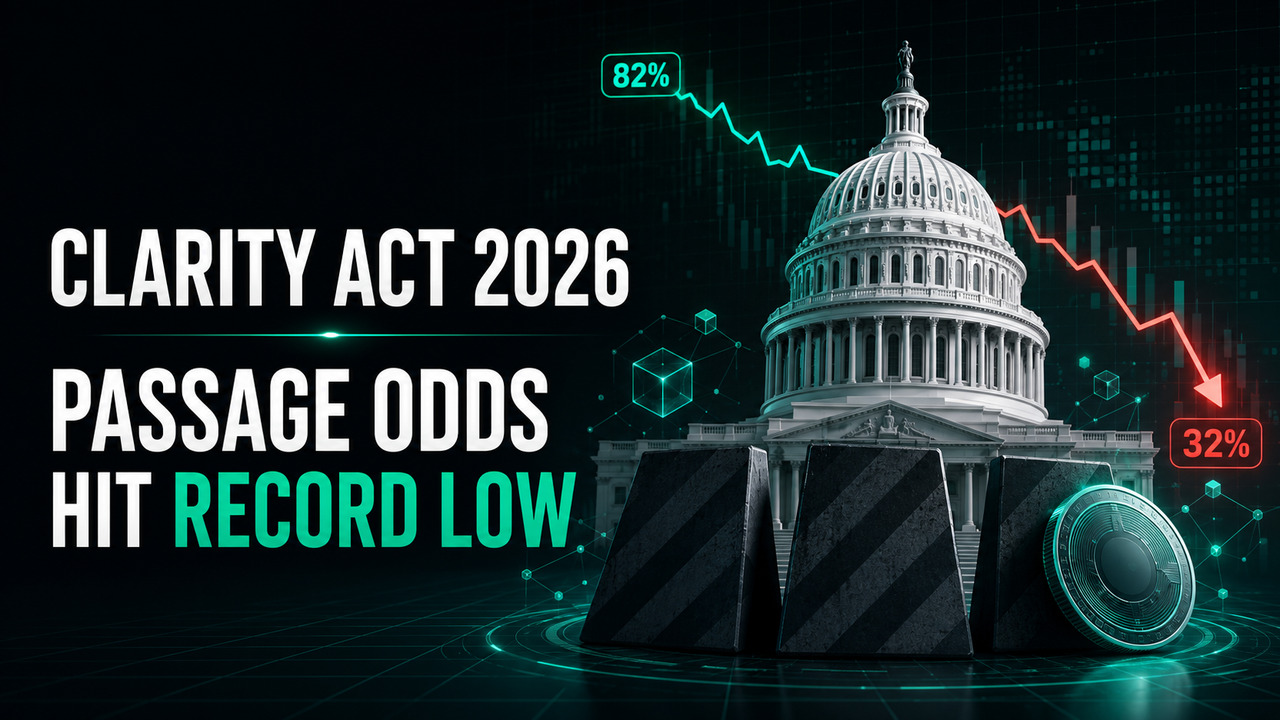
The CLARITY Act’s chances of becoming US law in 2026 have fallen sharply as unresolved policy disputes collide with a narrowing Senate calendar. Prediction-market odds dropped to a record-low 32% on July 17, compared with an 82% peak in February, before recovering to around 40% by July 21. The decline does not mean Congress has abandoned crypto market structure reform: the House has passed the legislation, and the Senate Banking Committee has advanced a revised version. However, lawmakers must still resolve government ethics rules, stablecoin rewards, decentralized finance protections, anti-money-laundering requirements and the division of authority between the SEC and CFTC before completing the legislative process.
CLARITY Act 2026 Passage Odds Hit Record Low as Senate Vote Deadline Nears
The legislation’s official name is the Digital Asset Market Clarity Act of 2025, or H.R. 3633, although “CLARITY Act 2026” has become a widely used term because Congress is attempting to complete the bill this year. The proposal would establish a federal framework for digital assets, introduce registration and customer-protection requirements, and clarify which crypto activities fall under SEC or CFTC oversight. Its falling prediction-market odds reflect uncertainty about whether committee-level progress can be converted into a final law before the end of 2026.
-
Why CLARITY Act Passage Odds Dropped to a Record Low
Polymarket traders reduced the implied probability of the CLARITY Act becoming law in 2026 to 32%, its lowest level since the prediction market opened in January. This represented a substantial decline from the 82% peak recorded on February 19, when traders appeared more confident that bipartisan negotiations would lead to final passage. Although the probability subsequently recovered to around 40%, it remained well below its early-2026 high, indicating that uncertainty has increased as negotiations continue without an announced Senate floor vote.
The prediction market does not resolve positively simply because the Senate debates or approves a crypto bill. H.R. 3633 must pass both chambers of Congress in identical form and be signed by the president before December 31, 2026. Its price therefore reflects the combined probability of several legislative stages:
-
Senate leaders must schedule the CLARITY Act for debate and voting.
-
Supporters must overcome any procedural opposition.
-
The Senate must approve a final version of the legislation.
-
The House must accept the Senate amendments or negotiate common language.
-
The completed bill must be signed by the president before year-end.
Prediction-market prices are not official congressional forecasts and can change quickly in response to political meetings, media reports, trader positioning and expectations of a possible compromise. Nevertheless, the decline from 82% to 32% shows how confidence has weakened as the legislative window has narrowed and the bill’s remaining procedural requirements have become more significant.
-
Current CLARITY Act Status in the House and Senate
The CLARITY Act has progressed further than many previous attempts to establish comprehensive US crypto legislation. The House passed H.R. 3633 by a bipartisan 294–134 vote on July 17, 2025, with 78 Democrats joining Republicans. The bill was subsequently sent to the Senate, where lawmakers developed a substantially revised framework covering digital commodities, securities regulation, stablecoins, decentralized finance, anti-money-laundering obligations and customer protection.
The legislation’s main milestones include:
-
July 17, 2025: The House approved H.R. 3633 by 294–134.
-
January 29, 2026: The Senate Agriculture Committee advanced separate provisions focused on CFTC oversight of digital commodity markets.
-
May 14, 2026: The Senate Banking Committee approved its revised CLARITY Act by 15–9, with two Democrats joining committee Republicans.
-
June 1, 2026: The revised legislation was formally reported and placed on the Senate legislative calendar as Calendar No. 423.
Being placed on the legislative calendar makes the CLARITY Act eligible for Senate consideration, but it does not require Senate leaders to schedule a vote. The Senate text also differs materially from the version previously approved by the House. If senators pass the revised legislation, the House must approve those changes or negotiate another version. Both chambers must ultimately pass identical language before the bill can be sent to the president.
-
Senate Vote Requirements and the Shrinking 2026 Calendar
Republicans hold 53 Senate seats, while Democrats hold 45 and independents hold two. Although final passage generally requires a simple majority, supporters would probably need 60 votes to invoke cloture, end debate and overcome a potential filibuster. Even if every Republican supports the legislation, its sponsors would still need votes from at least seven Democrats or independents.
The bipartisan Banking Committee result indicates that cross-party support exists, but the two Democratic senators who voted to advance the bill have not guaranteed their support on the Senate floor. Their final positions could depend on changes to government ethics, consumer-protection and financial-crime provisions. Committee approval should therefore be viewed as an important milestone rather than confirmation that the legislation has already secured a viable floor coalition.
Time creates an additional challenge. The Senate’s scheduled state work period begins on August 10 and continues through September 11, reducing the number of available legislative days before the midterm elections. A vote could still occur after lawmakers return, but funding bills, nominations and other policy priorities will compete for limited floor time. The closer the process moves toward the end of the year, the less time the House and Senate will have to resolve differences between their versions.
Why the US Crypto Market Structure Bill Faces Major Roadblocks and What Comes Next
The CLARITY Act’s most difficult obstacles are no longer about whether the United States needs clearer digital-asset regulation. Lawmakers broadly agree that crypto exchanges, token issuers, custodians and decentralized platforms require a more predictable federal framework. The disagreement concerns how that framework should handle political conflicts of interest, stablecoin rewards, DeFi software, financial crime and the regulatory boundary between securities and digital commodities.
-
Government Ethics and Stablecoin Rewards Divide the Coalition
Government ethics provisions have become one of the most politically sensitive parts of the negotiations. Democratic lawmakers want enforceable rules preventing senior elected officials from using public office to benefit from cryptocurrency holdings, token launches, licensing arrangements or related businesses. The issue has attracted greater attention because President Donald Trump and members of his family have publicly reported interests in crypto ventures. Supporters of stronger safeguards argue that officials should not be able to influence regulations that could increase the value of their own assets or business relationships.
The disagreement extends beyond whether an ethics provision should exist. Lawmakers must decide which officials and family members would be covered, what types of crypto income and ownership would be restricted, whether divestment would be required and which authority would investigate potential violations. Language that is too narrow could be criticized as ineffective, while a provision perceived as targeting one politician or party could lose Republican support.
Key ethics questions include:
-
Whether restrictions should cover the president, vice president, members of Congress, senior regulators and immediate family members.
-
Whether the rules should apply to tokens, governance rights, licensing income, promotional payments and indirect business interests.
-
Whether officials would need to divest assets, use qualified blind trusts or provide additional disclosures.
-
Which agency or independent authority would investigate violations and impose penalties.
Stablecoin rewards have created another major conflict between banks and crypto companies. Because stablecoins are designed to maintain a relatively stable value, yield-bearing products can begin to resemble deposit accounts when platforms pay users simply for holding them. Banks argue that these products could attract deposits away from regulated institutions while operating under different capital, liquidity and supervisory standards. Crypto platforms respond that sweeping restrictions could reduce competition and prevent legitimate rewards associated with payments, trading, loyalty programs and platform activity.
The proposed compromise attempts to distinguish passive interest paid solely for holding a stablecoin from rewards connected to qualifying activities. Regulators would still need to determine whether a program described as a transaction reward functions economically like interest, how rewards can be calculated and which entity is responsible when issuers, exchanges and third-party partners jointly operate the product.
-
DeFi, AML and SEC-CFTC Rules Create Regulatory Design Challenges
Decentralized finance applications present a difficult policy question because they do not always have an identifiable company controlling customer accounts. Supporters of developer protections argue that programmers publishing open-source code or creating non-custodial tools should not automatically be treated as brokers, banks or money transmitters when they cannot move, freeze or recover customer assets. Applying conventional intermediary requirements to neutral software developers could discourage innovation without necessarily improving compliance.
Critics worry that protections written too broadly could allow businesses to avoid anti-money-laundering and sanctions obligations by describing themselves as decentralized. Some protocols retain considerable influence through administrative keys, front-end websites, governance voting power, transaction fees or control over software upgrades. Because DeFi services commonly rely on smart contracts that automatically execute programmed rules, lawmakers must decide when control over the code, interface or governance system becomes sufficient to create regulatory responsibility.
Relevant indicators could include:
-
Whether an operator takes custody of funds or can redirect transactions.
-
Whether developers retain administrative or emergency access to smart contracts.
-
Whether one company controls the primary user interface.
-
Whether founders or affiliated investors hold concentrated governance power.
-
Whether an identifiable group collects fees and selects supported assets or services.
The SEC-CFTC boundary adds another layer of complexity. The CLARITY Act seeks to determine when a token should remain under SEC oversight and when it may be treated as a digital commodity regulated by the CFTC. The legislation attempts to separate the digital asset itself from the investment-contract transaction through which it may have been issued, potentially allowing some tokens to enter a commodity-based framework as their networks become functional and decentralized.
However, decentralization is difficult to measure. A network may distribute tokens widely while its founders continue to control governance, treasury assets, software updates or token supply. If the standards are unclear, projects could structure their operations to select the regulator offering the lighter compliance framework. The legislation must also preserve securities protections for tokenized stocks, bonds and other conventional financial instruments, since placing a security on a blockchain does not necessarily transform it into a commodity.
-
What Comes Next for the CLARITY Act?
The next phase will depend on whether negotiators can convert broad support for regulatory clarity into agreement on detailed legislative language. Political meetings and public statements may influence expectations, but meaningful progress would probably require a revised package that addresses ethics, stablecoin rewards, DeFi control and digital-asset classification.
Three potential scenarios could shape the remainder of the process:
-
A comprehensive bipartisan compromise: Lawmakers resolve the major political and regulatory disagreements within one package. This would provide the clearest route toward final consideration, although every compromise could affect support from banks, crypto businesses, consumer groups or individual senators.
-
A narrower market structure agreement: Congress could retain the core SEC-CFTC framework while leaving some technical issues to future agency rulemaking. This approach may make an agreement easier, but delegating too many decisions could weaken the legal certainty the legislation is intended to provide.
-
Legislation returns in the next Congress: If Congress does not complete the process in 2026, sponsors may need to reintroduce a market structure bill. Existing committee work could provide a foundation, but changes in leadership, committee membership and political priorities could produce a different proposal.
For crypto businesses, further delays would mean continuing to depend on existing statutes, agency interpretations, enforcement decisions and court rulings rather than one comprehensive federal framework. Passage could provide greater regulatory certainty, but it would not immediately resolve every legal question or guarantee higher cryptocurrency prices. Detailed implementation would still depend on future regulatory rules, while market performance would remain influenced by liquidity, interest rates, adoption and investor risk appetite.
What the CLARITY Act Would Change for US Crypto Regulation
If enacted, the CLARITY Act would introduce clearer federal rules for digital assets, trading platforms and token issuers. The framework would divide responsibilities between regulators while adding new compliance and customer-protection standards.
-
SEC and CFTC authority: The SEC would oversee digital-asset securities, while the CFTC would gain broader authority over spot markets for digital commodities.
-
Token classification and disclosure: The bill would establish standards for classifying tokens and require eligible issuers to disclose information about supply, governance, development and financial risks.
-
Exchange registration: Covered crypto exchanges, brokers and dealers would face federal registration, recordkeeping, market-surveillance and operational requirements.
-
Custody and DeFi protections: Platforms would need stronger asset-segregation and insolvency safeguards, while the distinction between custodial and non-custodial crypto wallets would help determine regulatory responsibility. Certain DeFi developers could receive tailored protections.
-
Stablecoin rewards and implementation: Passive rewards paid solely for holding payment stablecoins could face restrictions. The SEC, CFTC and Treasury would then develop detailed rules and transition periods before the framework became fully effective.
FAQs
Is the CLARITY Act the Same as the GENIUS Act?
No. The GENIUS Act primarily establishes rules for payment stablecoin issuers, including reserve, redemption and supervisory requirements. The CLARITY Act covers the wider digital-asset market, including token classification, crypto trading platforms and the division of authority between the SEC and CFTC. The two frameworks overlap in areas such as stablecoin rewards, but they serve different regulatory purposes.
Would the CLARITY Act Change How Cryptocurrency Is Taxed?
The CLARITY Act does not primarily rewrite federal crypto tax rules. Selling, exchanging or spending digital assets could continue to create taxable events under existing IRS requirements. Any major changes involving capital gains, staking income, mining rewards or crypto transaction reporting would generally require separate tax legislation or additional Treasury guidance.
How Could the CLARITY Act Affect Offshore Crypto Platforms?
An offshore platform serving or actively targeting US customers could potentially face federal registration, disclosure and compliance requirements. Some international businesses may choose to register, establish a US-regulated entity or restrict access for US users. The practical effect would depend on the final territorial provisions and how regulators define activity directed toward the United States.
Would State Crypto Regulations Still Apply?
Some state requirements could remain relevant after federal legislation is enacted. Crypto businesses may still face state money-transmitter licensing, cybersecurity, consumer-protection and commercial-law obligations unless the final legislation specifically overrides them. Companies operating across several states could therefore continue managing both federal and state compliance frameworks.
Would Existing SEC or CFTC Enforcement Cases End Automatically?
No. Passage of the CLARITY Act would not automatically dismiss existing investigations or court cases. Agencies and courts might reassess some matters if the new legislation changes the applicable definitions, but the outcome would depend on whether specific provisions apply retroactively. Conduct that violated other securities, commodities, fraud or anti-money-laundering laws could remain subject to enforcement.
Disclaimer
The information provided on this page may originate from third-party sources and does not necessarily represent the views or opinions of KuCoin. This content is intended solely for general informational purposes and should not be considered financial, investment, or professional advice. KuCoin does not guarantee the accuracy, completeness, or reliability of the information, and is not responsible for any errors, omissions, or outcomes resulting from its use. Investing in digital assets carries inherent risks. Please carefully evaluate your risk tolerance and financial situation before making any investment decisions. For further details, please consult KuCoin’s Terms of Use and Risk Disclosure.