

Fractal Bitcoin FIP-101 Public Beta Launch: Index Mining & Non-Custodial Staking Now Open
2026/05/21 16:39:02
Thesis Statement
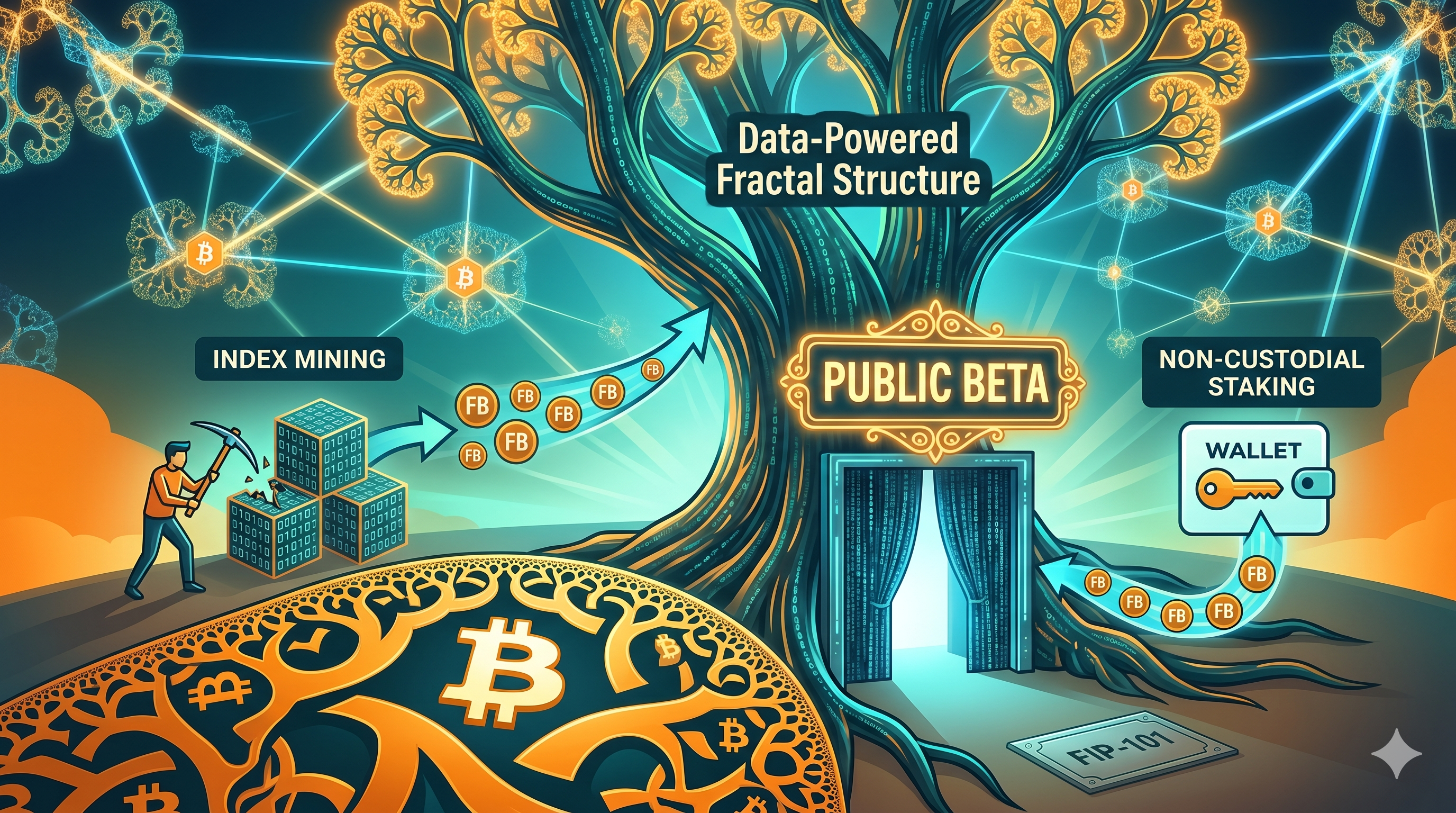
Fractal Bitcoin has rolled out the public beta for FIP-101, marking a notable step in its development of data infrastructure. Launched around May 14, 2026, the initiative opens index mining participation through non-custodial staking of FB tokens. Early data shows rapid adoption, with staking surpassing 1.5 million FB shortly after launch and reaching approximately 4 million FB in recent updates. This development integrates a standardized, open-source indexing service directly into the network’s block reward system, shifting indexing from external tools to an incentivized core component.
FIP-101 establishes a permissionless, economically aligned data layer for Fractal Bitcoin by reallocating incentives and enabling non-custodial participation, potentially reducing developer friction while supporting sustainable infrastructure growth in a Bitcoin-native ecosystem.
💡 Tips: New to crypto? KuCoin's Knowledge Base has everything you need to get started.
Understanding the Core Mechanics of FIP-101 Index Mining
FIP-101 introduces the Fractal Standard Indexing Service as an open-source, permissionless framework maintained with contributions from core teams like UniSat. The system adjusts block reward distribution to a 1:1:1 ratio among merged mining, permissionless mining, and data indexing. Each category targets roughly one-third of the 25 FB block reward in the long term, without altering total issuance or emission schedules. Stakers direct FB toward specific indexers via Taproot-based scripts, keeping full control of their assets since funds never leave the users' addresses. Rewards are distributed proportionally based on stake share after a settlement delay, typically around seven days or about 20,000 blocks, to maintain chain liveness. In the current public testing stage 1, only the official Fractal indexer operates, with staking open to all addresses holding at least 50 FB and no upper limit. Rewards begin from activation block 1,764,000 and follow a phased release, starting at 30% (7.5 FB per indexing block) and ramping toward 60% during this stage, with Stage 2 planned to test multi-indexer support and lightweight deployments.
This gradual approach allows testing of staking flows, reward calculations, and system stability before full activation. Indexers can charge limited commissions, such as the current 10% on the official one, while open-source tools, including an emergency unstake utility, provide additional security layers. By design, indexing failures do not halt block production, ensuring the network remains operational even during verification issues or downtime. This structure addresses prior fragmentation in indexing solutions, where inconsistent parsing and high maintenance costs hindered developers from building on Fractal assets like BRC-20 or Ordinals. Early participation data indicate a strong interest, reflecting confidence in the incentive model. The lightweight indexer design lowers hardware barriers, with reports of significantly reduced memory usage and faster synchronization times compared to earlier implementations. As the beta progresses, these elements aim to create verifiable, decentralized data availability that supports broader application composability without relying on centralized providers.
How Non-Custodial Staking Enhances User Control and Security
Non-custodial staking forms the foundation of FIP-101 participation, implemented through Taproot scripts that keep FB tokens under direct user control at all times. Participants select an indexer and commit their stake via the official portal at index-mining-beta.fractalbitcoin.io, yet the assets remain in the owner’s wallet without transfer to any operator. This eliminates counterparty risk common in traditional staking pools and allows instant unstaking at any moment with no lock-up periods. An open-source emergency unstake tool further supports this by enabling direct on-chain exits if the web interface experiences issues. During public testing, users connect compatible wallets such as UniSat to stake with the official indexer. Minimum requirements stay low at 50 FB per address to encourage broad participation while maintaining practical thresholds. Reward distribution occurs based on proportional stake share after settlement cycles, with no slashing mechanisms introduced in this proposal. This design choice prioritizes accessibility and trust minimization over punitive measures. As of recent network snapshots, total staked amounts have climbed steadily, demonstrating user comfort with the security model.
The approach contrasts with custodial alternatives by preserving UTXO-based ownership, aligning with Bitcoin’s core principles that Fractal extends. Developers and holders benefit because they can migrate stakes between indexers in the future without operator approval, fostering competition and reducing vendor lock-in. Security considerations include objective validity rules for indexing results and asynchronous settlement outside the critical block production path. These safeguards ensure that even temporary indexer offline periods pause rewards without compromising overall chain function. Practical examples from early testing show users preparing stakes ahead of activation blocks to position themselves for immediate reward eligibility upon milestones. The combination of non-custodial mechanics, open-source tooling, and transparent reward rules positions FIP-101 as a user-centric upgrade that could attract both retail participants and institutional infrastructure operators seeking verifiable participation. By embedding these features, Fractal strengthens its data layer while upholding decentralization standards essential for long-term adoption in Bitcoin scaling solutions.
Reward Distribution and Phased Public Testing Structure
Public testing of FIP-101 is divided into stages to validate staking, indexing performance, and reward flows. Stage 1 focuses on core staking mechanics with the single official indexer, where rewards follow the indexing portion of the 1:1:1 target but release gradually. For every three standard blocks, one indexing reward block applies, starting at 30% of the full 25 FB allocation and increasing linearly toward 60% over an estimated four-week period. Stage 2 expands to lightweight indexers, enabling anyone to operate nodes and accept stakes, with release percentages continuing upward to 100%. Settlement introduces a minimum seven-day delay to allow verification and maintain liveness, meaning participants see rewards credited after processing lags. This delay supports reorg handling and consistent rollbacks if needed. Current dashboard metrics display total staked figures around 4 million FB, with allocated rewards tracked against block heights such as the last settled near 1,761,690 and current blocks advancing past 1,781,000. Commission rates, like the 10% on the official indexer, are deducted from rewards before proportional distribution to stakers. These parameters create predictable economics for participants, calculating potential returns based on network stake share.
The phased model mitigates risks by allowing iterative improvements based on real usage data before broader rollout. Index operators receive incentives to maintain uptime and valid data outputs, as invalid performance triggers automatic reward suspension. For users, this translates to opportunities to earn FB by supporting infrastructure without specialized hardware for staking, though running full indexers requires a technical setup detailed in open-source repositories. Market observers note that successful testing could stabilize data availability for applications, indirectly supporting ecosystem growth in trading, gaming, and asset management tools on Fractal. The structure balances innovation with caution, ensuring that incentive realignment enhances rather than disrupts existing mining dynamics. As stages advance, accumulated data on participation and performance will inform any fine-tuning while preserving the core proposal goals of sustainability and openness.
Technical Foundations and Open-Source Implementation Details
The FIP-101 technical stack centers on a lightweight indexer design that achieves substantial efficiency gains, including roughly 80% lower memory usage and initial synchronization in about 24 hours. Core contributors open-sourced components such as the stake-indexer repository and unstake tools on GitHub, enabling community review and deployment. Standardized output formats and pluggable protocol parsers promote consistency across implementations, addressing previous fragmentation where varying indexing logic complicated developer integrations. Reference implementations include storage layers, RPC query interfaces, and Taproot staking templates. Deployment documentation covers index node setup, common failure scenarios, and migration procedures. This transparency lowers barriers for operators ranging from individual contributors to mining pools. The system defines objective criteria for valid indexing results, supporting automated verification and dispute processes.
Non-blocking design ensures indexing operations remain asynchronous, preventing any impact on PoW block production or difficulty adjustments. Progressive activation began with node upgrades at earlier block heights, followed by the public beta staking portal. Practical testing involves real stake flows and reward calculations tied to specific block milestones. For developers building on Fractal, unified data standards reduce redundant parsing efforts and integration costs, potentially accelerating dApp creation for Ordinals, BRC-20 tokens, or recursive assets. The open-source nature invites audits and contributions, fostering a more resilient infrastructure layer. Early beta metrics shows active staking growth, validating interest in the incentive-aligned model. As more indexers join in Stage 2, the network should demonstrate improved redundancy and data availability. These technical choices reflect careful consideration of Bitcoin compatibility while extending utility through dedicated indexing incentives. The result is a framework that supports scalable, decentralized data services essential for broader adoption of Layer-1 extensions like Fractal.
Impact on Fractal Bitcoin Ecosystem Development and Applications
FIP-101 targets reductions in development friction by providing standardized, reliable indexing that applications can query consistently. Previously, reliance on disparate solutions created maintenance overhead and potential inconsistencies in data interpretation for assets and transactions. With incentivized indexing, builders gain confidence in data availability, which supports smoother experiences in decentralized exchanges, gaming platforms, and inscription tools native to Fractal. Projects leveraging BRC-20 or Ordinals benefit from faster, more composable indexing that aligns with network economics. Ecosystem participants, including wallets like UniSat and explorers, stand to integrate more seamlessly with the standard service. Lower operational costs for infrastructure encourage experimentation and new use cases, from on-chain gaming to asset management. Staking participation distributes rewards to a wide base of FB holders, potentially increasing token utility beyond pure speculation. Early community engagement, evidenced by rapid staking uptake, suggests alignment between user incentives and network needs.
As data infrastructure strengthens, Fractal could attract more developers seeking Bitcoin-aligned scalability without high gas fees or complex bridging. The permissionless model promotes competition among indexers, driving innovation in performance and features, while standardized outputs prevent lock-in. Market implications include possible demand for FB used in staking, contributing to liquidity dynamics and long-term holding patterns. Practical examples include tools for batch minting or UTXO management that rely on robust backend indexing. Successful implementation positions Fractal as a forward-looking extension of Bitcoin capabilities, focusing on sustainable layers rather than short-term hype. Ongoing testing will reveal how effectively the system scales with growing transaction volumes and diverse asset types. This foundational upgrade supports the broader vision of extending Bitcoin utility through reliable, incentivized infrastructure.
Comparison with Traditional Indexing Approaches in Bitcoin Ecosystems
Traditional indexing in Bitcoin-related networks often depends on centralized providers or volunteer-maintained services lacking direct economic incentives. These setups frequently face sustainability challenges, inconsistent uptime, and high customization costs for applications. FIP-101 differentiates by embedding indexing into the block reward system through a 1:1:1 allocation, creating market-driven participation where operators and stakers share in FB emissions. Non-custodial mechanics further distinguish it from pooled staking models that require asset transfers. Permissionless entry allows diverse operators to run nodes using open-source code, contrasting with proprietary indexers that limit transparency. Standardized interfaces reduce the need for multiple parsing libraries, streamlining development compared to fragmented environments. The asynchronous, non-blocking verification preserves chain performance, unlike systems where data layer issues could cascade.
In practice, this means applications maintain access to transaction and asset data with greater reliability expectations. Early beta results show quick accumulation of staked capital, indicating viability of the incentive model. Other Bitcoin scaling projects have explored data solutions, but few integrate rewards so directly with consensus-adjacent incentives while maintaining full non-custody. The Taproot implementation leverages existing script capabilities without introducing new opcodes or structural changes. This conservative approach minimizes upgrade risks compared to more invasive modifications in alternative chains. For users, the ability to switch indexers seamlessly offers flexibility absent in single-provider setups. As the ecosystem matures, these differences could translate to stronger network effects through better data composability and lower barriers for new participants. The model emphasizes long-term statistical targets rather than rigid guarantees, allowing adaptive evolution based on performance feedback.
Stakeholder Perspectives and Early Participation Trends
Holders participating in the beta cite the non-custodial nature and low entry barriers as key attractions for supporting infrastructure while earning rewards. Operators exploring indexer roles appreciate open-source resources and potential commission revenue alongside allocated FB. Core contributors from teams like UniSat highlight efficiency improvements in their refactored systems as enabling this transition. Community discussions reflect optimism about reduced fragmentation and enhanced data reliability for daily use cases. Staking volumes grew from over 1.5 million FB initially to around 4 million in follow-up reports, occurring within days of launch. This trajectory suggests effective communication and accessible tooling. Minimum stake levels accommodate smaller participants, broadening involvement beyond large holders. Developers monitoring the rollout anticipate benefits for building reliable applications without maintaining custom index backends.
Mining pools and institutions may also explore dual roles as both miners and index operators under the new allocation. Feedback mechanisms during testing allow adjustments before full activation. Perspectives converge on the importance of sustainable incentives for public goods like indexing, which historically relied on indirect support. Practical participation involves wallet connection, stake selection, and monitoring via the dashboard, showing real-time metrics like stake share and block progress. The emergency tools and documentation address common concerns around technical reliability. As Stage 2 introduces multi-indexer competition, participants expect dynamic shifts in allocations and potential APR variations based on total network stake. These trends illustrate growing maturity in Fractal’s user base, balancing yield opportunities with contributions to network health. Broader ecosystem players watch closely for signals on how this layer strengthens overall value propositions
Broader Implications for Bitcoin Scaling and Data Infrastructure
By addressing indexing as a dedicated incentivized pillar, FIP-101 contributes to discussions on sustainable scaling solutions within Bitcoin ecosystems. Reliable data availability enables more complex applications without compromising core security properties. Fractal’s recursive layering and merged mining already provide throughput advantages, and the indexing upgrade complements these by ensuring usable outputs for end users and developers. The permissionless model could serve as a reference for other projects seeking decentralized data layers. Economic realignment distributes rewards across security, openness, and data pillars without increasing total supply. This supports long-term alignment among participants. Reduced developer costs may accelerate innovation cycles for Bitcoin-native tools, from DeFi primitives to collectibles platforms. Network observers note potential secondary effects on FB demand due to staking utility and infrastructure roles. The design’s focus on verifiability and exit flexibility mitigates centralization risks common in data services.
In the wider context of Layer-1 and Layer-2 developments, such upgrades highlight practical ways to enhance utility while respecting Bitcoin’s foundational constraints. Testing phases provide empirical data on performance under load, informing future optimizations. For the industry, successful outcomes demonstrate viable paths to incentivize essential but often underfunded infrastructure components. As adoption grows, standardized indexing could improve interoperability and user experiences across related chains. Fractal positions itself through these steps as an extension focused on both technical capability and economic soundness. Continued progress in the beta will clarify scalability limits and integration potential with existing Bitcoin tools and standards.
Operational Considerations in the Beta Phase
Public testing incorporates safeguards such as delayed settlements, automatic reward pauses for invalid indexers, and non-blocking verification to manage operational risks. Users benefit from full asset control and open-source unstake options, reducing platform dependency. Operators must maintain uptime and data validity to receive allocations, with transparent rules governing performance. The phased reward release allows monitoring for issues before higher percentages activate. Dashboard features track key metrics, including current blocks, settled heights, and stake totals, supporting informed participation. Documentation covers failure scenarios and recovery, promoting preparedness. No changes to core consensus elements like PoW or block structure limit systemic risk exposure. Participants should consider general cryptocurrency volatility and network-specific factors when engaging.
The absence of slashing simplifies entry but relies on economic incentives and verification for quality. Early data from high-stakes volumes indicates system handling of initial loads, though extended testing will assess sustained performance. Tools for emergency actions enhance resilience. For developers integrating data feeds, standardized outputs during beta provide early validation opportunities. The risk framework prioritizes chain liveness and user fund security above all. As more indexers activate, diversification of stakes could further distribute operational dependencies. These considerations support responsible engagement while advancing the network’s infrastructure goals. Monitoring official channels and documentation ensures awareness of updates during the testing window.
Integration and Long-Term Sustainability Goals
FIP-101 fits into Fractal’s progression toward enhanced utility, following node upgrades and alongside features like farming and ecosystem applications. Future stages will refine multi-indexer dynamics and expand participation options. Long-term targets include converged 1:1:1 reward distribution, guiding capital toward balanced infrastructure. Continuous evaluation based on performance data supports adaptive improvements without fixed overhauls. Sustainability stems from permissionless access, open standards, and incentive alignment that encourage ongoing investment in data services. Reduced fragmentation benefits application layers, potentially driving higher network activity and value accrual.
Integration with existing mining ecosystems maintains compatibility while adding indexing roles. Community governance elements through proposals allow evolution based on usage. Practical outcomes may include more robust explorers, wallets, and dApps relying on the standard service. As testing concludes, full activation will mark completion of this infrastructure milestone. Broader goals emphasize verifiable, decentralized data as foundational for scaling Bitcoin capabilities. Monitoring tools and metrics will remain essential for participants tracking progress. The approach avoids over-reliance on subsidies by tying rewards to verifiable contributions. This positions Fractal for potential growth in user base and developer activity. Iterative updates based on beta feedback will refine mechanics for optimal results.
Market Context and FB Token Utility Enhancements
Within current market conditions, FB trades around $0.45–$0.46 with a market capitalization of $46–$47 million and a circulating supply exceeding 102 million tokens toward a 210 million maximum. The introduction of index mining adds staking utility, potentially influencing holding behaviors and demand dynamics. Staked amounts represent a portion of the supply committed to network support, with rewards providing yield opportunities tied to block production. This utility layer complements existing uses in farming, swaps, and ecosystem projects. As infrastructure strengthens, indirect effects may emerge through increased activity in related applications. Participation requires FB acquisition and management, linking token economics more closely with network operations.
Observers track how staking volumes evolve alongside price action and broader crypto sentiment. The model distributes rewards to participants backing data integrity, creating a feedback loop with ecosystem health. No immediate supply changes occur, preserving emission predictability. For traders and holders, the beta offers new engagement avenues beyond passive ownership. Dashboard transparency aids in evaluating personal economics based on current totals and shares. As the network matures, sustained utility improvements could support fundamental value considerations. Integration with tools like UniSat wallets streamlines access. Market implications remain tied to execution success and adoption metrics during and after testing. This development exemplifies efforts to enhance token functionality in competitive Layer-1 environments.
Key Technical and Participation Guides for New Users
New participants access the staking portal to connect wallets and select indexers. Guides detail wallet compatibility, stake transactions, and reward tracking. Minimums and commission structures are clearly outlined to support decision-making. Open-source repositories provide code for advanced users interested in operating nodes. Documentation addresses common questions on settlement timing and unstaking flows. Practical steps include reviewing block heights for reward eligibility and monitoring network announcements for stage transitions. Users prepare UTXOs and test small stakes during beta to familiarize themselves with processes. Emergency tools offer reassurance for self-sovereign management.
Developers reference parser and API standards for integration planning. The framework encourages experimentation within safe parameters. Comprehensive resources reduce learning curves for both stakeholders and operators. As metrics update in real time, participants gain visibility into system performance. This educational aspect supports wider onboarding while maintaining technical rigor. Successful beta engagement lays the groundwork for fuller ecosystem involvement. Resources evolve with feedback to improve clarity and accessibility. Overall, guides emphasize security, transparency, and alignment with user control principles.
Evaluating the Role of Indexing in Next-Generation Blockchain Infrastructure
Reliable indexing underpins usability in modern blockchains by enabling efficient queries and application interactions. FIP-101 elevates this to an incentivized, decentralized service within Fractal’s architecture. The emphasis on standards and openness sets a direction for infrastructure that scales with demand while distributing benefits. This focus addresses common bottlenecks in data layers across crypto projects. By tying economics to performance, the system promotes accountability and innovation.
Early results from public testing provide initial validation of the approach. Long-term, such layers become critical differentiators for user retention and developer productivity. Fractal’s implementation balances innovation with compatibility, offering lessons for similar ecosystems. Continued refinement will determine full potential in supporting diverse applications. The initiative reinforces commitments to sustainable, permissionless growth in Bitcoin-derived networks.
FAQs
How does the phased reward release in FIP-101 public testing affect participant earnings?
The system starts with partial distribution of the indexing block reward allocation and gradually increases the percentage over time across stages. This allows thorough validation of mechanisms while participants earn proportional shares based on their stake once rewards activate from the specified block height. Settlement delays apply, and users can track progress through official dashboards.
What makes the non-custodial staking in Fractal’s index mining different from other protocols?
Assets stay fully controlled by the user’s private keys via Taproot scripts, with no transfer to operators and instant unstaking capability. Open-source emergency tools add redundancy, minimizing trust requirements compared to custodial or locked staking models.
Who can operate an indexer during and after the public beta?
Anyone can run nodes using the open-source lightweight indexer code in Stage 2 and beyond. Operators accept stakes, charge commissions within limits, and earn portions of rewards based on performance and validity rules. Documentation supports deployment for technical users.
How does FIP-101 impact FB token utility and potential demand?
Staking for index mining introduces direct yield opportunities tied to network rewards, encouraging holding and participation. Broader data infrastructure improvements may boost ecosystem activity, indirectly supporting token use cases in applications and services.
What safeguards protect the network during indexing operations?
Design ensures indexing failures do not block production, with asynchronous settlement and automatic reward pauses for invalid results. Non-blocking verification and reorg handling maintain liveness and consistency.
Where can users find the latest guides and staking portal for FIP-101?
The official staking portal is available at index-mining-beta.fractalbitcoin.io, with detailed guides on the Fractal documentation site covering participation, rewards, and operator setup. Always verify links through official channels.
Disclaimer: This content is for informational purposes only and does not constitute investment advice. Cryptocurrency investments carry risk. Please do your own research (DYOR).