

The Blockchain Trilemma Explained: Why Can't We Have It All?
2026/03/30 15:15:02
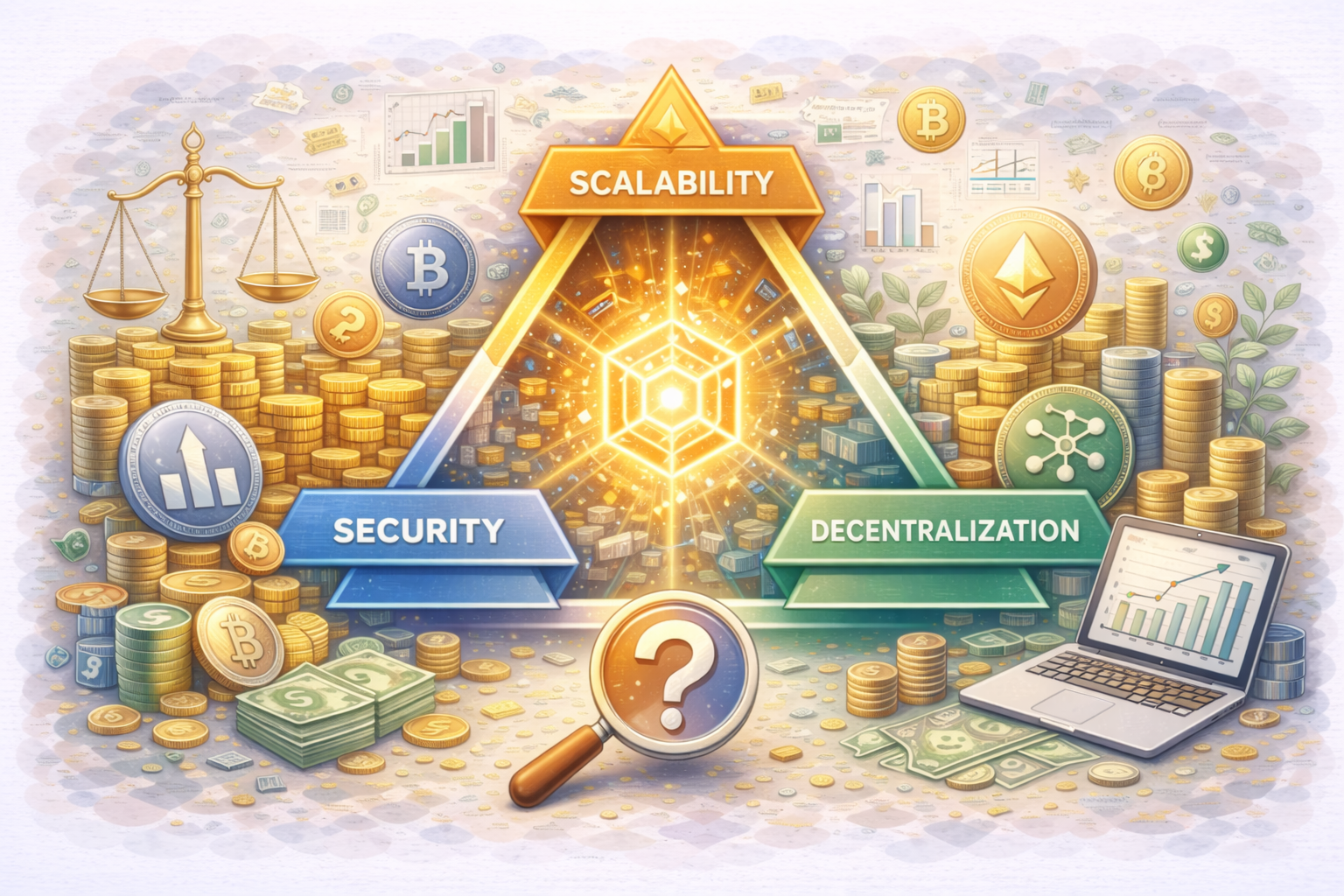
The blockchain trilemma is one of the most debated structural challenges in distributed systems design. It describes the difficulty of simultaneously achieving three core properties in a blockchain network: decentralization, security, and scalability. The concept, popularized by Ethereum co-founder Vitalik Buterin, holds that optimizing for any two of these properties tends to come at the expense of the third — a constraint that has shaped the architecture of virtually every public blockchain built since Bitcoin's launch in 2009.
This article unpacks the blockchain trilemma in depth, examines how different networks navigate the scalability trilemma trade-off, and explores what these design choices mean for the assets traders interact with daily.
Key Takeaways
-
The blockchain trilemma, a term associated with Vitalik Buterin, holds that decentralization, security, and scalability cannot all be maximized simultaneously in a single blockchain layer.
-
Decentralization refers to the distribution of validation authority across many independent nodes; security refers to resistance to attacks; scalability refers to the network's capacity to process transactions efficiently at volume.
-
Early blockchain designs like Bitcoin prioritized decentralization and security, accepting low transaction throughput as the cost of those properties.
-
Layer 2 protocols and sharding are the two primary architectural approaches developed to expand scalability without dismantling the security and decentralization of the base layer.
-
Different blockchain networks make explicit trade-offs within the trilemma, and understanding those trade-offs helps traders interpret why different assets behave differently under network stress.
-
The trilemma remains an active area of protocol research; no network has fully resolved it, though various approaches have meaningfully expanded the practical scalability of decentralized systems.
What Is the Blockchain Trilemma?
The blockchain trilemma is a framework for understanding why it is structurally difficult to build a blockchain network that is simultaneously decentralized, secure, and scalable. Each of the three properties is individually achievable, and any two can be combined with relative ease — but pushing all three to their maximum simultaneously creates competing architectural demands that cannot all be satisfied by the same design choices.
The term is most closely associated with Vitalik Buterin, who used it to describe the fundamental engineering constraints facing blockchain developers. While the concept predates its association with any individual — it draws on earlier work in distributed systems theory, including the CAP theorem from computer science — Buterin's articulation of it in the context of blockchain design brought it into mainstream crypto discourse and made it a standard reference point for evaluating network architecture.
Understanding the trilemma is not merely academic. The trade-offs each network makes within it determine its transaction costs, confirmation times, validator requirements, and vulnerability profile — all of which directly affect the practical experience of using and trading assets built on that network. Traders accessing crypto markets through KuCoin encounter the consequences of these trade-offs every time they assess gas fees, transaction finality times, or network congestion during periods of high demand.
The Three Properties Defined
Each vertex of the trilemma represents a distinct and measurable property of a blockchain network. Defining them precisely is essential to understanding why they conflict.
Decentralization
Decentralization in a blockchain context means that validation authority is distributed across many independent nodes rather than concentrated in a small group of operators. A highly decentralized network has thousands of nodes globally, each independently verifying the full transaction history. No single node or small coalition can alter the ledger, censor transactions, or take the network offline.
Decentralization has a direct cost: it requires that every validating node process every transaction and maintain a full copy of the ledger. As the number of transactions increases, the hardware and bandwidth requirements for running a full node increase proportionally. If those requirements grow beyond what ordinary participants can meet, node operation concentrates among a smaller set of well-resourced operators — reducing decentralization even if the network remains technically distributed.
Security
Security refers to the network's resistance to attacks — specifically, to attempts by a bad actor to rewrite transaction history, double-spend funds, or disrupt the network's operation. In proof-of-work networks, security is a function of the total computational power (hash rate) securing the chain: an attacker would need to control more than 50% of that hash rate to execute a sustained reorganization attack. In proof-of-stake networks, security is a function of the total value staked: attacking the chain requires acquiring and risking a majority of staked assets.
Security and decentralization are generally complementary: a network with thousands of independent validators is harder to attack than one with a handful. However, maintaining high security requires that validators have economic skin in the game — either through hardware investment in proof-of-work or through staked capital in proof-of-stake — which creates its own concentration pressures.
Scalability
Scalability refers to the network's capacity to process a large volume of transactions quickly and at low cost. A scalable network can handle thousands or tens of thousands of transactions per second without significant increases in fee rates or confirmation times. Scalability is what makes a network practical for high-frequency use cases such as payments, trading, or decentralized applications with large user bases.
Scalability is the property most directly in tension with the other two. Increasing throughput typically requires either reducing the number of nodes that must validate each transaction (reducing decentralization) or reducing the security threshold each transaction requires (reducing security). Doing neither while increasing throughput has proven the central technical challenge of blockchain development.
How Bitcoin and Ethereum Positioned Themselves Within the Trilemma
The trilemma's practical implications are most clearly visible in the design choices made by the two largest blockchain networks by market capitalization.
Bitcoin's design, as specified in the 2008 white paper by Satoshi Nakamoto and implemented in January 2009, prioritized decentralization and security above scalability. The 1MB block size limit, combined with a target block time of approximately 10 minutes, produces a maximum throughput of roughly 7 transactions per second under optimal conditions. This is far below the capacity of centralized payment networks but was a deliberate choice: smaller blocks mean lower hardware requirements for running a full node, preserving broad participation in validation. The consequence is that during periods of high demand, transaction fees rise sharply as users compete to have their transactions included in the limited block space — a pattern observable in Bitcoin's fee history and reflected in BTC/USDT trading activity on KuCoin during high-network-congestion periods, when on-chain settlement costs can influence spot market behavior.
Ethereum, launched in 2015, made similar initial choices — prioritizing decentralization and security — but with a more explicit acknowledgment that scalability would need to be addressed as the network's use cases expanded. Ethereum's transition from proof-of-work to proof-of-stake, completed in September 2022 in an event known as The Merge, did not directly increase transaction throughput but reduced the network's energy consumption by approximately 99.95% and restructured the security model to enable subsequent scaling upgrades. Ethereum's longer-term scaling roadmap addresses throughput through a combination of Layer 2 networks and data availability improvements at the base layer.
Approaches to Resolving the Scalability Trilemma
No blockchain has fully resolved the trilemma, but several architectural approaches have meaningfully expanded the practical scalability of decentralized networks without abandoning their security or decentralization properties entirely.
Layer 2 Scaling
Layer 2 protocols process transactions off the main blockchain (Layer 1) and periodically settle compressed proofs or batched transaction data back to the base layer. This approach allows the Layer 2 network to handle high transaction volumes at low cost while inheriting the security guarantees of the underlying Layer 1 chain.
The two primary Layer 2 architectures are optimistic rollups and zero-knowledge rollups. Optimistic rollups assume transactions are valid by default and allow a challenge period during which invalid transactions can be disputed. Zero-knowledge rollups use cryptographic proofs to verify the validity of batched transactions mathematically, without requiring a challenge period. Both approaches significantly increase effective throughput while anchoring security to the base chain.
Sharding
Sharding divides the blockchain's validator set into smaller groups (shards), each responsible for processing a subset of the network's transactions in parallel. Rather than every node processing every transaction, each shard processes its assigned transactions independently, and the results are periodically reconciled. This increases throughput proportionally to the number of shards without requiring each individual node to handle the full transaction load.
Sharding introduces coordination complexity: transactions that span multiple shards require cross-shard communication, which adds latency and potential attack surfaces. Implementing sharding securely while maintaining meaningful decentralization has proven one of the more technically demanding problems in blockchain engineering.
Alternative Consensus Mechanisms
Some networks address the trilemma by modifying their consensus mechanism to reduce the overhead of achieving agreement. Delegated proof-of-stake, for example, limits active validation to a smaller elected set of delegates, enabling faster consensus and higher throughput at the cost of reduced decentralization. These networks accept a more concentrated validator set as a deliberate trade-off. Traders comparing assets on KuCoin's market data can observe how networks with different consensus designs respond differently during periods of market stress — faster networks may show more consistent on-chain settlement, while more decentralized networks may experience fee spikes during congestion.
The Trilemma in Practice: What It Means for Traders
For traders, the blockchain trilemma manifests in concrete, observable ways that affect the cost and speed of interacting with on-chain assets.
The relationship between network congestion and transaction fees is the most direct expression of the scalability constraint. When demand for block space exceeds supply — as occurs during periods of high market volatility or popular NFT mints on Ethereum — fees rise sharply because users bid competitively to have their transactions processed. This fee dynamic affects the economics of on-chain trading, arbitrage, and DeFi interactions.
Network congestion also affects finality — the point at which a transaction is considered irreversible. Different networks offer different finality guarantees, ranging from probabilistic finality (where a transaction becomes more secure as more blocks are added on top of it) to economic finality (in proof-of-stake systems, where a supermajority of validators have cryptographically committed to a block's validity). Faster finality supports more responsive trading environments; slower finality introduces settlement risk.
Understanding which trilemma trade-offs a network has made also helps in interpreting its long-term development roadmap. Networks prioritizing decentralization and security will pursue scaling through off-chain or Layer 2 mechanisms rather than by concentrating validation. Networks that prioritize throughput by limiting validator sets will face different security assumptions that matter when assessing the risk profile of assets built on them. The KuCoin educational blog provides in-depth analysis of how specific network architectures affect asset behavior and on-chain market dynamics.
Why the Trilemma Has Not Been Solved — and Whether It Can Be
The blockchain trilemma remains an open problem in distributed systems research. No production network has demonstrated that all three properties can be simultaneously maximized without meaningful trade-offs, and the theoretical foundations of the trilemma suggest that this constraint may be fundamental rather than merely a consequence of current engineering limitations.
The closest approximations to trilemma solutions combine multiple architectural layers: a highly decentralized and secure base layer that handles settlement and data availability, with high-throughput execution layers built on top. This layered model accepts that throughput is achieved off the most decentralized layer, not on it — a pragmatic accommodation of the trilemma rather than its resolution.
Research continues into cryptographic techniques — particularly advances in zero-knowledge proof systems — that may reduce the computational overhead of validation sufficiently to enable higher throughput without reducing the number of validators. If verification becomes cheap enough that ordinary hardware can validate proofs for thousands of transactions per second, the throughput constraint could be relaxed without compromising decentralization. Whether this represents a genuine solution to the trilemma or a shift in where the bottleneck lies remains an open question among protocol researchers. Traders and developers who want to track how these developments affect listed assets can monitor KuCoin's platform announcements for relevant network upgrade notices.
Conclusion
The blockchain trilemma, articulated most prominently by Vitalik Buterin, describes the structural difficulty of simultaneously achieving decentralization, security, and scalability in a single blockchain layer. Bitcoin and Ethereum both prioritized decentralization and security in their base layer designs, accepting limited throughput as the cost. Layer 2 protocols, sharding, and alternative consensus mechanisms represent the primary engineering responses to the scalability constraint, each making different secondary trade-offs. For traders, the trilemma's consequences are observable in transaction fees, confirmation times, and network behavior under load — making it a practical framework for understanding the assets and networks that underpin crypto markets.
Create a free KuCoin account to discover the next crypto gems and trade over 1,000 global digital assets today. Create Now!
FAQs
What is the blockchain trilemma?
The blockchain trilemma is a framework describing the difficulty of simultaneously achieving decentralization, security, and scalability in a blockchain network. Associated with Vitalik Buterin, it holds that optimizing for any two of these properties tends to require compromising the third, creating a structural trade-off that shapes every major blockchain's architecture.
Who coined the term blockchain trilemma?
The term is most closely associated with Vitalik Buterin, co-founder of Ethereum, who used it to describe the core engineering constraints facing blockchain designers. The underlying concept draws on earlier distributed systems theory, but Buterin's framing of it specifically for blockchain contexts brought it into mainstream crypto discourse.
How does the scalability trilemma affect transaction fees?
When a blockchain prioritizes decentralization and security at the expense of scalability, its transaction throughput is limited. During periods of high demand, users compete for limited block space by paying higher fees, causing fee spikes. This is the direct market expression of the scalability constraint — observable during periods of network congestion on any throughput-limited chain.
What is a Layer 2 solution and how does it address the trilemma?
A Layer 2 solution processes transactions off the main blockchain and periodically settles compressed proofs or batched data back to the base layer. This allows high transaction throughput at low cost while inheriting the security of the underlying Layer 1 chain. It addresses scalability without reducing base-layer decentralization or security, though it introduces additional trust assumptions specific to the Layer 2 design.
Has any blockchain fully solved the trilemma?
No production blockchain has demonstrated that all three trilemma properties can be simultaneously maximized without meaningful trade-offs. Current approaches — including Layer 2 rollups, sharding, and delegated consensus — address scalability by shifting throughput to separate layers or by concentrating validation, rather than resolving the trilemma at the base layer. Research into advanced cryptographic techniques continues, but no complete solution has been demonstrated at scale.
Further reading
Disclaimer: The information on this page may have been obtained from third parties and does not necessarily reflect the views or opinions of KuCoin. This content is provided for general informational purposes only, without any representation or warranty of any kind, nor shall it be construed as financial or investment advice. KuCoin shall not be liable for any errors or omissions, or for any outcomes resulting from the use of this information. Investments in digital assets can be risky. Please carefully evaluate the risks of a product and your risk tolerance based on your own financial circumstances. For more information, please refer to our Terms of Use and Risk Disclosure.