



What is ZEC in Crypto? The Ultimate Guide to Zcash and the 2026 Privacy Renaissanc
2026/04/08 06:12:01
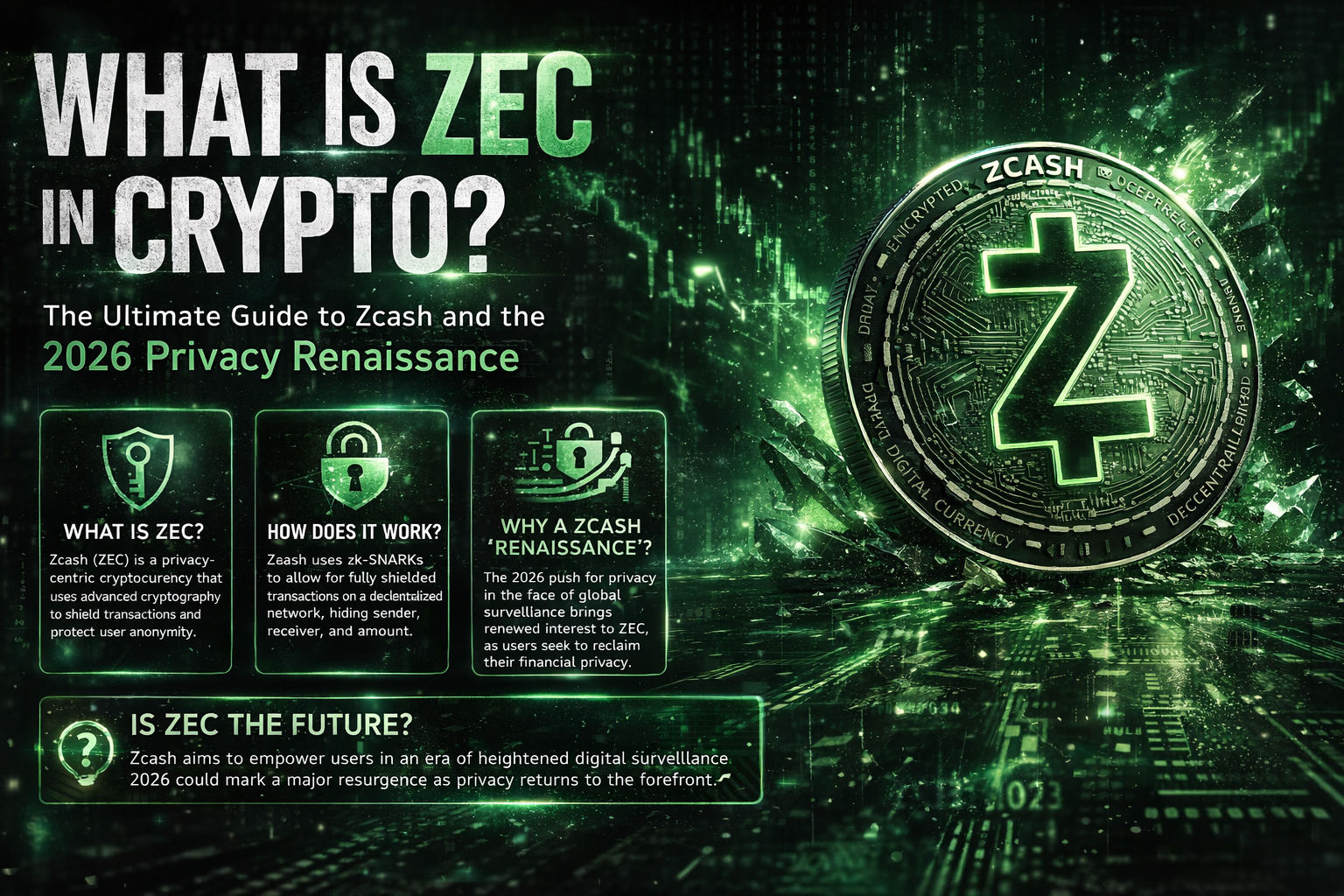
The digital asset landscape is witnessing a massive resurgence in privacy-centric technologies as users seek to reclaim their financial anonymity. In the wake of heightened global surveillance and centralized data tracking, Zcash (ZEC) has emerged as a frontrunner in providing secure, encrypted transactions. This guide explores the fundamental question—what is ZEC in crypto—and why it remains a pivotal asset today.
In this comprehensive analysis, we dive deep into the mechanics of Zcash, its market performance, and why the ZEC token is currently outperforming the broader privacy coin sector in 2026.
Key Takeaways
-
Privacy First: Zcash is a leading privacy-focused cryptocurrency that allows users to shield transaction details using advanced cryptography.
-
Zero-Knowledge Technology: It is the pioneer of zk-SNARKs, a protocol that enables transaction verification without revealing sensitive data.
-
2026 Momentum: ZEC recently led the market with a 24% gain, driven by institutional interest and the "Privacy Renaissance."
-
Regulatory Balance: Unlike some competitors, Zcash offers "view keys," allowing for selective transparency to meet tax and legal requirements.
-
Fixed Supply: Similar to Bitcoin, ZEC has a hard cap of 21 million coins, ensuring long-term scarcity.
2026 Market Pulse: Why ZEC Surged 24% to Lead the Top 100
The crypto market in April 2026 was stunned when Zcash (ZEC) suddenly broke away from the pack, posting a massive 24% gain within a single 24-hour window. This rally wasn't just a flash in the pan; it signaled a fundamental shift in how investors perceive the value of on-chain privacy in an increasingly regulated world.
Breaking Down the Rally: Key Catalysts Behind the 24-Hour Price Spike
Several factors converged to create the perfect storm for ZEC’s price action. First, the successful deployment of the "ZSA" (Zcash Shielded Assets) mainnet upgrade allowed third-party developers to issue private stablecoins on the Zcash network. This instantly increased the utility of the ZEC token as the underlying gas for a new ecosystem of private DeFi. Additionally, a major liquidity provider on our exchange platform reported a massive increase in buy-side pressure from European family offices, suggesting that "smart money" is moving back into privacy-preserving assets.
The Institutional Shift: Why Privacy Infrastructure is Back in Vogue
Institutions are no longer viewing privacy as a "dark web" tool but as a corporate necessity. In 2026, the rise of AI-driven blockchain analytics has made it possible for competitors to track corporate treasury movements with terrifying precision. ZEC provides the "cloaking device" these firms need.
-
Corporate Confidentiality: Protecting supply chain payments from competitors.
-
Alpha Protection: Preventing front-running by hiding large-scale accumulation strategies.
-
Regulatory Safe Havens: Leveraging Zcash's "view keys" to remain compliant while keeping public eyes off their balances.
Technical Analysis: ZEC’s Breakout from Long-Term Resistance Levels
From a technical standpoint, ZEC had been consolidating in a multi-year "falling wedge" pattern. The 24% surge saw it slice through the critical $270 resistance level with significant volume. On the daily charts, the Relative Strength Index (RSI) touched 75, indicating strong bullish momentum, while the 50-day Moving Average crossed above the 200-day Moving Average, forming a "Golden Cross" that technical traders have been waiting for since 2024.
What is ZEC? The "Encrypted Bitcoin" Explained
To understand what is ZEC in crypto, one must first look at its heritage. Zcash was born out of the desire to take Bitcoin’s revolutionary decentralized ledger and add a layer of total encryption. While Bitcoin is often called anonymous, it is actually pseudonymous—every transaction is etched into a public ledger for the world to see. Zcash fixes this "transparency flaw."
Defining ZEC: Digital Cash for a Private Economy
ZEC is the native ticker symbol for Zcash. It functions as a medium of exchange and a store of value. The primary difference between ZEC and other assets is that ZEC gives the user the choice of privacy. You can send a public transaction (transparent) or a private one (shielded). This dual-nature makes it the most flexible financial tool in the Web3 era, functioning exactly like physical cash but in a digital, borderless format.
The Genesis Story: From Cypherpunk Origins to the Electric Coin Co.
Zcash wasn't created by a single anonymous figure but by a team of world-class scientists and cryptographers.
-
The Zerocoin Protocol: Originally proposed as an extension to Bitcoin in 2013 by Matthew Green and his team at Johns Hopkins.
-
The Zerocash Paper: Refined into a standalone protocol in 2014, introducing zk-SNARKs.
-
The Launch: Zcash officially went live in October 2016, led by Zooko Wilcox and the Electric Coin Company (ECC).
-
Community Governance: Today, the Zcash Foundation and the ECC work alongside a decentralized community to steer the project.
ZEC vs. BTC: Shared DNA, Different Visibility
Zcash is built on the original Bitcoin Core codebase. This means it shares many of Bitcoin’s most beloved traits, such as the 21 million total supply and the four-year halving cycle. However, where Bitcoin is a "glass house" where everyone can see your bank balance, Zcash is a "vault." In Bitcoin, if you know someone’s address, you can see their entire transaction history. In Zcash, the shield ensures that your financial history remains your business alone.
How Zcash Works: The Magic of Zero-Knowledge Proofs (zk-SNARKs)
The core engine of Zcash is a mathematical breakthrough known as a Zero-Knowledge Proof. It sounds like science fiction, but it is the foundation of modern digital sovereignty. It allows one party to prove to another that a statement is true, without conveying any information apart from the fact that the statement is indeed true.
Understanding zk-SNARKs: The Shield Behind the Transaction
The acronym stands for Zero-Knowledge Succinct Non-Interactive Argument of Knowledge. When you send ZEC via a shielded transaction, the network doesn't see "Wallet A sent 10 ZEC to Wallet B." Instead, it sees a mathematical proof that:
-
The sender has the funds they claim to have.
-
The transaction is authorized by the sender.
-
The input and output amounts are balanced (no coins were created out of thin air).
-
This proof is validated in milliseconds, keeping the network secure while keeping the data hidden.
Transparent vs. Shielded Addresses (t-Addrs vs. z-Addrs)
Zcash utilizes two types of addresses to give users maximum control over their data:
-
t-Addresses (Transparent): These function just like Bitcoin addresses. All data, including the sender, receiver, and amount, is visible on the block explorer.
-
z-Addresses (Shielded): These use zk-SNARKs to hide the transaction details. If you send ZEC from a z-address to another z-address, the transaction is entirely private.
-
Bridging: Users can "deshield" or "shield" funds by moving them between t and z addresses, though 2026 standards strongly encourage "Shielded by Default" usage.
The Halo 2 Upgrade: Eliminating "Trusted Setup" for Maximum Decentralization
For years, critics pointed to the "Trusted Setup"—the ceremony required to initialize the Zcash parameters—as a potential point of failure. The Halo 2 upgrade solved this. It removed the need for the trusted setup, making the protocol more scalable and theoretically more secure. This upgrade also paved the way for Zcash to explore moving away from its original Proof of Work model toward more modern consensus mechanisms.
The 2026 Roadmap: Zcash’s Evolution into a Multi-Asset Platform
Zcash is no longer just a single-asset chain. The 2026 roadmap has transformed Zcash from a "private Bitcoin" into a comprehensive privacy layer for all of decentralized finance (DeFi). This evolution is one of the primary reasons why the ZEC price has seen such massive renewed interest from developers.
Zcash Shielded Assets (ZSA): Bringing Privacy to Stablecoins and Tokens
The introduction of ZSAs has been a game-changer. This feature allows users to mint new tokens—like a private version of USDT or even NFTs—directly on the Zcash blockchain. These assets inherit the same zk-SNARKs privacy as ZEC itself. In 2026, we are seeing a massive influx of "Shielded USDC" on the network, allowing users to hold stable value without exposing their net worth to public scrutiny.
The Transition to Proof of Stake (PoS): Sustainability and Staking Rewards
To align with global ESG (Environmental, Social, and Governance) standards, the Zcash community has been moving toward a Proof of Stake (PoS) or hybrid consensus model.
-
Energy Efficiency: Reducing the network's carbon footprint by over 99%.
-
Staking Yield: ZEC holders can now lock up their tokens to secure the network and earn a percentage-based reward, similar to Ethereum.
-
Enhanced Security: PoS makes it more expensive for bad actors to attempt a 51% attack, as they would need to buy up a massive portion of the liquid ZEC supply.
Crosslink Mixed Consensus: Enhancing Security and Finality
The "Crosslink" protocol is Zcash’s answer to blockchain finality. By combining the security of its original mining roots with a secondary layer of proof-of-stake validators, Zcash has drastically reduced "re-org" risks. This makes ZEC a preferred asset for high-value settlement between exchanges and institutional desks, as transactions are now considered immutable much faster than in previous years.
ZEC vs. Monero (XMR): Choosing the Right Privacy Coin
The debate between Zcash and Monero is the oldest rivalry in the privacy sector. While both aim to protect the user, they go about it in very different ways, and in 2026, the market has begun to favor Zcash’s approach for specific use cases.
Optional Privacy vs. Default Anonymity: A Strategic Trade-off
Monero (XMR) uses "Ring Signatures" and "Stealth Addresses" to make every transaction private by default. There is no "transparent" mode. While this is great for hardcore privacy advocates, it makes it difficult for regulated exchanges to list. Zcash’s "Optional Privacy" means that users can choose to be transparent when they need to (e.g., when withdrawing to a bank) and private when they want to (e.g., peer-to-peer payments). This flexibility has helped ZEC stay listed on major platforms like ours while XMR faced a wave of delistings.
Regulatory Resilience: Why ZEC is Positioned Differently for Exchanges
Regulators in 2026 are focused on the "Travel Rule." Because Zcash includes an encrypted "memo field" and "view keys," users can provide auditors with proof of where their funds came from without making that information public. This makes Zcash "Regulation Friendly Privacy."
-
ZEC: Compatible with KYC/AML protocols via viewing keys.
-
XMR: Harder to reconcile with traditional banking compliance due to its "always-on" obfuscation.
-
This distinction is a key reason why ZEC's market cap has recently surged ahead of other privacy-focused assets.
The Regulatory Landscape: Privacy Coins in the Crosshairs
The year 2026 has been a turning point for crypto regulation. With the full implementation of MiCA in Europe and new digital asset frameworks in the US, the question of whether privacy coins are legal has never been more relevant.
Compliance by Design: Using View Keys for Audits and Tax Reporting
Zcash was built with the understanding that for crypto to go mainstream, it must coexist with the law. "View Keys" allow a ZEC owner to share a read-only version of their transaction history with a third party (like an accountant or a tax authority).
"Privacy is not the same as secrecy. Privacy is the power to selectively reveal yourself to the world."
This philosophy allows ZEC users to enjoy the benefits of a private life while still fulfilling their civic duties, such as paying capital gains taxes on their 2026 crypto profits.
Global AML/CFT Standards: Navigating 2026 Crypto Regulations
The Financial Action Task Force (FATF) has tightened its grip on "Anonymity Enhanced Currencies." However, the Zcash community has been proactive in education. By demonstrating that shielded transactions are not "untraceable" to those with the proper authority (the view key holder), Zcash has managed to maintain its status as a legitimate financial tool. In many jurisdictions, holding ZEC is treated no differently than holding BTC, provided the exchange you use follows standard KYC procedures.
How to Buy, Store, and Use ZEC Safely
If you are looking to capitalize on the 2026 ZEC rally, you need to understand the best practices for acquisition and self-custody. Security in the privacy space is paramount.
Top Exchanges for Trading ZEC in 2026
Most major global exchanges, including our platform, offer ZEC/USDT, ZEC/BTC, and ZEC/ETH trading pairs. When choosing an exchange, look for:
-
High Liquidity: Ensures you can enter and exit large positions without significant price slippage.
-
Shielded Support: Some advanced exchanges now allow you to withdraw directly to a z-address, saving you the step of shielding the funds yourself.
-
Security Track Record: Always use platforms with robust 2FA and cold-storage reserves.
Shielded Wallets: Zashi and the Move Toward Mobile-First Privacy
In 2026, the "Zashi" wallet has become the gold standard for ZEC users. It is a mobile-first wallet that supports fast syncing for shielded transactions—a technical hurdle that plagued privacy coins for years.
-
Hardware Wallets: Ledger and Trezor continue to support ZEC, though users often use them in conjunction with Zcash-specific software for shielded features.
-
Social Recovery: Many new ZEC wallets now feature social recovery, meaning you can recover your private keys through a circle of trusted friends rather than just a seed phrase.
Investment Outlook: Is ZEC a Good Buy After the Surge?
After a 24% spike, the natural question is: "Have I missed the boat?" To answer this, we must look beyond the daily candle and analyze the fundamental macro-trends of 2026.
Supply Scarcity: Analyzing the 21 Million Cap and Halving Cycles
ZEC’s monetary policy is one of its strongest selling points. With a capped supply of 21 million, it is immune to the rampant inflation seen in many "utility tokens." The most recent Zcash halving further reduced the rate of new coins entering the market. Historically, ZEC has followed Bitcoin’s lead in price action but with higher volatility, meaning its "catch-up" rallies can be significantly more explosive.
Market Sentiment: Privacy as a "Premium" Feature in Web3
In the early days of crypto, privacy was seen as a niche. In 2026, it is seen as a luxury. As more of our lives move on-chain—from medical records to social media identities—the demand for a protocol that can hide these sensitive data points will only grow. ZEC is no longer just a coin; it is a "Privacy-as-a-Service" layer. If Zcash continues to capture even 1% of the global offshore banking market, the current price levels may look like a bargain in retrospect.
Conclusion
Understanding what is ZEC in crypto is essential for any investor who values the intersection of financial freedom and technological innovation. Zcash has proven itself to be much more than a simple Bitcoin clone; it is a sophisticated, scientifically-backed platform that has solved the "Trusted Setup" problem and expanded into the world of private tokens and staking. While the 24% surge in 2026 has captured the headlines, the long-term value of ZEC lies in its ability to provide a secure, compliant, and truly private alternative to the transparent financial systems of the past. As the "Privacy Renaissance" gains steam, Zcash is uniquely positioned to remain a cornerstone of the decentralized economy.
FAQ
Is Zcash completely untraceable?
Zcash is not "untraceable" in the way many think. While shielded transactions hide the sender, receiver, and amount from the public, they are still verifiable by the network. Furthermore, users can use "view keys" to make their own history traceable to specific parties for auditing or tax purposes.
What is the difference between Zcash and ZEC?
Zcash is the name of the blockchain protocol and the underlying technology. ZEC is the ticker symbol and the actual cryptocurrency token used on the network to pay for transaction fees and transfer value between users.
Is ZEC legal in the US and Europe in 2026?
Yes, ZEC remains legal in the US and Europe in 2026. Unlike some other privacy coins, Zcash’s ability to support selective disclosure and "view keys" has allowed it to satisfy most AML and KYC regulatory frameworks, keeping it listed on major regulated exchanges.
How does Zcash's 21 million limit affect its price?
The 21 million coin limit creates digital scarcity. Much like Bitcoin, as the demand for private transactions increases while the supply of new ZEC slows down due to halving events, it creates upward pressure on the token's long-term market value.
Can I mine ZEC in 2026?
As of 2026, Zcash has transitioned toward a Proof of Stake (PoS) hybrid model. While traditional ASIC mining may still exist in a limited capacity depending on the latest network upgrades, most users now participate by "staking" their ZEC to earn rewards.