

Musk's $60B AI Power Play: What SpaceX × Cursor Means for Crypto in 2026
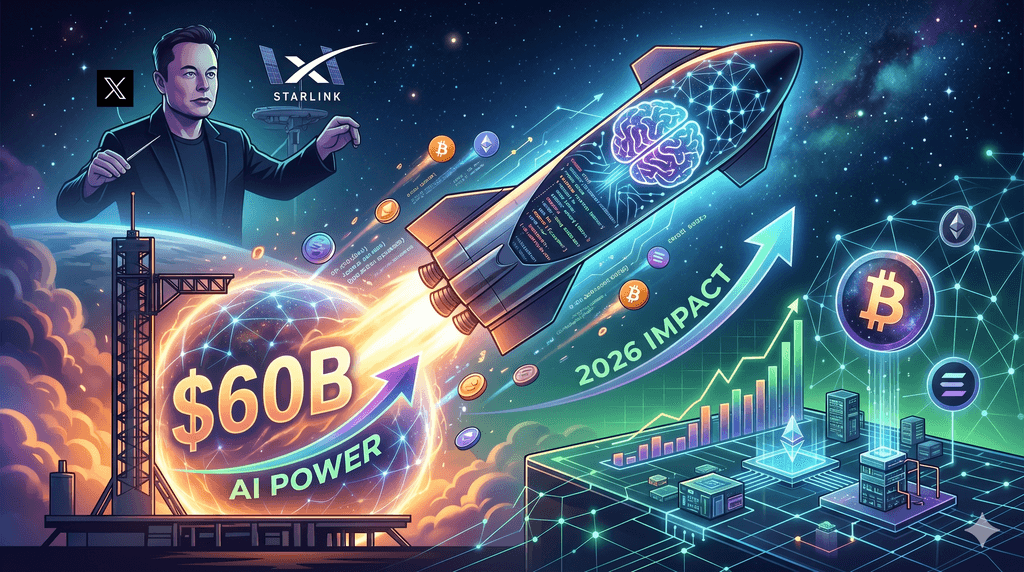
The intersection of space exploration, artificial intelligence, and decentralized finance has reached a fever pitch. In late April 2026, the technology sector was rocked by the announcement that SpaceX—now a vertically integrated AI and aerospace behemoth—has secured the rights to acquire the AI coding sensation Cursor (Anysphere Inc.) for a staggering $60 billion.
This isn't just another Silicon Valley acquisition; it is a structural realignment of the digital economy. As Elon Musk prepares SpaceX for a historic IPO with a rumored valuation of $1.75 trillion, the integration of Cursor's "vibe coding" mastery with xAI's Colossus supercomputer (leveraging 1 million Nvidia H100 equivalents) signals the birth of a new era. For the cryptocurrency market, this move is a catalyst that bridges the gap between massive centralized compute and the burgeoning world of DePIN (Decentralized Physical Infrastructure Networks) and AI-driven smart contracts.
Key Takeaways:
-
Vertical AI Integration: SpaceX is moving "upstack," combining massive hardware (Colossus) with the world’s most popular AI coding interface (Cursor) to dominate the developer workflow.
-
The Rise of "Vibe Coding": The acquisition validates the trend where AI agents handle complex programming, lowering the barrier for building decentralized applications (dApps) and complex blockchain protocols.
-
Space-Based Compute: Musk’s push for orbital data centers via Starlink could provide a censorship-resistant, high-uptime backbone for future decentralized networks.
-
Crypto Market Catalysts: The deal shines a spotlight on AI-tokens, DePIN projects, and high-performance blockchains capable of supporting the massive throughput required by Musk’s integrated AI stack.
-
The IPO Factor: The SpaceX IPO (expected Q2 2026) acts as a "liquidity magnet," likely drawing institutional capital toward tech-adjacent sectors, including AI-focused crypto assets.
-
The $60 Billion Synergy: Why Cursor is Musk’s Missing Piece
To understand the impact on crypto, one must first understand why SpaceX is paying a premium for a coding tool. Cursor, which saw its valuation leap from $2.5 billion in early 2025 to $60 billion in April 2026, has become the "OS for developers." By acquiring Cursor, SpaceX solves the "compute bottleneck" for software engineers while gaining a massive distribution channel for xAI’s models.
In the crypto world, software is law. The faster and more reliably code can be generated, the faster the "Singularity" in DeFi and Web3 can occur. Musk is effectively buying the "printing press" for the next generation of software, much of which will be hosted on-chain. This vertical integration—from the silicon in Memphis (Colossus) to the code editor in a developer's hands—creates a closed loop that could potentially outpace OpenAI and Anthropic in the race to build autonomous agents.
The synergy here is twofold. First, Cursor provides the Interface. It is where human intent meets machine execution. Second, xAI provides the Intelligence. By feeding the telemetry and data from SpaceX’s aerospace engineering and Starlink’s global network into Cursor’s LLMs, Musk is creating a specialized "Hard Tech" AI that understands physical systems as well as digital ones. For blockchain developers, this means AI agents that aren't just good at Solidity, but are experts in optimizing low-level Rust for high-performance chains like Solana or Monad.
-
"Vibe Coding" and the Acceleration of Web3 Development
The term "vibe coding" emerged in early 2025 and has become the dominant paradigm by 2026. It refers to a workflow where developers provide high-level "vibes" or prompts, and AI agents like Cursor’s Composer 2.5 handle the heavy lifting of writing, debugging, and deploying code.
For the cryptocurrency market, this is a massive tailwind. Building secure, audited smart contracts has historically been a slow and expensive process.
How Vibe Coding Changes the Crypto Landscape:
-
Automated Real-Time Audits: Integrated AI tools can identify reentrancy attacks and logic flaws as the code is being "vibed." By 2026, the era of the $100M exploit is fading, replaced by AI-shielded protocols.
-
Rapid Prototyping of dApps: A developer can now "vibe" an entire cross-chain liquidity aggregator or a novel DAO governance structure into existence in a single weekend.
-
Democratizing Development: As SpaceX scales Cursor’s intelligence via Colossus, we expect a surge in "long-tail" crypto projects. The cost of technical talent, once a barrier to entry for innovative Web3 startups, has dropped by 90%.
The result is an explosion of "Agentic DeFi"—protocols that are not just static code, but living AI agents that manage risk, rebalance portfolios, and hunt for yield across a dozen chains simultaneously.
-
From Earth to Orbit: The Orbital DePIN Vision
One of the most radical insights from the SpaceX merger with xAI in early 2026 is the plan for orbital data centers. Musk has noted that space-based solar power is 5x more efficient than terrestrial equivalents because there is no atmosphere to attenuate the sun's rays. With a million-satellite data center network filing now with the FCC, SpaceX is building a literal "Cloud" in the stars.
Why This Matters for Decentralized Networks (DePIN):
This aligns perfectly with DePIN (Decentralized Physical Infrastructure Networks). While SpaceX remains a centralized entity, its infrastructure provides the ultimate "Hard Tech" layer that decentralized protocols can leverage.
-
Censorship Resistance: If a government attempts to shut down terrestrial nodes or throttle internet access, orbital compute via Starlink provides a "god-mode" backup for blockchain validators.
-
Global Latency Reduction: By processing data in orbit and beaming it directly to Starlink terminals, the latency for global consensus mechanisms could reach theoretical physical limits.
-
Zero-Knowledge Proof (ZKP) Generation: The massive compute power of the SpaceX orbital network can be rented by ZK-Rollups to generate proofs at scale, solving the scaling bottleneck for Ethereum and other Layer 2s.
The crypto projects that win in late 2026 will be those that figure out how to bridge terrestrial DePIN rewards with SpaceX’s orbital bandwidth, creating a truly hybrid "Earth-Space" internet.
-
Institutional Liquidity: The IPO Halo Effect on AI Tokens
The SpaceX IPO, rumored for June 2026, is set to be the largest in history. Historically, when a massive tech trend (like AI or Space) reaches a massive liquidity event, the "overflow" capital finds its way into high-beta assets—most notably, cryptocurrency.
The Wealth Effect and Crypto Rotation:
Investors are already front-running this by rotating into AI-Crypto hybrids.
-
Capital Overflow: As SpaceX employees and early investors cash out billions, a significant portion of that capital will seek high-growth alternatives.
-
The Narrative Shift: The $60 billion Cursor deal confirms that "AI Compute" is the new oil. Crypto tokens that provide decentralized compute (like Render or Akash) or AI-agent marketplaces are seeing increased correlation with SpaceX/Tesla news.
-
ETF Synergy: With Bitcoin and Ethereum ETFs already mature by 2026, the "Musk Trade" is now a standard part of institutional portfolios. Investors are looking for the "SpaceX of Crypto"—projects that mirror Musk’s vertical integration and aggressive scaling.
With such massive shifts in the macro landscape, traders in 2026 are no longer just looking at candlestick charts; they are monitoring GPU cluster deployments, satellite launch schedules, and AI model benchmarks. The volatility introduced by Musk’s "Power Plays" requires a trading environment that is as fast as the AI models being built.
Bridging the Gap Between AI Innovation and Trade Execution:
As you look to position yourself for the SpaceX IPO and the Cursor integration, the choice of platform becomes your most strategic asset. KuCoin has positioned itself at the forefront of this convergence, offering early access to the very AI and DePIN tokens that stand to benefit from the Musk ecosystem's expansion.
The beauty of a modern exchange lies in its ability to adapt to the "Vibe Coding" era. For example:
-
Early Access Gems: While the "vibe coding" movement simplifies building dApps, the market remains fragmented. KuCoin’s research-driven approach allows traders to discover AI gems before they hit the mainstream.
-
Smart Automation: Much like Cursor automates the coding process, KuCoin’s advanced trading bots allow you to "vibe trade"—setting sophisticated parameters that execute your macro thesis while you sleep.
-
Deep Liquidity for Volatility: When a $60 billion acquisition is announced, prices move in milliseconds. KuCoin’s deep liquidity ensures that your hedges or directional bets in the Grok-themed assets or Space-DePIN projects are executed at competitive prices.
Whether you are a long-term holder of the "AI Settlement Layer" or a short-term trader riding the SpaceX hype cycles, the platform provides the professional-grade tools needed to navigate an era where $60 billion deals are the new baseline.
-
The "Singularity" of Money: Bitcoin’s Role in an AI Economy
In a provocative 2026 podcast, Musk declared that we have reached the "Singularity," where AI, robotics, and automation are collapsing the cost of labor. In a world of digital abundance created by SpaceX and Cursor, what happens to the concept of value?
The Scarcity Thesis:
The prevailing thesis among macro analysts is that as AI drives the cost of creation to zero, the value of scarcity becomes infinite. This is the primary driver for Bitcoin in 2026.
-
AI Settlement Layer: As SpaceX builds the infrastructure for an autonomous future, billions of AI agents will need a way to settle value. These agents don't have bank accounts; they have wallets. Bitcoin’s Lightning Network and newer Layer 2s provide the native, non-sovereign currency agents need to pay for compute, data, and orbital bandwidth.
-
The Anti-Inflation Hedge: While AI-driven productivity is disinflationary for goods, the massive energy and capital expenditures required for Musk’s "Colossus" supercomputers put pressure on fiat systems. Bitcoin remains the "Sound Money" foundation that protects wealth from the structural shifts of the AI era.
The integration of Cursor into SpaceX means more autonomous agents will be born in 2026 than in all previous years combined. Every single one of those agents is a potential Bitcoin user.
-
The Regulatory Frontier: Musk vs. the SEC in the AI Era
No Musk power play would be complete without a regulatory battle. In 2026, the focus has shifted from "Is it a security?" to "Who owns the AI?" The $60B Cursor acquisition has triggered antitrust probes from the FTC, while the SEC is scrutinizing how SpaceX uses its AI to trade its own supply chain data.
For the crypto market, this regulatory friction is actually a bullish catalyst.
-
The Case for Decentralization: The more Musk centralizes AI power, the stronger the argument for decentralized AI protocols. Investors are hedging against "Big AI" by buying tokens that represent open, permissionless models.
-
Regulatory Arbitrage: SpaceX’s orbital data centers may eventually exist in a "legal gray zone," mirroring how crypto has operated for years. This shared "outsider" status creates a cultural and financial bridge between Musk fans and crypto enthusiasts.
-
Strategy for the Second Half of 2026: Positioning Your Portfolio
As we head toward the SpaceX IPO and the full integration of Cursor, the "Musk Trade" is evolving. It is no longer about "Dogecoin to the moon," but about the Compute-Energy-Money triad.
Recommended Portfolio Allocations:
-
The Infrastructure Layer (DePIN): High-performance blockchains and decentralized compute providers that can act as the "subcontractors" for SpaceX’s orbital ambitions.
-
The Intelligence Layer (AI Tokens): Projects focusing on decentralized LLMs and AI agent marketplaces that compete with or complement the Cursor/xAI stack.
-
The Scarcity Layer (BTC): The ultimate hedge against the digital abundance created by automated coding and space-based manufacturing.
-
Liquid Hedges: Using platforms like KuCoin to maintain exposure to high-beta "Elon memes" while using futures to protect against IPO-related volatility.
Conclusion: The New Alpha of 2026
The SpaceX × Cursor deal is a signal that the "AI Arms Race" has moved beyond software into the realm of total verticality. SpaceX isn't just a rocket company; it is the physical body for an AI brain (xAI) that now has the world's best hands (Cursor).
For the crypto investor, the "Alpha" in late 2026 lies in understanding the synergy between Musk's centralized compute (Colossus/Starlink) and the decentralized world's need for permissionless value transfer. The inflation-hedge thesis of the past has evolved into a productivity-hedge thesis.
As the lines between developer tools, space-based hardware, and crypto-economics blur, the winners will be those who recognize that the $60B power play is not just about code—it's about who owns the infrastructure of the future. The "Singularity" is here, and it is being built in orbit, written in AI-generated code, and settled on the blockchain.
FAQs:
Will SpaceX launch its own cryptocurrency?
While Musk has integrated Dogecoin into various payments and Grok (xAI) predicts prices for various assets, SpaceX has focused on the IPO route for liquidity. However, many expect a "Starlink Token" or similar incentive mechanism for orbital compute providers to emerge in the DePIN space.
How does the Cursor acquisition affect my current AI tokens?
It acts as a massive valuation benchmark. If a coding tool is worth $60B, decentralized AI protocols that offer "open-source" alternatives are currently seen as significantly undervalued by market analysts.
Is "vibe coding" safe for financial smart contracts?
In 2026, AI-generated code is actually considered safer than human-written code, provided it is verified by multiple, independent AI "formal verification" agents. The "Human-in-the-loop" model is still standard for billion-dollar protocols.
What is the "Colossus" supercomputer’s role in crypto?
Colossus is primarily used to train xAI’s models, which then power Cursor. However, rumors persist that SpaceX is renting out "excess compute" to decentralized AI networks, creating a bridge between centralized hardware and decentralized software.
What is the best way to trade the SpaceX IPO news?
Stay liquid and use platforms that offer a wide array of AI-related pairs. The market reacts instantly to Musk's "X" posts; having a pre-set strategy or a trading bot on an exchange like KuCoin can help you capture moves before the retail crowd catches on.
Disclaimer: This article is for informational purposes only and does not constitute financial or investment advice. The technology and crypto markets are highly volatile; always conduct your own research.