

HYPE Enters Crypto Top 10: A New Era Begins for HyperEVM Ecosystem
2026/06/02 18:14:00
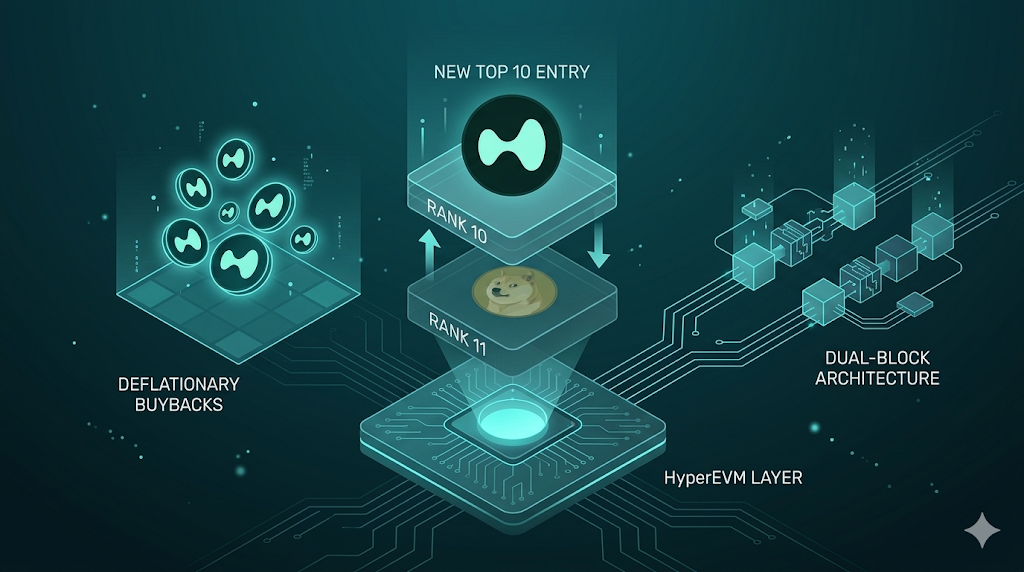
Did you know that a utility-driven decentralized exchange token officially surpassed Dogecoin in market capitalization in 2026? Hyperliquid's native token, HYPE, successfully entered the top 10 cryptocurrencies globally by breaching a $16 billion valuation in early June 2026. This massive financial milestone confirms that institutional and retail investors now heavily prioritize revenue-generating blockchain infrastructure over purely speculative meme assets.
The rapid expansion of the HyperEVM ecosystem—a high-performance Ethereum Virtual Machine layer—directly catalyzed this explosive growth by uniting deep on-chain liquidity with seamless smart contract deployment.
The Significance of HYPE Entering the Crypto Top 10
HYPE securing a top-10 cryptocurrency ranking fundamentally proves that the digital asset market has matured to reward actual utility and protocol revenue. Investors are aggressively migrating their capital away from stagnant legacy networks toward high-performance Layer-1 blockchains that capture real economic value. This capital rotation demonstrates a permanent shift in market psychology during the 2026 trading cycle. Projects that deliver verifiable on-chain revenue are entirely dominating those that rely exclusively on internet hype and community sentiment.
The token achieved this milestone by combining a flawless technical architecture with an incredibly aggressive, deflationary economic model. By late May 2026, the Hyperliquid protocol had processed trillions of dollars in cumulative volume and generated over $1.16 billion in absolute revenue. This fundamental financial strength justifies the massive valuation premium awarded by the market. Traders recognize that HYPE is not merely a governance token, but a direct financial claim on the most successful decentralized exchange ecosystem in existence.
Flipping Dogecoin in Market Capitalization
Flipping Dogecoin definitively signals the end of the meme coin dominance era and the triumph of decentralized financial engineering. According to June 2026 data from CoinGecko, HYPE reached an all-time high of $74.04, pushing its total market capitalization past $16 billion. This impressive price action allowed the decentralized exchange token to comfortably displace Dogecoin from the highly coveted top-10 rankings. The market is ruthlessly pricing out legacy assets that lack modern smart contract capabilities.
This historic flip occurred because institutional capital requires assets with predictable revenue streams and robust technical foundations. Meme coins inherently lack the structural mechanics necessary to absorb billions of dollars in sophisticated Wall Street investments. Conversely, the Hyperliquid platform acts as an automated profit engine, systematically capturing trading fees to support the underlying network economy. This structural advantage made the eventual flipping of purely speculative assets a mathematical certainty.
Institutional Adoption and ETF Capital Inflows
Institutional adoption is rapidly accelerating the HYPE token valuation because major asset managers are aggressively launching dedicated exchange-traded products. Based on early June 2026 reports, prominent firms like Grayscale are structuring massive private placements to acquire millions of tokens via ETF share swaps. This direct institutional pipeline allows traditional finance funds to gain exposure to the decentralized perpetual futures market safely. Wall Street money is flooding into the ecosystem, providing an incredibly robust price floor.
These massive ETF inflows create severe supply shocks on secondary cryptocurrency exchanges as tokens are locked into institutional custody vaults. When traditional asset managers purchase millions of dollars in HYPE, they completely remove that circulating supply from active retail trading pools. This aggressive institutional accumulation forces late retail buyers to bid prices significantly higher to secure their desired allocations. The resulting liquidity squeeze heavily drove the token's spectacular seventy percent gain throughout the month of May.
Deflationary Mechanics and Assistance Fund Buybacks
Deflationary mechanics continuously drive the token value higher because the protocol uses its massive trading revenues to execute relentless, automated buybacks. Nearly all transaction fees generated by the decentralized exchange flow directly into a specialized Assistance Fund dedicated to network sustainability. This fund systematically repurchases tokens from the open market and permanently burns them, continuously reducing the total circulating supply. This aggressive value accrual mechanism heavily rewards long-term token holders.
Because the exchange processes over a billion dollars in daily trading volume, the resulting buyback pressure is mathematically staggering. As trading activity scales across the network, the rate of token destruction actively accelerates, creating a highly reflexive upward price cycle. According to May 2026 network analytics, this direct relationship between platform usage and supply reduction makes HYPE one of the most fundamentally sound assets globally. Investors are mathematically guaranteed to benefit as the exchange captures more market share.
Understanding the HyperEVM Ecosystem Architecture
The HyperEVM ecosystem represents a massive evolutionary leap in blockchain engineering by directly integrating general-purpose smart contracts into a high-speed trading ledger. Developers can build traditional Ethereum-style applications while simultaneously accessing the unparalleled speed and deep liquidity of the Hyperliquid Layer-1 network. This unified architecture completely eliminates the complex technical barriers that previously separated standard decentralized finance protocols from institutional-grade order books. It is the ultimate foundation for next-generation financial software.
By utilizing the native HyperBFT consensus mechanism, the virtual machine environment easily inherits the massive security and sub-second finality of the primary core network. Smart contract developers no longer need to compromise between decentralization, transaction speed, and platform security. They can deploy highly complex algorithms capable of executing trades in milliseconds without paying exorbitant gas fees. This perfect technological synergy makes the ecosystem the most attractive deployment destination for modern blockchain builders.
The Power of Dual-Block Architecture
Dual-block architecture ensures that rapid transaction execution perfectly coexists with secure, decentralized network finality. The system cleverly separates its operations into high-speed HyperBlocks for immediate transaction processing and slower MacroBlocks for absolute cryptographic settlement. HyperBlocks handle rapid execution with near-instant confirmation, ensuring a smooth, latency-free experience for high-frequency algorithmic traders. This brilliant architectural split completely solves the notorious blockchain trilemma that has plagued older generation networks for years.
Simultaneously, the MacroBlocks finalize large batches of these rapid transactions, adding an impenetrable layer of mathematical security and network consistency. This mechanism guarantees that even if a massive volume spike occurs, the underlying ledger remains perfectly synchronized and completely secure against malicious rollback attacks. Based on May 2026 technical audits, this dual-block design allows the network to process institutional-scale order flows without experiencing any degradation in overall performance.
Seamless HyperCore Order Book Integration
Seamless integration with HyperCore order books allows independent smart contracts to directly access billions of dollars in deep on-chain liquidity instantly. Lending protocols and yield aggregators built on the virtual machine can programmatically execute massive spot trades without relying on fragile, low-liquidity automated market makers. This direct connection to a central limit order book represents a fundamental paradigm shift for decentralized application development. Capital efficiency reaches unprecedented levels when applications bypass inefficient liquidity pools.
For a Solidity developer, interacting with this massive liquidity is as simple as calling a standard built-in software function. If an automated lending protocol needs to liquidate an undercollateralized position, it can instantly send a swap order directly to the native exchange engine. This eliminates the dangerous price slippage that routinely destroys user portfolios during volatile market liquidations. The entire decentralized finance ecosystem becomes dramatically safer and mathematically more efficient.
Eliminating Vulnerable Bridging Risks
Eliminating cross-chain bridging risks is the primary security advantage of building decentralized applications directly within this unified ecosystem. Because the virtual machine and the core trading engine share the exact same cryptographic state, assets move instantly without ever interacting with third-party network bridges. Hackers cannot exploit complex locking contracts because the assets never actually leave the native blockchain environment. This unified state drastically reduces the attack vectors available to malicious network actors.
Historically, complex cross-chain bridges have suffered catastrophic multi-billion dollar exploits due to logic errors and compromised validator signatures. By keeping all assets strictly within a single, high-performance consensus environment, developers protect their users from these devastating external vulnerabilities. According to a June 2026 security analysis by CertiK, the unified state architecture provides an institutional-grade security framework that legacy fragmented networks simply cannot replicate.
The Developer Experience on Hyperliquid Layer 1
The developer experience on this network is exceptionally frictionless because builders can utilize their existing Ethereum development tools without requiring any new programming languages. The environment provides perfect EVM compatibility, meaning developers can instantly deploy their established Solidity codebases directly onto this high-speed infrastructure. This strategic design decision drastically reduces the technical learning curve, allowing massive engineering teams to migrate their decentralized applications in a matter of hours.
Furthermore, the ecosystem actively supports the deployment of fully permissionless spot assets seamlessly linked to the primary trading engine. Developers can launch a new token project and immediately access a global, highly liquid trading market without paying exorbitant centralized exchange listing fees. This open, fair-launch philosophy actively democratizes financial access, ensuring that innovative projects can secure liquidity based entirely on their fundamental technological merit.
Cost-Effective Smart Contract Deployment
Cost-effective smart contract deployment is completely guaranteed because the network utilizes HYPE as its highly efficient native gas token. Developers and end-users benefit immediately from transaction costs that represent a tiny fraction of typical legacy network fees. Under the network's deflationary EIP-1559 implementation, all base gas fees and priority tips are permanently burned, aligning developer activity directly with token scarcity. This incredibly cheap execution environment allows builders to design highly complex, calculation-heavy applications that would be economically impossible to run on older blockchains. Micro-transactions and automated grid trading become highly profitable for everyday retail participants.
This low-cost environment strongly encourages rapid iteration and continuous live testing by independent software engineering teams. Startups can deploy massive product upgrades and complex governance contracts daily without draining their corporate treasuries on exorbitant network fees.
Zero-Tracking RPC Privacy Infrastructure
Zero-tracking RPC privacy infrastructure provides absolute cryptographic protection against malicious data harvesting and targeted front-running attacks. By utilizing specialized endpoints from providers like 1RPC, decentralized applications can connect to the network without exposing sensitive user metadata or IP addresses. The system actively wipes all request data immediately after the transaction is relayed to the blockchain nodes. True zero-tracking privacy ensures that massive centralized corporations cannot exploit user trading patterns for financial gain.
This verifiable privacy is absolutely mandatory for institutional traders managing highly sensitive, multi-million dollar portfolios. Sophisticated transaction sanitizers act as powerful anti-phishing toggles, automatically defending users against malicious smart contract interactions that attempt to steal funds. This robust security layer allows high-frequency trading firms to confidently deploy capital without fearing that external observers are front-running their complex algorithmic strategies.
Native Token Launch Mechanics
Native token launch mechanics empower communities to deploy structural, long-term assets directly onto Hyperliquid’s premier central limit order book, yet under strict economic guardrails. When a project team deploys an ERC-20 contract on HyperEVM, they must bid for and secure a highly coveted native HIP-1 token deployment slot. To prevent order book spam, this deployment privilege is rationed through a rigorous Dutch auction held every 31 hours, requiring winners to commit significant HYPE capital to purchase the ticker rights. Once mathematically linked, the token can be utilized dynamically across the EVM DeFi ecosystem while maintaining institutional liquidity on the underlying HyperCore ledger.
Furthermore, under the network's specialized HIP-6 framework, native token launches utilize Continuous Clearing Auctions (CCA) to eliminate price manipulation and front-running. This process enforces uniform clearing prices and mandates that a portion of raised funds automatically seeds permanent on-chain liquidity. This innovative mechanic bypasses the exploitative gatekeeping and exorbitant listings fees typically demanded by massive centralized exchanges. The launch process is entirely transparent, cryptographically secure, and completely algorithmic, replacing behind-the-scenes listing bribes with a fair, capital-efficient, on-chain meritocracy.
The Future of Decentralized Perpetual Trading
Decentralized perpetual trading is capture-oriented, continuously shifting substantial retail and institutional volume away from traditional centralized platforms. As an advanced financial alternative, this network demonstrates that a highly optimized, fully decentralized architecture can comfortably rival the throughput, order book depth, and responsiveness of traditional corporate trading platforms. By completely neutralizing the severe counterparty and solvency risks inherent in centralized escrow models, the non-custodial protocol provides an infinitely more secure capital environment, enabling participants to maintain absolute cryptographic custody of their digital assets at all times.
The platform continuously pushes boundaries by expanding its catalog of algorithmic perpetual contracts and innovative, oracle-driven synthetic assets. By capturing significant volume in tokenized indices and non-crypto commodities under its native HIP-3 asset parameters, the ecosystem effectively bridges the gap between traditional asset exposure and decentralized engineering. This aggressive expansion guarantees that the network will remain a dominant venue for on-chain derivatives and automated yield-hedging across evolving global macroeconomic cycles.
Achieving Sub-Second Cryptographic Finality
Achieving sub-second cryptographic finality remains the foundational technical pillar that elevates this network to institutional-grade execution status. When a participant triggers a complex margin or futures order, the custom HyperBFT consensus layer settles the entire transaction within a 0.07-second block window, eliminating execution lag and trade-slippage. This near-instantaneous determinism is highly mandatory for sophisticated algorithmic entities relying on automated high-frequency trading (HFT) and rapid statistical arbitrage models.
This low-latency architecture significantly curtails the ability of malicious validators or market makers to exploit latency arbitrage at the expense of everyday retail flow. Every market participant interacts with an identical, lightning-fast matching engine, neutralizing geographic front-running and ensuring execution equity. According to recent 2026 network analytics, this democratized execution speed establishes one of the most structurally fair, highly competitive derivatives trading environments currently operating in the global decentralized Web3 landscape.
Gasless Trading and User Experience
Gasless trading dramatically improves the onboarding experience for new retail users accustomed to the frictionless interfaces of traditional financial applications. Traders simply sign a cryptographic message with their digital wallet to execute an order, completely avoiding the incredibly confusing process of paying variable network gas fees. The protocol seamlessly handles all complex underlying blockchain interactions on behalf of the user. This elegant design philosophy entirely removes the massive technical friction that heavily stifles mainstream decentralized finance adoption.
By abstracting away the complex realities of blockchain infrastructure, the platform allows users to focus entirely on their core trading strategies. Retail investors do not need to constantly monitor network congestion or meticulously calculate gas limits before placing an urgent stop-loss order. This streamlined, highly professional user interface is directly responsible for the massive surge in active wallet addresses throughout early 2026.
Scalable Onchain Liquidation Engines
Scalable onchain liquidation engines protect the entire financial ecosystem from catastrophic cascading failures during periods of extreme macroeconomic volatility. The protocol utilizes a highly optimized risk-engine capable of accurately evaluating millions of active trading positions in absolute real-time. If an account falls below its strict margin requirements, the system instantly and automatically liquidates the position directly against the central limit order book. This algorithmic precision prevents the platform from ever accumulating dangerous bad debt.
Because this critical liquidation process occurs entirely on-chain without relying on slow external oracles, the network remains exceptionally resilient during flash crashes. The system can easily absorb massive, instantaneous market corrections that routinely bankrupt traditional decentralized lending platforms. Based on market data from May 2026, this robust risk architecture allowed the platform to successfully process billions of dollars in liquidations flawlessly without a single system outage.
How to Trade HYPE Tokens on KuCoin
Trading Hyperliquid (HYPE) tokens on KuCoin provides a centralized alternative for investors seeking exposure to the HyperEVM ecosystem without managing decentralized private keys. KuCoin supports the standard HYPE/USDT trading pair on its spot market, offering accessible liquidity and automated execution tools for both retail and institutional market participants
-
Users must register an account and complete standard Identity Verification (KYC) to access full platform features and comply with localized digital asset regulations.
-
After depositing supported fiat currencies or stablecoins, navigate to the Spot Market interface and locate the HYPE/USDT pair.
-
The interface supports standard market and limit orders. For advanced strategies, users can deploy built-in trading bots, including Spot Grid, Infinity Grid, and DCA, to manage trade execution during periods of market volatility.
Conclusion
The historic entry of HYPE into the top 10 global cryptocurrencies underscores a profound market maturation in the digital asset sector. By displacing Dogecoin and surging past a $16 billion market capitalization in June 2026, the milestone demonstrates that the trading cycle heavily rewards verifiable utility and predictable protocol cash flows. Institutional capital continues to migrate toward this infrastructure due to its capacity to capture massive transaction volumes, which directly feed its hard-coded, deflationary buyback mechanics. This alignment of underlying network usage with absolute token scarcity provides a structurally sound economic foundation for long-term valuation premium.
Simultaneously, the steady expansion of the HyperEVM architecture establishes a highly optimized environment for decentralized financial engineering. By integrating an Ethereum-compatible virtual machine directly with a high-performance central limit order book, the protocol systematically resolves legacy cross-chain liquidity fragmentation. Within this unified cryptographic state, developers can deploy complex smart contracts that leverage sub-second finality, zero-tracking RPC privacy infrastructure, and robust algorithmic asset launch frameworks. This comprehensive infrastructure represents a significant advancement in the deployment of institutional-grade decentralized finance.
FAQs
What exactly is the HYPE cryptocurrency token?
HYPE is Hyperliquid's native gas, staking, and governance token. Its value is directly driven by automated buyback-and-burn mechanics fueled by network trading fees.
How did HYPE surpass Dogecoin in market capitalization?
HYPE flipped Dogecoin via capital rotation into revenue-generating L1s. Massive fee buybacks and Grayscale/Bitwise ETF filings triggered a severe secondary market supply shock.
What is the core function of the HyperEVM?
HyperEVM provides an Ethereum-compatible execution layer natively integrated with HyperCore's order books. This eliminates cross-chain bridge risks, allowing Solidity dApps to directly access deep liquidity.
Why is dual-block architecture important for this blockchain?
It prevents execution-versus-capacity trade-offs by running ~1-second small blocks for quick trades and ~1-minute large blocks for heavy smart contract deployments under a unified consensus.
Are there risks to building applications on this network?
Yes. While native infrastructure neutralizes cross-chain bridge vulnerabilities, standard application-level risks persist. Poorly engineered smart contracts remain highly susceptible to malicious liquidity exploits.
Disclaimer:This content is for informational purposes only and does not constitute investment advice. Cryptocurrency investments carry risk. Please do your own research (DYOR).