

Gold vs Silver vs Bitcoin: Which Asset Will Dominate Future Investments in 2026 and Beyond?
2026/03/25 10:57:02
Did you know that as of 2025, Bitcoin ETFs had over $50 billion in institutional inflows, while global central banks were buying gold at record rates? This raises a compelling question: in a world of high debt, inflation, and technological transformation, which of these assets will define the next decade of investing metals mined from the earth or assets created in code?
Overview
What if the next decade's main investment theme isn’t stocks or bonds but a battle between gold, silver, and Bitcoin? In 2026, these three assets are no longer just alternative hedges; they are competing narratives about the future of money, value, and risk. Gold has re‑entered the spotlight as central banks and ETFs pile in, silver is amplifying its moves with green‑tech and industrial demand, and Bitcoin is evolving from a speculative “digital gold” story into a high‑beta, ETF‑driven asset class.
Right now, the cryptocurrency landscape is defined by deeper institutional adoption, regulatory maturation, and a shift from pure DeFi hype to real‑world utility and macro‑linked narratives. At the same time, Bitcoin and other digital assets are increasingly being seized and compared against traditional safe‑haven plays like gold, reshaping how portfolios are constructed.
Investors today can access Bitcoin and other digital assets through regulated platforms like KuCoin, wallets, and real-time market tracking for diversified portfolios
By the end of this article, you will understand:
-
How gold, silver, and Bitcoin differ as drivers of market momentum,
-
Which asset is most likely to become the dominant investment theme in the near term and in the long term,
-
And what concrete crypto‑aware investors can do to position their portfolios across all three.
Thesis
While gold provides timeless stability and silver delivers cyclical leverage, Bitcoin emerges as most likely to become the main investment theme of the future due to its engineered digital scarcity, institutional adoption via ETFs, and alignment with a programmable global economy. Readers will gain precise insights into gold silver Bitcoin investment trends, market momentum for 2026 rotations, and portfolio frameworks to balance defense with high-upside growth empowering confident decisions in precious metals vs crypto hedging.
Introduction to Gold, Silver, and Bitcoin
Key Assets Shaping Investment Trends in 2026
As investors navigate the evolving financial landscape, gold, silver, and Bitcoin stand out as critical components for both wealth preservation and growth. While each serves as a hedge against inflation and economic uncertainty, their underlying characteristics, market behavior, and adoption trends differ significantly. Understanding these differences is essential for making informed investment decisions in 2026 and beyond.
Gold: The Timeless Safe Haven
Gold has been a symbol of wealth for over 5,000 years, transcending cultures and economies. Its enduring appeal lies in several key factors:
Scarcity and Stability: Gold is finite, chemically stable, and globally recognized. Central banks hold over 36,000 metric tons, roughly 20% of all gold ever mined, as a cornerstone of reserve assets.
Portfolio Protection: Gold has historically moved inversely to equities during crises, providing a reliable hedge against volatility and currency risk.
Diverse Demand Sources: Approximately 50% of gold demand comes from jewelry and investment, 40% from reserves and ETFs, and 10% from industry, ensuring a broad support base for prices.
In 2025, gold prices exceeded $4,500 per ounce, driven by inflation fears, central bank purchases, and geopolitical uncertainty.
Gold’s primary role remains stability and preservation, making it a defensive anchor in investment portfolios, particularly during turbulent macroeconomic periods.
Silver: Industrial Strength with Monetary Heritage
Silver is often referred to as the “poor man’s gold,” offering a dual identity as both a precious metal and an industrial commodity. Its unique characteristics include:
Industrial Demand: Over 50% of silver’s annual consumption comes from electronics, solar panels, electric vehicle batteries, and AI chips, linking its price to technological and industrial trends.
Cyclical Upside: Unlike gold, silver’s performance is sensitive to economic growth, giving investors opportunities for higher returns during industrial booms.
Limited Supply: Most silver is mined as a byproduct of copper, lead, or zinc, creating relatively inelastic supply. Recent deficits exceeded 215 million ounces, intensifying upward price pressure.
Silver’s dual function means it can outperform gold during periods of economic expansion, though it carries greater volatility risk. Its $1.5 trillion market is smaller than gold’s, but industrial integration and scarcity make it a compelling tactical asset for investors.
Bitcoin: Digital Gold for the Modern Era
Bitcoin, launched in 2009, represents a paradigm shift in money and investing. As a digital asset, it combines scarcity, security, and global accessibility. Key features include:
Programmable Scarcity: Bitcoin’s supply is capped at 21 million coins, with issuance halving approximately every four years. The most recent halving occurred in 2024, historically preceding major price rallies.
Global Liquidity: Bitcoin can be traded 24/7 worldwide, settled on blockchain networks, and held in self-custody wallets, enabling frictionless access for investors.
Institutional Adoption: Over 1 billion addresses exist, and ETFs have seen more than $50 billion in inflows, reflecting growing trust among institutional investors.
Portfolio Integration: Bitcoin’s non-correlation with traditional assets, combined with its digital nature, makes it an attractive addition for forward-looking portfolios seeking exposure to the digital economy.
Bitcoin is increasingly viewed as digital gold, offering a hedge against fiat currency debasement while also serving as a high-growth, high-beta investment. Its programmable nature and integration into emerging financial products like tokenized assets and decentralized finance (DeFi) provide unique advantages over traditional metals.For investors interested in integrating Bitcoin into their portfolios, exchanges like KuCoin offer secure custody, global liquidity, and advanced trading tools
Summary of Asset Fundamentals
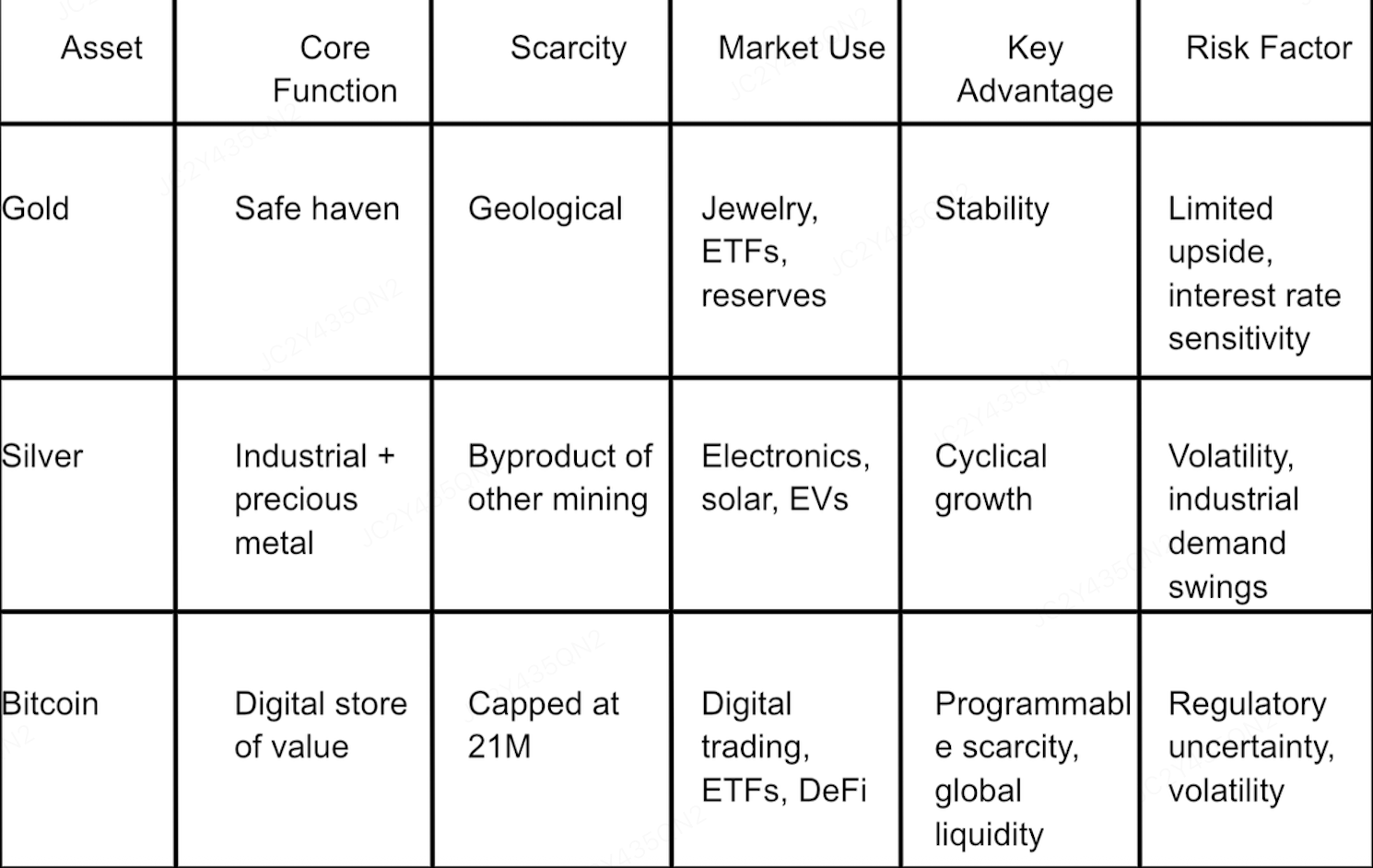
This framework highlights how each asset serves different investor needs: gold anchors portfolios, silver amplifies gains during cycles, and Bitcoin captures long-term structural growth opportunities.
Impact of Gold, Silver, and Bitcoin on Investment Markets
Key Takeaways for Investors
-
Gold remains the anchor during crises and high uncertainty.
-
Silver provides amplified returns tied to industrial and cyclical trends.
-
Bitcoin offers structural growth opportunities in portfolios, benefiting from digital scarcity and institutional adoption.
Market Dynamics and Macro Trends in 2026
The interplay of macroeconomic forces, industrial demand, and investor sentiment is shaping the roles of gold, silver, and Bitcoin in modern portfolios. Each asset responds differently to factors such as inflation, interest rates, geopolitical risks, and technological adoption, which makes understanding these dynamics essential for strategic allocation.
Gold: The Defensive Hedge in Volatile Markets
Gold has long been regarded as a safe haven, and its performance in 2025 and early 2026 underscores this role.
-
Correlation with Equities: Historically, gold prices move inversely to stock markets during periods of economic stress. For instance, during the 2025 mid-year selloff in equities, gold surged as investors sought capital preservation.
-
Response to Inflation and Interest Rates: Gold tends to perform well when real yields are negative. As central banks globally grapple with debt exceeding $300 trillion, gold provides a hedge against currency debasement and rising inflation.
-
Institutional Influence: ETFs and sovereign reserves continue to support gold’s price, ensuring stability even in volatile environments.
In 2025, gold’s price reached over $4,500 per ounce, primarily driven by central bank purchases and investor risk-aversion strategies.
Silver: The Cyclical Amplifier
Silver’s performance is influenced by both macroeconomic trends and industrial demand cycles. Unlike gold, silver often acts as a high-beta asset within the precious metals space.
-
Industrial Linkage: Silver powers electronics, solar energy, and EV batteries, which make up more than 50% of annual consumption. As these industries grow, silver demand rises, creating amplified price movements.
-
Cyclical Nature: Silver benefits during periods of economic expansion. For example, in 2025, a surge in renewable energy projects contributed to multi-year highs for silver, highlighting its sensitivity to economic cycles.
-
Supply Constraints: As most silver is mined as a byproduct of other metals, supply is relatively inelastic. Shortages in 2025 intensified upward pressure, reinforcing its appeal to investors seeking growth during industrial booms.
While silver can outperform gold during favorable cycles, its volatility requires careful portfolio management to balance risk and reward.
Bitcoin: The High-Beta Growth Asset
Bitcoin operates in a fundamentally different way from metals. Its price dynamics are influenced by liquidity flows, regulatory developments, and market sentiment rather than physical supply constraints alone.
-
Institutional Adoption: Bitcoin ETFs, futures, and institutional holdings have grown exponentially, adding stability to its otherwise volatile nature. The integration into mainstream financial products signals broader acceptance.
-
Correlation with Risk Assets: Bitcoin often behaves as a risk-on asset, rallying when investor confidence and liquidity are high, and declining during tightening cycles. Unlike gold, Bitcoin does not inherently rise during crises.
-
Halving Events and Structural Demand: The 2024 halving reduced Bitcoin’s issuance rate, historically preceding significant price rallies. This structural feature creates a predictable scarcity-driven momentum for long-term investors.
By late 2025, cumulative returns for Bitcoin vastly outpaced gold and silver, despite periods of steep corrections, showcasing its potential as a high-reward component of diversified portfolios.
Gold, Silver & Bitcoin: 2026 Investment Advantages Comparison
Why Gold, Silver, and Bitcoin Dominate 2026 Portfolios
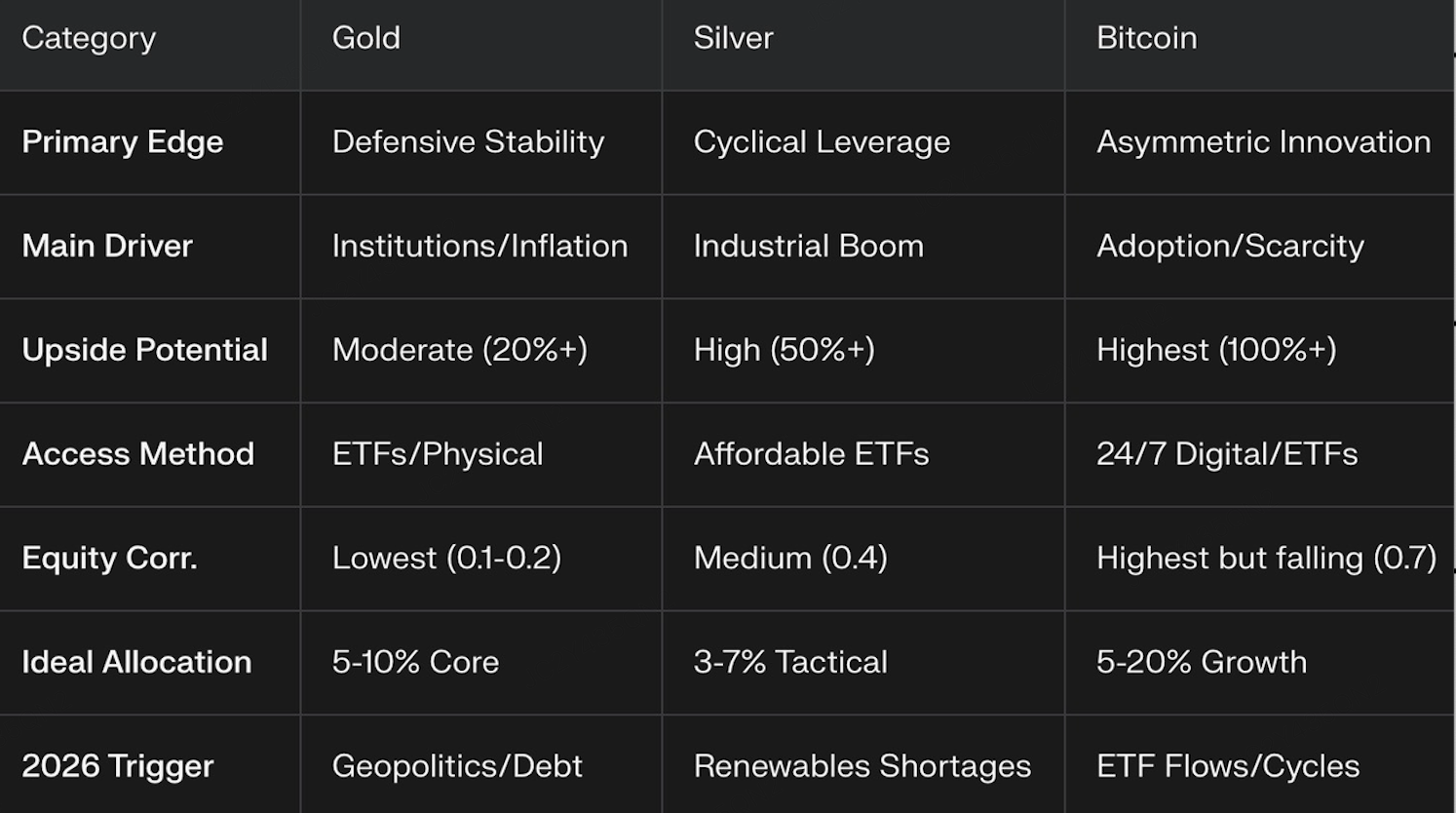
In 2026, gold, silver, and Bitcoin offer complementary investment advantages for navigating inflation, volatility, and growth opportunities: gold provides unmatched stability as the ultimate safe-haven with low equity correlation (0.1-0.2), central bank backing (36,000+ tons held), and proven inflation protection amid $300T+ global debt; silver delivers cyclical leverage through 50%+ industrial demand in solar panels, EVs, and electronics, achieving 1.5-2x gold’s returns during 2025’s +150% green tech boom fueled by 215M oz supply deficits; Bitcoin captures asymmetric digital growth via its 21M scarcity cap, $50B+ ETF inflows, and halving-driven cycles that historically yield 4-5x rallies despite high-beta risk (0.7 equity correlation). A balanced gold silver Bitcoin portfolio strategy allocating 5-10% gold defensively, 3-7% silver tactically, and 5-20% Bitcoin for upside optimizes returns across risk-off crashes, industrial expansions, and liquidity surges, historically outperforming traditional 60/40 allocations by 5-8% annually.
Quick Comparison for Investors
Challenges and Considerations for Gold, Silver, and Bitcoin
Gold, silver, and Bitcoin each offer unique advantages, but investors must understand their distinct risks to make informed portfolio decisions in 2026 and beyond.
Gold is a safe-haven asset, yet its near-term upside may be limited due to already-elevated prices, interest rate sensitivity, and currency exposure. Gold is best used as a portfolio anchor, ideally combined with yield-generating instruments to balance returns.
Silver serves both industrial and monetary roles, making it subject to cyclical volatility, leveraged futures risks, and dependency on sectors like renewable energy, electronics, and electric vehicles. Tactical allocation allows investors to capture industrial growth while managing volatility.
Bitcoin offers high potential rewards but faces regulatory uncertainty, extreme price volatility, correlation with risk assets, and security or custody risks. Allocating a small, diversified portion and maintaining long-term holding strategies can help smooth out its swings.
Comparative Framework Roles in Future Investing
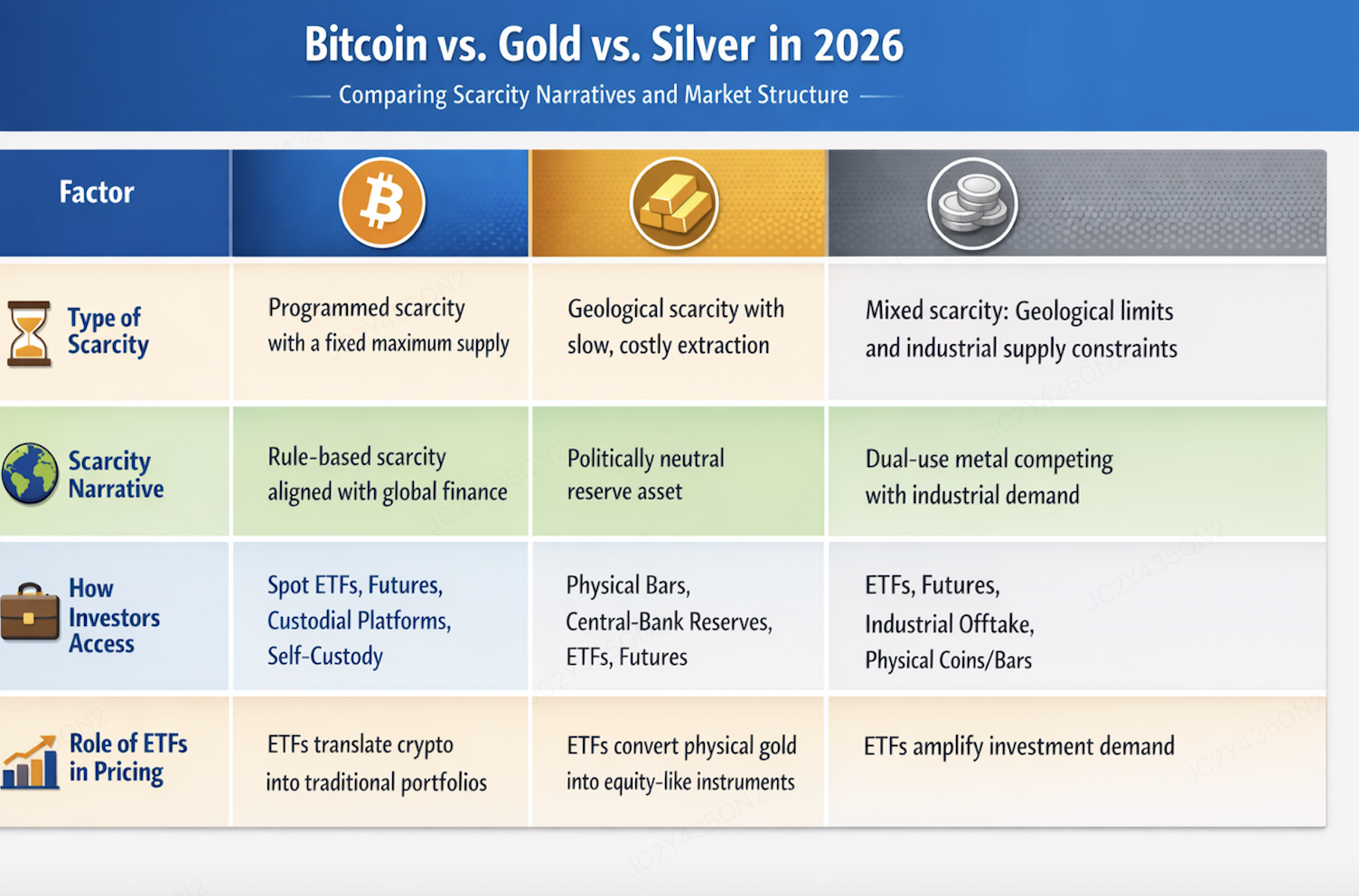
This table compares Bitcoin, gold, and silver in 2026, highlighting scarcity, narratives, access, and ETFs. Bitcoin has fixed, programmed scarcity and is accessible via digital platforms and ETFs. Gold’s geological scarcity makes it a neutral reserve asset, accessed through physical bars, ETFs, and central-bank holdings. Silver combines geological limits with industrial demand, available via ETFs, futures, and physical coins. The table shows how each asset’s scarcity and accessibility shape its role in future investing.
Strategic Insight for Risk Management
Investors can balance the risk-reward tradeoff by understanding the unique challenges of each asset:
-
Use gold for stability and crisis protection
-
Use silver for tactical exposure during cyclical growth
-
Use Bitcoin for long-term structural growth with controlled exposure
In 2026, effective portfolio construction requires blending defensive, cyclical, and high-growth assets to achieve resilience and maximize potential returns.
Conclusion
In 2026, investors face a transformative landscape where traditional and digital assets compete for prominence. Gold, silver, and Bitcoin each offer distinct paths to preserving and growing wealth. Gold continues to anchor portfolios with its stability and historical trust, making it the go-to hedge during economic uncertainty. Silver provides amplified growth potential, driven by industrial demand, renewable energy adoption, and cyclical economic trends. Bitcoin stands out as the digital innovation of the era, combining programmable scarcity, global liquidity, and increasing institutional adoption, positioning it as a potential long-term structural theme in modern investment strategies.
No single asset is universally superior. Instead, combining these three allows investors to balance defense, cyclical opportunity, and high-growth potential. By understanding the advantages, risks, and market dynamics of each, portfolios can be designed to weather volatility, hedge inflation, and participate in emerging trends, from green technology to digital finance. As global financial systems evolve, staying informed and strategically allocating across gold, silver, and Bitcoin will be key for investors seeking resilience and long-term growth in 2026 and beyond.
Ready to explore the digital asset frontier? On KuCoin, you can easily trade Bitcoin and other cryptocurrencies, track market trends, and access advanced tools to integrate digital assets into your portfolio. Whether you’re new to crypto or a seasoned investor, combining Bitcoin with traditional hedges like gold and silver can help you maximize growth potential while managing risk.
Start building your diversified portfolio today on KuCoin and position yourself for the future of investing.
FAQs
Can Bitcoin replace gold as a store of value?
Bitcoin offers digital scarcity and growing institutional adoption, but gold’s historical trust and central bank reserves suggest coexistence rather than replacement.
Why did gold outperform Bitcoin in 2025?
Gold benefited from central bank demand and market uncertainty, while Bitcoin experienced short-term volatility and liquidity-driven price swings.
Is silver a good hedge against inflation?
Silver can hedge inflation, especially during industrial growth cycles, but its dual role makes it more volatile than gold.
How do ETFs influence these assets?
ETFs increase liquidity and accessibility for both precious metals and Bitcoin, making it easier to include them in diversified portfolios.
What is the best timeframe for holding Bitcoin?
Due to its high volatility, Bitcoin is best held with a long-term strategy of 5+ years to ride out market cycles.
Can silver outperform gold?
Yes, particularly during periods of industrial expansion, when silver’s demand for electronics, solar energy, and EV batteries accelerates.
What are the main risks of Bitcoin?
Regulatory uncertainty, high volatility, and security risks are the key concerns. Using secure wallets and reputable exchanges like KuCoin can help mitigate these risks.
How should I allocate my portfolio across gold, silver, and Bitcoin?
A balanced approach could include gold for stability, silver for cyclical growth, and Bitcoin for long-term upside, tailored to your risk tolerance and investment horizon.
How can I safely invest in Bitcoin on KuCoin?
KuCoin provides secure wallets, advanced trading tools, and real-time market insights, allowing investors to trade Bitcoin confidently. Features like two-factor authentication, cold storage, and regulated ETFs make it easier to integrate digital assets into diversified portfolios, complementing traditional investments like gold and silver.
Disclaimer: The information provided on this page may originate from third-party sources and does not necessarily represent the views or opinions of KuCoin. This content is intended solely for general informational purposes and should not be considered as financial, investment, or professional advice. KuCoin does not guarantee the accuracy, completeness, or reliability of the information, and is not responsible for any errors, omissions, or outcomes resulting from its use. Investing in digital assets carries inherent risks. Please carefully evaluate your risk tolerance and financial situation before making any investment decisions. For further details, please consult our Terms of Use and Risk Disclosure