

Bitcoin Las Vegas 2026: An Industry Feast You Can't Miss
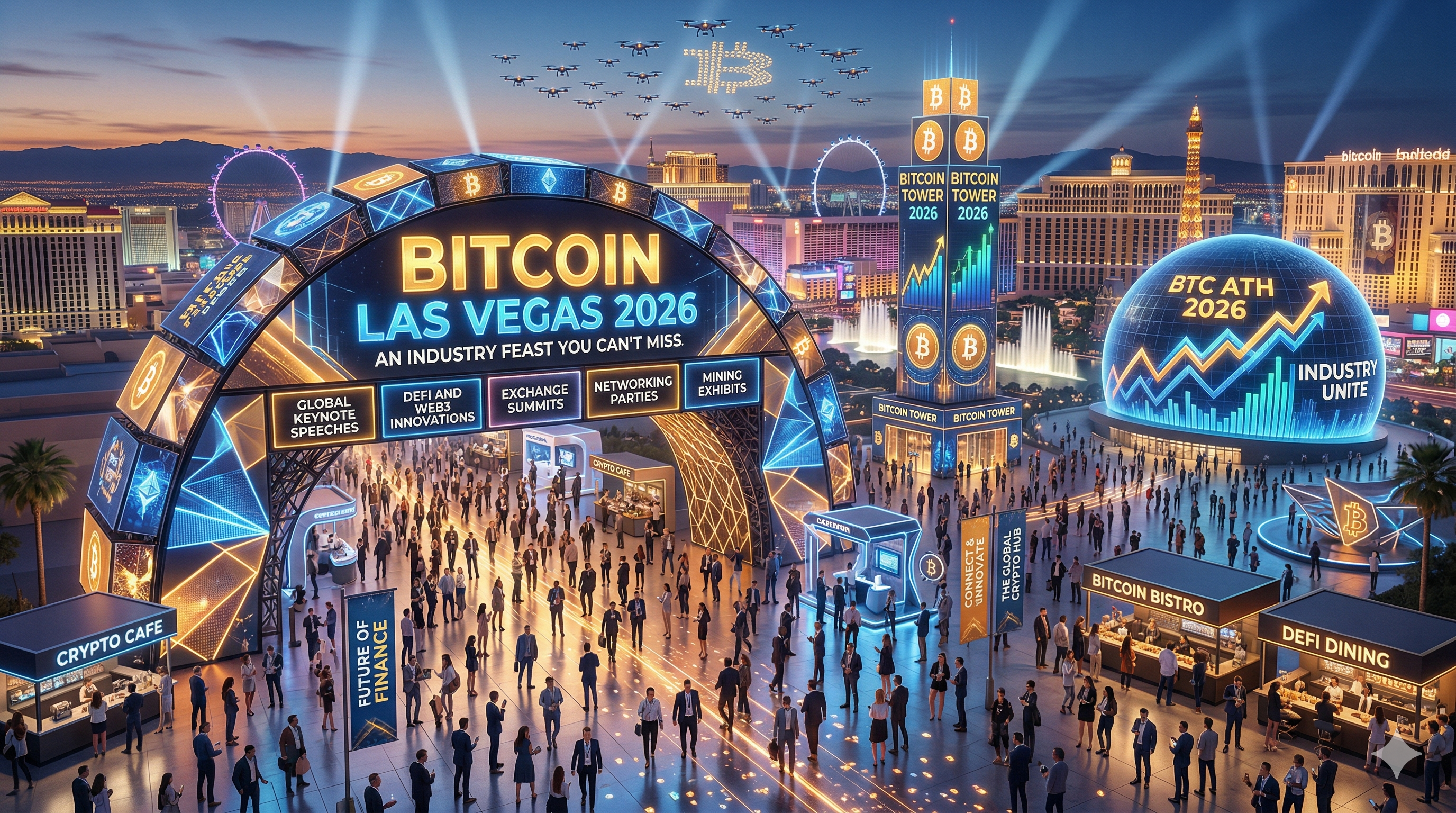
Bitcoin has moved far beyond its early identity as a niche digital asset. Today, it sits at the center of global conversations around finance, regulation, and digital ownership. With institutional capital flowing in and new technologies rising, the ecosystem is developing quickly.
Bitcoin Las Vegas 2026 comes at a time when the market is balancing growth with uncertainty. Institutional demand remains strong, but macroeconomic pressure and regulatory delays are shaping how the market behaves.
This article breaks down why the event matters, the key trends being discussed, and what traders, investors, and builders should pay attention to as Bitcoin continues to mature.
Why Bitcoin Conference 2026 Matters More Than Ever
The 2026 edition of the Bitcoin conference is happening at a critical moment in the market cycle.
Over the past two years, institutional adoption has accelerated through spot Bitcoin ETFs. According to data reported by CoinMarketCap, cumulative net inflows into U.S. Bitcoin ETFs have reached around $53 billion, far exceeding early expectations and marking one of the most successful ETF launches in history.
Even in 2026, the momentum continues. A single trading day recently saw $843 million in inflows, showing that institutional appetite remains active despite market volatility.
At the same time, the market is not in a straight uptrend. Bitcoin has experienced fluctuations between roughly $60,000 and $97,000, reflecting uncertainty driven by macroeconomic conditions and policy delays.
This is why the conference matters more than ever:
-
It reflects how Bitcoin is transitioning from speculation to structured finance
-
It provides insight into how institutions are positioning themselves
-
It acts as a signal for where the next phase of growth may come from
For many participants, the event is less about hype and more about understanding direction.
Key Themes Shaping the Future of Bitcoin
Several major themes are expected to dominate discussions at Bitcoin Las Vegas 2026.
1. Institutional Capital and ETF Dominance
Institutional flows are now one of the biggest drivers of Bitcoin’s price. In fact, ETF-related demand is estimated to be up to 12 times larger than daily mining supply, showing how much influence these products now have.
Recent data also shows a $1.56 billion monthly inflow into Bitcoin ETFs in early 2026, signaling renewed demand after a period of outflows.
2. Market Structure Is Changing
Unlike previous cycles driven mostly by retail traders, the current market includes long-term institutional holders. This shift has led to:
-
More stable holding patterns
-
Slower but more sustained price movements
-
Reduced dependence on short-term hype
Analysts have even suggested Bitcoin may be moving away from its traditional four-year cycle due to institutional participation.
3. Macro Conditions Still Matter
Bitcoin is now closely tied to global financial conditions. Interest rates, inflation, and liquidity directly impact market sentiment.
Recent analysis shows Bitcoin trading in a wide range partly due to:
-
High interest rates
-
Strong U.S. dollar
-
Global economic uncertainty
4. Expanding Use Cases
Bitcoin is gradually moving beyond the “digital gold” narrative. New use cases are emerging, including:
-
Payment systems
-
Layer-2 scaling solutions
-
Early-stage Bitcoin-native DeFi
These developments are expected to be a major focus at the conference.
Spotlight on Breakthrough Technologies and Builders
Innovation remains a core pillar of the Bitcoin ecosystem, and 2026 is seeing a shift toward building rather than speculation.
One of the most discussed concepts is BitVM, which aims to enable more advanced computation on Bitcoin without changing its base layer. This could open the door to more complex applications while preserving security.
There is also growing interest in zero-knowledge technologies and how they can integrate with Bitcoin. Solutions inspired by ecosystems like Starknet are being explored to improve scalability and privacy.
At the same time, Bitcoin-native DeFi is gaining traction. While still early, developers are experimenting with:
-
Lending protocols
-
Liquidity layers
-
Yield mechanisms built around BTC
This shift shows that Bitcoin is no longer just a store of value, it is slowly becoming a platform for broader financial activity.
Market Insights: What Traders and Investors Should Watch
Bitcoin conferences often influence market sentiment, both in the short and long term.
In the current cycle, traders are watching institutional behavior closely. For example:
-
ETF inflows have become a key signal of demand
-
Large holders (whales) are accumulating again, often indicating potential stabilization
However, the market is still mixed. Some analysts expect consolidation, with Bitcoin possibly ranging between $65,000 and $75,000 during periods of reduced momentum.
Others see long-term upside, with projections around $150,000 depending on macro conditions and continued adoption.
For traders, the key signals from the conference include:
-
Institutional sentiment shifts
-
Announcements from major financial players
-
Technological developments that could drive adoption
Understanding these factors can help traders avoid reacting purely to hype.
Networking Opportunities with Industry Leaders
Bitcoin Las Vegas is not just about panels and presentations, it is also a major networking hub.
The event brings together:
-
Developers building core infrastructure
-
Founders launching new projects
-
Institutional investors allocating capital
-
Policymakers shaping regulation
These interactions often lead to:
-
Partnerships
-
Funding opportunities
-
New product launches
In many cases, the most important discussions happen outside the main stage. For builders and investors alike, these connections can shape long-term strategies.
The Role of Exchanges: How KuCoin Supports the Bitcoin Ecosystem
Crypto exchanges remain a critical part of the Bitcoin ecosystem, providing access, liquidity, and tools for users worldwide.
Platforms like KuCoin allow users to interact with Bitcoin in multiple ways:
-
Spot Trading for direct exposure
-
Futures Trading for advanced strategies
-
Copy Trading for beginners
-
Earning products for passive income
As the market grows, exchanges are also adapting. They now focus more on:
-
Security and asset protection
-
User education
-
Expanding access to new financial tools
In an environment where institutional and retail participation is growing, exchanges help bridge the gap between innovation and accessibility.
Regulation continues to shape the future of Bitcoin.
One key issue in 2026 is the delay of major legislation in the United States. Reports indicate that stalled regulatory frameworks are already impacting market expectations and institutional momentum.
Despite these challenges, there is progress:
-
Governments are working toward clearer crypto frameworks
-
Discussions around compliance and taxation are becoming more structured
-
Institutions are more willing to participate when rules are defined
At Bitcoin Las Vegas, policymakers and industry leaders are expected to discuss:
-
The balance between innovation and regulation
-
The future of ETF products
-
Global coordination on crypto policies
These conversations will likely shape how the industry evolves over the next few years.
Why Las Vegas Is the Perfect Backdrop for Bitcoin Innovation
Las Vegas has become one of the leading destinations for large-scale tech and crypto events.
The city offers:
-
World-class infrastructure for global conferences
-
Easy accessibility for international participants
-
A fast-paced environment that matches the crypto industry
Beyond logistics, the atmosphere plays a role. The energy of Las Vegas aligns with the experimental and forward-looking nature of Bitcoin.
It creates a setting where ideas, capital, and innovation can come together in a way that few other locations can match.
Bitcoin Mining, Energy Trends, and Sustainability in 2026
Bitcoin mining has become one of the most discussed topics in recent years, especially as global attention on energy use continues to grow.
In 2026, the narrative around mining is shifting. Instead of being seen purely as energy-intensive, Bitcoin mining is increasingly being integrated into broader energy systems. According to data tracked by platforms like Cambridge Centre for Alternative Finance, a growing share of Bitcoin mining is now powered by renewable energy sources, with estimates often ranging between 50% to over 60% depending on methodology.
This shift is being driven by economic incentives rather than regulation alone. Renewable energy, especially excess or stranded energy, is often cheaper. Mining companies are now setting up operations in regions where:
-
Hydroelectric power is abundant
-
Solar and wind energy produce excess supply
-
Energy would otherwise go unused
Another emerging trend is the use of flare gas from oil production. Instead of wasting this energy, companies are redirecting it into Bitcoin mining operations, turning an environmental liability into an economic asset.
However, challenges still exist. Critics continue to question:
-
Total energy consumption
-
Carbon footprint transparency
-
Regulatory oversight in different jurisdictions
At Bitcoin Las Vegas 2026, mining is expected to be a key discussion point, not just from a technical standpoint, but from an environmental and economic perspective.
Panels are likely to focus on:
-
Sustainable mining practices
-
Energy grid integration
-
The role of mining in stabilizing power systems
This shift in narrative is important. Mining is no longer just a backend process—it is becoming part of the broader global energy conversation.
The Rise of Bitcoin Culture, Media, and Community Influence
Beyond technology and finance, Bitcoin has developed something many other assets lack, a strong global culture.
Over the years, Bitcoin has grown into a movement supported by developers, investors, creators, and everyday users. This cultural layer plays a significant role in shaping sentiment, adoption, and long-term belief in the asset.
Events like Bitcoin Las Vegas are not just industry conferences, they are also cultural gatherings. Attendees include:
-
Developers building on the protocol
-
Influencers and content creators
-
Long-term holders (often referred to as “Bitcoiners”)
-
New entrants trying to understand the ecosystem
Social platforms such as X and Reddit have become central hubs for Bitcoin discussions. Market sentiment, narratives, and even short-term price reactions are often influenced by conversations happening in these spaces.
This community-driven dynamic creates both opportunities and risks.
Positive Impact
-
Faster spread of information
-
Strong grassroots adoption
-
Increased awareness globally
Risks
-
Misinformation and hype cycles
-
Emotional trading behavior
-
Overreaction to short-term news
Analysts have noted that during major events, online engagement around Bitcoin spikes significantly. This increase in attention can lead to:
-
Higher trading volume
-
Increased volatility
-
Rapid narrative shifts
At Bitcoin Las Vegas 2026, the cultural aspect is expected to be more visible than ever. From side events to live discussions, the conference reflects not just where Bitcoin is technically, but how people feel about it.
This matters because markets are not driven by data alone. They are also driven by belief, sentiment, and collective behavior.
The Future of Digital Assets
Recent data from CoinGecko shows that the total crypto market has remained structurally strong, even after volatility, with market capitalization reaching around $3 trillion by the end of 2025, while trading activity stayed high at over $160 billion in daily volume. At the same time, stablecoins, often seen as the bridge between traditional finance and crypto, grew significantly, hitting a record $311 billion market cap, reflecting increasing use in payments and financial settlements.
Industry outlooks for 2026 suggest the market is moving away from speculation toward real utility and institutional integration, with Bitcoin, stablecoins, and tokenized assets playing a central role in global finance. As regulatory frameworks continue to develop and traditional institutions deepen their involvement, digital assets are likely to become a permanent layer within the global financial system, complementing, rather than replacing, existing financial infrastructure.
Conclusion
Bitcoin Las Vegas 2026 comes at a time when the market is evolving into a more mature and complex system.
Institutional flows, technological innovation, and regulatory developments are all shaping the next phase of Bitcoin’s growth. The conference brings these elements together, offering a clear view of where the industry is heading.
For traders, investors, and builders, the value lies not just in attending, but in understanding the signals that come out of it.
As always, market participants should approach opportunities with caution, conduct proper research, and stay informed as the ecosystem continues to develop.
FAQ: Frequently Asked Questions
1. What is Bitcoin Las Vegas 2026?
It is a global Bitcoin-focused conference where industry leaders discuss trends, technology, and market developments.
2. Why is the event important for investors?
It provides insights into institutional behavior, market trends, and future developments.
3. What role do ETFs play in Bitcoin today?
ETFs are now a major driver of demand, with billions of dollars flowing into Bitcoin through regulated investment products.
4. Can conference announcements affect Bitcoin’s price?
Yes, major announcements and sentiment shifts can influence short-term and long-term market trends.
5. Is Bitcoin still growing in 2026?
Yes, despite volatility, institutional adoption and technological innovation continue to support long-term growth.
6. What are the biggest risks in the current market?
Regulatory uncertainty, macroeconomic pressure, and fluctuating institutional demand.
7. How can beginners participate in Bitcoin markets?
Through crypto exchanges that offer spot trading, educational tools, and user-friendly features like KuCoin.
8. Should investors rely on conference insights alone?
No, investors should always combine multiple sources of information and conduct independent research.