

Ethereum vs. Ethereum Classic: The Origins of the Fork and ETC's Fixed Supply Model
Key Takeaways
-
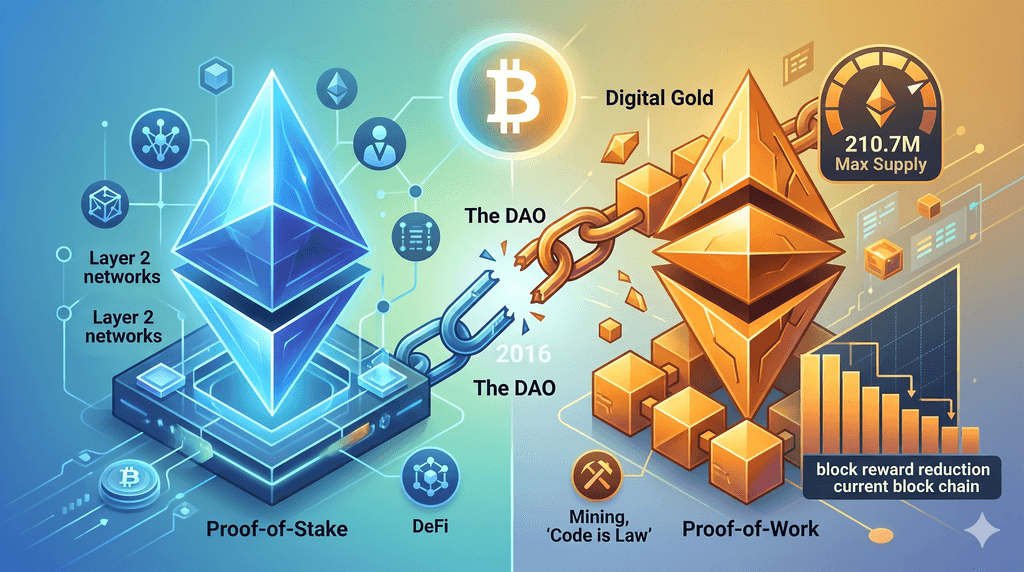
ETH and ETC were once the same chain, sharing identical history until block 1,920,000 on July 20, 2016 — when a controversial hard fork split the community forever.
-
The divide is philosophical. Ethereum rewrote its history to recover stolen funds; Ethereum Classic refused, upholding "Code is Law" and the absolute immutability of blockchain transactions.
-
ETC has a hard cap of 210,700,000 coins — a Bitcoin-inspired monetary policy locked into the protocol since December 2017. ETH has no fixed supply limit.
-
ETH is Proof of Stake; ETC remains Proof of Work. After Ethereum's 2022 Merge, ETC absorbed millions of displaced miners and became the world's largest PoW smart contract platform, with hashrate surging from ~24 TH/s to 150+ TH/s.
-
The Olympia Upgrade is ETC's biggest catalyst of 2026, targeting mainnet activation by year-end — introducing EIP-1559 fee mechanics, an on-chain treasury, and DAO governance without altering ETC's fixed monetary policy.
-
ETC currently trades at ~$8.37 with a ~$1.31 billion market cap (ranked #50), while ETH continues to dominate the global smart contract ecosystem.
Cryptocurrency is full of ideological battles. Few have been as formative — or as lasting — as the split that produced two separate blockchains from a single origin: Ethereum (ETH) and Ethereum Classic (ETC).
The split was triggered by a catastrophic 2016 hack, resolved through an extraordinary decision to rewrite the blockchain's own history, and memorialized in two competing visions of what a decentralized network should be. A decade on, Ethereum powers the vast majority of global DeFi, NFTs, and Web3 infrastructure. Ethereum Classic has carved a distinct niche as the world's largest Proof-of-Work smart contract platform — one with a hard-capped supply, a "Code is Law" philosophy, and a community that insists it, not ETH, is the true continuation of the original chain.
This article covers the origins of the fork, the philosophy dividing them, how ETC's fixed supply model actually works, where both chains stand in April 2026, and what the landmark Olympia Upgrade means for ETC's future.
The DAO Hack: The Event That Split Ethereum in Two
In April 2016, Slock.it launched a decentralized autonomous organization called "The DAO" through a crowdsale on Ethereum, raising over $150 million worth of ether — one of the largest crowdfunding campaigns in crypto history. At its peak, The DAO controlled approximately 14% of all ETH in circulation.
On June 17, 2016, an attacker exploited a reentrancy vulnerability in The DAO's smart contract code. The bug allowed a function to call back into itself before the first execution completed, draining funds in a recursive loop. The attacker didn't "hack" Ethereum's network in any traditional sense — they used the code exactly as written. Approximately 3.6 million ETH, worth around $50 million, was siphoned into a child DAO controlled by the attacker.
The Ethereum community faced an unprecedented choice. The theft was technically a legitimate execution of the smart contract. But $50 million had been taken from thousands of investors. After weeks of debate, the Ethereum Foundation proposed a hard fork: a deliberate change to blockchain rules that would retroactively nullify the attacker's transactions and return the stolen funds. Of the 5.5% of ether supply that voted, roughly 80% supported the fork. On July 20, 2016, at block 1,920,000, the fork executed.
Two chains now existed. The forked chain kept the Ethereum name and ETH ticker, backed by the Foundation and the majority. The original unaltered chain — which still recorded the DAO hack in its ledger — became Ethereum Classic, listed under ETC by Poloniex on July 24, 2016.
Code is Law vs. Social Consensus: The Philosophical Divide
The split wasn't just about recovering stolen money. It was a rupture along a deep philosophical fault line that continues to define both networks today.
Ethereum Classic's core principle: "Code is Law." In a decentralized network, the outcome of a smart contract execution must be treated as final and binding. The code is the contract. The blockchain is the judge. No external authority — no foundation, no committee, however well-intentioned — should override a transaction executed according to the protocol's own rules.
ETC proponents argue the hard fork enabled exactly what blockchain technology exists to prevent: subjective human manipulation of a trustless ledger. The attacker followed Ethereum's rules perfectly. By reversing that outcome, the Ethereum Foundation set a dangerous precedent — that social consensus can override immutability in extreme cases. For ETC supporters, that precedent is an existential threat, not a feature.
Ethereum embraced the opposite view: "Social Consensus" can and should correct clearly unjust outcomes. The network is built by humans, for humans, and should serve human interests. If the community agrees an outcome was wrong, the technology should accommodate that judgment.
This divide still shapes everything today. Ethereum demonstrated its Social Consensus philosophy most dramatically with the September 2022 Merge — a historic transition from Proof of Work to Proof of Stake executed through community coordination. Ethereum Classic has never wavered from PoW consensus, strict immutability, and zero-intervention principles across its entire history.
ETC's Fixed Supply Model: Bitcoin-Inspired Digital Scarcity
One of the most important — and most underappreciated — differences between ETH and ETC is monetary policy. On this front, ETC deliberately looks far more like Bitcoin than Ethereum.
On December 11, 2017, ETC's total supply was hard-capped at 210,700,000 coins via the Gotham hard fork (ECIP-1017). This added a Bitcoin-inspired deflationary emission schedule called "5M20": block rewards reduce by 20% every 5,000,000 blocks, approximately every 2.5 years. Each reduction is called a "fifthening" — ETC's analog to Bitcoin's halving. The next fifthening is scheduled for mid-2026, cutting block rewards again and further compressing new supply issuance.
As of April 2026, approximately 156.3 million ETC are in circulation, leaving roughly 54 million coins still to be mined — a slow, predictable, protocol-enforced process.
Ethereum has no fixed supply cap. Its issuance rate varies with staking activity and has been modified multiple times through governance — most notably via EIP-1559 (which burns a portion of transaction fees) and the transition to PoS. The fundamental difference is structural: ETH's monetary policy is adjustable by community consensus, while ETC's is immutable by design.
This makes ETC's scarcity a protocol guarantee rather than a policy choice. No vote can change it. ETC proponents call this "sound money" — the cost to produce each coin reflects real computational work, the supply trajectory is predictable decades in advance, and no authority can alter it retroactively. It is often described as "the philosophy of Bitcoin with the technology of Ethereum."
Where Both Chains Stand in April 2026
Nine years after the fork, the gap between ETH and ETC in ecosystem size and market dominance is vast — but the context around ETC has shifted in ways that matter.
Ethereum remains the undisputed center of the smart contract universe: the second-largest cryptocurrency globally, hosting the majority of DeFi activity, stablecoins, NFTs, and Layer 2 solutions. ETH staking yields approximately 3–5% APY through Proof of Stake, and the network's total value locked across DeFi protocols runs into the billions. For developers and users who prioritize ecosystem depth and application diversity, ETH is the clear default.
Ethereum Classic trades at approximately $8.37 as of April 20, 2026, with a market cap of ~$1.31 billion and roughly $50–56 million in daily trading volume, ranked around #50 globally. These numbers tell part of the story accurately: ETC operates in a clearly different weight class.
But ETC's security transformation since 2022 is real and significant. Between 2019 and 2020, ETC suffered multiple 51% attacks, costing exchanges millions in double-spend losses. Those attacks were possible because ETC shared Ethereum's Ethash mining algorithm but had only a fraction of its hashrate — making network domination cheap to rent on services like NiceHash.
Two developments changed the picture dramatically. First, MESS (Modified Exponential Subjective Scoring) was deployed in October 2020, penalizing large block reorganizations. Second — and far more impactful — when Ethereum's 2022 Merge stranded an enormous GPU mining fleet overnight, many of those displaced miners migrated to ETC. Hashrate exploded from ~24 TH/s to 150+ TH/s, a more than six-fold increase, making 51% attacks orders of magnitude more expensive and impractical. In 2025, the ETChash hashrate surpassed 300 TH/s, and ETC now controls roughly 90–95% of all ETChash mining power. The security profile of 2020 simply does not describe the network of 2026.
The Olympia Upgrade: ETC's Biggest 2026 Catalyst
The single most important development in the Ethereum Classic ecosystem this year is the Olympia Upgrade — the most ambitious protocol change in ETC's history, targeting mainnet activation by end of 2026.
Olympia bundles four Ethereum Classic Improvement Proposals (ECIPs 1111–1114) into one coordinated initiative that addresses ETC's long-standing weakness: sustainable, decentralized development funding. Historically, ETC relied on off-chain donations, temporary teams, and ad hoc coordination — none providing reliable long-term support.
Olympia solves this through three interconnected components. EIP-1559 fee mechanics (ECIP-1111) introduce dynamic base fee pricing for predictability and improved EVM tooling compatibility. Critically, unlike on Ethereum where the base fee is burned, on ETC the entire base fee is redirected to the Olympia Treasury — miner tips and block rewards remain untouched. The Olympia Treasury (ECIP-1112) is a deterministic, immutable smart contract receiving all redirected fees — governance-isolated and inaccessible to any human signer except through the authorized governance path. The Olympia DAO (ECIP-1113) establishes on-chain governance via a modular Governor, Timelock, and Executor architecture, allowing permissionless community proposals and voting on Ethereum Classic Funding Proposals.
The design is backward-compatible: legacy transactions are unaffected, no new tokens are minted, and ETC's fixed monetary policy, PoW consensus, and block rewards remain completely unchanged. Olympia simply adds what ETC has always lacked — a sustainable, on-chain, community-controlled funding mechanism. Combined with the mid-2026 fifthening cutting new supply issuance, these two events represent the most significant supply/demand catalyst ETC has seen in years.
Trading ETH and ETC on KuCoin
The philosophical divide between Ethereum and Ethereum Classic isn't just a historical debate — it creates live, ongoing trading opportunities that active market participants are watching closely in 2026. And both assets are fully accessible on KuCoin, one of the world's most established exchanges with over 41 million users and $1.7 trillion in lifetime trading volume.
Here's what makes KuCoin particularly well-suited for traders tracking this story: you can approach ETH and ETC as complementary positions within a single account. On KuCoin's ETC/USDT Spot Market, you can build exposure ahead of the Olympia Upgrade and the mid-2026 fifthening — two fundamental catalysts converging in the same window. The ETCUSDTM Perpetual on KuCoin Futures opens up leveraged directional plays and hedging strategies for more advanced participants. For ETH, the ETHUSDTM perpetual carries daily volumes often exceeding $3 billion, with KuCoin's Futures Grid Bot available to automate buy/sell cycles within a defined price range — ideal for ETH's current consolidating behavior.
Beyond spot and futures, KuCoin supports margin trading (up to 10x) on both assets, DCA bots for systematic accumulation, and its 2026 Elite Trader Premier Program for copy trading — where you can follow verified lead traders who specialize in exactly this kind of macro-philosophical relative value strategy. KuCoin holds SOC 2 Type II and ISO 27001:2022 security certifications, providing the institutional-grade infrastructure to act on both assets' upcoming catalysts.
If the ETH vs. ETC debate has sharpened your view on where value sits in this two-chain universe — KuCoin is where that conviction becomes a position.
ETH vs. ETC at a Glance: 2026 Comparison
| Metric | Ethereum (ETH) | Ethereum Classic (ETC) |
| Origin | Post-DAO hard fork chain | Original unaltered chain |
| Philosophy | Social Consensus | Code is Law |
| Consensus | Proof of Stake | Proof of Work |
| Supply Cap | None (adjustable) | 210,700,000 (hard cap) |
| Emission Schedule | Variable (governance-adjustable) | 5M20 — 20% cut every ~2.5 years |
| Market Cap (Apr 2026) | Hundreds of billions (#2) | ~$1.31B (#50) |
| Hashrate | N/A (PoS) | 150+ TH/s (dominant ETChash) |
| 2026 Key Catalyst | L2 expansion, institutional staking | Olympia Upgrade + fifthening |
| Smart Contracts | Full EVM, massive ecosystem | Full EVM, smaller ecosystem |
Conclusion
Ethereum and Ethereum Classic represent something genuinely rare in technology: a community that divided not over features or funding, but over first principles. Should a blockchain be truly immutable? Or should human judgment be allowed to correct manifest injustice, even at the cost of that immutability?
ETH chose pragmatism and has thrived — building the world's most expansive smart contract ecosystem and executing one of the most significant technical upgrades in blockchain history. ETC chose principle and paid a real price in ecosystem size, but in 2026 stands as the world's largest PoW smart contract platform, with hardened security, a fixed-supply monetary model, and its most ambitious upgrade yet approaching.
The two chains are no longer competing for the same users. Ethereum is the infrastructure layer of the global decentralized economy. Ethereum Classic is a philosophical artifact — the blockchain that refused to blink — now quietly building the sustainability infrastructure it needs to survive the next decade.
FAQs
Which chain is the "real" original Ethereum?
Technically, ETC is the continuation of the original unaltered chain with history going back to Ethereum's 2015 launch. ETH followed the fork that altered that history. However, the Ethereum Foundation holds the "Ethereum" trademark and "ETH" ticker, which is why the legacy chain was renamed Ethereum Classic.
How does ETC's fixed supply model work?
ETC's supply was hard-capped at 210,700,000 coins via the Gotham hard fork in December 2017. Block rewards follow a "5M20" schedule — a 20% reduction every 5 million blocks (~2.5 years), called a "fifthening." As of April 2026, ~156.3 million ETC are in circulation. The cap is encoded in the protocol and cannot be changed by governance vote.
How did the Ethereum Merge affect ETC's security?
Dramatically. When Ethereum switched to Proof of Stake in September 2022, GPU miners lost their revenue and many migrated to ETC. Hashrate surged from ~24 TH/s to 150+ TH/s — a 6x+ increase — making 51% attacks far more expensive and impractical. ETC now controls ~90–95% of all ETChash mining power, a fundamentally different security profile from the vulnerable chain of 2019–2020.
What is the Olympia Upgrade?
Olympia is ETC's most significant planned protocol change, targeting mainnet by end of 2026. It introduces EIP-1559-style fee mechanics (with base fees funding an on-chain treasury instead of being burned), an immutable Olympia Treasury, and an Olympia DAO for decentralized governance of development funds — all without changing ETC's monetary policy, PoW consensus, or block rewards.
Can ETC be staked like ETH?
No. ETC is Proof of Work — new coins are created only through mining. ETH's Proof of Stake allows validators to earn ~3–5% APY by staking a minimum of 32 ETH. ETC's community views PoS as an inferior consensus design and has no plans to make the switch.
Disclaimer: This article is for informational purposes only and does not constitute financial or investment advice. Always conduct your own research before making investment decisions. Price data cited reflects conditions as of April 20, 2026.