

Telegram Launches No-Code AI Bot Builder: Managed Bots Explained
2026/04/28 14:03:02
Introduction
Telegram has transformed from a simple messaging app into a powerful ecosystem for communities, businesses, and developers. With over 900 million active users globally, the platform continues to push boundaries with innovative features. In April 2026, Telegram unveiled its no-code AI Bot Builder, marking a significant milestone in accessible automation technology. This new capability allows users to create sophisticated AI-powered bots without writing a single line of code, democratizing access to automation tools that were previously reserved for developers with technical expertise.
The introduction of managed bots represents Telegram's strategic move toward AI integration within its messaging ecosystem. Users can now configure intelligent assistants that handle customer inquiries, moderate communities, and provide 24/7 support through intuitive visual interfaces. This development comes at a time when businesses and communities increasingly demand automation solutions that are both powerful and easy to implement.
This article explains how Managed Bots work, what makes them different from traditional bot creation, and why they matter for anyone using Telegram for business, trading, or community building. For readers who want to know more background info, the below are the recommended articles:
-
Crypto Community Bots enable automated token alerts and group moderation;
-
and No-Code Bot Creation removes technical barriers for non-developers.
What Are Managed Bots and How Do They Work?
Managed Bots are a new architecture within Telegram's Bot API 9.6 that allows a single manager bot to spawn separate, isolated bot instances for individual users. Each instance is private, independent, and fully functional within Telegram's messaging environment.
The setup process is designed for zero friction. A developer creates a manager bot, enables management mode, and generates a shareable creation link. When a user clicks that link, Telegram provisions a new bot instance tied specifically to that user. The user does not need to register for an external service, configure hosting, or understand what an API token is. The entire deployment happens inside Telegram's existing infrastructure.
Each managed bot instance operates as its own entity. It can send and receive messages, update its profile information, and communicate with other bots. This enables multi-agent workflows where one bot handles customer inquiries, another monitors market data, and a third coordinates between them. The architecture is closer to spinning up a personal cloud service on demand than to using a shared public chatbot.
Privacy is built into the design. Because each user gets a separate instance, data is not pooled across users in the same way it would be with a single shared bot. The manager bot handles the underlying infrastructure, but the individual bot instances remain isolated. This matters for businesses handling sensitive customer data and for crypto traders who want their alert configurations and wallet monitoring to remain private.
The flagship example Telegram founder Pavel Durov highlighted is @teleclaw_bot, built on the OpenClaw framework. It demonstrates the practical range Managed Bots are designed to support: drafting and sending emails, managing calendar entries, generating business pitches, and fielding routine messages. These are tasks that productivity software has promised to automate for years but rarely delivered with this little setup friction.
The No-Code AI Bot Builder: Features and Capabilities
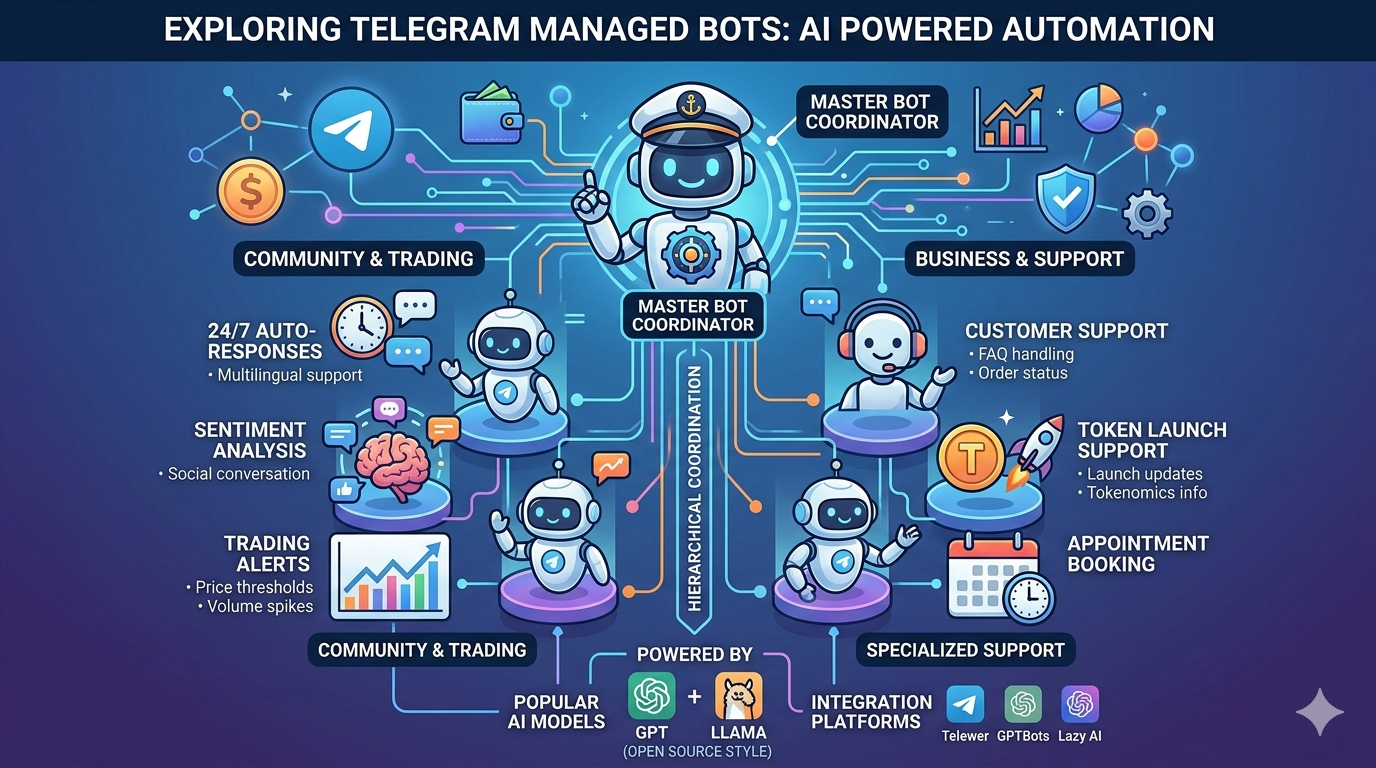
Telegram's no-code AI bot builder, integrated with Managed Bots, allows users to customize AI agents by selecting options rather than writing code. The system supports multiple AI models including GPT and Llama, and it integrates with third-party platforms such as Telewer, GPTBots, and Lazy AI.
Users obtain a token by interacting with the LobsterFather bot, then connect it to their preferred AI platform. From there, they configure the bot's conversation style, task distribution rules, and multi-bot collaboration settings through a point-and-click interface. The builder supports configuring auto-replies, community management workflows, and customer inquiry handling without any programming knowledge.
The integration with Telegram Business is particularly significant. Businesses can deploy AI-powered support agents that autonomously reply to messages, welcome new members 24/7, filter spam, and answer frequently asked questions. For small teams and independent operators who use Telegram as their primary customer communication channel, this removes the need to be manually present and responsive at all times, or to integrate external chatbot services that require their own API setup and ongoing maintenance.
Multi-bot collaboration is another key feature. Users can create Master Bots that manage and assign tasks to sub-bots. This is useful for handling multiple chat groups, coordinating complex workflows, or managing different aspects of a business from a single control point. A Master Bot might oversee customer support sub-bots for different product lines, or manage trading alert sub-bots monitoring different cryptocurrency pairs.
The crypto use case deserves particular attention. Telegram has been the default communication layer for crypto communities for years, hosting project channels, trading groups, and protocol governance discussions at a scale no other messaging platform approaches. Managed Bots land into an ecosystem that already has millions of users who want automated market alerts, wallet activity notifications, liquidity event warnings, and community moderation tools. Previously those tools required either hiring a developer or using third-party services with their own pricing and reliability considerations. Now they can be built directly inside Telegram by the community members who need them.
How Managed Bots Differ from Traditional Bot Creation
Traditional Telegram bot creation required technical expertise at every stage. A developer needed to register a bot with @BotFather, obtain an API token, write code to handle message parsing and response logic, deploy that code to a server, and maintain the infrastructure to keep the bot running. The process typically took hours or days, and it created a hard barrier that kept bot development in the hands of developers and technical teams.
Managed Bots collapse that barrier entirely. The technical complexity is abstracted away behind a shareable link. Users click, confirm, and receive a working AI agent. The setup is measured in seconds rather than hours. The manager bot handles the underlying infrastructure, token management, and deployment logic. The end user sees none of it.
The architectural difference is also significant. Traditional bots are typically single, shared instances. Every user interacts with the same bot, and the bot's developer must build user isolation and data separation into their code. Managed Bots provision separate, isolated instances for each user automatically. This is not a configuration option. It is the default behavior. Privacy and isolation are baked into the design rather than being the developer's responsibility to implement.
For developers who have been building Telegram bots professionally, Managed Bots change the competitive landscape for simple use cases while opening new opportunities at the higher end. Commodity bot functionality, the standard alert systems and basic chat agents, will increasingly be self-served by end users. Complex, deeply integrated, high-reliability bot infrastructure for enterprise or high-volume crypto applications remains a specialist offering. The no-code layer handles the simple end of the market and generates demand awareness for the sophisticated end.
The cost structure also shifts. Traditional bot development required server hosting, domain management, and ongoing maintenance time. Managed Bots leverage Telegram's existing infrastructure, removing the server cost and maintenance burden from the individual user or small business. The main cost becomes the AI model usage, which is handled through the integrated platforms.
Practical Use Cases for Managed Bots
Managed Bots are already demonstrating practical value across several domains. The range of applications is expanding as developers and users explore what is possible with zero-friction AI agent deployment.
Customer Support Automation. Small businesses using Telegram for customer communication can deploy AI-powered support agents that handle routine inquiries, provide product information, and escalate complex issues to human staff. The bot operates 24/7 within the same environment where customer conversations already happen.
Community Management. Telegram group administrators can use Managed Bots to welcome new members automatically, filter spam, enforce community rules, and answer frequently asked questions. This reduces the manual workload on moderators and improves the experience for community members.
Crypto Trading Alerts. Individual traders and trading groups can create bots that monitor market conditions, track wallet activity, and send alerts for price movements, liquidity events, or large transactions. The bot can be customized to monitor specific tokens or trading pairs relevant to the user's strategy.
Content Distribution. Media creators and newsletter operators can use Managed Bots to deliver content to subscribers, manage distribution lists, and handle subscription preferences through automated conversations.
Task Automation. Personal productivity bots can manage calendars, draft emails, generate reports, and coordinate with other bots to handle multi-step workflows. The OpenClaw framework demonstration shows this capability in action with @teleclaw_bot handling email drafting and calendar management.
Security Considerations and Risks
The convenience of Managed Bots comes with security considerations that users should understand before deploying AI agents that handle sensitive data.
Third-party platform integration is the primary risk factor. When users connect their Managed Bot to platforms like Telewer, GPTBots, or Lazy AI, their conversation data flows through those third-party services. Users should review the privacy policies and data handling practices of any platform they connect to their bot. Telegram's infrastructure provides the messaging layer, but the AI processing happens on the integrated platform's servers.
Token management is another consideration. The LobsterFather token system grants access to bot creation capabilities. Users should treat these tokens with the same care they would apply to API keys or passwords. Sharing tokens or using them on untrusted platforms could compromise bot security.
Data isolation within Managed Bots is strong at the instance level, each user gets their own bot, but users should still be cautious about what information they share with AI agents. AI models may process conversation data for training or improvement purposes depending on the platform's policies. Users handling sensitive financial, business, or personal information should verify the data retention and processing policies of their chosen AI platform.
The standard Telegram bot security practices still apply. Users should verify the authenticity of manager bots before clicking creation links, be cautious about granting excessive permissions, and monitor bot activity for unexpected behavior.
Should You Build a Managed Bot on Telegram?
If you use Telegram for business, trading, community management, or customer communication, Managed Bots offer a compelling value proposition that was not available even weeks ago. The ability to deploy a customized AI agent in seconds, without technical expertise or infrastructure costs, removes the primary barriers that kept automation tools out of reach for non-technical users.
For crypto communities and trading groups, the timing is particularly relevant. Telegram is already the central hub for Web3 communication. Managed Bots allow community managers, project founders, and individual traders to build the automated tools they need, customized to their specific requirements, without depending on external services or developer resources.
For small businesses, the integration with Telegram Business means customer support automation is now accessible without the complexity and cost of traditional chatbot platforms. An AI agent that handles routine inquiries, operates around the clock, and escalates complex issues appropriately is achievable with a few clicks rather than a development project.
The ecosystem is still early. New manager bots, AI platform integrations, and use case templates are appearing daily. Early adopters who experiment with Managed Bots now will be positioned to take advantage of more sophisticated capabilities as the ecosystem matures. The barrier to entry has never been lower, and the potential applications are expanding rapidly.
Conclusion
Telegram's Managed Bots represent a genuine inflection point for how AI agents are deployed and used at scale. By collapsing the technical barrier between wanting an AI bot and having one, Telegram has put automated agent capabilities into the hands of its one billion users. The Bot API 9.6 update is not merely a developer tool. It is a platform strategy that accelerates the density of useful automated tools within Telegram's ecosystem and makes the platform more valuable for tasks that might otherwise require leaving the app.
The architecture is what makes this significant. Isolated bot instances, shareable creation links, multi-bot collaboration, and integration with Telegram Business create a foundation that supports everything from simple auto-replies to complex multi-agent workflows. For crypto communities, this means automated trading alerts and community moderation tools built by the community members who need them. For businesses, it means customer support agents deployed without development teams. For individual users, it means personal AI assistants that handle real tasks with almost no setup friction.
The shift follows a logic that has worked well for other platforms that opened creation tools to non-technical users. Notion's template ecosystem, Shopify's app store, and Zapier's workflow builder all expanded their platform value by making previously technical capabilities accessible to users who knew what they wanted to build but not how to build it. Telegram is applying the same principle to AI agents at a moment when the appetite for automation tools is unusually high and the underlying AI models have reached a capability level that makes no-code outputs genuinely useful rather than superficial.
Managed Bots will not replace complex, custom-developed bot infrastructure for enterprise or high-volume applications. But they will handle the simple and medium-complexity use cases that previously required developer time, and they will generate awareness and demand for more sophisticated solutions. For anyone using Telegram as a business, trading, or community platform, the question is no longer whether you can afford to build a bot. It is what you will build first.
FAQs
What are Telegram Managed Bots?
Managed Bots are a feature in Telegram's Bot API 9.6 that allows users to create and deploy private, isolated AI bot instances through a simple shareable link, without writing any code.
Do I need programming skills to create a Managed Bot?
No. Managed Bots are designed for zero-code deployment. Users click a shareable creation link, and their personal AI bot instance is provisioned automatically.
What AI models do Telegram Managed Bots support?
Managed Bots support multiple AI models including GPT and Llama, integrated through third-party platforms such as Telewer, GPTBots, and Lazy AI.
Can Managed Bots handle crypto trading alerts and community moderation?
Yes. Managed Bots can be configured to monitor market data, send trading alerts, welcome new group members, filter spam, and answer frequently asked questions automatically.
Are Managed Bots secure for handling sensitive business data?
Managed Bots provide isolated instances for each user, but data flows through third-party AI platforms for processing. Users should review the privacy policies of integrated platforms and follow standard security practices for token management.