

NVIDIA Emerges as the Capital Allocator of the AI Era, Driving Industry Financialization
2026/07/28 11:00:00
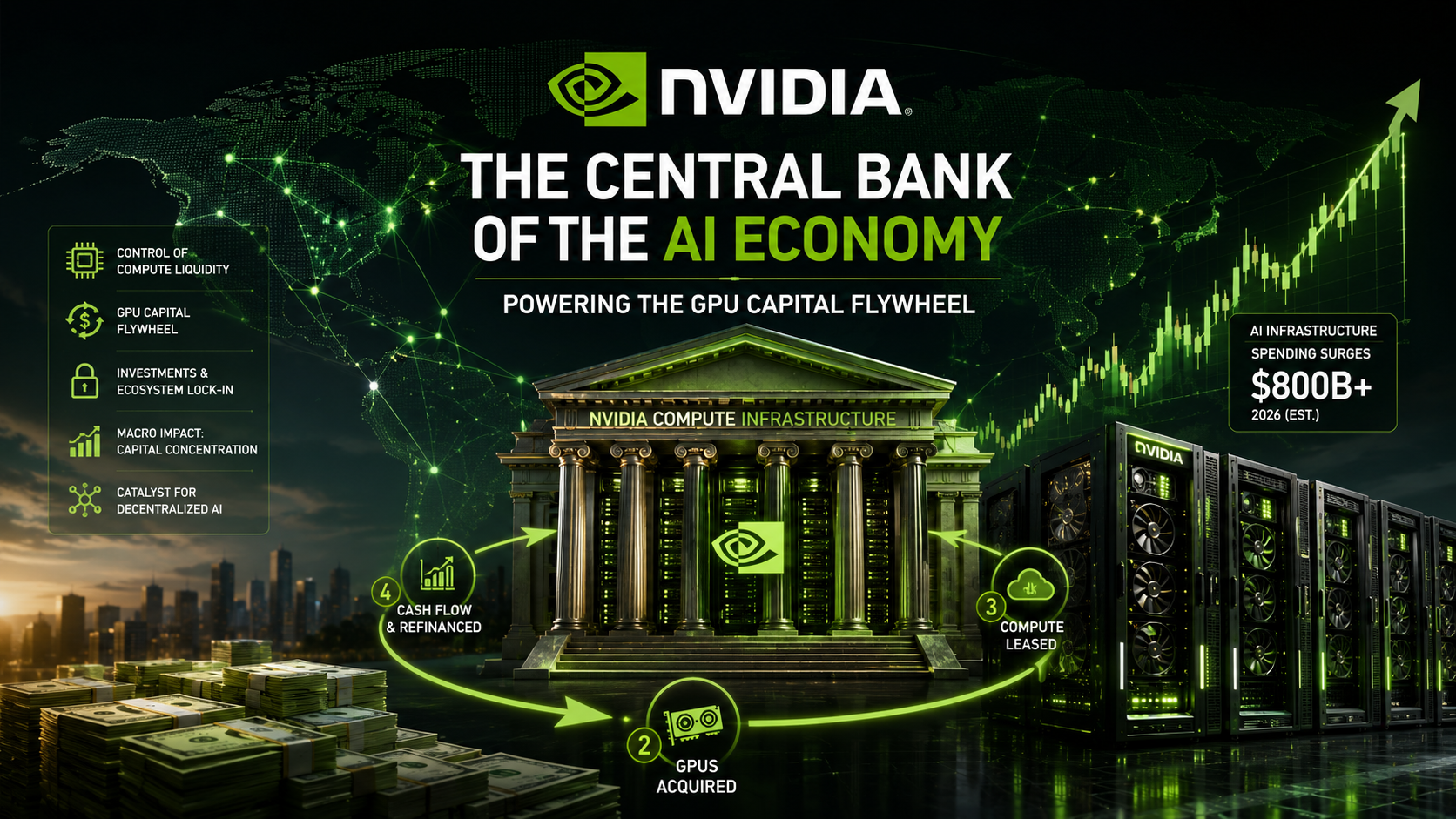
Key Takeaways
-
The AI Central Bank: NVIDIA controls global compute liquidity, using GPU allocation power to dictate market winners and influence tech corporate strategy worldwide.
-
The GPU Capital Flywheel: Hardware has evolved into yield-bearing collateral, enabling specialized cloud providers ("NeoClouds") to raise billions in debt backed directly by GPU fleets.
-
Circular Ecosystem Reinforcement: Strategic equity investments in foundational labs and supply chain partners lock in demand, enforce CUDA software dominance, and bypass rival chipmakers.
-
Macroeconomic Capital Concentration: Insatiable AI infrastructure spending is absorbing global liquidity, structurally elevating long-term corporate borrowing costs across non-AI sectors.
-
Catalyst for Decentralized AI: Centralized capital bottlenecks are driving rapid adoption of Web3 DePIN compute networks and AI tokens, available for trading on KuCoin.
NVIDIA has effectively transitioned from a semiconductor hardware vendor into the ultimate financial clearinghouse and central capital allocator of the artificial intelligence boom. By controlling the allocation of graphics processing units (GPUs)—the most critical physical currency in modern computing—NVIDIA dictates how hundreds of billions of dollars in global capital flow through technology, private credit, and data center infrastructure. According to market analysis published by KuCoin in July 2026, NVIDIA operates in a manner analogous to a sector-specific central bank, steering real-world compute liquidity, underpinning structured debt markets, and driving the comprehensive financialization of the AI ecosystem. This strategic pivot has transformed raw computing power from an operational expense into a financialized asset class, reshaping global capital markets and creating powerful ripple effects across decentralized computing networks, Web3 AI protocols, and digital asset markets worldwide.
How Is NVIDIA Operating as the Central Bank of the AI Economy?
NVIDIA functions as the central monetary authority of the artificial intelligence economy by controlling the issuance and distribution of compute capacity, which serves as the fundamental unit of value in modern tech infrastructure. Although NVIDIA cannot print fiat currency or set benchmark interest rates, its distribution decisions regarding high-performance GPUs govern which technology firms, cloud providers, and foundational model developers receive the physical resources necessary to generate revenue.
Based on industry research released in July 2026, aggregate capital expenditures across major technology hyperscalers—including Microsoft, Alphabet, Meta, and Amazon—are projected to surpass $690 billion for the fiscal year 2026, with calendar-year infrastructure spending approaching $800 billion. The vast majority of this capital flows directly toward securing NVIDIA silicon and surrounding data center architecture.
Because demand for advanced compute drastically exceeds global supply, allocation rights granted by NVIDIA act as an implicit credit rating for emerging technology companies. A startup or cloud provider securing an enterprise-level allocation of Blackwell or next-generation Hopper GPUs immediately gains access to private credit markets, venture equity, and sovereign wealth investment.
Furthermore, NVIDIA actively uses its financial strength to stabilize and manage this artificial economic ecosystem. According to financial regulatory filings from June 2026, NVIDIA initiated plans to issue at least $20 billion in investment-grade corporate bonds—its first major debt offering since the start of the AI boom—to optimize its capital structure, fund large-scale strategic investments, and secure long-term supply chain capacity for high-bandwidth memory (HBM) and advanced packaging.
By borrowing deeply from traditional debt capital markets while simultaneously extending financial backing to its supply chain partners and primary customers, NVIDIA regulates market liquidity, absorbs sector volatility, and ensures that capital continuously recirculates back into its proprietary hardware and software technology stack.
What Is the GPU Capital Flywheel and How Does It Drive Asset Securitization?
The GPU capital flywheel is a closed-loop financial structure wherein physical compute clusters are leveraged as yield-bearing collateral to secure debt, generate predictable rental revenues, and attract continuous capital refinancing. This operational structure transforms semiconductor hardware—historically classified as a fast-depreciating operational technology expenditure—into a standardized, yield-generating infrastructure asset class similar to commercial real estate or energy infrastructure.
Based on insights from financial market reports published in July 2026, specialized AI cloud providers (commonly referred to as "NeoClouds") have pioneered debt-financed expansions by using large-scale fleets of NVIDIA GPUs directly as loan collateral. Private credit funds and infrastructure syndicates issue multi-billion-dollar loans secured by the physical chips and their underlying cloud tenant contracts.
| Asset Feature | Traditional Tech Asset Model | Financialized GPU Infrastructure Model |
| Balance Sheet Classification | Depreciating operational equipment (CapEx) | Yield-generating infrastructure asset |
| Financing Structure | Funded through corporate cash reserves or equity | Debt-financed using GPU fleets as loan collateral |
| Revenue Stream | Internal operational productivity | Long-term compute leases and securitized cash flows |
| Capital Lifecycle | Purchased, used, and written off over 3–5 years | Refinanced, pooled, and structured into asset-backed credit |
| Market Liquidity Hub | Fragmented hardware vendors | NVIDIA-centric allocation and collateral ecosystem |
This capital flywheel operates through a distinct four-stage credit loop:
-
Capital Accumulation: NeoClouds and data center builders raise private debt and equity capital anchored by guaranteed access to NVIDIA hardware allocations.
-
Hardware Acquisition: Secured capital is immediately deployed to purchase high-end NVIDIA GPU clusters, enterprise networking equipment, and high-bandwidth memory setups.
-
Compute Leasing: Enterprise hardware is leased to artificial intelligence labs, sovereign entities, and enterprise developers under long-term compute contracts.
-
Refinancing and Securitization: The predictable cash flows generated by these leases are bundled, securitized, and presented back to debt markets to refinance existing loans and acquire additional GPU capacity.
This securitization process alters how institutional capital evaluates digital infrastructure. Financial institutions now structure complex debt instruments around GPU rental yields, enabling data center operators to raise external funding at unprecedented scale. Consequently, computing power has successfully evolved from a static hardware commodity into a fluid, highly financialized yield instrument that drives continuous capital expansion across the global tech sector.
How Do Circular Financing and Ecosystem Equity Deals Reinforce NVIDIA’s Market Power?
NVIDIA reinforces its dominant market power by deploying enterprise cash reserves into strategic equity investments across its customer base and supply chain, creating a self-sustaining circular financing loop. Instead of allowing record corporate profits to sit idle, NVIDIA systematically reinvests capital into foundational AI developers, specialized cloud networks, optical component makers, and next-generation energy suppliers.
According to financial analysis published in July 2026, NVIDIA’s strategic equity strategy directly drives customer demand while building structural barriers against competing hardware vendors like AMD and custom enterprise ASICs such as Google TPUs or Amazon Trainium. When NVIDIA takes an equity stake in a promising AI research lab or cloud operator, that capital is almost universally recycled back into purchasing NVIDIA compute hardware and licensing CUDA-based software environments.
This ecosystem investment strategy protects NVIDIA’s competitive moat across three distinct layers:
-
Hardening Software Lock-In
By directly investing in foundational artificial intelligence labs—such as OpenAI, Anthropic, and xAI—NVIDIA ensures that emerging flagship models are co-engineered on native CUDA architecture. When researchers write custom software code tailored to NVIDIA’s specific hardware design, those software routines become entrenched as global industry standards. Rival accelerator frameworks, such as AMD’s ROCm, face steep technical friction when attempting to execute code developed natively for CUDA environments.
-
Securing Upstream Supply Priority
NVIDIA deploys substantial balance sheet capital to co-fund capital expenditure expansions for its most critical manufacturing partners. By funding long-term production build-outs for high-bandwidth memory suppliers like SK Hynix and advanced packaging facilities operated by TSMC, NVIDIA secures priority access to scarce components. This financial positioning ensures that rival chip designers face chronic component shortfalls even if their standalone chip architectures demonstrate competitive performance metrics.
-
Neutralizing Hyperscaler In-House Chips
To counteract major cloud providers building proprietary in-house chips to lower operational spending, NVIDIA uses its investment arm to nurture independent NeoClouds and sovereign data initiatives. By providing debt guarantees, direct capital, and preferred hardware delivery schedules to independent cloud builders, NVIDIA builds an alternative distribution network that bypasses traditional hyperscaler gatekeepers entirely.
While critics caution that circular financial commitments can obscure true end-user demand signals, this strategy locks the broader software, hardware, and financial infrastructure of the artificial intelligence boom directly into NVIDIA’s corporate ecosystem.
What Macroeconomic and Liquidity Shifts Stem from the Financialization of AI Compute?
The financialization of artificial intelligence compute is driving structural shifts across global macroeconomic liquidity, credit distribution, and capital allocation. As artificial intelligence data centers evolve into one of the largest capital-absorbing sectors in economic history, the sheer scale of borrowing and equity issuance required to sustain compute infrastructure is influencing interest rate dynamics and corporate capital allocation worldwide.
Based on research published by the Bank for International Settlements (BIS) in July 2026, aggregate global investment in artificial intelligence infrastructure is on track to run into trillions of dollars over the coming years, with annual hyperscaler capital expenditures expected to exceed $700 billion. This intense absorption of capital impacts broader macroeconomic conditions in several pronounced ways:
-
Elevated Long-Term Financing Costs: The insatiable demand for credit to fund power grid expansions, data centers, fiber optic networks, and high-performance GPUs absorbs vast pools of institutional capital. Market research indicates that even if central banks adjust short-term benchmark rates downward, long-term corporate borrowing costs are likely to remain structurally elevated due to the intense competition for long-duration infrastructure capital.
-
Capital Crowding Out Non-AI Sectors: Because institutional investors, private credit funds, and sovereign wealth managers prioritize the guaranteed yields and rapid growth associated with AI compute assets, traditional non-AI corporate sectors face higher borrowing spreads and tighter lending standards. Capital is aggressively directed toward infrastructure backed by tangible compute assets over legacy industrial operations.
-
Shift to Short-Lived Capital Assets: Financial data released in July 2026 by FactSet highlights that hyperscaler capital allocation is shifting rapidly toward short-lived compute assets (GPUs, optical switches, and specialized servers), which are expected to account for roughly 60% of total tech capex in 2026, up from 43% in 2022. Because compute assets carry shorter depreciation cycles compared to traditional physical real estate, technology firms are required to refinance debt and re-invest capital at an accelerated pace, heightening market sensitivity to debt conditions.
This macroeconomic reordering establishes physical compute as a primary driver of modern industrial policy and institutional financial flows.
How Does Centralized AI Financialization Impact Decentralized AI Compute and Tokens?
The financialization and centralized capital control of physical AI compute by corporate behemoths have created a direct catalyst for decentralized physical infrastructure networks (DePIN) and Web3 AI protocols. As small-to-medium AI developers, academic researchers, and independent startups are priced out of centralized GPU cloud rentals due to high costs, corporate allocation controls, and strict credit requirements, decentralized compute marketplaces built on blockchain technology offer a transparent, open-access alternative.
According to market tracking data from KuCoin in July 2026, the aggregate market capitalization of AI crypto tokens has grown to over $25 billion, driven by surging enterprise and developer interest in permissionless compute access, decentralized machine learning networks, and open-source agent frameworks.
Decentralized networks directly address the vulnerabilities introduced by centralized capital allocation through several core mechanisms:
Permissionless GPU Aggregation
Decentralized physical infrastructure protocols aggregate underutilized consumer, enterprise, and secondary-market GPUs from around the globe into unified computing clusters. By creating peer-to-peer marketplaces, projects provide accessible compute capacity without requiring tenants to execute rigid multi-year enterprise contracts or pass restrictive corporate credit evaluations.
Incentive Alignment via Crypto Tokens
Instead of relying on traditional debt markets and complex securitization, Web3 protocols utilize native utility tokens to reward hardware providers, network validators, and AI model developers. This tokenized economic structure lowers entry barriers for hardware owners while enabling global investors to gain liquid exposure to the growing demand for compute capacity.
| Protocol / Token | Core Architecture | Primary AI Function | Ecosystem Value Driver |
| Bittensor (TAO) | Decentralized Subnet Protocol | Machine learning model competition & intelligence aggregation | Subnet performance and institutional network staking |
| Render Network (RENDER) | Distributed GPU Marketplace | High-performance 3D rendering and node-based AI compute | Direct compute rental demand and network job execution |
| Artificial Superintelligence Alliance (FET) | Autonomous Agent Framework | Multi-agent coordination and decentralized workflow automation | Agent service transactions and platform deployment |
| Near Protocol (NEAR) | High-Throughput Layer-1 | User-owned AI infrastructure, data privacy, and hosting | On-chain AI transaction fees and decentralized app usage |
By democratizing compute distribution and monetizing idle silicon globally, decentralized AI protocols present an essential counterweight to the centralized financial financialization controlled by mega-cap tech conglomerates.
Should You Trade AI Infrastructure Tokens on KuCoin?
Trading AI infrastructure tokens on KuCoin allows investors to gain direct, highly liquid exposure to the expansion of artificial intelligence, decentralized computing, and DePIN ecosystems. As traditional financial markets restrict direct GPU yields to accredited debt funds and institutional investors, crypto markets provide liquid spot and derivatives instruments that mirror the real-world growth of compute demand.
KuCoin stands out as a premier global cryptocurrency exchange for trading AI-focused crypto assets due to its deep market liquidity, comprehensive token coverage, and advanced trading tools. Whether you are seeking to trade established market cap leaders or emerging decentralized compute protocols, KuCoin provides a secure and feature-rich trading platform.
Key advantages of trading AI tokens on KuCoin include:
-
Extensive Selection of Top AI Tokens: KuCoin offers immediate spot access and high-liquidity trading pairs for flagship AI protocols, including Bittensor (TAO), Render Network (RENDER), Near Protocol (NEAR), and the Artificial Superintelligence Alliance (FET).
-
Advanced Trading Features and Futures: Traders can utilize spot, margin, and perpetual futures contracts to execute sophisticated trading strategies, hedge portfolio risk, or capture short-term volatility trends across the AI market sector.
-
Automated Trading Bots: KuCoin provides built-in automated spot grid and dollar-cost averaging (DCA) bots, allowing users to execute systematic trading strategies on AI tokens 24/7 without manual intervention.
-
Institutional-Grade Security and Liquidity: KuCoin maintains robust security protocols, cold storage asset custody, and transparent proof-of-reserves, ensuring a safe trading environment backed by deep market order books.
To start capitalizing on the rapid financialization of artificial intelligence and Web3 compute networks, register for a KuCoin account today, complete identity verification, deposit funds, and explore the AI token trading pairs available on the platform.
Conclusion
NVIDIA’s transformation into the primary capital allocator of the artificial intelligence boom marks a fundamental turning point in global finance and technology. By controlling the distribution of GPUs and using its robust balance sheet to execute strategic equity investments, back supply chain partners, and issue investment-grade corporate bonds, NVIDIA has transformed compute hardware into a financialized asset class. This operational model has created a self-reinforcing capital flywheel that powers data center infrastructure expansion, secures proprietary CUDA software dominance, and attracts hundreds of billions of dollars in hyperscaler capital expenditures and private credit debt financing.
At the same time, this centralized control over real-world compute liquidity has accelerated interest in decentralized physical infrastructure networks and open-source AI protocols. Web3 platforms are actively democratizing computing power by building peer-to-peer marketplaces that bypass corporate gatekeepers and monetize global hardware capacity. As artificial intelligence continues to absorb vast pools of institutional liquidity worldwide, digital asset platforms like KuCoin provide traders and investors with the liquid access necessary to participate directly in the ongoing financialization and growth of the global AI economy.
FAQs
What does it mean for NVIDIA to act as a capital allocator in the AI era?
Acting as a capital allocator means NVIDIA uses its market power, corporate treasury, and control over GPU supply to direct capital flows across the tech industry. Rather than simply selling chips, NVIDIA makes strategic equity investments, helps customers secure debt financing using GPUs as collateral, and co-funds supplier expansions, effectively acting as a central clearinghouse for AI infrastructure capital.
How are GPUs used as collateral in debt financing?
Specialized AI cloud providers and data center operators pledge their physical fleets of NVIDIA GPUs and the associated long-term compute lease contracts as collateral to secure multi-billion-dollar loans from private credit funds. If the borrower defaults, the lenders can take possession of the GPU hardware or collect the lease revenues generated by renting compute capacity to enterprise customers.
What is the difference between centralized AI compute and decentralized DePIN networks?
Centralized AI compute relies on massive, corporate-owned data centers managed by tech giants that require expensive long-term rental contracts and proprietary software stacks. Decentralized physical infrastructure networks (DePIN) aggregate idle, independent GPU capacity worldwide through blockchain protocols, providing permissionless, pay-as-you-go compute access powered by crypto tokens.
How does NVIDIA’s circular financing impact its CUDA software moat?
NVIDIA's circular financing reinforces its CUDA moat because when NVIDIA invests in AI research labs or startups, those entities use the funds to buy NVIDIA hardware and build models co-optimized for CUDA. This makes CUDA the default development standard, forcing software developers to stay within NVIDIA's ecosystem rather than switching to rival platforms like AMD's ROCm.
How can retail investors get exposure to the AI compute infrastructure boom?
Retail investors can gain exposure to the AI compute boom by trading AI-focused crypto tokens on exchanges like KuCoin. Projects such as Render (RENDER) and Bittensor (TAO) allow investors to participate directly in the economic growth of decentralized compute marketplaces, GPU rendering networks, and open-source artificial intelligence infrastructure.