

Can Aave Recover from Its Trust Crisis? Major Service Provider Departures Threaten DeFi Giant
2026/04/17 09:54:02
Introduction: A Perfect Storm
What happens when the three most critical service providers abandon a protocol within weeks of each other?
That is exactly what has happened to Aave, the world’s largest decentralized lending protocol. In April 2026, Chaos Labs, BGD Labs, and the Aave Chan Initiative (ACI) all announced their departure from the Aave ecosystem, triggering a profound trust crisis that has left the DeFi community reeling.
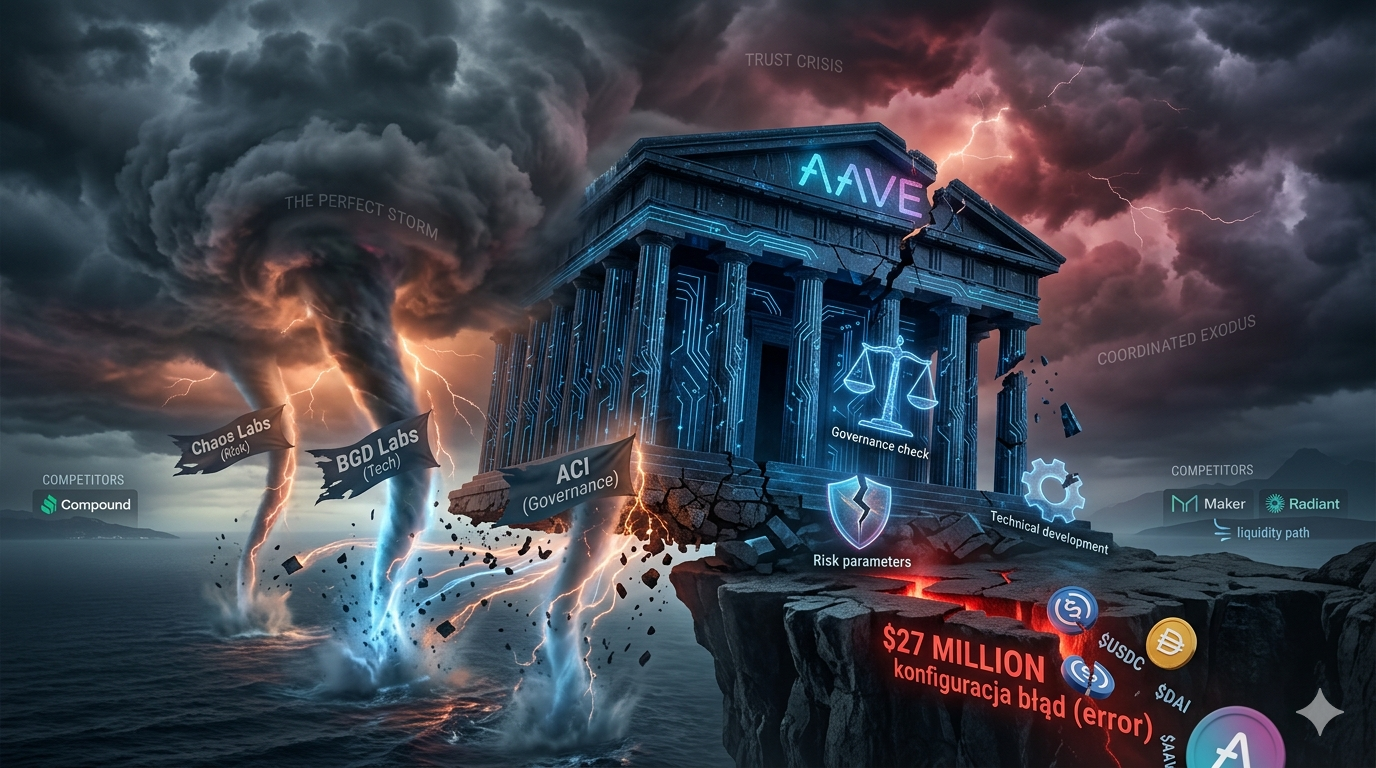
In just seven days, Aave lost three of its most important service partners. Chaos Labs, which managed risk parameters for the protocol. BGD Labs, which contributed key technical development to Aave V3. And ACI, which served as a crucial governance check on Aave Labs’ power. This coordinated exodus represents an unprecedented challenge for any DeFi protocol.
This article examines the specific events that triggered Aave’s trust crisis, analyzes what these departures mean for the protocol’s future, and evaluates whether Aave can survive this coordinated exodus of its most important service partners. For anyone invested in DeFi or considering participation in lending protocols, understanding what happened at Aave provides critical insights into the risks and rewards of decentralized finance.
The Departures: What Happened
Chaos Labs Exit (April 6, 2026)
Chaos Labs, Aave’s primary risk management partner, announced its departure on April 6, 2026, citing fundamental disagreements with Aave Labs over the direction of the protocol. The company’s statement revealed that long-term financial losses, combined with the departures of BGD Labs and ACI, made continued participation untenable.
The dispute centers on Aave Labs’ aggressive push for V4 development and what Chaos Labs describes as an unacceptable “hub-and-spoke” architecture that would amplify systemic risk across the protocol. Beyond philosophical disagreements, contract renewal negotiations broke down when Aave Labs rejected Chaos Labs’ exclusivity demands, which included being the sole risk manager for the protocol, replacing Chainlink oracles with alternative data sources, and becoming the default vault for business-to-business integrations.
A critical security incident preceded the departure announcement, highlighting the real-world consequences of the service provider transition. An on-chain configuration error led to the forced liquidation of $27 million in healthy user positions, exposing the risks of depending on a single risk provider (LlamaRisk) after Chaos Labs’ eventual departure. This incident demonstrated that the loss of experienced risk management creates immediate dangers for user funds.
The controversy around this liquidation raises serious questions about Aave’s risk management capabilities going forward. Without the experienced oversight that Chaos Labs provided, what other configuration errors might occur undetected?
BGD Labs Exit (April 1, 2026)
BGD Labs, responsible for some of the most important technical contributions to Aave V3, ended its service on April 1, 2026, with sharp criticism of Aave Labs’ management. The team’s public statement accused the parent company of deliberately restricting V3 development, intentionally devaluing the existing protocol that users currently depend on, and aggressively pushing the immature V4 without adequate consideration for community input or technical readiness.
BGD Labs’ departure leaves Aave without some of its most experienced technical contributors who have built and maintained the protocol’s core infrastructure. Their departure signals a brain drain that could affect the protocol’s ability to identify and fix bugs, implement improvements, and respond to emerging security threats.
The team made clear that they felt marginalized in decision-making processes and believed their contributions were being dismissed by management. This sense of alienation represents a significant change from the collaborative relationship that previously existed between service providers and Aave Labs.
ACI Departure (Planned July 2026)
The Aave Chan Initiative, one of the most influential governance organizations in the Aave ecosystem, announced plans to leave in July 2026. ACI’s departure was triggered primarily by BGD Labs’ exit and broader concerns about governance centralization that had been building over time.
ACI characterized Aave Labs’ actions as a “slow-motion coup,” pointing to the company’s control of a significant portion of AAVE tokens and their consistent practice of using token voting to crush community proposals that conflicted with management preferences. This centralization of governance power represents a fundamental departure from Aave’s original promise of decentralized, community-driven development.
The departure of ACI, which served as a check on management power and represented diverse community voices, marks the end of the balance system that previously governed Aave. Without this counterweight, Aave Labs faces fewer obstacles to implementing controversial changes.
Root Causes of the Crisis
V4 Development Dispute
The core conflict that triggered the current crisis centers on Aave Labs’ “Aave Will Win” framework, which aims to transform the protocol into a more cohesive, efficient ecosystem capable of meeting institutional demands and improving revenue capture. Service providers argue this vision sacrifices the decentralization that made Aave successful in favor of centralized control that prioritizes profitability over community interests.
The V4 architecture introduces a hub-and-spoke model that critics describe as fundamentally different from previous Aave versions. Under this new structure, a central hub would coordinate multiple spoke networks, creating dependencies that could amplify systemic risk across the entire ecosystem. Service providers were effectively told to accept this direction or leave the protocol.
The disagreement reflects a broader philosophical divide in DeFi about the proper balance between growth and decentralization. Aave Labs appears to believe that addressing institutional requirements necessitates more centralized control, while service providers argue that this compromises the core principles that differentiate DeFi from traditional finance.
Governance Centralization
Multiple departing teams pointed to concerning trends in Aave’s governance that have shifted power away from the community and toward Aave Labs management. ACI’s detailed analysis shows that Aave Labs now controls a significant portion of voting tokens through various entities, enabling them to override community decisions that conflict with management preferences.
This centralization represents a fundamental departure from Aave’s original promise of decentralized, community-driven development. When Aave launched, governance was positioned as a key differentiator from traditional financial institutions. The current situation suggests that promise has been abandoned in pursuit of efficiency and institutional acceptance.
The mechanism of this centralization involves token accumulation by Aave Labs and allied entities, strategic voting to defeat community proposals, and pressure on service providers to align with management positions. These tactics, while potentially effective for short-term decision-making, have undermined the trust that originally attracted participants to the Aave ecosystem.
Financial Pressures
Service providers also cited significant financial pressures contributing to their departures. Long-term losses from operating in the Aave ecosystem made continued participation economically unviable, particularly when combined with the strategic disagreements that made collaboration untenable.
The economics of serving as a DeFi service provider have become increasingly challenging. Protocol fees often do not cover the costs of maintaining sophisticated technical infrastructure, and the volatility of token-based compensation creates revenue uncertainty that makes long-term planning difficult.
These financial pressures, combined with the philosophical disagreements over protocol direction, created an impossible situation for service providers who could not continue operating under conditions they considered unacceptable.
Immediate Consequences
Security Concerns
The forced liquidation of $27 million in user positions due to configuration errors demonstrates the immediate security risks created by the service provider exodus. This was not an exploit or attack, but a configuration mistake that should have been caught by proper risk management processes.
With only LlamaRisk remaining as the protocol’s risk provider, the protocol lacks the redundancy that could prevent similar incidents in the future. A single point of failure in risk management creates dangerous exposure to errors that could affect large numbers of users simultaneously.
The complexity of V4 development raises additional security concerns for the future. New code typically introduces new vulnerabilities, and the departure of experienced technical contributors reduces the review capability available during development. Without BGD Labs’ technical expertise to identify potential issues, bugs and vulnerabilities may go undetected longer.
The security implications extend beyond smart contract vulnerabilities to include oracle manipulation, collateral valuation errors, and liquidity management failures. Each of these areas requires experienced oversight that has now been compromised by service provider departures.
Reputational Damage
Aave’s brand, built over years as a trusted decentralized lending protocol, has suffered significant damage that will be difficult to repair. The coordinated departure of three major service providers within weeks signals to the market that fundamental problems exist within the protocol’s leadership and governance.
This reputational damage extends beyond current users to potential future participants who may question whether Aave can be trusted with their assets. In the competitive DeFi lending space, where users have many alternatives, a reputation for internal conflict and management dysfunction creates significant competitive disadvantages.
The departure announcements included detailed criticisms of Aave Labs’ management style and strategic decisions, which have been widely circulated in the crypto community. These public statements have shaped perception of Aave in ways that will require significant effort to reverse.
Funding Uncertainty
The crisis has created significant uncertainty about Aave’s financial trajectory and long-term sustainability. The departure of service providers reduces the protocol’s execution capability, meaning fewer teams are working on improvements and bug fixes. Meanwhile, governance dysfunction complicates strategic decision-making and slows response to emerging challenges.
Investors and users alike are questioning whether Aave can maintain its position as the leading DeFi lending protocol. The loss of experienced service providers creates execution risk that could affect protocol performance and user experience. This uncertainty may lead to continued withdrawal of funds and talent from the ecosystem.
The broader market’s perception of Aave’s situation affects not only the protocol but the entire DeFi sector. A high-profile failure or decline would have implications for decentralized finance adoption and investment across the industry.
Technical Implications
Risk Management Changes
The departure of Chaos Labs leaves a significant gap in Aave’s risk management infrastructure. Previously, the protocol benefited from multiple layers of risk review and oversight. Now, a single provider must handle responsibilities that were previously distributed across multiple teams.
This consolidation of risk management creates single points of failure that could have serious consequences. Configuration errors that previously would be caught during review may now proceed to implementation, as demonstrated by the $27 million liquidation incident.
The transition to LlamaRisk as the primary risk provider raises questions about their capability to handle the complexity of Aave’s risk parameters. Unlike established providers with years of experience, LlamaRisk must quickly develop the expertise necessary to manage a protocol with billions in total value locked.
Development Capacity
BGD Labs’ departure reduces the technical capacity available for protocol development and maintenance. Their contributions to Aave V3 established core infrastructure that the protocol depends on daily. Losing this expertise creates risks for ongoing development and maintenance.
V4 development now proceeds with reduced technical oversight, increasing the probability of implementation errors. The complexity of the hub-and-spoke architecture creates challenges that require experienced developers to navigate successfully. Without BGD Labs’ expertise, the development team may face difficulties identifying and resolving issues.
The departure also affects knowledge transfer and institutional memory. When experienced contributors leave, they take with them understanding of design decisions, historical context, and implicit knowledge that is difficult to document or transfer.
Governance Implications
ACI’s departure removes an important voice from Aave governance. Their role in balanced decision-making cannot be easily replaced, and the governance structure now lacks the checks and balances that previously constrained management power.
The concentration of voting power in Aave Labs’ hands creates risks for minority token holders who may find their preferences consistently overridden. This dynamic could lead to further departures of community members who feel their voices are not heard.
Without effective governance oversight, management may pursue strategies that benefit token-rich entities at the expense of broader community interests. The current trajectory suggests governance will become increasingly centralized, potentially alienating participants who value decentralized decision-making.
Recovery Pathways
Can Aave Survive?
Aave retains significant advantages that could support recovery if properly leveraged. The protocol still has substantial total value locked, exceeding $26 billion in Aave's TVL, providing a deep liquidity base that serves users across various use cases. The protocol’s brand recognition, despite current challenges, remains higher than most competing DeFi platforms.
Institutional relationships built over years provide access to resources and expertise that could help address current challenges. Aave Labs has maintained partnerships with traditional financial institutions that could provide support during this difficult period. However, these relationships may also be affected by perceptions of the protocol’s governance problems.
The question of survival depends on whether Aave can address the fundamental issues that triggered this crisis. Without meaningful change to governance practices, V4 development approach, and relationship with the broader community, the current trajectory suggests continued decline.
What Needs to Change
Any path to recovery must address the core concerns that triggered the service provider departures. This includes significantly greater transparency about V4 development plans and timelines, more inclusive governance processes that genuinely incorporate community input, and explicit commitment to maintaining the decentralization that originally defined Aave’s value proposition.
Aave Labs must rebuild trust with the remaining community by demonstrating genuine commitment to collaborative development rather than centralized control. This requires actions, not just statements, that show management is willing to share power and listen to diverse perspectives.
The protocol needs to establish redundant service provider relationships that create resilience against future departures. Concentrating critical functions in single providers creates dangerous exposure that could lead to repeat incidents.
Timeline for Recovery
Recovery, if it occurs, will require significant time to accomplish. The damage to relationships and reputation cannot be repaired quickly. Optimistically, meaningful recovery might take twelve to eighteen months if Aave Labs makes substantial changes to its approach.
During this period, Aave must maintain core functionality and security while implementing governance reforms. Any additional incidents during recovery would significantly setback progress and potentially become irreversible.
The competitive environment provides pressure to improve quickly. Competing protocols are actively working to attract users and liquidity from Aave, creating urgency for recovery that may lead to mistakes if pursued too aggressively.
The Path Forward: Scenarios
Optimistic Scenario
In the best case, Aave Labs recognizes the severity of the current situation and implements significant governance reforms that restore community trust. V4 development is restructured to incorporate broader input, and new service providers are recruited to replace departed teams. Users return as confidence builds, and the protocol stabilizes at reduced but sustainable levels of activity.
This scenario would see Aave remain a significant player in DeFi lending, though with reduced market share compared to its peak. The crisis would ultimately lead to a more resilient governance structure that could better withstand future challenges.
Achieving this outcome requires substantial change that may be difficult given current power dynamics. The probability of this best case is uncertain.
Pessimistic Scenario
In the worst case, Aave continues on its current trajectory with accelerating departure of talent and liquidity. Governance becomes increasingly dysfunctional as community voices are marginalized, leading to decisions that benefit token-rich entities at the expense of broader users. Security incidents multiply as experienced oversight is lost, potentially leading to significant user losses.
This scenario would likely result in Aave becoming a minor player in DeFi lending, with its market position captured by competitors who have not experienced similar internal conflicts. The AAVE token would lose most of its value as the protocol’s importance diminishes.
Intermediate Scenario
The most likely outcome falls between these extremes, with Aave achieving partial stabilization but not fully recovering its previous position. The protocol remains relevant in DeFi lending but faces ongoing challenges from competitors and governance limitations.
This scenario requires ongoing effort to maintain a competitive position, with success depending on execution quality and absence of additional major incidents. Users should plan for this uncertain trajectory when making decisions about participation.
Should I Invest in AAVE Token on KuCoin?
If you believe Aave can successfully navigate this trust crisis through meaningful governance reforms and stable V4 execution, the AAVE token may present a high-risk, high-reward opportunity in the current market. With over $26 billion in TVL still locked in the protocol, AAVE continues to benefit from strong brand recognition and deep liquidity, which could support a recovery-driven price rebound if confidence is restored.
However, the recent service provider exits highlight significant near-term risks, including heightened security concerns, governance centralization, and potential further capital outflows. Investors should carefully weigh these challenges against Aave’s long-term potential as the leading DeFi lending protocol.
How to Buy AAVE on KuCoin
Buying AAVE on KuCoin is simple and takes just a few minutes:
-
Log in to your KuCoin account (or register for free if you don’t have one) and complete any required KYC verification.
-
Deposit funds into your KuCoin account using fiat (credit/debit card, bank transfer) or transfer crypto from your wallet.
-
Go to the AAVE/USDT trading pair in the spot market.
-
Place a market or limit order to buy AAVE tokens.
Once purchased, you can hold your AAVE in your KuCoin wallet for easy access or transfer it to a personal wallet for added security. KuCoin offers competitive trading fees, fast execution, and secure custody, making it a convenient platform to enter or add to your AAVE position during this pivotal period for the protocol.
Conclusion
Aave is facing its biggest crisis ever, with three key service providers—Chaos Labs, BGD Labs, and Aave Chan Initiative—departing within weeks. The exits stem from major disagreements over V4 development and increasing governance centralization.
Immediate impacts include heightened security risks, serious reputational damage, and funding uncertainty that makes it harder to attract talent. The forced liquidation of $27 million in user positions shows the real consequences.
Recovery will depend on genuine governance reform, transparent V4 progress, and renewed commitment to decentralization. Without these changes, Aave’s substantial TVL and brand strength will erode rapidly.
This event serves as a broader warning for DeFi: maintaining true decentralization is extremely difficult in practice. Participants should monitor not only smart contract security but also organizational health and governance dynamics, as internal conflicts can override even the best code.
FAQs
Why did Chaos Labs leave Aave?
Chaos Labs left due to fundamental disagreements with Aave Labs over V4 development direction, the hub-and-spoke architecture, contract renewal terms including exclusivity demands, and the departures of other key service providers. They also cited long-term financial losses from operating in the ecosystem.
What happened with the $27 million liquidation?
An on-chain configuration error after Chaos Labs’ departure led to the forced liquidation of $27 million in healthy user positions. This incident demonstrated the security risks created by relying on a single risk provider (LlamaRisk) and exposed gaps in Aave’s risk management oversight.
What is the Aave Chan Initiative?
ACI is a governance organization that served as a critical check on Aave Labs’ power. They announced departure planned for July 2026 due to concerns about governance centralization and what they characterized as a “slow-motion coup” by Aave Labs.
What is V4 and why is it controversial?
V4 is Aave’s next-generation protocol that introduces a hub-and-spoke architecture. Critics argue it centralizes control and increases systemic risk. Service providers were pressured to accept this direction or leave, with Chaos Labs, BGD Labs, and ACI all choosing departure.
Is Aave still safe to use?
Users should conduct their own research and assess their risk tolerance. The departure of key service providers has created security and governance concerns that represent increased risk. The $27 million liquidation demonstrates real consequences from these changes.
Can Aave recover from this crisis?
Recovery is possible but requires significant governance changes, V4 development reform, and restoration of trust with the broader community. The outcome remains highly uncertain and depends on actions taken by Aave Labs.
How does this affect AAVE token holders?
Token holders face significant uncertainty about governance reforms and the protocol’s future direction. The current crisis may lead to changes in how Aave is managed, potentially affecting token utility and value.
What alternatives exist to Aave?
Competitors including Compound, Maker, Radiant, and EigenLayer offer DeFi lending services. Users concerned about Aave’s situation may consider diversifying across multiple protocols to reduce concentration risk.