

DTCC Selects Stellar to Tokenize $114 Trillion in Assets: In-Depth Analysis of XLM's 14% Surge
2026/05/29 17:15:00
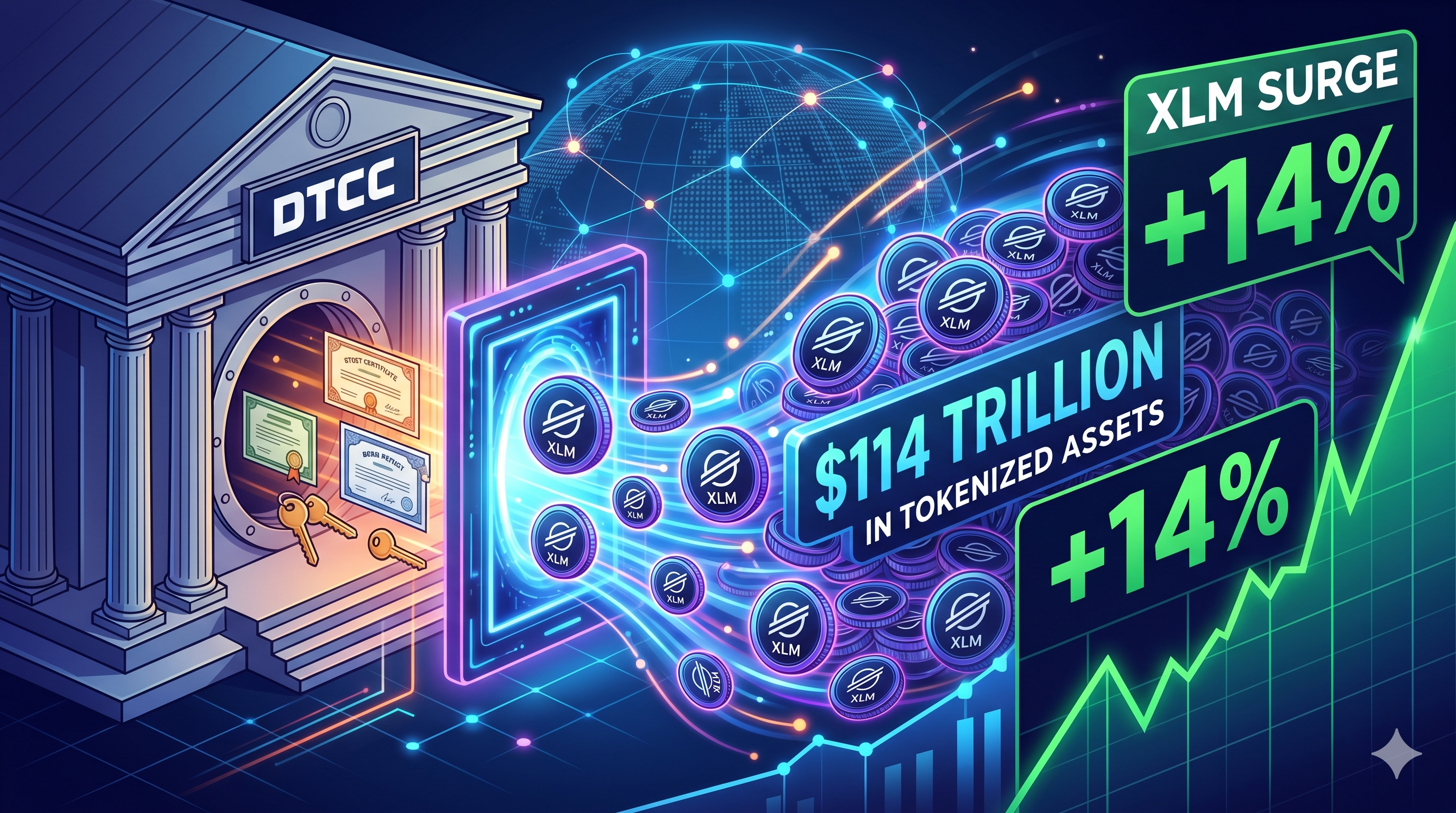
The Depository Trust & Clearing Corporation (DTCC), the foundational pillar of global financial market infrastructure, has officially selected the Stellar (XLM) network to pilot the tokenization of its colossal $114 trillion asset repository. This landmark integration merges traditional finance with decentralized ledgers, instantly sending the native XLM token soaring by 14% across major exchanges. As institutional capital aggressively pivots toward Real World Asset (RWA) tokenization in mid-2026, this collaboration positions Stellar at the absolute forefront of the enterprise blockchain race. Anticipating a full-scale institutional rollout by 2027, market participants are rapidly recalibrating their long-term price targets for XLM. This comprehensive analysis breaks down the core mechanics of the DTCC partnership, the fundamental reasons behind Stellar’s selection, the immediate market impact, and the strategic trading setups required to navigate this unprecedented structural shift in digital asset infrastructure.
💡 Tips: New to crypto? KuCoin's Knowledge Base has everything you need to get started.
Key Takeaways
-
Historic Institutional Adoption: The DTCC will utilize the Stellar blockchain to tokenize traditional securities, unlocking liquidity from a $114 trillion traditional finance (TradFi) asset pool.
-
Immediate Price Action: XLM experienced an instant 14% bullish breakout, smashing through multi-month resistance levels as trading volume surged by over 400% globally.
-
Compliance First: Stellar was explicitly chosen over competitors due to its enterprise-grade compliance features, built-in asset clawback capabilities, and high-throughput architecture.
-
2027 Launch Runway: A phased testnet deployment will dominate late 2026, culminating in a highly anticipated, fully compliant mainnet launch for institutional clearing in 2027.
-
RWA Dominance: This partnership officially transitions Stellar from a cross-border payment network into a primary Layer-1 infrastructure hub for the multi-trillion-dollar Real World Asset sector.
Core Event: Key Details of the DTCC and Stellar Collaboration
The core foundation of this historic partnership involves the DTCC leveraging Stellar’s decentralized infrastructure to build a highly regulated, on-chain clearing and settlement environment for traditional financial instruments. Rather than attempting to replace legacy systems overnight, this pilot program acts as a direct bridge, issuing tokenized representations of US Treasury bonds and low-risk institutional funds directly onto the Stellar mainnet.
The integration utilizes Stellar's native asset issuance capabilities to create digital twins of traditional securities. These digital assets are then tracked, transferred, and settled using blockchain consensus, drastically reducing the traditional T+1 or T+2 settlement windows down to mere seconds. According to the initial structural framework released this month, the DTCC will deploy specialized validator nodes on the Stellar network to ensure data fidelity and regulatory oversight.
Furthermore, the collaboration heavily relies on Stellar's recently upgraded smart contract platform, Soroban. By utilizing Soroban, the DTCC can program specific compliance rules directly into the tokenized assets. This means that securities can only be transferred between whitelisted, mathematically verified institutional wallets, entirely eliminating the risk of retail commingling or unauthorized capital flight. This highly controlled environment provides the exact specifications required by federal regulators to approve widespread blockchain adoption in traditional clearinghouses.
Why Stellar? 5 Core Reasons Behind DTCC's Selection
Stellar successfully outmaneuvered several higher-profile blockchain networks to secure this contract primarily because its foundational architecture was purpose-built for regulated financial institutions rather than retail speculation. The DTCC's selection committee prioritized structural security, deterministic transaction costs, and explicit regulatory control above all other metrics.
Here is the detailed breakdown of the five core reasons the DTCC selected Stellar:
-
Native Asset Clawback Capabilities
Stellar features a unique protocol-level function known as "Clawback," which allows the issuer of a token to forcibly recover it from a holder's wallet under specific legal conditions. For a heavily regulated entity like the DTCC, this feature is non-negotiable. If a fraudulent transaction occurs, or a court order mandates asset seizure, traditional finance requires the ability to reverse settlements—something strictly immutable chains like Bitcoin cannot offer without breaking consensus.
-
Deterministic and Predictable Low Fees
Institutional clearing involves millions of daily micro-transactions and massive data settlements. Network congestion and unpredictable gas fees (such as those historically seen on Ethereum) destroy the economic viability of on-chain clearing. Stellar’s fee structure remains incredibly low (fractions of a cent) and highly predictable regardless of network volume, allowing corporate treasuries to accurately forecast their operational infrastructure costs.
-
Enterprise-Grade Throughput and Finality
Stellar operates on the Stellar Consensus Protocol (SCP), which finalizes transactions in roughly 3 to 5 seconds. In the high-stakes environment of global asset clearing, immediate deterministic finality is required to prevent counterparty risk. The DTCC requires a system that settles instantly, removing the overnight credit risk inherent in traditional multi-day clearing operations.
-
Built-In KYC/AML Compliance Frameworks
The network allows asset issuers to mandate that tokens can only be held by accounts that have passed rigorous Know Your Customer (KYC) and Anti-Money Laundering (AML) checks. This "Trustline" feature ensures that tokenized securities never interact with sanctioned wallets or anonymous decentralized finance (DeFi) participants, perfectly aligning with strict US Securities and Exchange Commission (SEC) guidelines.
-
Proven Track Record with Financial Institutions
Stellar has spent a decade building quiet, compliant relationships with major financial players, including Franklin Templeton, MoneyGram, and Circle (USDC). The DTCC preferred to partner with an ecosystem that already understood traditional finance linguistics and regulatory boundaries, rather than a purely crypto-native team learning institutional compliance on the fly.
XLM Price Analysis: The 14% Short-Term Surge and Long-Term Targets
The native XLM token responded to the DTCC announcement with absolute aggression, printing a massive 14% green daily candle and slicing through significant macro resistance blocks. This rapid influx of capital was driven by both spot accumulation from institutional market makers and a massive short-squeeze across retail derivatives platforms.
Following the immediate news drop, XLM price action broke out of its multi-month descending wedge, jumping from a baseline support of $0.28 directly into the $0.32 resistance zone within a four-hour trading window. Trading volume experienced a spectacular 400% surge, shifting from a daily average of $150 million to over $750 million. The Relative Strength Index (RSI) aggressively spiked into the overbought territory at 76, indicating sheer momentum-driven buying pressure.
From a long-term technical perspective, this institutional validation fundamentally alters XLM's macro market structure. If Stellar successfully captures even a fraction of a percent of the DTCC's $114 trillion repository, the utility-driven demand for XLM (used to pay for network transactions and account reserves) will be astronomical. Analysts are currently revising their late-2026 and early-2027 targets, noting that if XLM can hold the $0.30 level as newly established support, the next major macro resistance zones sit at $0.45 and $0.55. In a maximum bullish scenario leading up to the 2027 mainnet launch, a return to its previous all-time high ranges above $0.80 is mathematically probable.
-
Timeline to 2027: Key Milestones and Catalysts
The pathway to fully clearing multi-trillion-dollar traditional assets on a public blockchain requires a meticulously staged rollout, and market participants must closely track the timeline leading into the official 2027 launch. The integration is broken down into highly specific quarterly milestones, each acting as a potential fundamental catalyst for the XLM ecosystem.
Q3 2026: Closed Testnet Environment Launch
During this phase, the DTCC and Stellar engineers will operate exclusively on customized testnets. They will simulate high-stress volume scenarios, specifically testing the Soroban smart contract logic for automated compliance. While no real-world value is exchanged here, technical success reports leaked or published during this period typically drive speculative momentum.
Q4 2026: Regulatory Audits and Security Reviews
Before any traditional assets touch the mainnet, independent third-party cybersecurity firms and federal regulators must audit the smart contract architecture. This quarter will be dominated by compliance news. A public statement from regulatory bodies confirming the architecture meets legacy financial standards will serve as a massive de-risking event for institutional investors observing XLM.
Q1 2027: Limited Beta Mainnet Integration
The integration will move to the live Stellar mainnet, but will be restricted to a small cohort of elite banking partners and specific, highly liquid asset classes (like short-term US Treasury Bills). This is the moment real Total Value Locked (TVL) will begin visibly flowing into the Stellar ecosystem.
Q2 2027: Official Production Launch and Scaling
The full-scale launch will open the tokenization infrastructure to a broader range of traditional financial institutions connected to the DTCC. At this stage, the daily transaction volume and network utility mechanics for XLM will face their true fundamental test, determining the long-term price floor of the asset.
RWA Sector Impact: Can Stellar Become the Tokenization Core Hub?
The DTCC collaboration instantly elevates Stellar from a niche remittance network into a dominant Layer-1 infrastructure provider within the hyper-competitive Real World Asset (RWA) tokenization race. Capturing traditional financial infrastructure is the ultimate endgame for blockchain networks, and Stellar has secured the crown jewel of US financial clearing.
Historically, Ethereum has dominated early RWA experimentation, largely due to BlackRock's BUIDL fund and the deep liquidity of the ERC-20 standard. However, Ethereum's gas volatility and public mempool mechanics remain severe friction points for traditional clearinghouses. By securing the DTCC, Stellar is proving that a purpose-built, compliance-focused architecture is far more attractive to legacy financial monopolies than the fragmented, purely decentralized ethos of Ethereum.
This integration will likely trigger a massive domino effect. When tier-2 and tier-3 banks see the DTCC routing assets through Stellar, they will naturally migrate to the same network to maintain interoperability and reduce friction. Stellar is structurally positioning itself to become the standard institutional "intranet" for digital asset clearing, effectively cornering the market on highly regulated, enterprise-grade securities tokenization while leaving retail DeFi to other chains.
Ecosystem Impact: Synergy Across Stellar DeFi, Stablecoins, and Institutions
The onboarding of billions (and potentially trillions) of dollars in tokenized traditional assets will dramatically bootstrap and energize Stellar's native decentralized finance and stablecoin ecosystem. Institutional capital does not sit idle; it seeks yield, utility, and efficient capital allocation across the network.
The immediate beneficiary of this integration is the stablecoin sector on Stellar, primarily Circle's USDC. As tokenized securities are traded and cleared on-chain, the corresponding cash settlement legs must also happen on-chain to achieve atomic settlement. This will drive an unprecedented explosion in USDC velocity and issuance on the Stellar network.
Furthermore, the introduction of massive, high-quality collateral (like tokenized US Treasuries) into the Stellar ecosystem provides the foundation for institutional-grade DeFi. Automated Market Makers (AMMs) and native lending protocols built on Soroban will be able to utilize these DTCC-backed assets as pristine collateral for on-chain borrowing and liquidity provision. While retail users will not be able to interact directly with restricted institutional tokens, the resulting network effects, increased validator rewards, and overall liquidity deepening will significantly benefit the broader XLM community.
Competitive Landscape: Stellar vs. XRP vs. Ethereum
To truly understand the magnitude of this partnership, one must evaluate how Stellar now stacks up against its primary Layer-1 competitors in the institutional space. While Ethereum and XRP have distinct advantages, the DTCC integration carves out a highly defensible monopoly for Stellar in the securities clearing sector.
Ethereum remains the king of retail DeFi and permissionless innovation, holding the vast majority of current global TVL. However, its architecture is inherently hostile to privacy and predictable corporate budgeting. XRP, Stellar's historical twin, has focused intensely on cross-border fiat remittance and central bank digital currencies (CBDCs) via RippleNet. While Ripple fights for global payment routing, Stellar has quietly captured the backend infrastructure for domestic securities clearing.
| Feature/Metric | Stellar (XLM) | Ethereum (ETH) | Ripple (XRP) |
| Primary Institutional Focus | Securities Clearing, RWA, Asset Issuance | Smart Contracts, Decentralized Finance | Cross-Border Payments, CBDCs |
| Fee Predictability | Extremely High (Deterministic) | Low (Gas Volatility) | High (Predictable) |
| Asset Clawback Feature | Native at Protocol Level | Requires Custom Smart Contracts | Restricted to Specific Hubs |
| DTCC Integration Status | Official Pilot Network | Fragmented Independent Projects | None Currently Announced |
Risk Factors: 5 Major Threats That Could Trigger an XLM Correction
Despite the incredibly bullish fundamental narrative surrounding the DTCC partnership, seasoned market participants must recognize that XLM still faces significant macroeconomic and structural risks. A failure in execution or external market shocks could easily erase the recent 14% gains and trigger a severe downward correction.
-
Technical Pilot Failures or Delays
Enterprise blockchain integrations are notoriously complex. If the closed testnets reveal that Stellar's Soroban smart contracts cannot handle the massive data payloads required by the DTCC, the 2027 launch could be delayed indefinitely. Any announcement of technical setbacks will immediately trigger institutional sell-offs.
-
Drastic Macroeconomic Tightening
If global central banks are forced to raise interest rates to combat resurgent inflation in late 2026, capital will aggressively flee high-risk assets like cryptocurrencies. Even a fundamentally strong token like XLM cannot survive a broader macro liquidity drain, and would likely be pulled down alongside Bitcoin and traditional equities.
-
Regulatory Pivot or SEC Interference
While the DTCC is highly regulated, the SEC's overarching stance on public blockchain infrastructure remains aggressively unpredictable. If regulatory bodies decide that public ledgers cannot be used for national securities clearing under any circumstances, the DTCC would be forced to abandon the Stellar pilot.
-
Intense Layer-1 Competition and Cannibalization
Networks like Avalanche (with their institutional subnets) and Polygon are aggressively pursuing the exact same RWA market share. If a competitor offers the DTCC a more lucrative technical setup or deeper interoperability with existing Ethereum liquidity, Stellar could lose its exclusivity.
-
Native Token Inflation and Validator Dumping
The Stellar ecosystem continually releases XLM into circulation through inflation mechanics and foundation grants to fund development. If the utility demand from the DTCC pilot does not outpace the mechanical inflation of the token supply, the natural downward pressure will suppress any long-term price appreciation.
-
Trading Strategy: Short, Mid, and Long-Term Action Plans
Navigating a massive fundamental news event requires a structured, multi-timeframe trading strategy to separate emotional FOMO from calculated execution. Traders must blend technical levels with the fundamental timeline of the DTCC 2027 rollout.
For the short-term swing trader, the immediate goal is capital preservation. XLM has just experienced a violent 14% pump; buying at the absolute local top is mathematically dangerous. Traders should wait for the initial hype to cool and look for re-entry on a structural retest of previous resistance, now acting as support.
| Trading Horizon | Strategic Approach | Key Entry/Support Levels | Primary Profit Targets |
| Short-Term (1-4 Weeks) | Wait for momentum cool-off and retest. Trade the volatility range. | $0.28 - $0.30 Zone | $0.34 - $0.36 |
| Mid-Term (3-6 Months) | Accumulate during testnet silence. Scale in on macro market dips. | $0.25 - $0.27 Zone | $0.45 - $0.50 |
| Long-Term (To 2027 Launch) | Hold a core "moon-bag." Stake or provide liquidity if applicable. | Any accumulation below $0.35 | $0.80 - $1.20+ |
Mid-term investors should adopt a dollar-cost averaging (DCA) approach during the inevitable "quiet periods" between major testnet announcements in late 2026. Long-term position traders should focus on securing a core allocation immediately, ignoring short-term chop, and holding strictly for the explosive liquidity events expected during the Q2 2027 mainnet deployment.
Conclusion
The DTCC’s decision to tokenize a portion of its $114 trillion asset repository on the Stellar network is a watershed moment that fundamentally bridges the divide between legacy financial systems and the digital asset economy. This integration validates Stellar’s decade-long commitment to compliance, security, and enterprise-grade architecture, directly resulting in XLM’s immediate 14% market surge. By offering built-in clawback features, deterministic fees, and instant finality, Stellar has proven itself uniquely capable of handling the stringent demands of traditional financial clearinghouses.
As the market eyes the meticulous rollout schedule leading up to the 2027 mainnet launch, XLM is no longer just a cross-border payment token; it is the foundational infrastructure for the Real World Asset tokenization boom. While investors must remain vigilant regarding macroeconomic headwinds, regulatory shifts, and technical execution risks, the sheer scale of the DTCC partnership provides immense long-term upside potential. The convergence of traditional securities and decentralized ledgers is no longer a theoretical concept—it is actively being built, and Stellar is undeniably leading the charge.
FAQs
What exactly is the DTCC and why does its choice matter?
The Depository Trust & Clearing Corporation (DTCC) is the premier post-trade market infrastructure for the global financial services industry, processing trillions of dollars in securities transactions daily. Their choice of Stellar matters because it validates public blockchain technology at the highest levels of traditional institutional finance, signaling a massive influx of legitimate, regulated capital into the crypto ecosystem.
Can retail investors buy the tokenized DTCC assets on Stellar?
No, the tokenized assets issued by the DTCC during this pilot program are strictly ring-fenced for verified, whitelisted institutional entities that have passed extensive KYC/AML compliance checks. Retail investors cannot interact with or trade these specific enterprise tokens, but they can invest in the native XLM token which powers the underlying network infrastructure.
How does Soroban fit into this new institutional partnership?
Soroban is Stellar's native smart contract platform, and it is strictly required to program the complex compliance logic, regulatory bounds, and automated settlement rules demanded by the DTCC. It allows the network to execute programmable financial agreements, such as instant atomic swaps of tokenized treasuries for stablecoins, without relying on manual intervention.
Will the DTCC's adoption of Stellar increase the inflation rate of XLM?
The DTCC integration does not mechanically alter the hard-coded supply emission or inflation metrics of the XLM token protocol. In fact, massive institutional adoption is expected to increase network transaction volume and account reserve requirements, creating natural utility-driven demand that can help offset existing token unlocks.
Does this partnership mean Stellar is abandoning its cross-border payments focus?
Stellar is not abandoning cross-border payments; rather, it is expanding its network utility to encompass the broader Real World Asset (RWA) sector. Securities clearing and cross-border remittances are synergistic, as both require fast, cheap, and compliant settlement layers, allowing Stellar to dominate multiple institutional verticals simultaneously.
Disclaimer: This article is for informational purposes only and does not constitute financial, legal, or investment advice. Always conduct your own thorough research and consult with a certified financial advisor before engaging in trading activities.