

Introduction and Prospects of Ritual (Decentralized AI Computing Platform and Projects Comparison)
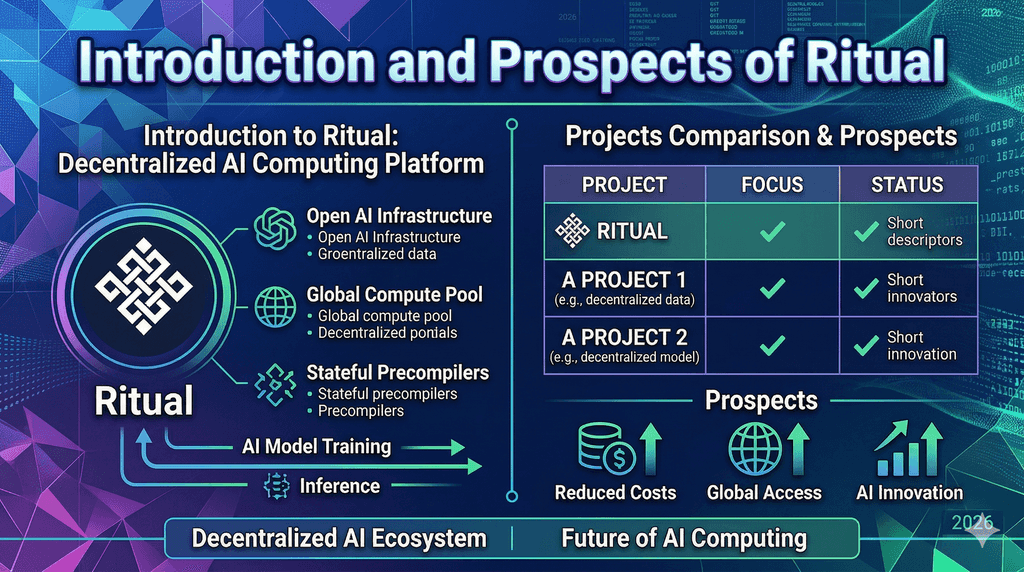
Decentralized AI computing platforms are rising as critical infrastructure for the next phase of artificial intelligence, moving control from centralized tech giants to open, permissionless networks. Ritual represents a new design paradigm where AI models, compute, and economic incentives converge on-chain, offering a transparent and programmable environment for machine intelligence. Its direction, alongside competitors, signals a broader transformation in how AI is built, accessed, and monetized.
Ritual and the Rise of On-Chain AI Infrastructure
The acceleration of artificial intelligence has exposed a structural imbalance in compute ownership. A handful of large corporations control the majority of training infrastructure, datasets, and deployment pipelines, limiting access for independent developers. Ritual enters this ecosystem as a decentralized alternative, positioning itself as a programmable layer where AI models can be executed, verified, and monetized directly on-chain. Its architecture reflects a shift from API-based AI consumption toward verifiable computation, where outputs can be trusted without relying on centralized providers.
Ritual’s core idea revolves around integrating AI execution into blockchain environments. Instead of sending data to a closed server, developers can run inference in a system that records results transparently. This concept aligns with broader movements in decentralized computing, where trust is minimized through cryptographic guarantees. The emergence of such platforms mirrors earlier transitions in cloud computing, where infrastructure evolved from private servers to shared networks. In this case, the changes extends further, joining intelligence itself into decentralized systems.
Recent developments in decentralized AI shows growing demand for open infrastructure. According to a16z’s crypto research, decentralized compute networks are gaining traction as AI costs rise and access becomes increasingly restricted . Ritual’s approach places it at the center of this trend, offering a framework where AI becomes composable, verifiable, and economically aligned with contributors.
Architectural Design: How Ritual Embeds AI into Blockchain Systems
Ritual’s architecture is built around the concept of “AI as a native primitive.” This means that instead of treating AI as an external service, it becomes part of the blockchain’s execution environment. Developers can deploy models that interact directly with smart contracts, enabling automated decision-making processes that are transparent and auditable.
At a technical level, Ritual introduces a system where off-chain computation is paired with on-chain verification. This hybrid model addresses one of the biggest challenges in decentralized AI: the high cost of running complex models entirely on-chain. By separating execution from verification, Ritual ensures efficiency while maintaining trust. This design resembles emerging patterns in verifiable computing, where proofs are used to confirm the correctness of external computations.
The platform also integrates incentive mechanisms that reward contributors who provide compute resources or improve models. This creates a marketplace for AI services, where supply and demand determine pricing. Such systems draw inspiration from decentralized networks like Bittensor, which uses token incentives to coordinate machine learning tasks across a distributed network.
Technical documentation from Ritual Labs outlines how these components interact, emphasizing scalability and composability . The result is a system that not only supports AI execution but also integrates it into a broader economic and computational framework.
Why Ritual Matters in the AI Infrastructure Stack
The importance of Ritual lies in its attempt to redefine how AI infrastructure is accessed and controlled. Traditional AI platforms operate through centralized APIs, where users must trust providers to deliver accurate and unbiased outputs. Ritual introduces a model where outputs can be independently verified, reducing reliance on trust and increasing transparency.
This move has implications for industries that depend on reliable AI systems. Financial services, for example, require auditability to ensure compliance and accuracy. Healthcare applications demand transparency to validate diagnoses and recommendations. Ritual’s architecture addresses these needs by embedding verification mechanisms directly into the computation process.
The platform also enables new forms of collaboration. Developers can build on top of existing models, creating layered systems that evolve over time. This composability mirrors the success of decentralized finance, where protocols interact seamlessly to create complex financial products.
A report by Messari shows the growing importance of decentralized AI networks in addressing centralization risks . Ritual’s approach aligns with this narrative, offering a framework that prioritizes openness and accountability. Its role in the AI stack extends beyond computation, influencing how intelligence is distributed and governed.
Token Economics and Incentive Design in Ritual
Economic incentives form the backbone of decentralized systems, and Ritual is no exception. The platform introduces a token-based model that rewards participants for contributing compute resources, validating outputs, and improving models. This structure ensures that the network remains active and competitive, as participants are motivated to deliver high-quality services.
The token economy is designed to balance supply and demand. Users pay for AI services, creating revenue streams for contributors. At the same time, staking mechanisms encourage long-term participation, as tokens are locked to secure the network and validate computations. This dual structure supports both short-term activity and long-term stability. Incentive design also plays a role in maintaining quality. Contributors who provide inaccurate results risk losing rewards, creating a system where accuracy is financially incentivized. This aligns with broader trends in decentralized networks, where economic mechanisms replace centralized oversight.
Comparisons can be drawn with platforms like Fetch.ai, which uses token incentives to coordinate autonomous agents. Ritual extends this concept to AI computation, creating a marketplace where intelligence itself becomes a tradable resource. Insights from tokenomics research emphasize the importance of aligning incentives with network goals . Ritual’s design reflects this principle, aiming to create a sustainable ecosystem for decentralized AI.
Real-World Use Cases Driving Ritual Adoption
Ritual’s design opens the door to a wide range of applications that extend beyond traditional AI deployment. One of the most compelling use cases lies in decentralized finance, where AI models can analyze market data and execute strategies directly through smart contracts. This integration allows for automated trading systems that operate transparently, reducing the risk of hidden biases or manipulation.
Another area of interest is data marketplaces. Ritual enables developers to monetize datasets by integrating them into AI models that generate value for users. This creates a new economic layer where data contributors are compensated based on the performance of the models they support. Such systems could reshape industries that rely heavily on proprietary data. Gaming and virtual environments also present opportunities. AI-driven characters and systems can be embedded directly into decentralized platforms, creating dynamic experiences that evolve based on user interactions. This aligns with the broader trend of integrating AI into digital ecosystems.
Research from Stanford’s Human-Centered AI Institute highlights the growing demand for decentralized AI solutions across multiple sectors. Ritual’s architecture positions it to address these demands, offering a flexible framework for innovation.
Comparing Ritual with Bittensor: Incentive Networks vs Execution Layers
A comparison between Ritual and Bittensor reveals two distinct approaches to decentralized AI. Bittensor focuses on creating a network where models compete to produce the best outputs, with rewards distributed based on performance. This creates an ecosystem centered on model quality and continuous improvement.
Ritual, on the other hand, emphasizes execution and verification. Its architecture integrates AI directly into blockchain environments, enabling models to interact with smart contracts and produce verifiable outputs. This focus on execution differentiates it from networks that prioritize model training and evaluation.
The distinction reflects broader design philosophies. Bittensor operates as a marketplace for intelligence, where models compete for recognition and rewards. Ritual functions as an infrastructure layer, providing the tools needed to deploy and verify AI systems in real-world applications.
Both approaches address different aspects of decentralized AI ecosystem. Bittensor excels in fostering innovation and competition among models, while Ritual provides a framework for integrating AI into decentralized applications. Together, they illustrate the diversity of solutions emerging in this space.
Comparing Ritual with Fetch.ai: Autonomous Agents vs AI Primitives
Fetch.ai introduces a model centered on autonomous agents that perform tasks on behalf of users. These agents interact with each other and external systems, creating a network of automated services. Fetch.ai’s strength lies in its ability to coordinate complex workflows through decentralized agents.
Ritual takes a different approach by focusing on AI primitives. Instead of building agent-based systems, it provides the underlying infrastructure for executing and verifying AI computations. This allows developers to create custom applications without being constrained by predefined agent frameworks. The contrast shows the versatility of decentralized AI. Fetch.ai offers a ready-made ecosystem for automation, while Ritual provides a flexible foundation for building new types of applications. Each platform addresses different needs, catering to developers with varying requirements.
Industry analysis from Binance Research underscores the diversity of decentralized AI models and their potential impact on the broader ecosystem . Ritual’s position within this landscape reflects its focus on infrastructure and composability.
Ritual vs Gensyn and Other Emerging Compute Networks
Emerging projects like Gensyn focus on providing decentralized compute power for training machine learning models. These platforms address the high cost of training by distributing workloads across a network of contributors. Ritual complements this approach by focusing on inference and execution. While training requires significant computational resources, inference involves running trained models to generate outputs. Ritual’s architecture is optimized for this stage, enabling efficient and verifiable execution.
The distinction between training and inference is critical. Training builds the model, while inference delivers value to users. By targeting inference, Ritual positions itself closer to end-user applications, where real-time results are essential. This layered ecosystem reflects the complexity of AI infrastructure. Different platforms address different stages of the pipeline, creating opportunities for collaboration and integration. Ritual’s role within this ecosystem highlights its focus on usability and deployment.
Developer Experience and Ecosystem Growth
Developer adoption plays a crucial role in the success of any platform, and Ritual places significant emphasis on usability. Its tools and documentation are designed to lower the barrier to entry, enabling developers to integrate AI into decentralized applications without extensive technical expertise.
The platform supports composability, allowing developers to build on existing models and create complex systems through modular components. This approach accelerates innovation, as developers can focus on creating value rather than building infrastructure from scratch.
Community engagement is also a key factor. Ritual fosters an ecosystem where developers, researchers, and contributors collaborate to improve the platform. This collaborative environment drives continuous improvement and ensures that the platform evolves in response to user needs.
Reports from Electric Capital highlight the importance of developer activity in determining the success of blockchain projects. Ritual’s focus on developer experience positions it well for long-term growth.
Challenges Facing Ritual and Decentralized AI Platforms
Despite its potential, Ritual faces challenges common to decentralized AI platforms. Scalability remains a significant concern, as the demand for AI services continues to grow. Ensuring that the network can handle large volumes of computation without compromising performance is critical. Interoperability is another issue. Integrating with other platforms and systems requires standardized protocols and seamless communication. Without this, the ecosystem risks fragmentation.
User adoption also presents a challenge. While the platform simplifies many aspects of decentralized computing, it still requires users to understand basic blockchain concepts. Bridging this knowledge gap is essential for widespread adoption. Ongoing research in decentralized systems shows these challenges and explores potential solutions. Ritual’s ability to address these issues will play a key role in its future development.
Where Ritual Fits in the AI Economy
The future of decentralized AI is closely tied to the broader evolution of the digital economy. As demand for AI services increases, platforms like Ritual are positioned to play a central role in providing accessible and transparent infrastructure.
The integration of AI with blockchain opens new possibilities for automation, data ownership, and economic coordination. Ritual’s architecture supports these developments by enabling verifiable computation and programmable intelligence.
Industry forecasts suggest that decentralized AI networks will become an integral part of the technology landscape . Ritual’s position within this ecosystem reflects its potential to influence how AI is developed and deployed.
Conclusion
Ritual represents a significant step forward in the evolution of decentralized AI infrastructure. By integrating AI execution into blockchain systems, it introduces a new model for building and deploying intelligent applications. Its focus on transparency, composability, and economic incentives sets it apart from traditional platforms.
Comparisons with projects like Bittensor, Fetch.ai, and Gensyn shows the diversity of approaches within the decentralized AI space. Each platform addresses different aspects of the ecosystem, contributing to a broader transformation in how AI is accessed and utilized.
The direction of Ritual and similar projects suggests that decentralized AI will play an increasingly important role in the future of technology. As these platforms mature, they have the potential to reshape industries and redefine the relationship between data, computation, and intelligence.
FAQs
-
What is Ritual in simple terms?
Ritual is a decentralized platform that allows AI models to run and be verified on blockchain systems.
-
How is Ritual different from Bittensor?
Ritual focuses on execution and verification, while Bittensor focuses on model competition and training.
-
What are the main use cases?
DeFi automation, data marketplaces, gaming, and AI-powered applications.
-
Is Ritual widely adopted?
It is still emerging but gaining attention in the decentralized AI sector.
Disclaimer
This content is for informational purposes only and does not constitute investment advice. Cryptocurrency investments carry risk. Please do your own research (DYOR).