

The Giant Whale Continues to Increase Its Position in LINK: What Are the On-Chain Funds Betting On?
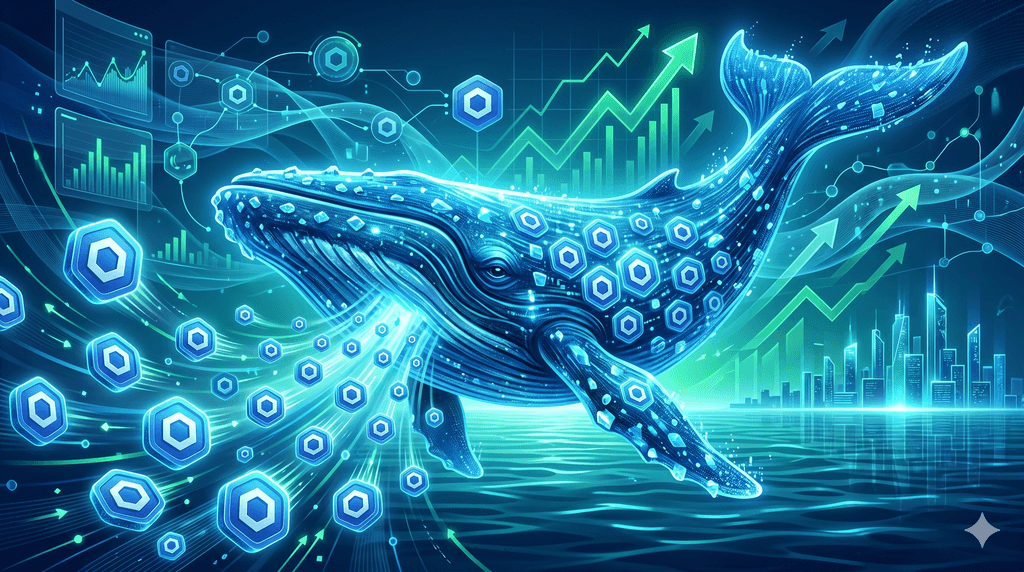
Chainlink is once again gaining attention as large on-chain wallets continue to increase their LINK holdings. While the token has not yet confirmed a major breakout, whale accumulation has become one of the most closely watched signals in the market. Large investors often build positions before retail traders return, which is why repeated whale buying can create strong speculation about LINK’s next major move.
The current interest in LINK is not only about short-term price action. On-chain funds appear to be watching Chainlink’s deeper role in the crypto economy. As decentralized finance, real-world assets, institutional blockchain adoption, and cross-chain applications continue to grow, Chainlink remains one of the most important infrastructure projects in the market.
This article looks at the recent whale accumulation around LINK, the possible reasons behind large investor interest, and the major risks traders should consider before assuming that whale buying automatically means a bullish breakout.
Market Context Behind LINK Accumulation
The renewed accumulation of LINK is happening at a time when many altcoins are still struggling to regain strong momentum. In such market conditions, large investors usually become more selective. Instead of chasing every token, they tend to focus on projects with stronger fundamentals, deeper liquidity, and long-term utility.
Chainlink fits that profile because it is not only a speculative crypto asset. It provides oracle infrastructure that allows smart contracts to access real-world data. This makes it important for DeFi platforms, lending markets, derivatives protocols, tokenized assets, and cross-chain applications.
The market context also matters because whale accumulation during quiet price action can be more meaningful than buying during a hype-driven rally. When large wallets increase exposure while retail interest is still limited, it may suggest that funds are positioning early for a future shift in sentiment.
The Giant Whale Continues to Increase Its Position in LINK
Whale Accumulation Returns to the Spotlight
Chainlink is once again attracting attention from on-chain analysts as large wallet holders continue to increase their LINK positions. These major holders, often called whales, are closely watched because their movements can reveal early signs of market positioning before broader retail interest returns.
Recent whale activity suggests that some large investors are using LINK’s current price range as an accumulation zone. Instead of selling into uncertainty, these wallets appear to be moving tokens away from exchanges and into long-term storage or custody wallets.
This kind of behavior is especially important when it happens during a quiet market. If whales accumulate during strong rallies, the move can sometimes be dismissed as momentum chasing. But when whales accumulate while price action remains slow or range-bound, it can suggest stronger long-term conviction.
Why Whale Buying Matters
Whale accumulation does not guarantee an immediate price rally, but it often changes market sentiment. When large holders buy or withdraw tokens from exchanges, it can reduce the amount of LINK available for short-term selling.
This behavior is usually interpreted as a sign of confidence. If whales expected a major downside move, they would likely keep tokens on exchanges or reduce their holdings. Instead, continued accumulation suggests that large players may be preparing for a longer-term upside move.
For retail traders, whale activity is often treated as a signal. Large wallets usually have access to better research, deeper liquidity, and more advanced market tools. Their moves are not always correct, but they can reveal how sophisticated participants are positioning before the wider market reacts.
Exchange Outflows Signal Long-Term Positioning
One of the most important signals in whale behavior is exchange outflow. When LINK leaves centralized exchanges, it usually means those tokens are being moved into private wallets, institutional custody, or long-term storage.
This reduces immediate sell pressure. While not every withdrawal is bullish, repeated large outflows often indicate that whales are not positioning for quick selling. Instead, they may be building exposure before a possible market recovery.
Exchange outflows are especially important in assets with strong long-term narratives. If demand rises while liquid supply decreases, price can move more aggressively once buyers return. This is why traders closely watch whether LINK balances on exchanges are rising or falling.
LINK Price Remains in a Key Range
Despite whale accumulation, LINK has not yet confirmed a major breakout. The token remains stuck near important resistance levels, with traders closely watching whether buyers can push the price above the upper range.
This makes the current setup interesting. On-chain data appears supportive, but the chart still needs confirmation. A strong breakout above resistance could turn whale accumulation into a broader bullish narrative.
Until that happens, LINK remains in a waiting phase. Bulls want to see rising volume, continued exchange outflows, and a successful move above resistance. Bears, on the other hand, may argue that whale accumulation is not enough unless price follows.
The Market Is Watching the Next Move
The continued increase in whale positions shows that large investors are not ignoring LINK. Even while short-term price action remains uncertain, on-chain behavior suggests that some major players are quietly building positions.
This creates a potential setup where LINK could benefit if broader crypto sentiment improves, exchange supply continues to fall, and demand returns to infrastructure-focused altcoins.
For now, the market is watching whether whale accumulation can turn into price momentum. If LINK breaks higher, the recent buying could be seen as early positioning. If the token fails to hold support, the accumulation thesis may need more time to play out.
What Are the On-Chain Funds Betting On?
Betting on Chainlink as Core Crypto Infrastructure
On-chain funds appear to be betting on Chainlink’s role as essential blockchain infrastructure. Chainlink is best known for its oracle network, which helps smart contracts access real-world data such as asset prices, market feeds, proof-of-reserve data, and other external information.
This makes Chainlink important for decentralized finance, lending protocols, derivatives platforms, tokenized assets, and cross-chain applications. If blockchain adoption grows, demand for reliable oracle infrastructure may grow with it.
For funds, this makes LINK different from many speculative altcoins. Chainlink is not only a token tied to hype or short-term trading cycles. It is connected to infrastructure that many blockchain applications need in order to function.
The Real-World Asset Narrative
One of the biggest themes behind LINK accumulation is the real-world asset, or RWA, narrative. Tokenized assets such as bonds, funds, equities, commodities, and credit products need accurate data and secure infrastructure to operate on-chain.
Chainlink is positioned as one of the leading networks connecting real-world financial data with blockchain applications. On-chain funds may be betting that as RWA adoption expands, Chainlink’s importance will increase.
The RWA narrative has become one of the strongest long-term themes in crypto. Traditional finance is exploring tokenization because it can improve settlement, transparency, liquidity, and access. But tokenized finance cannot work without reliable data. This is where Chainlink’s role becomes important.
If real-world assets continue moving on-chain, oracle networks and interoperability layers could become essential market infrastructure. LINK holders may be betting that Chainlink will capture value from this shift.
Institutional Adoption and Long-Term Demand
Another major bet is institutional adoption. Large financial institutions are increasingly exploring tokenization, blockchain settlement, and on-chain data systems. Chainlink’s infrastructure could play a major role in helping traditional finance interact with blockchain networks.
For funds, LINK may offer exposure to this long-term trend. Rather than treating LINK as only a short-term trading asset, whales may be viewing it as a strategic position in the future of institutional blockchain infrastructure.
Institutional adoption does not usually happen overnight. It develops through pilots, integrations, partnerships, and gradual infrastructure testing. This means price may not immediately reflect the long-term value of adoption. Whales may be accumulating before the wider market fully prices in this trend.
Cross-Chain Growth and CCIP
Chainlink’s Cross-Chain Interoperability Protocol, known as CCIP, is another important part of the investment thesis. As crypto becomes more multi-chain, projects need secure ways to move data and value between different blockchains.
On-chain funds may be betting that Chainlink can become a key interoperability layer. If CCIP adoption grows, Chainlink could become more deeply integrated into the broader crypto economy.
The future of crypto is unlikely to depend on one blockchain alone. Instead, assets, applications, and users are spread across many networks. This creates demand for secure cross-chain messaging and settlement systems. If Chainlink becomes a trusted layer for this activity, LINK’s long-term value proposition could strengthen.
Supply Compression and Breakout Potential
Funds may also be betting on supply compression. If whales continue removing LINK from exchanges, the available trading supply may decrease. When supply falls and demand increases, price can move more quickly.
This does not mean a breakout is guaranteed, but it creates a more favorable setup. If LINK breaks above key resistance levels while whale accumulation continues, momentum traders may enter the market and strengthen the move.
Supply compression is one of the most important hidden forces in crypto markets. Prices can stay quiet for long periods while supply slowly moves into stronger hands. Then, when demand returns, there may be fewer tokens available for buyers. That is when price can move quickly.
A Long-Term Infrastructure Bet, Not Just a Short-Term Trade
The larger message from on-chain funds appears clear: they are not simply betting on a quick price spike. They seem to be betting on Chainlink’s long-term role in DeFi, tokenized assets, institutional adoption, and cross-chain infrastructure.
Whale accumulation is only one part of the story, but it supports the idea that large investors see value in LINK at current levels. The market is still waiting for price confirmation, but on-chain activity suggests that major players are already positioning ahead of the next move.
LINK Is Attracting Large Investors
-
Chainlink Has a Stronger Utility Case Than Many Altcoins
Many altcoins depend mainly on speculation, branding, or short-term market cycles. Chainlink has a different profile because it provides services used by decentralized applications and financial protocols.
Its oracle network helps smart contracts access data they cannot obtain on their own. Without oracles, smart contracts are limited to information already available on-chain. This creates a major problem for DeFi, insurance, derivatives, prediction markets, tokenized assets, and many other blockchain use cases.
Chainlink solves this problem by connecting blockchains with external data sources. This gives it a strong utility case, and that utility is one reason large investors may continue to accumulate LINK.
-
Chainlink Benefits From Multiple Crypto Narratives
Another reason LINK remains attractive is that it connects to several major crypto narratives at once.
It is linked to DeFi because lending platforms, trading protocols, and derivatives markets need accurate price feeds. It is linked to real-world assets because tokenized products need external financial data. It is linked to institutional adoption because traditional financial firms need reliable infrastructure before moving meaningful value on-chain. It is also linked to interoperability because the crypto ecosystem is becoming increasingly multi-chain.
This gives Chainlink a broader investment case than tokens tied to only one sector. If any of these narratives strengthens, LINK could benefit from renewed attention.
-
Whales May Be Accumulating Before Retail Returns
Retail investors often enter after price has already moved. Whales and funds, however, usually try to build positions earlier, when sentiment is weaker and liquidity is less competitive.
This may be what is happening with LINK. The token has not yet entered a strong retail-driven rally, but on-chain activity suggests larger wallets are positioning in advance.
If retail attention returns after a technical breakout, whales that accumulated earlier may already be sitting on stronger positions. This is a common pattern in crypto markets: large wallets accumulate during quiet periods, then retail traders notice the asset after momentum becomes obvious.
How to Buy LINK on KuCoin
Investors who want to gain exposure to Chainlink can buy LINK directly through KuCoin. Before making a purchase, traders can first check the LINK price chart to review live price movement, trading activity, and recent market trends. This helps users understand whether LINK is trading near support, resistance, or a possible breakout zone.
To purchase Chainlink, users can visit KuCoin’s buy Chainlink page, create or log in to their account, complete the required verification steps, and choose a supported payment method. After funding the account, users can buy LINK through KuCoin’s available trading options and store it in their KuCoin account or transfer it to a personal wallet for long-term holding.
As with any crypto investment, users should compare market conditions, review fees, and consider risk before buying LINK, especially because whale accumulation does not guarantee immediate price growth.
The Technical Setup for LINK
LINK still needs price confirmation despite positive whale activity. The key level to watch is resistance. If LINK breaks above its recent range with strong volume, traders may see whale accumulation as early positioning before a larger move.
Volume is also important. A breakout with weak volume may fail quickly, while rising volume would show stronger buyer demand and better market confidence.
Support levels must also hold. If LINK stays above key support while whales continue accumulating, the bullish setup remains stronger. But if support breaks with heavy selling, the accumulation story may weaken in the short term.
The Risks Behind the Whale Accumulation Story
-
Whale movements are useful, but they are not perfect signals. A large withdrawal from an exchange does not always mean a whale is buying for long-term holding. It could be related to custody transfers, OTC deals, internal fund movements, market-making activity, or wallet restructuring.
-
Investors should avoid treating every whale move as automatically bullish. On-chain data shows movement, but it does not always reveal intent. The strongest signal comes when whale accumulation is supported by multiple factors, such as rising large-holder balances, falling exchange supply, improving price structure, stronger volume, and positive fundamental developments.
-
Even strong projects can struggle in weak markets. If Bitcoin weakens, liquidity dries up, or altcoin sentiment turns negative, LINK may face pressure regardless of whale accumulation.
-
Crypto assets often remain highly correlated during risk-off periods. This means LINK’s individual fundamentals may not be enough to protect it from broader market volatility. Whale buying is more powerful when it happens alongside improving market sentiment.
-
Chainlink’s adoption story is strong, but investors should still ask how network growth translates into LINK demand. A project can be widely used while its token price grows more slowly than expected.
-
For LINK, long-term value depends on how Chainlink’s services, staking, fees, reserves, and token utility develop over time. Institutional partnerships and integrations are important, but the market also wants to see clear token-value capture.
-
This remains one of the biggest questions for long-term LINK investors: whether Chainlink’s growing adoption can create sustained demand for the LINK token itself.
Conclusion
The giant whale’s continued increase in LINK exposure is more than a simple market headline. It reflects a broader trend of large holders showing interest in Chainlink while the token remains in a key accumulation range.
On-chain funds appear to be betting on Chainlink’s future as a core infrastructure layer for blockchain finance. Their thesis likely includes real-world assets, institutional adoption, oracle demand, cross-chain interoperability, and possible supply compression from exchange outflows.
Still, whale accumulation is not a guarantee of immediate upside. LINK must confirm strength on the chart, break through resistance, and attract broader market demand. Investors should also remember that whale activity can be misread and that broader crypto conditions still matter.
Large wallets appear to be positioning for Chainlink’s long-term infrastructure role, but the market is still waiting for price confirmation.
If LINK can combine continued whale accumulation with stronger technical momentum and growing institutional adoption, the current accumulation phase may later be seen as early positioning before a much larger move.
FAQs
What does whale accumulation mean for LINK?
Whale accumulation means large wallet holders are increasing their LINK positions. This can suggest confidence in Chainlink’s long-term potential, but it does not guarantee an immediate price rally.
Why are large investors buying LINK?
Large investors may be buying LINK because Chainlink plays an important role in oracle services, DeFi, real-world assets, institutional blockchain adoption, and cross-chain infrastructure.
Is whale buying always bullish for Chainlink?
No. Whale buying can be a positive signal, but it can also be misread. Large transfers may involve custody moves, OTC deals, market-making activity, or wallet restructuring rather than direct long-term accumulation.
What role does Chainlink play in real-world assets?
Chainlink helps connect blockchain applications with real-world data. This is important for tokenized assets such as bonds, funds, commodities, and other financial products that need accurate external information.
Can LINK price rise if whale accumulation continues?
LINK could rise if whale accumulation is supported by stronger demand, lower exchange supply, positive market sentiment, and a confirmed technical breakout. However, broader crypto market conditions still matter.
Disclaimer: This article is for informational purposes only and is not financial advice. Always do your own research before buying or trading crypto.