

Big Tech AI Capex to Hit 3.2% of US GDP by 2027, Surpassing Defense Spending for the First Time
2026/07/06 19:26:00
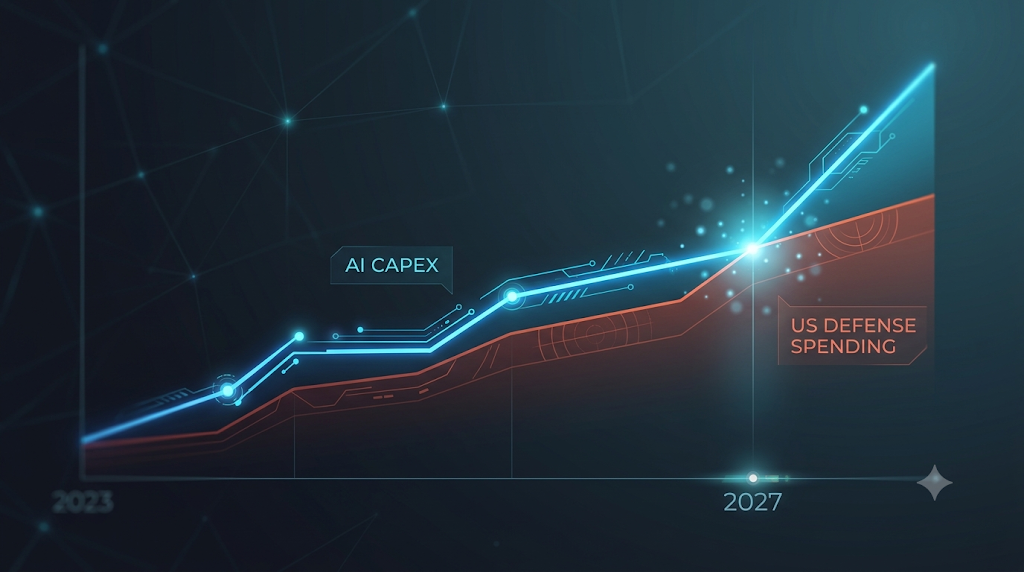
Did you know that five technology companies are on track to outspend the United States military on infrastructure? By 2027, the combined capital expenditures of Alphabet, Amazon, Meta, Microsoft, and Oracle are projected to reach 3.2% of U.S. GDP. This aggregate $1.1 trillion investment, heavily accelerated by the artificial intelligence boom, is expected to surpass projected national defense spending for the first time. This data highlights a historic macroeconomic shift, where private sector digital infrastructure investment is becoming a primary driver of global capital allocation.
The Macroeconomic Scale of Technology Investments
Comparing Corporate Expenditures to National Defense
Combined capital expenditures from major technology firms are projected to surpass the U.S. national defense budget within the next eighteen months. While national defense spending is estimated to represent approximately 2.7% of U.S. GDP next year, the top five technology companies are expanding their infrastructure budgets to support cloud and artificial intelligence capabilities. This convergence of spending trajectories reflects a notable shift in large-scale asset allocation within the U.S. economy.
Historically, military procurement constituted the largest singular driver of advanced hardware infrastructure. Today, private hyperscalers represent a dominant force in advanced technology and physical computing acquisition. The scale of this transition underlines the growing interdependence between macroeconomic stability, semiconductor manufacturing, and data center capacity.
The GDP Proportion Trajectory
The share of national GDP allocated to these corporate capital budgets is expanding at a significant pace. According to forecasting models, the combined capital expenditures of these five tech giants are projected to grow from 1.5% of GDP in 2025 to approximately 2.5% in 2026. This year-over-year trajectory highlights the capital-intensive nature of the ongoing digital infrastructure build-out.
By 2027, this figure is expected to reach 3.2% of the total U.S. economy. This accelerated investment suggests that leading technology firms view computational and data infrastructure as a core strategic necessity for long-term growth. A capital injection of this concentration within a single corporate segment has not been observed since the telecommunications expansion of the late 1990s.
The Kobeissi Letter Projections
An analysis released by The Kobeissi Letter in July 2026 highlights this shifting economic balance. Their models project that the aggregate capital expenditures of Alphabet, Amazon, Meta, Microsoft, and Oracle will reach $1.1 trillion by 2027. This data offers a quantifiable framework for evaluating the scale of the current infrastructure cycle.
The report estimates that spending for 2026 alone will exceed $800 billion. These figures illustrate the high financial entry barriers within the advanced hyperscale landscape. Smaller market participants face difficulties matching this scale of capital deployment, which heavily favors ongoing infrastructure consolidation among established industry leaders.
Breaking Down the $1.1 Trillion Infrastructure Spend
Semiconductor Procurement and Hardware Investment
Acquisition of advanced processing hardware, particularly graphics processing units (GPUs), represents one of the largest capital components within this $1.1 trillion infrastructure cycle. These specialized semiconductors are essential for training and operating large-scale language models efficiently. Alphabet, Meta, and Microsoft routinely secure hundreds of thousands of high-end units annually to sustain their computational capabilities.
Without these foundational chips, scaling next-generation artificial intelligence software remains technically unfeasible. Intense corporate competition for limited silicon supply has sustained hardware pricing at substantial premiums, guaranteeing robust revenue streams for leading chip designers over the coming years.
Data Center Construction and Structural Expansion
Physical data center development consumes a major portion of the projected budget due to the unique spatial and engineering demands of AI server clusters. Modern artificial intelligence computing requires specialized architectural layouts to accommodate high-density equipment and advanced liquid cooling mechanisms, making legacy data centers difficult to retrofit for these intense workloads. Consequently, technology firms are acquiring vast tracts of land globally to build dedicated facilities. These construction expenditures encompass reinforced structural engineering and high-bandwidth fiber optic networks, anchoring the digital AI economy into tangible, real-world real estate assets.
Power Generation and Energy Infrastructure Integration
Securing dedicated energy access has emerged as a primary strategic expense for technology firms expanding their server capacity. Artificial intelligence operations require significantly more electricity per rack than traditional cloud services. To mitigate grid constraints and guarantee uninterrupted uptime, companies are increasingly funding independent energy initiatives and utility-scale battery storage solutions. Because delays in power procurement directly bottleneck silicon deployment, tech giants are entering into multi-decade power purchase agreements (PPAs), frequently involving nuclear and renewable energy. This capital deployment effectively bridges the gap between technology investments and traditional utility infrastructure development.
Analyzing the Big Five Tech Giants
Microsoft: Strategic Infrastructure Host for Frontier AI
Microsoft allocates a substantial portion of its capital expenditure toward powering OpenAI’s frontier models and sustaining its own Copilot ecosystem. The company positions computational infrastructure as a primary competitive moat within the enterprise software sector. By ensuring scalable processing capacity for OpenAI, Microsoft maintains priority access and integration rights to leading generative models. This capital commitment has accelerated Azure's positioning as a premier cloud host for advanced AI workloads, allowing Microsoft to directly monetize these hardware assets through recurring enterprise subscriptions and cloud consumption fees.
Alphabet: Vertically Integrated Full-Stack Development
Alphabet uniquely distributes its capital across custom silicon design, data center construction, and proprietary algorithmic research. Through Google's continuous development of its Tensor Processing Units (TPUs), the company mitigates its baseline reliance on third-party semiconductor providers. This vertically integrated architecture provides Alphabet with significant cost efficiencies when deploying AI-driven features across its global user base. By controlling the underlying hardware and the Gemini model series simultaneously, Alphabet optimizes workloads specifically for its high-margin search and advertising ecosystems, partially insulating itself from external supply chain bottlenecks.
Meta: Open-Source Proliferation and Infrastructure Scale
Meta’s capital expenditure strategy focuses heavily on accumulating massive processing capacity to develop and train its open-source Llama model ecosystem. Management has committed to significant hardware procurement cycles to establish Meta as a foundational provider in the open-source research community. Unlike enterprise hyperscalers, Meta primarily leverages its AI infrastructure to enhance internal engagement and targeting capabilities across its social media platforms. By licensing powerful models openly, Meta strategically commoditizes the software layer, challenging the direct subscription revenue models of its primary cloud and software rivals.
Amazon: Cloud Leadership and Multi-Architecture Offerings
Amazon deploys its infrastructure capital defensively to protect AWS’s position as the world’s largest public cloud provider. Its investment strategy follows a dual-pronged approach, investing heavily in third-party GPU clusters while aggressively scaling its proprietary Trainium and Inferentia silicon lines. This matrix ensures that AWS can service a broad spectrum of enterprise requirements, from low-cost inference to maximum-performance training. Driven by immediate demand from its global enterprise and startup client base, Amazon's large-scale spending secures the broad compute availability necessary to remain the default backend for independent AI deployment.
Oracle: High-Performance Interconnect and Specialized Enterprise Clusters
Oracle channels its capital expenditure toward building specialized, high-performance data center environments tailored for dense AI workloads. The company has secured a highly lucrative segment of the infrastructure market by offering custom-configured server clusters optimized for exceptionally fast network interconnect speeds. This architectural advantage has allowed Oracle to win massive infrastructure hosting contracts from leading AI labs and sovereign entities. While its total spending footprint is smaller than that of Amazon or Microsoft, Oracle's targeted capital deployment prioritizes secure cloud deployments and strict data isolation, attracting regulatory, financial, and specialized development clients.
Supply Chain and Semiconductor Market Impact
Foundry Capacity and Advanced Node Bottlenecks
The $1.1 trillion capital injection creates persistent production pressures at leading global semiconductor foundries, primarily TSMC. Fabricating the most advanced AI logic processors requires cutting-edge manufacturing processes, currently focused on 3-nanometer and next-generation nodes. Because capacity on these specialized nodes is inherently finite, technology giants must secure production allocations years in advance.
This manufacturing bottleneck heavily influences the actual pace of global artificial intelligence hardware deployment. Even with significant capital reserves, hyperscalers cannot deploy infrastructure faster than foundries can physically process silicon, granting premier foundry operators substantial pricing power in the current macroeconomic landscape.
Advanced Packaging Constraints and CoWoS Integration
Advanced semiconductor packaging represents one of the most critical physical chokepoints in the AI hardware supply chain. High-performance processors rely on advanced packing methodologies, such as TSMC’s CoWoS (Chip-on-Wafer-on-Substrate) technology, to bridge high-bandwidth memory (HBM) modules directly to the logic core.
Global capacity for these precise packaging techniques remains severely constrained, directly capping total GPU and accelerator output. Consequently, industry capital expenditures are increasingly directed toward expanding dedicated backend packaging facilities to ensure that fully manufactured logic wafers do not sit idle, as the supply chain scales complex manufacturing architectures to meet hyperscaler demand.
Custom Silicon Proliferation and Architectural Shifting
To mitigate traditional supply chain vulnerabilities and reliance on single-source vendors, tech giants are channeling massive R&D budgets into developing proprietary artificial intelligence processors. Designing custom application-specific integrated circuits (ASICs) allows companies to eliminate redundant hardware features and optimize silicon specifically for their proprietary algorithmic workloads.
This transition introduces long-term structural competition for legacy, generalized semiconductor designers. While developing custom silicon requires substantial upfront engineering investments, these expenses are readily absorbed by Big Tech's infrastructure budgets, ultimately lowering long-term total cost of ownership (TCO) and restructuring the technology hardware sector.
The Energy Infrastructure Crisis
Straining the National Power Grid
The immense scale of AI capital expenditure poses significant structural challenges to the stability of the United States electrical grid. Modern artificial intelligence training clusters require massive, sustained power loads that strain localized utility infrastructure. Grid operators in high-density data center regions have voiced escalating concerns regarding transmission constraints and potential capacity shortfalls.
Technology giants are increasingly required to co-fund local grid upgrades and invest in utility-scale battery storage from their own capital budgets, as the physical limitations of electrical transmission emerge as a primary constraint on computational scaling.
Nuclear Energy Investments and SMR Development
To secure carbon-free, highly reliable baseload power, hyperscalers are actively directing capital into the nuclear energy sector. Leading technology firms have entered into landmark power purchase agreements (PPAs) to source electricity directly from nuclear facilities, partially bypassing public grid congestion to guarantee uninterrupted power for extensive training runs.
Furthermore, substantial investment is flowing into the commercialization of Small Modular Reactors (SMRs) designed to provide dedicated, scalable power directly to isolated server facilities. This pivot underscores a fundamental realignment of corporate energy procurement, establishing nuclear power as a foundational element of long-term AI infrastructure strategy.
Thermal Management and Liquid Cooling Integration
Dissipating the extreme heat generated by high-density AI processors represents a substantial portion of modern data center development costs. Because traditional air-cooling systems are thermally inadequate for handling the elevated power densities of advanced server racks, the industry is aggressively transitioning to direct-to-chip (D2C) liquid cooling architectures.
Integrating specialized plumbing and complex manifold systems directly into server environments necessitates entirely new architectural engineering and elevated upfront capital investment. This widespread mechanical overhaul is essential to prevent hardware degradation, control operational environments, and sustain optimal processor performance.
Economic and Geopolitical Implications
Redefining National Priorities and Corporate Strategic Intertwining
The massive influx of corporate capital into digital infrastructure is actively reshaping traditional frameworks of macroeconomic and geopolitical influence. As private technology firms scale expenditures beyond standard defense procurement budgets, the deployment of computational infrastructure increasingly aligns with national security interests. Establishing dominance within the digital and semiconductor landscapes is now viewed as a critical component of strategic state capability.
This financial inversion incentivizes closer collaboration between state authorities and hyperscalers to secure resilient computing networks. Consequently, modern national strategies are highly dependent on the commercial hardware and infrastructure scaled by this $1.1 trillion capital cycle, blurring the distinction between corporate assets and critical national infrastructure.
The Proliferation of the Sovereign AI Race
Nations globally are recognizing that a total reliance on foreign corporate computing infrastructure presents structural sovereign risks. In response, international governments are increasingly initiating localized, state-funded capital expenditure programs to construct domestic, state-aligned AI data centers. This paradigm shift has created a secondary, public-sector infrastructure boom running parallel to Big Tech’s investments.
These Sovereign AI initiatives seek to ensure that sensitive national data, public-sector workloads, and regional language models are processed exclusively within domestic borders using locally governed hardware. This decentralized global expansion intensifies the existing constraints on the semiconductor supply chain, ensuring that collective infrastructure and hardware spending will remain elevated for the next decade.
How to trade tech narratives on KuCoin Spot Markets
Identifying Tech-Correlated Assets
Traders can capitalize on major macroeconomic shifts in technology infrastructure by targeting digital assets that correlate with silicon and data center expansions. While tech giants' massive expenditures flow primarily into traditional infrastructure, this foundational narrative influences valuations within related Web3 infrastructure sectors. Monitoring corporate capital expenditure guidance serves as a sentiment indicator for digital markets. When hyperscalers signal sustained infrastructure build-outs, risk appetite typically expands across interconnected sectors.
focusing on:
-
Decentralized data storage protocols
-
Distributed computational networks
-
Artificial intelligence utility and agent ecosystems
Executing Spot Market Strategies
KuCoin spot markets provide an established trading venue to execute positions based on these macro trends. Utilizing the platform's advanced order types, including limit, stop-limit, and stop-market orders, allows for precise entry control and standard risk mitigation. By interpreting the capital allocations highlighted in institutional market insights, spot traders can structurally align their portfolios with the multi-year technology infrastructure cycle.For investors seeking to gain exposure to these emerging Web3 infrastructure sectors, you can create your trading account to begin exploring the spot market.
Conclusion
The historic projection that combined capital expenditures from Big Tech will reach 3.2% of U.S. GDP by 2027 marks a profound transition in global economic priorities. Alphabet, Amazon, Meta, Microsoft, and Oracle are deploying an aggregate $1.1 trillion to secure their positioning in the cloud and artificial intelligence landscapes. By expanding relative to traditional defense procurement, these corporate budgets highlight that physical computational infrastructure has emerged as a critical asset class within the modern global economy.
This substantial capital injection places pressure on the semiconductor supply chain, sustaining bottlenecks at major foundries and advanced packaging facilities. Simultaneously, the immense power density requirements of high-performance server clusters are driving tech giants to directly co-fund renewable and nuclear energy projects to mitigate localized grid constraints. The economic and geopolitical implications of this infrastructure cycle are actively reshaping how sovereign nations evaluate technological sovereignty and strategic assets.
FAQs
Why is tech capital expenditure projected to surpass U.S. defense spending?
Tech giants view artificial intelligence as an existential requirement for future market dominance, necessitating unprecedented investments in hardware and data centers. The resulting $1.1 trillion expenditure scale organically eclipses the national defense budget, reflecting a shift where digital supremacy demands more capital than traditional military procurement.
Which five companies are driving this $1.1 trillion AI investment?
Alphabet, Amazon, Meta, Microsoft, and Oracle are the five primary technology companies driving this massive capital expenditure. These corporations possess the unique cash reserves necessary to secure priority access to limited semiconductor supplies and build specialized global data center networks.
How does this massive spending affect the semiconductor supply chain?
The massive capital deployment creates severe production bottlenecks at major semiconductor foundries, strictly limiting the availability of advanced 3-nanometer and 5-nanometer logic chips. Furthermore, it completely exhausts global advanced packaging capacities, directly restricting the total output of finished graphics processing units.
Why are tech giants investing in nuclear energy for AI?
Tech giants are investing in nuclear energy because modern artificial intelligence data centers consume far more electricity than traditional power grids can safely supply. Nuclear power provides the massive, uninterrupted, and carbon-free baseload electricity strictly required to keep supercomputers running without causing regional blackouts.
Disclaimer
The information provided on this page may originate from third-party sources and does not necessarily represent the views or opinions of KuCoin. This content is intended solely for general informational purposes and should not be considered financial, investment, or professional advice. KuCoin does not guarantee the accuracy, completeness, or reliability of the information, and is not responsible for any errors, omissions, or outcomes resulting from its use. Investing in digital assets carries inherent risks. Please carefully evaluate your risk tolerance and financial situation before making any investment decisions. For further details, please consult KuCoin’s Terms of Use and Risk Disclosure.