

Next-Gen Analytics: What Differentiates Surf AI From Nansen, Dune, and Glassnode?
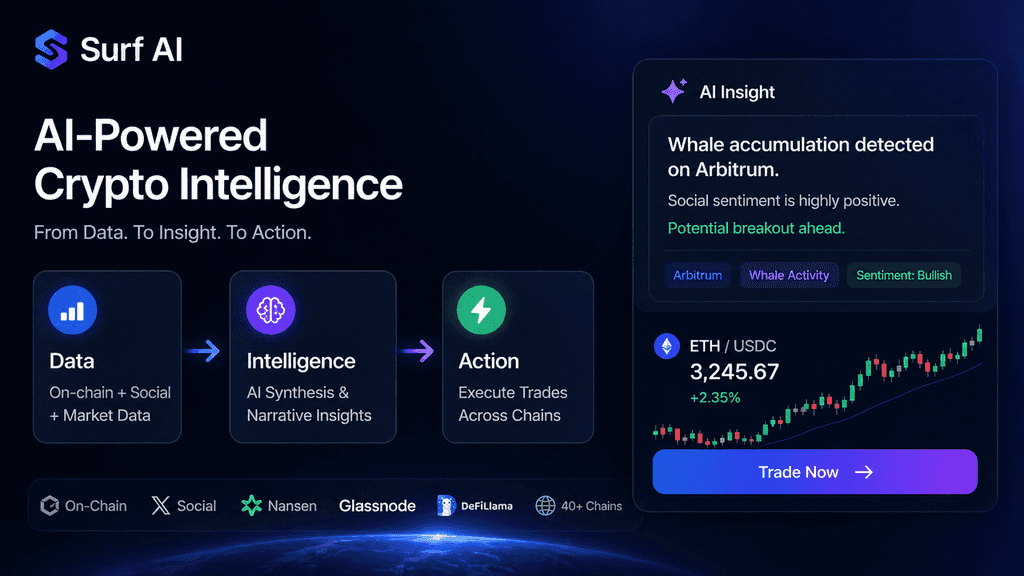
In the rapidly evolving digital asset landscape of 2026, investors are pivoting from manual data tracking to automated intelligence to maintain a competitive edge. As the market complexity grows across dozens of Layer 2 solutions and decentralized protocols, the demand for sophisticated synthesis has never been higher for retail and institutional traders who are constantly evaluating the differences between Surf AI and existing crypto analytics tools.
This deep dive explores the fundamental differences between Surf AI and existing crypto analytics tools like Nansen, Dune, or Glassnode, highlighting how AI-driven synthesis is redefining the modern trading workflow for users of leading crypto exchange platforms.
Key Takeaways:
The transition from traditional analytics to AI-native platforms represents a paradigm shift in how we consume blockchain information. For years, the industry standard was built on the "Dashboard Economy," where platforms like Nansen or Glassnode provided high-quality visualizations of raw data. However, the burden of interpretation remained entirely on the user.
In the current market, the differences between Surf AI and existing crypto analytics tools are characterized by several pivotal shifts:
-
Passive vs. Active Insight: Traditional tools show you what is happening (e.g., a spike in exchange inflows); Surf AI explains why it matters and what the likely outcome will be.
-
Siloed vs. Integrated Sources: While Nansen focuses on wallets and Glassnode on macro, Surf AI aggregates these with real-time social signals.
-
Technical Barrier vs. Conversational Ease: The move from complex SQL queries to natural language prompts.
-
Observation vs. Execution: The leap from just viewing a chart to executing a trade in the same window.
This shift is not merely about convenience; it is about reducing the "time-to-insight." In a 24/7 market, the minutes saved by an AI summarizing a complex on-chain event can be the difference between a profitable trade and a missed opportunity.
The Evolution of Insights: Narrative Synthesis vs. Raw Data Silos
The core of the differences between Surf AI and existing crypto analytics tools lies in the data architecture itself. Legacy tools were built to be "Windows into the Blockchain," providing a clear but narrow view. Surf AI was built to be a "Context Engine," connecting the dots that aren't visible on the ledger alone.
Beyond the Chart: How Surf AI Connects On-Chain Data with Social Sentiment
On-chain data tells us what the "Smart Money" is doing, but social sentiment tells us what the "Crowd" is thinking. Historically, these two worlds were separated. A trader would check Nansen's "Smart Money" flow and then manually scroll through Twitter (X) to find the catalyst.
Surf AI bridges this gap through multimodal processing. Its Cyber AI model scans over 120,000 curated X accounts, Discord channels, and Telegram groups in real-time. When it detects a significant on-chain movement, it immediately correlates it with social volume and sentiment polarity.
-
Sentiment Lag: Often, on-chain movements are a reaction to social narratives. Surf AI identifies these lead-lag relationships.
-
Contextual Alerts: Instead of a generic alert saying "Whale moved $10M," Surf AI provides an alert saying "Whale moved $10M following the project lead's resignation announcement on X."
The Knowledge Graph Advantage: Moving Past Nansen’s Labels and Glassnode’s Macro
Nansen revolutionized the industry with wallet labels, and Glassnode did the same with macro metrics like "Realized Cap." However, these are often isolated data points.
Surf AI utilizes a dynamic Knowledge Graph. This is a multidimensional map that links:
-
Entities: Founders, VCs, and prominent whales.
-
Protocols: The smart contracts and their dependencies.
-
Events: Hack incidents, governance votes, and token unlocks.
When you ask about the differences between Surf AI and existing crypto analytics tools, you must consider how Surf AI understands the relationship between these nodes. If a VC-linked wallet moves funds, Surf AI understands the historical context of that VC's vesting schedule and their previous sell patterns across different chains—something that would require hours of manual work on Nansen or Dune.
Real-Time Verifiability: Solving the AI Hallucination Problem in Crypto Research
One of the major hurdles for AI in the financial sector is the risk of "hallucination"—generating false data. This is where the differences between Surf AI and existing crypto analytics tools become a matter of trust and security.
Surf AI employs a "Search-Augmented" approach. It does not rely solely on its pre-trained memory. Instead, it performs real-time deterministic lookups.
-
Traceable Sources: Every statement made by Surf AI is backed by a citation. If it claims a protocol's TVL dropped 20%, it provides a direct link to DeFiLlama or the specific block explorer query.
-
Cross-Referencing: It compares data from multiple providers (e.g., CoinGecko and CMC) to filter out outlier data or API glitches.
-
Fact-Checking Layer: A secondary AI layer audits the output for mathematical consistency before the user sees the report.
Redefining Usability: Understanding the Differences Between Surf AI and Traditional Tools
Usability is the bridge between data and profit. The differences between Surf AI and existing crypto analytics tools are most visible in the user interface and the required "skill set" of the researcher.
From SQL Queries to Natural Language: Why Surf AI Wins on Accessibility
Dune Analytics is the "God Mode" of crypto data, but only for those who speak SQL. This creates a technical elite.
-
The SQL Barrier: On Dune, if you want to know the "retention rate of users on a specific L2 bridge," you must write or find a 50-line code query.
-
The Surf AI Solution: You simply type that question into the chat box. Surf AI's LLM translates your intent into the necessary data calls.
This democratization of data is one of the most significant differences between Surf AI and existing crypto analytics tools. It empowers the "subject matter expert" (the trader or analyst) over the "data engineer." You no longer need a degree in computer science to perform deep forensic blockchain analysis.
Workflow Aggregation: How Surf AI Replaces the "20-Tab" Research Routine
The current crypto research workflow is fragmented. A professional trader typically keeps 10 to 20 tabs open at all times. This "context switching" leads to fatigue and errors.
Surf AI functions as an Aggregator Layer. It fetches:
-
Prices from DEX Screener.
-
Whale Flows from Nansen-style trackers.
-
Historical Macro from Glassnode-style charts.
-
News from specialized crypto wires.
By condensing these into a single "Command Center," Surf AI allows for Continuous Research. You can start with a broad question about market trends and drill down into specific transaction hashes without ever leaving the page. This is a fundamental shift in the differences between Surf AI and existing crypto analytics tools—moving from a collection of tools to a singular intelligence partner.
Insight-to-Action: The Leap from "Read-Only" Analytics to On-Chain Execution
Historically, analytics and trading were separate activities. You did your research on Nansen or Glassnode, and then you went to an exchange or Uniswap to trade.
Surf AI introduces Execution Agents. This is perhaps the most disruptive of the differences between Surf AI and existing crypto analytics tools.
-
Integrated Wallets: Users can connect their non-custodial wallets directly to the Surf interface.
-
Intent-Based Execution: After a "Deep Research" session on a specific token, you can simply say, "Buy 1 ETH worth of this token and bridge it to Arbitrum."
-
Automated Safeguards: The AI can check for slippage, liquidity depth, and contract security before you sign the transaction.
This closes the loop between "Insight" and "Action," allowing traders to capitalize on alpha before it is front-run by bots or competitors.
Conclusion
In conclusion, understanding the differences between Surf AI and existing crypto analytics tools is vital for anyone navigating the complex waters of the 2026 crypto market. While legacy giants like Nansen, Dune, and Glassnode remain invaluable for providing deep, verifiable raw data and macro-economic overviews, Surf AI represents the next step in the industry's evolution. By combining the precision of on-chain data with the nuance of social sentiment and the ease of a natural language interface, Surf AI transforms "data" into "intelligence." Whether you are a retail investor looking to simplify your workflow or an institutional researcher requiring rapid synthesis, Surf AI provides an integrated, action-oriented "second brain" that traditional platforms simply cannot match. As we move forward, the competitive edge will belong to those who use AI to turn information into action in real-time.
FAQ
What are the primary differences between Surf AI and existing crypto analytics tools like Nansen?
The main differences between Surf AI and existing crypto analytics tools lie in data synthesis. Nansen provides high-quality labels for on-chain data, while Surf AI combines that data with real-time social sentiment and news to explain the "why" behind the numbers through a conversational AI interface.
How does Surf AI solve the accessibility issues found in Dune Analytics?
Dune requires users to write or understand SQL to extract custom data. One of the key differences between Surf AI and existing crypto analytics tools is that Surf AI uses natural language processing, allowing users to perform complex data queries using simple English commands instead of code.
Is Surf AI's data as reliable as the macro metrics from Glassnode?
Yes. While Glassnode specializes in proprietary macro models, Surf AI ensures reliability by citing its sources. It pulls live data from top-tier providers and provides transparent links to the blockchain, ensuring that its AI-driven insights are grounded in the same raw data used by institutional platforms.
Can Surf AI execute trades like a crypto exchange platform?
While Surf AI is not an exchange itself, it acts as an execution layer. A major point in the differences between Surf AI and existing crypto analytics tools is its ability to connect to wallets and execute swaps or bridges across 40+ chains directly from the research chat, unlike "read-only" tools like Glassnode.
Who should choose Surf AI over traditional tools?
Traders who value speed and "workflow aggregation" will find Surf AI superior. If your strategy relies on connecting social media trends to on-chain movements quickly, the differences between Surf AI and existing crypto analytics tools make it the clear choice for a more integrated and automated research experience.