

Thune: CLARITY Act Unlikely to Pass Senate Before Summer Recess
2026/07/27 17:26:00
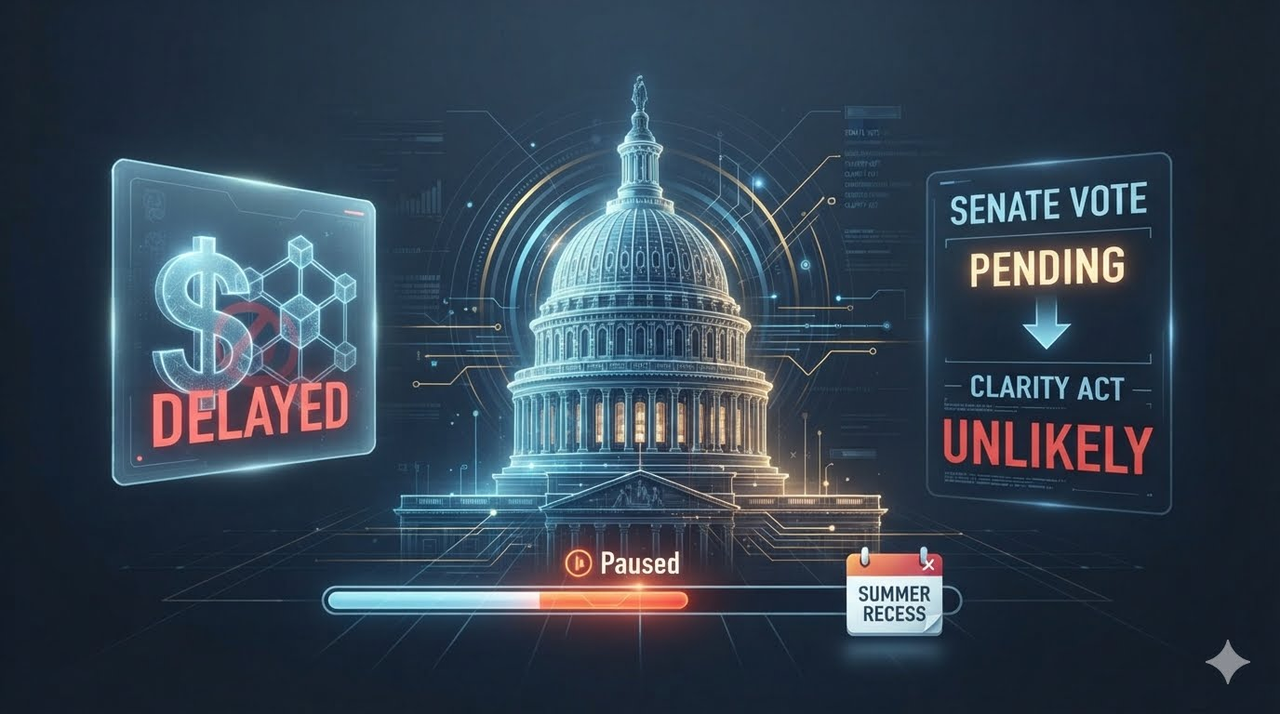
Senate Majority Leader John Thune expressed in late July 2026 that the Digital Asset Market Clarity Act, which is commonly referred to as the CLARITY Act, is unlikely to achieve final passage before the Senate’s upcoming summer recess. The effective legislative window for the chamber is set to close around August 7, after which lawmakers will shift their focus to midterm campaigning activities. Thune conveyed to reporters that he still aims to initiate the floor process on the bill before the break, emphasizing that he would like to at least get the Clarity Act started and would subsequently assess where the votes stand in terms of support. The legislation is designed to establish clearer jurisdictional boundaries between the Securities and Exchange Commission (SEC) and the Commodity Futures Trading Commission (CFTC) concerning digital assets.
More so, it aims to address various aspects of market structure, decentralization standards, and related compliance requirements that are essential for the effective regulation of digital assets. Industry observers had previously viewed the pre-recess period as the critical window for the enactment of this legislation in 2026, especially given the compressed calendar in September and the competing legislative priorities that are likely to arise. Thune’s comments represent a significant recalibration of expectations regarding comprehensive crypto market structure legislation for this year, shifting realistic prospects toward a narrower window for action after the recess, amid ongoing ethical disputes and legislative congestion that complicate the process.
Thune’s Assessment of the Pre-Recess Timeline
Senate Majority Leader John Thune assessed the remaining calendar and concluded that completing the multi-stage floor process for the CLARITY Act before the August recess presents substantial practical barriers. The Senate requires time for debate, potential amendments, and the 60-vote threshold to overcome filibuster risks, steps that typically consume several days even for less contested measures. Thune expressed a preference for initiating consideration prior to the break so the bill could resume in the brief September session, yet he acknowledged the difficulty of finishing it in the current window. Competing floor priorities, including a bipartisan Russia sanctions package, further constrain available days.
White House crypto adviser Patrick Witt responded by noting the first week of August remains theoretically open, though he concurred that a final July vote appears improbable. The majority leader’s remarks effectively lowered near-term expectations that had built around earlier committee progress and a newly circulated draft text. Lawmakers and industry groups now recalibrate advocacy efforts toward preserving momentum rather than securing immediate enactment. The assessment shows the broader challenge of advancing specialized financial legislation in a compressed pre-election calendar.
Core Objectives of the Digital Asset Market Clarity Act
The CLARITY Act aims to resolve longstanding ambiguity over which federal agency holds primary authority over various digital asset activities. Provisions seek to define when a platform qualifies as sufficiently decentralized, thereby determining whether it falls under securities or commodities oversight. The legislation addresses secondary market trading, custody standards, and safe harbors for activities such as node operation that demonstrate genuine decentralization. It also incorporates measures intended to close gaps related to entities that present themselves as decentralized while retaining centralized control over customer funds.
Supporters argue the framework would reduce enforcement-driven uncertainty that has complicated compliance planning for exchanges, developers, and institutional participants. The House advanced an earlier version of related market structure legislation in 2025 with bipartisan support, providing a foundation for Senate negotiations. Senate Banking Committee action in May 2026 moved a version forward, after which negotiators worked to merge Banking and Agriculture committee approaches. Latest draft language has focused additional attention on ethics restrictions applicable to senior government officials’ involvement with digital assets. These elements collectively seek to create a more predictable operating environment while maintaining investor protection mechanisms.
Legislative Path and Remaining Procedural Hurdles
Advancing the CLARITY Act requires navigation of the full Senate floor process after committee clearance. Once placed on the legislative calendar, the bill faces potential holds, amendment opportunities, and the necessity of securing 60 votes for cloture. Republican leadership holds a majority, yet the threshold necessitates support from a meaningful number of Democratic senators. Continued negotiations over ethics language, stablecoin-related provisions, and decentralization tests continue to shape the text and the breadth of potential support. A revised draft circulated in the days preceding Thune’s comments represented progress toward a merged product, yet several members of both parties identified remaining concerns.
Floor time itself competes with other must-consider items, including national security measures and appropriations-related work. Initiating debate before recess could lock in procedural positioning for September, when the calendar shrinks further under midterm pressures. The multi-committee origin of the text adds complexity, as differences between Banking and Agriculture approaches require reconciliation. Successful navigation of these steps would still leave House concurrence and presidential signature as subsequent requirements. The overall path remains viable but increasingly constrained by time.
Ethics Provisions and Bipartisan Friction Points
Ethics restrictions targeting senior officials’ digital asset activities have emerged as a prominent point of contention in recent negotiations. Certain Democratic senators have criticized the current formulation as insufficiently robust, particularly regarding potential conflicts involving high-level executive branch figures. Republican negotiators, including Senator Cynthia Lummis, have indicated openness to further discussion of these sections in an effort to broaden support. The temporary or permanent nature of any ethics rules remains under active consideration in the growing text. These disagreements illustrate the difficulty of crafting language that satisfies both investor-protection priorities and concerns about overreach into private economic activity.
Resolution of the ethics package is viewed by many participants as a prerequisite for securing the cross-aisle votes needed for cloture. Parallel discussions continue around stablecoin yield treatment and the precise definition of decentralized systems. Industry associations have urged leadership to move the bill forward while remaining open to refinements that address legitimate concerns. The persistence of these friction points contributes to the compressed timeline and the majority leader’s tempered outlook. Constructive compromise on ethics could still unlock additional support in the remaining days.
Competing Legislative Priorities in the Final Pre-Recess Days
The Senate calendar in late July and early August 2026 faces multiple claims on limited floor time. A bipartisan sanctions measure targeting Russian leadership, previously championed by the late Senator Lindsey Graham, ranks as an immediate priority according to leadership staff. Funeral observances and related scheduling further reduce available days. Broader national security and appropriations work typically command attention as recesses approach. The CLARITY Act, while important to the digital asset sector, competes as specialized financial market structure legislation rather than must-pass funding or defense measures.
Thune’s willingness to begin consideration reflects recognition of industry urgency, yet the practical sequencing places other items ahead. Midterm election dynamics intensify the competition, as senators allocate increasing time to campaign activities. Successful initiation of the floor process before recess would at least preserve a procedural foothold for the shorter September window. Failure to secure any floor action risks further postponement into a period dominated by election-year priorities. The allocation of remaining days will therefore determine whether the bill retains realistic 2026 viability.
Industry Expectations and Market Implications of Delay
Digital asset market participants had viewed the pre-recess period as the best opportunity to set durable federal rules in 2026. The ongoing uncertainty continues to impact investment decisions, the timing of product development, and the location of certain functions. More consistent compliance frameworks and, perhaps, more institutions could participate if jurisdictional boundaries were clearer. A delay into September raises the stakes on uncertainty, with the post-recess calendar favoring higher-profile legislation and the demands of the campaign. Some companies have already adjusted operations to the patchwork of state rules and agency enforcement patterns while they wait for comprehensive federal guidance.
The possibility of not meeting the preferred window has renewed advocacy that emphasizes the need to preserve momentum, not to expect near-term enactment. Market observers say better conditions for secondary trading and related infrastructure go hand in hand with regulatory clarity. Participants continue to consider legislative progress in forward assessments, with broader market indicators, including moves in the bitcoin price, also being monitored. This time compression makes it all the more important for Thune to make whatever procedural progress he can prior to the break. The bill needs continued support from the industry and supportive legislators to keep it alive.
Context of Market Structure Negotiations
Efforts to establish comprehensive digital asset market structure rules have spanned multiple Congresses and successive committee drafts. The House advanced a version with substantial bipartisan support in 2025, creating a legislative foundation. Senate Banking Committee action in May 2026 represented the most significant upper-chamber progress to date, followed by efforts to harmonize approaches with the Agriculture Committee. Earlier stablecoin-focused legislation, the GENIUS Act, provided a partial precedent for bipartisan digital asset work yet left broader market structure questions unresolved.
The current CLARITY text builds on those experiences by attempting to address secondary markets, decentralization tests, and agency coordination in a single package. Repeated cycles of negotiation have refined certain technical provisions while leaving core jurisdictional and ethics questions subject to ongoing discussion. Prediction market odds for 2026 passage have fluctuated with each procedural development, reflecting the sensitivity of outcomes to calendar and vote counts. The pattern illustrates both the persistence of demand for clearer rules and the difficulty of finalizing complex financial legislation under political time constraints. Lessons from prior efforts inform the present negotiations over remaining contested sections. Continued refinement of the text remains possible even as the calendar tightens.
Potential September Window and Election-Year Constraints
If the Senate initiates floor consideration before recess, a limited September window could still allow completion of the process. The post-recess period typically lasts only a few weeks before attention fully shifts to November midterms. Must-pass spending measures and other high-priority items will claim substantial time, leaving limited capacity for specialized legislation. Election-year dynamics often reduce appetite for complex, potentially contentious votes that require bipartisan cooperation. Successful navigation would still require House action on any final Senate product and subsequent presidential consideration.
Thune’s stated desire to begin the process acknowledges this constrained pathway while preserving an option that would otherwise close. Industry groups continue to emphasize the economic value of resolving regulatory uncertainty ahead of the election cycle. The narrower window elevates the importance of resolving remaining text disputes quickly so that any floor debate can focus on final passage rather than extensive amendment. Political incentives for both parties will shape willingness to allocate scarce September days. The outcome will depend on leadership prioritization and the ability to demonstrate sufficient vote support early in the process.
Role of Democratic Support in Securing Cloture
Passage of the CLARITY Act requires approximately 60 votes, making Democratic participation essential under current Senate rules. A limited number of Democratic senators have previously supported related committee advances, yet broader caucus concerns over ethics language and certain market provisions persist. Negotiators have indicated that targeted revisions could expand the pool of potential yes votes. The absence of a firm bipartisan deal at the time of Thune’s comments contributes to uncertainty about cloture prospects. Some Republican senators have also raised questions regarding stablecoin yield and related technical language, further complicating vote counts.
Leadership must therefore balance the desire for a clean text against the need for sufficient cross-aisle support. Public statements from key Democratic members have shown remaining shortcomings while leaving open the possibility of further discussion. Industry advocates have encouraged constructive engagement to address legitimate concerns without undermining core market structure objectives. The ability to demonstrate a viable path to 60 votes will influence how much floor time leadership ultimately allocates. Resolution of these dynamics remains central to any realistic advancement timeline.
Imputation for Digital Asset Market Participants
Continued delay in establishing comprehensive federal rules extends the period of operational uncertainty for exchanges, developers, custodians, and institutional investors. Firms must maintain compliance programs calibrated to evolving enforcement patterns and state-level requirements while planning for eventual federal standards. Clearer definitions of agency jurisdiction would reduce the risk of conflicting expectations and support more efficient product development. The current environment has encouraged some activity to migrate toward jurisdictions with more established frameworks, a trend that clearer U.S. rules could potentially moderate.
Market infrastructure providers monitoring conditions such as how crypto futures leverage works and related risk parameters continue to operate under existing guidance pending new legislation. Institutional capital allocation decisions often incorporate regulatory timeline assessments as a material factor. The CLARITY Act’s progress or further postponement will therefore influence near-term strategic planning across the sector. Participants remain engaged with lawmakers to emphasize the economic and competitive implications of prolonged ambiguity. Adaptation strategies developed during the current period will shape readiness once any final framework emerges.
Broader Political and Calendar Dynamics
The 2026 midterm elections exert increasing influence over the Senate’s remaining legislative capacity. Members allocate growing time to campaign activities, reducing appetite for extended floor debates on specialized subjects. Leadership must balance the interests of industry stakeholders seeking clarity against the political realities of an election year. Prioritization of national security and fiscal measures reflects standard end-of-session dynamics that frequently sideline less urgent bills. Thune’s comments accurately reflect these structural constraints while leaving open a narrow procedural path.
External advocacy, including joint letters from industry associations, continues to urge floor consideration as a means of maintaining momentum. The interaction between legislative calendars, vote arithmetic, and election incentives will largely determine whether the CLARITY Act advances this year. Observation of how competing measures are sequenced in the final pre-recess days will provide early signals of relative priority. The overall environment underscores the challenge of enacting complex financial market reforms under compressed timelines.
Outlook for Continued Negotiations and Advocacy
Despite the tempered timeline assessment, negotiations over remaining text provisions continue among key senators and staff. Openness to further discussion of ethics and related sections creates space for potential compromise that could expand support. Industry organizations maintain active engagement with leadership offices to underscore the importance of initiating floor action. Any procedural steps taken before recess would strengthen the bill’s positioning for the limited September period. Prediction market assessments have adjusted to reflect the reduced near-term probability while still assigning meaningful residual odds to eventual 2026 enactment.
The combination of technical refinement and political advocacy will shape whether the legislation retains viability. Stakeholders monitoring related market conditions, including the differences between isolated and cross-margin approaches in trading environments, continue to prepare for multiple regulatory scenarios. Sustained focus on resolving discrete points of disagreement remains the most constructive path forward. The coming weeks will clarify whether leadership can translate the desire to begin consideration into concrete floor time.
Join KuCoin 9th Anniversary Trading Campaign
KuCoin is celebrating its 9th anniversary with a special platform campaign filled with exclusive rewards, trading activities, and limited-time offers. Don’t miss the chance to participate and enjoy the benefits as the exchange marks nine years of growth and innovation. Visit the official campaign page now:

FAQs
What are the primary remaining obstacles to advancing the CLARITY Act?
Key challenges include unresolved differences over ethics restrictions on senior officials’ digital asset activities, the need to secure approximately 60 votes for cloture, competition for limited floor time from other bills, and the technical refinement of decentralization and stablecoin-related provisions.
How would successful passage of the CLARITY Act affect digital asset market structure?
The legislation would establish clearer jurisdictional lines between the SEC and CFTC, define standards for decentralized systems, and create more predictable rules for secondary market activity and custody, thereby reducing reliance on enforcement actions and state-level variation.
What happens if the bill does not advance before the recess?
Further delay would push consideration into a compressed September window already crowded with other priorities and election-year dynamics, substantially lowering the probability of final 2026 enactment and extending the period of regulatory uncertainty for market participants.
Why is the CLARITY Act considered important for the U.S. digital asset industry?
The CLARITY Act is intended to provide a comprehensive regulatory framework that clearly defines the responsibilities of the SEC and CFTC over digital assets. Supporters believe this would reduce legal uncertainty, improve compliance planning, encourage institutional participation, and strengthen the competitiveness of the U.S. digital asset market.
Could the CLARITY Act still become law in 2026 despite the current delay?
Yes. Although Senate leadership believes final passage before the August recess is unlikely, the legislation could still advance if floor consideration begins before the break and negotiations resolve key issues during the limited September session. However, election-year priorities and a crowded legislative calendar make the remaining path significantly more challenging.
Disclaimer
The information provided on this page may originate from third-party sources and does not necessarily represent the views or opinions of KuCoin. This content is intended solely for general informational purposes and should not be considered financial, investment, or professional advice. KuCoin does not guarantee the accuracy, completeness, or reliability of the information, and is not responsible for any errors, omissions, or outcomes resulting from its use. Investing in digital assets carries inherent risks. Please carefully evaluate your risk tolerance and financial situation before making any investment decisions. For further details, please consult KuCoin’s Terms of Use and Risk Disclosure.