

The April 2026 Crypto Report: A KuCoin Strategic Insight
2026/04/08 12:03:02
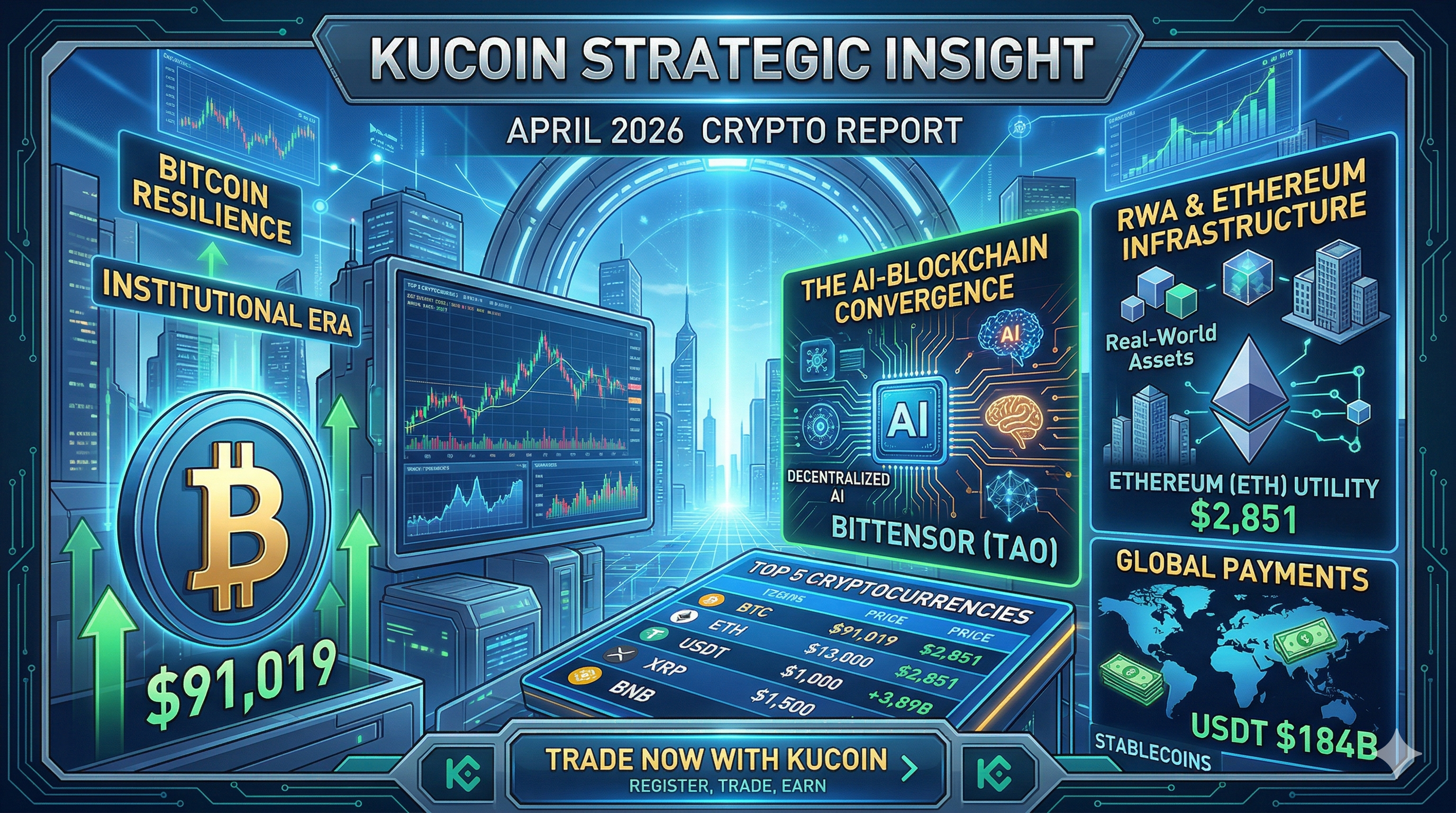
The digital asset landscape in April 2026 stands at a historic crossroads. The market has transcended the volatile "wild west" phase of previous cycles, maturing into a sophisticated, institutional-grade financial ecosystem. This month, we observed the convergence of three seismic shifts: the full-scale integration of Artificial Intelligence (AI) with blockchain infrastructure, the stabilization of Bitcoin as a primary macro asset, and the implementation of definitive regulatory frameworks across the globe.
As we navigate the complexities of April, the interplay between on-chain innovation and macroeconomic policy has never been more critical. This report provides a deep-dive analysis of these trends, backed by the latest market data, to equip you with the strategic insights necessary for the current cycle.
Key Takeaways
-
The New Bitcoin Floor: Bitcoin (BTC) has established a robust support base above $90,000, transitioning from a speculative vehicle to a "leading price-setter" in global finance, dictated by institutional flows rather than retail hype.
-
The AI-Blockchain Nexus: Decentralized AI infrastructure, led by protocols like Bittensor (TAO) and Render (RENDER), has emerged as the dominant growth sector of 2026, with verifiable revenue models replacing pure narrative speculation.
-
Regulatory Maturity: The joint SEC-CFTC ruling in March 2026 has provided unprecedented jurisdictional clarity in the U.S., while the EU’s MiCA enforcement creates a standardized "passporting" environment for crypto services.
-
Ethereum’s Infrastructure Pivot: Ethereum remains the settlement layer of choice for Real-World Assets (RWA), bolstered by the "Glamsterdam" upgrade which further optimizes Layer-2 scaling and user experience.
-
Strategic Action: In this high-stakes environment, selecting the right partner is paramount. KuCoin provides the deep liquidity and diverse asset selection required to navigate the AI and RWA sectors effectively.
-
Macro Analysis: The "Institutionalization" of 2026
In April 2026, the total cryptocurrency market capitalization has consolidated around $3.5 trillion. Unlike the 2021 bull run, which was fueled by stimulus checks and retail FOMO, the current market is supported by the "Three Pillars of Stability": Spot ETFs, Sovereign adoption, and Enterprise-grade DeFi.
Bitcoin (BTC): The Digital Gold Barometer
Bitcoin enters the second week of April trading at approximately $91,019. The narrative of "halving cycles" has been superseded by "liquidity cycles." With spot BTC ETFs now managing over $150 billion in assets, Bitcoin has become a standard component of 60/40 institutional portfolios.
Bitcoin Performance & Volatility Matrix (April 2026)
| Metric | Value | 30-Day Trend | Significance |
| Spot Price | $91,019 | 0.042 | Testing 95k Resistance |
| Market Cap | $1.38 Trillion | Stable | Larger than most S&P 500 firms |
| ETF Net Inflows | $230M (Daily Avg) | Increasing | Sustained institutional demand |
| Realized Volatility | 42% | Decreasing | Becoming a mature macro asset |
| Fear & Greed Index | 72 (Greed) | Rising | Retail interest returning |
| Active Addresses | 1.1M | 0.085 | Increasing network utility |
| Funding Rate | 0.01% | Neutral | Low risk of immediate liquidation cascade |
Source: Compiled from Aggregate Exchange Data & Institutional Flow Trackers (April 8, 2026).
The Fed and the "Soft Landing"
Market participants are closely watching the Federal Reserve's stance on interest rates. In early 2026, the "soft landing" of the U.S. economy has emboldened risk-on sentiment. However, Bitcoin is increasingly behaving as a hedge against fiat debasement as global debt levels continue to climb.
-
Sector Deep-Dive: Decentralized AI (DeAI)
The most significant trend of April 2026 is the explosion of the DeAI sector. The realization that centralized AI entities (like OpenAI or Google) create data monopolies has driven capital toward decentralized alternatives.
The Rise of Compute & Intelligence Marketplaces
Projects that provide the "fuel" (GPU power) and the "brains" (model training) for AI are seeing record-breaking on-chain activity.
Bittensor (TAO): In early 2026, Bittensor's Templar subnet completed the largest LLM (Large Language Model) training run ever recorded on a decentralized network. This proved that peer-to-peer networks can rival centralized server farms.
Render Network (RENDER): As AI inference demands skyrockets, Render has successfully pivoted from being just a "CGI tool" to a primary provider of GPU compute for AI startups.
Fetch.ai (ASI): The merger of the Artificial Superintelligence Alliance has created a unified ecosystem for autonomous AI agents capable of executing complex financial transactions on-chain.
Leading AI Infrastructure Tokens (April 2026)
| Asset | Current Price | Market Cap | Q1 2026 Growth | Core Utility |
| Bittensor (TAO) | $645.20 | $4.2B | 0.56 | Decentralized Model Marketplace |
| Render (RENDER) | $12.45 | $5.1B | 0.38 | Distributed GPU Compute Power |
| Fetch.ai (ASI) | $2.85 | $6.4B | 0.67 | Autonomous AI Agent Frameworks |
| Grass (GRASS) | $1.90 | $850M | 0.29 | Decentralized AI Data Pipelines |
| Ocean Protocol (ASI) | $1.75 | $1.1B | 0.42 | Data Monetization for AI Training |
Source: WazirX & Zerocap Market Reports (March/April 2026).
-
Ethereum and the Layer-2 Renaissance
While Bitcoin captures the "Store of Value" headline, Ethereum is winning the "Utility" war. The Glamsterdam upgrade, deployed in the first half of 2026, has introduced "Smart Accounts" as a native feature, making crypto wallets as easy to use as a standard banking app.
Tokenization of Real-World Assets (RWA)
By April 2026, the tokenization of U.S. Treasuries, real estate, and private equity have surpassed $20 billion on the Ethereum network. Major financial institutions like BlackRock and JP Morgan are now using Ethereum-based Layer-2s (such as Base and Arbitrum) to settle secondary market trades.
The Staking Economy
The Ethereum staking yield has stabilized around 3.5% - 4.2%, providing a "risk-free rate" for the crypto ecosystem. This has led to the rise of Liquid Staking Tokens (LSTs) and Re-staking protocols, which allow users to maximize capital efficiency.
To capitalize on these yields without the technical hurdle of running a node, savvy investors are turning to KuCoin. The platform provides a seamless entry point into professional-grade staking and savings products, offering some of the most competitive APYs in the industry for ETH and stablecoin holdings.
-
Regulatory Landscape: The Great Consolidation
The "Regulatory Fog" of 2023–2024 has largely lifted. In March 2026, a landmark joint ruling by the SEC and CFTC classified 16 major digital assets—including BTC, ETH, and XRP—as "Digital Commodities."()
US vs. EU: Different Paths, Same Goal
United States: The focus has shifted to market integrity and surveillance. Federal stablecoin legislation (the GENIUS Act) has finally provided a legal path for banks to issue their own USD-backed tokens.
European Union: The MiCA (Markets in Crypto-Assets) framework is now fully enforceable. This has forced smaller, unregulated "fly-by-night" exchanges out of the European market, leaving only the most transparent and compliant platforms.
Asia: Hong Kong and Singapore have solidified their status as the "Crypto Hubs of the East," attracting billions in venture capital through clear licensing for RWA and Web3 gaming.
-
Stablecoins: The Global Liquidity Rail
Stablecoins have evolved from being "trading collateral" to becoming the primary rail for global payments. In April 2026, stablecoin transaction volume has exceeded $5 trillion annually, rivaling traditional payment processors like Visa.
The Multi-Polar Stablecoin World
USDT (Tether): Remains the king of liquidity, particularly in emerging markets where it serves as a "Digital Dollar" for those with limited access to banking.
USDC (Circle): The preferred choice for Western institutional settlement due to its rigorous compliance and transparency reports.
PYUSD & Bank-Issued Stables: These are increasingly used for "on-ramp" and "off-ramp" activities, bridging the gap between traditional bank accounts and DeFi.
Stablecoin Market Composition (April 2026)
| Stablecoin | Market Cap | Primary Network | Key Use Case |
| USDT (Tether) | $184 Billion | TRON / ETH | Global Remittances & CEX Liquidity |
| USDC (Circle) | $62 Billion | ETH / Solana | Institutional DeFi & US Regulatory Compliance |
| DAI/SKY | $12 Billion | Ethereum | Decentralized Lending & Over-collateralized Stability |
| PYUSD (PayPal) | $4.5 Billion | ETH / Solana | Consumer E-commerce & Merchant Payments |
Source: TRM Labs 2026 Adoption Report.
-
Strategic Trading and Portfolio Management
As the market enters a "post-peak consolidation phase" in April 2026, the strategy for successful investors has shifted from High-Leverage Speculation to Yield-Centric Accumulation.
Why the "Hype Phase" is Ending
In previous cycles, "Meme Coins" could sustain 10,000% gains for months. In 2026, while memes still exist (primarily on high-speed chains like Solana), the "Smart Money" is focused on assets with Verifiable On-Chain Revenue (VOC). If a protocol does not generate fees or provide a service (like AI compute), its valuation is quickly corrected by institutional short-sellers.
Tools for the Modern Trader
Successful participants are using:
Automated Trading Bots: To capture volatility in the $90,000–$95,000 Bitcoin range.
Structured Products: Using "Call Overwriting" strategies to generate yield on flat market days.
Cross-Chain Aggregators: Find the best prices across the fragmented L2 landscape.
For those looking to access the most innovative projects—including early-stage AI tokens and RWA protocols—KuCoin remains the premier choice. With a reputation as the "People’s Exchange," it offers access to over 700 assets and advanced trading features that allow you to stay ahead of the curve.
Conclusion: The Road Ahead
April 2026 is a testament to the resilience and ingenuity of the cryptocurrency industry. We have moved past the era of doubt and entered an era of Operational Reality. The integration of AI, the clarity of regulation, and the explosion of real-world tokenization have created a market that is more robust, transparent, and accessible than ever before.
As we look toward the remainder of the year, the "winners" will be those who prioritize infrastructure over hype and utility over speculation. By staying informed through strategic reports and utilizing world-class trading platforms, you are positioned not just to survive the market dynamics of 2026, but to thrive within them.
FAQs
Q1: Is Bitcoin still a good investment at $90,000?
In April 2026, Bitcoin is viewed less as a "get rich quick" scheme and more as a "Store of Value" similar to gold. While 10x returns from here are unlikely in the short term, Bitcoin’s role as a hedge against global economic instability makes it a staple for long-term wealth preservation.
Q2: What makes AI crypto different from previous "bubbles"?
The 2026 AI cycle is backed by real demand.() Centralized AI companies are facing a shortage of GPU power and data; decentralized protocols like Render and Grass are providing tangible solutions to these problems.() Look for projects with "live" subnets and verifiable revenue.
Q3: How has the Ethereum "Glamsterdam" upgrade changed things?
The upgrade focused on "Chain Abstraction." This means users no longer need to know which Layer-2 they are using; the wallet handles all cross-chain logic in the background. This has drastically lowered the barrier to entry for non-technical users.
Q4: Are stablecoins safe under the new 2026 regulations?
Yes. Regulation (like MiCA in the EU and the GENIUS Act in the US) requires major stablecoin issuers to hold 1-to-1 liquid reserves in government-approved assets. This has significantly reduced the risk of a "de-pegging" event like those seen in earlier years.
Q5: How can I earn passive income in a sideways market?
April 2026 is a "yield hunter's market." You can use liquid staking (staking your ETH while keeping a tradable token) or use platforms like KuCoin to deposit stablecoins into high-yield savings accounts that benefit from institutional borrowing demand.
Disclaimer: The content provided in this report is for informational purposes only and does not constitute financial, investment, or legal advice. Cryptocurrency markets are subject to high volatility and risk. You should consult with a professional financial advisor and perform your own due diligence before making any investment decisions.