



a16z Crypto Leads $300M Digital Asset Funding Round at $2B Valuation: What It Means for Canton Network
2026/05/12 02:57:02
Introduction
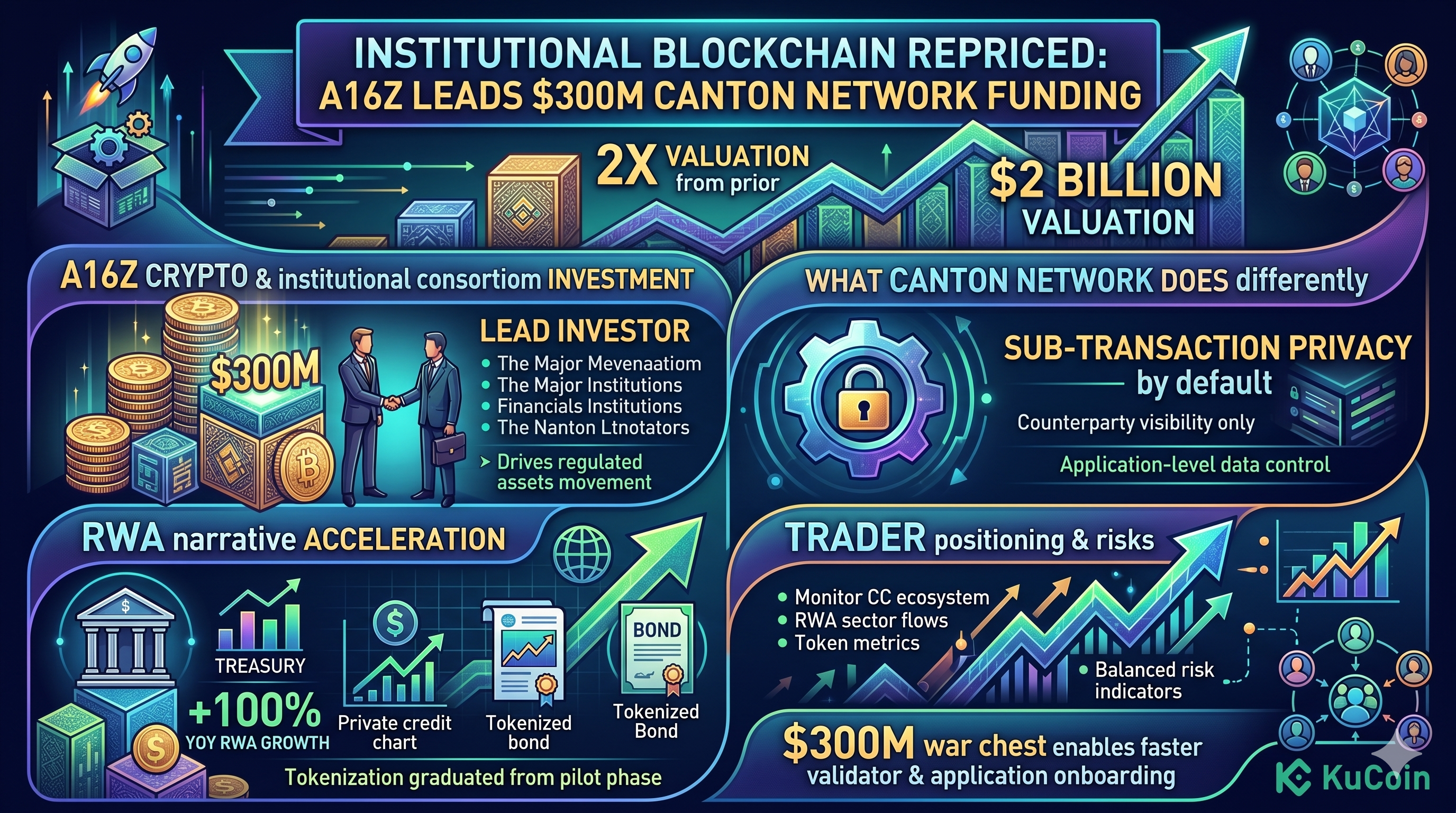
A single funding round just repriced the entire institutional blockchain category. Andreessen Horowitz's crypto arm (a16z Crypto) has led a $300 million investment into Digital Asset Holdings, valuing the company behind the Canton Network at $2 billion — one of the largest enterprise blockchain raises in recent memory, according to reporting circulating across crypto media in May 2026.
The capital is earmarked for scaling Canton Network, a privacy-enabled public blockchain purpose-built for tokenized real-world assets (RWAs) and regulated institutional finance. Backers reportedly include DRW, Tradeweb, BNP Paribas, Citadel Securities, Goldman Sachs, and DTCC — a who's-who of traditional finance, signaling that institutional adoption of tokenization has moved from pilot phase to balance-sheet commitment.
This article breaks down the deal, why a16z Crypto led it, what Canton Network actually does differently, and what it means for traders watching the next leg of the RWA narrative.
What Is the a16z Crypto-Led $300M Digital Asset Funding Round?
The $300 million Series E values Digital Asset Holdings at approximately $2 billion post-money, with a16z Crypto leading and a consortium of major financial institutions participating. The round, reported in May 2026, more than doubles Digital Asset's valuation from prior financings and ranks among the top five enterprise blockchain raises since 2024.
Who Participated in the Round?
The investor list reads like a tier-one banking syndicate. Alongside a16z Crypto as lead investor, participating firms reportedly include:
-
DRW and Citadel Securities — leading proprietary trading firms
-
Tradeweb — the institutional electronic trading platform
-
BNP Paribas and Goldman Sachs — global investment banks
-
DTCC — the central securities depository handling most US equity settlement
This is notable because these are not passive financial backers. Each participant operates infrastructure that touches trillions of dollars in daily settlement flows. Their participation suggests Canton is being positioned not as a speculative bet but as future market plumbing.
What Will the Capital Be Used For?
Digital Asset plans to use the proceeds to scale Canton Network validator infrastructure, expand its developer ecosystem, and accelerate the onboarding of tokenized asset issuers. The company has indicated that a portion of the funds will support privacy primitives — specifically, mechanisms that let institutions transact on a public chain without leaking trade-sensitive data to competitors.
Why Did a16z Crypto Lead This Investment?
a16z Crypto led the round because Canton Network solves the single biggest blocker keeping regulated institutions off public blockchains: data privacy combined with regulatory auditability. Most public chains broadcast every transaction. For a bank moving client collateral or a trading firm executing a repo, that transparency is a non-starter.
a16z's Thesis on Institutional Blockchain
a16z Crypto has been increasingly vocal that the next trillion-dollar layer of crypto value will come from regulated assets moving onchain, not from new memecoins. Partners at the firm have publicly argued that tokenization of treasuries, money market funds, and private credit will be the dominant onchain growth vector through 2027.
Canton fits that thesis precisely. It is one of the few networks where:
-
Each transaction is private by default
-
Counterparties can selectively disclose to regulators or auditors
-
Settlement finality is deterministic and atomic across asset classes
The Track Record Behind the Bet
Canton already processes meaningful institutional volume. According to disclosures referenced in industry coverage during Q1 2026, more than $4 trillion in tokenized assets have been registered or transacted across Canton's connected applications, with participants including major asset managers, banks, and exchanges. That existing footprint substantially de-risks the a16z thesis compared with funding a pre-revenue protocol.
What Is Canton Network and How Does It Work?
Canton Network is a privacy-enabled, interoperable public blockchain designed specifically for regulated financial assets. Unlike Ethereum or Solana, where every transaction is globally visible, Canton uses a sub-transaction privacy model where only counterparties and explicitly authorized parties see transaction details.
The Core Technical Architecture
Canton is built on Daml, Digital Asset's smart contract language, which encodes the rights and obligations of each party directly into contract logic. The network operates through a federation of validators run by participating institutions rather than a single global state machine.
Three properties distinguish Canton from general-purpose L1s:
-
Application-level privacy — transaction data is shared only with parties that have a need to know
-
Atomic composability across applications — a tokenized bond on one application can settle against cash on another in a single atomic transaction
-
Permissioned validators with public accessibility — anyone can build applications, but validators are operated by regulated entities
Canton Coin and the Economic Layer
Canton Coin (CC) is the native utility token used to pay for network resources and reward validators and application providers. Unlike speculative L1 tokens, Canton Coin's design ties value accrual directly to the volume of regulated assets transacted on the network. The token began trading on select venues in 2024 and has seen steadily growing institutional and retail interest in 2025-2026 as RWA narratives expanded.
How Does This Funding Boost Canton Network?
The $300 million injection accelerates Canton's transition from a consortium-led network to a mature institutional financial market infrastructure. Three specific effects matter most for traders and developers.
Faster Validator and Application Onboarding
Capital allows Digital Asset to subsidize validator economics during the bootstrap phase and to underwrite integration costs for new asset issuers. Industry observers expect a meaningful acceleration in the number of live applications — particularly in tokenized money market funds, repo, and collateral mobility — during the second half of 2026.
Stronger Competitive Position Against Rivals
Canton now competes more directly with permissioned offerings from other enterprise chains and with institutional Ethereum L2s targeting RWA settlement. The combination of a16z's brand, the institutional cap table, and a fresh $300 million war chest gives Canton a credibility moat that competitors will struggle to match in the short term.
Validation for the Broader RWA Narrative
The deal is being read by markets as confirmation that institutional tokenization is structurally underpriced. According to data referenced by RWA.xyz in early May 2026, the total value of tokenized real-world assets onchain has surpassed $30 billion, more than doubling year-over-year. A $2 billion valuation for the infrastructure layer beneath that growth looks defensible — and potentially conservative — if the trend continues.
Who Are the Competitors and How Does Canton Compare?
Canton's main competition comes from three categories: permissioned enterprise chains, institutional-focused public L1s, and tokenization-specific L2s. Canton differentiates primarily on privacy and atomic cross-application settlement.
|
Network Type
|
Example
|
Privacy Model
|
Primary Use Case
|
|
Privacy-enabled public L1
|
Canton Network
|
Sub-transaction privacy by default
|
Regulated RWA settlement
|
|
General-purpose public L1
|
Ethereum
|
Fully transparent
|
Broad smart contracts, DeFi
|
|
Institutional L2
|
Various RWA L2s
|
Optional / ZK-based
|
Tokenized treasuries, funds
|
|
Permissioned chain
|
Corda, Hyperledger
|
Network-level permissioning
|
Bilateral institutional workflows
|
The key question for the next 18 months is whether institutions ultimately consolidate on a single privacy-native chain like Canton or fragment across multiple Ethereum-aligned L2s using zero-knowledge privacy. The a16z investment is a clear vote for the former path.
What Does This Mean for Crypto Traders?
For traders, the funding round signals three actionable themes: continued capital rotation into RWA-related tokens, growing legitimacy for privacy-enabled infrastructure plays, and a likely repricing of Canton Coin and adjacent ecosystem assets.
Implications for the RWA Sector
Tokens associated with real-world asset infrastructure have outperformed broader crypto benchmarks over the past two months, with sector indices tracked by major analytics providers showing meaningful relative strength versus large-cap majors. Capital that institutional investors deploy into private equity rounds like this Digital Asset raise typically foreshadows public-market interest in liquid tokens with comparable exposure.
Canton Coin and Ecosystem Tokens
Canton Coin specifically benefits from increased application count, higher network throughput, and the marketing halo of a tier-one venture round. Traders should monitor:
-
Validator participation growth
-
Number of new applications launched on Canton
-
Tokenized asset value transacted on the network monthly
-
Secondary listing announcements across major exchanges
Risks Traders Should Weigh
This is not a one-way trade. Regulatory frameworks for tokenized securities remain incomplete in major jurisdictions, institutional rollouts move slower than retail crypto cycles, and competition from Ethereum-aligned RWA infrastructure is intensifying. Position sizing should reflect these structural uncertainties.
Conclusion
The a16z Crypto-led $300 million investment into Digital Asset Holdings at a $2 billion valuation is one of the most important institutional blockchain transactions of 2026. It validates Canton Network's privacy-first architecture, brings tier-one financial institutions onto the cap table alongside crypto-native capital, and signals that tokenization of real-world assets has moved decisively from experimentation to scale-up phase.
For Canton specifically, the funding accelerates validator economics, application onboarding, and competitive positioning against both permissioned chains and Ethereum-aligned RWA L2s. For the broader market, the deal reprices the institutional blockchain category and reinforces a thesis that the next leg of crypto growth comes from regulated assets moving onchain rather than from speculative retail cycles.
Traders should watch Canton Coin metrics, RWA sector flows, and follow-on institutional announcements closely. While risks around regulation, execution pace, and competing standards remain real, the structural direction is clear — and a $300 million vote of confidence from a16z and the world's largest financial institutions is not easily dismissed.
FAQs
Is Canton Coin available on major exchanges?
Canton Coin has been listed on a growing number of venues since its initial trading debut in 2024, with liquidity expanding across both centralized and decentralized markets through 2025-2026. Traders should verify current listings on their preferred exchange before transacting, as availability varies by jurisdiction.
How is Canton Network different from a private permissioned blockchain?
Canton is a public network with permissioned validators, not a private chain. Anyone can build applications and participate as a user, but validators are operated by regulated institutions. This hybrid model preserves censorship resistance and global accessibility while delivering the privacy and accountability that regulated finance requires.
What is Digital Asset Holdings' relationship to Canton Network?
Digital Asset Holdings is the original developer of Daml, the smart contract language powering Canton, and remains a core contributor to the network's protocol development. However, Canton itself is governed by the Global Synchronizer Foundation and operated by a distributed set of validator participants — not by Digital Asset alone.
Could this deal trigger more a16z investments in RWA infrastructure?
Yes, and observers expect it to. a16z Crypto has signaled across published research that tokenization of regulated assets is one of its highest-conviction multi-year themes. Additional investments in tokenized asset issuers, compliance infrastructure, and institutional DeFi protocols are likely follow-ons over the coming quarters.
What are the biggest risks to Canton Network's growth thesis?
The largest risks are regulatory fragmentation across jurisdictions, slower-than-expected institutional rollout timelines, and competition from Ethereum-aligned L2s using zero-knowledge proofs to deliver comparable privacy. A failure to grow active applications and transacted volume in line with valuation expectations would also pressure both equity holders and Canton Coin holders.