

a16z Crypto Fund 5: What Its $2.2B Bet Means for EigenCloud, Stablecoins, and Asset Tokenization
Introduction: What Happened to a16z crypto fund?
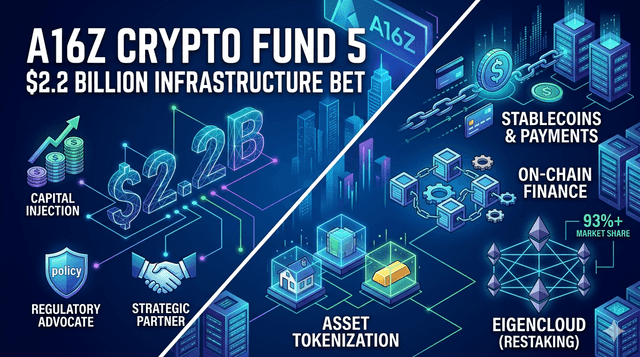
In May 2026, Andreessen Horowitz (a16z) announced a $2.2 billion fifth crypto fund despite a 20.4% quarterly decline in total crypto market capitalization, according to CoinGecko's Q1 2026 industry report . The fund targets stablecoins, on-chain finance, payments, and asset tokenization — the sectors a16z believes will produce "more of the lasting value" during quieter market cycles, as stated in the firm's official announcement. For investors tracking EigenCloud, stablecoins, and real-world asset (RWA) tokenization, this capital injection signals accelerated infrastructure development and stronger institutional validation.
This article breaks down exactly how a16z's $2.2 billion commitment affects the assets and infrastructure you care about.
For readers who want to know more background information, the below are the recommended readings:
-
"What is EigenCloud" explains the restaking protocol formerly known as EigenLayer and its critical role in Ethereum's security stack.
-
"Stablecoins Guide" covers how dollar-backed tokens are becoming the default payment rail for on-chain finance and why a16z is doubling down on them.
-
"Real World Asset Tokenization" examines how traditional assets are moving onto blockchains and what that means for liquidity and access.
What Is a16z? And Why Is It Often Mentioned in the Crypto Industry?
a16z (Andreessen Horowitz) is the largest dedicated crypto venture capital firm by cumulative capital deployed, and it is frequently mentioned in blockchain circles because its bets often define the next cycle's winners. Founded in 2009 by Marc Andreessen and Ben Horowitz, the firm manages over $40 billion in assets and has applied a full-service investment model to crypto since 2013, when it first backed Coinbase.
The crypto division, a16z crypto, has now raised approximately $9.8 billion across five funds, according to recent reports and the firm’s own announcements. This scale matters because a16z does not merely write checks — it operates as a strategic partner. The firm maintains in-house teams and expertise for executive recruiting, marketing, communications, token design/tokenomics, engineering/security, research, and regulatory/government affairs. For founders building complex infrastructure like restaking protocols or tokenized asset platforms, this operational support can be as valuable as the capital itself.
a16z is also one of the most active policy advocates in Washington. The firm lobbies for clear regulatory frameworks — including legislation like the GENIUS Act that governs stablecoin issuance — and publishes the annual State of Crypto report that lawmakers and industry participants reference. When a16z announces a new fund, the market listens because its allocation decisions function as directional signals for the next 3-5 years of blockchain development.
What Does a16z Fund 5 Mean for Crypto Investors?
a16z Crypto Fund 5 is a $2.2 billion vote of confidence in infrastructure-over-speculation at a time when the broader market is contracting. According to official announcements from a16z crypto and reporting by CoinDesk, the fund will deploy capital across all stages over a decade, with explicit focus on payments, financial services, and decentralized systems . This matters for retail and institutional investors in four concrete ways.
First, the fund validates the "build in the bear" thesis. a16z partners Chris Dixon, Ali Yahya, Guy Wuollet, and newly promoted GP Eddy Lazzarin wrote that "we're at one of those quieter moments now," and that downturns historically produce more durable infrastructure than bull-market hype cycles .
Second, the capital concentration is significant. While the $2.2 billion figure is smaller than the $4.5 billion raised for Fund 4 in 2022, it still ranks as one of the largest crypto venture vehicles announced in 2026 . The timing is notable: March 2026 recorded the slowest monthly trading volume across crypto exchanges since November 2023, per CoinGecko data cited by TechCrunch, and Coinbase announced a 14% workforce reduction on the same day as the fund launch .
Third, the sector focus is laser-sharp. Unlike competitors such as Paradigm, which is reportedly raising $1.5 billion to expand into robotics and AI, a16z Crypto Fund 5 is "100% dedicated to investing in crypto entrepreneurs across all stages," according to The Block . This means stablecoin issuers, RWA tokenization platforms, and restaking infrastructure like EigenCloud will receive disproportionate attention. Fourth, the social signaling effect is real. Market consensus holds that a16z's counter-cyclical raise releases a positive signal — VC capital is concentrating in headline projects and infrastructure. Historical data shows that a16z portfolio tokens often experience short-term sentiment boosts following fund announcements, as participants anticipate follow-on investments and ecosystem grants.
What Is EigenCloud and How Is It Connected to a16z?
EigenCloud, formerly known as EigenLayer, is the dominant restaking infrastructure protocol on Ethereum, commanding over 93% of the restaking market share as of early 2026, according to analysis from Intellectia.ai . The protocol allows Ethereum validators to "restake" ETH that is already securing the base layer to simultaneously protect other decentralized applications and middleware — a mechanism called restaking that dramatically expands the utility of staked capital without requiring new hardware or token emissions.
The connection to a16z runs deep. a16z crypto led or participated in multiple funding rounds for EigenLayer before the protocol's evolution into EigenCloud, and the firm has consistently identified restaking as a critical piece of Ethereum's modular security stack. With Fund 5 explicitly targeting infrastructure that turns "new infrastructure into products people use every day," as a16z partners wrote in the fund announcement , EigenCloud sits at the intersection of every priority: it is infrastructure, it is security-critical, and it enables the decentralized finance and tokenization applications that a16z wants to scale.
The protocol's dominance is not merely theoretical. By enabling shared security across rollups, oracle networks, and cross-chain bridges, EigenCloud reduces the cost for new protocols to launch while maintaining Ethereum-grade security guarantees. As a16z deploys Fund 5 capital into on-chain finance and AI-crypto intersections, EigenCloud's restaking layer is positioned to become the default security backplane — making it a direct beneficiary of a16z's continued conviction and recent attention.
Should You Invest in EigenCloud Now?
The bullish case for EigenCloud rests on a16z's sustained conviction and the protocol's structural monopoly in Ethereum restaking. a16z's historical portfolio reveals a strong preference for AI infrastructure and the restaking sector, and Fund 5's emphasis on "turning infrastructure into daily products" suggests follow-on capital will flow into EigenCloud's ecosystem. If that deployment materializes, it would amplify liquidity and narrative heat around restaking tokens, potentially lifting valuations across the sector and pushing related project valuations higher.
However, the bearish case is equally concrete. As of May 2026, a16z has not disclosed specific allocation percentages from the $2.2 billion vehicle, and the broader market remains in a risk-off phase. According to CoinGecko's Q1 2026 report, total crypto market capitalization fell 20.4% to $2.4 trillion , while JPMorgan analysts noted that bitcoin dropped roughly 23% and ether declined more than 30% during the same period . Even with a16z's backing, a sustained macro downturn could compress EigenCloud's token valuation and delay ecosystem milestones, limiting short-term rebound space.
The risk factors are specific and worth weighing carefully. EigenCloud's architecture is fundamentally tethered to Ethereum's health. If ETH underperforms due to execution-layer congestion, competition from Solana or other Layer 1s, or adverse regulatory rulings on staking and restaking, EigenCloud's entire value proposition weakens. Additionally, restaking introduces novel slashing risks and centralization concerns that regulators may scrutinize as the sector grows. Investors should treat a16z's fund as a long-term validation signal rather than a short-term price catalyst, and they must remain vigilant about liquidity risks in the current bear-market environment.
What Representative Crypto Projects Has a16z Invested In?
a16z crypto's portfolio reads like a history of blockchain's most consequential infrastructure. The table below highlights representative investments across exchanges, DeFi, Layer 1s, restaking, custody, and consumer applications.
|
Project
|
Sector
|
Notable Significance
|
|
Coinbase
|
Exchange
|
First major U.S. crypto IPO; validated regulated exchange model
|
|
Uniswap
|
DeFi / DEX
|
Largest decentralized exchange by cumulative volume; pioneered AMM design
|
|
Solana
|
Layer 1 Blockchain
|
High-throughput chain enabling low-cost payments and DeFi
|
|
EigenCloud (EigenLayer)
|
Restaking
|
93%+ restaking market share; Ethereum's shared-security backbone
|
|
Anchorage Digital
|
Custody
|
Federally chartered crypto bank; institutional-grade asset safekeeping
|
|
Phantom
|
Wallet
|
Leading Solana wallet; consumer on-ramp for millions of users
|
|
Kalshi
|
Prediction Markets
|
Regulated event-contracts platform; bridges TradFi and on-chain markets
|
These investments share a common thread: they are infrastructure layers that other applications depend on, rather than speculative tokens or short-lived narratives. a16z's preference for "picks and shovels" over gold-rush bets explains why Fund 5 gravitates toward stablecoins, RWA tokenization, and restaking — all foundational plumbing for the next wave of adoption.
What Makes a16z Unique Compared to Other Crypto VCs?
a16z crypto differentiates itself from competitors like Paradigm, Haun Ventures, Dragonfly, and Blockchain Capital through three structural advantages: full-stage conviction, regulatory engagement, and operational intensity.
First, while many crypto VCs are diversifying into AI and robotics — Paradigm is reportedly raising $1.5 billion to expand beyond crypto, and Haun Ventures is actively hunting AI-agent intersections while deploying its own $1 billion second fund — a16z Crypto Fund 5 remains "100% dedicated to investing in crypto entrepreneurs," according to The Block . This purity of focus means portfolio companies receive sustained attention without competition from robotics or generative-AI deals. Dragonfly's recent $650 million fourth fund and Blockchain Capital's reported $700 million raise are sizable, but neither matches a16z's cumulative $9.8 billion crypto-specific war chest .
Second, a16z operates one of the most sophisticated policy and regulatory teams in venture capital. The firm actively lobbies for legislation like the GENIUS Act, which provides clearer stablecoin rules, and publishes the annual State of Crypto report that lawmakers and founders reference . This policy work directly benefits portfolio companies building in regulated sectors such as stablecoin issuance and RWA tokenization. When a16z speaks, regulators and institutional allocators listen — a megaphone that smaller funds cannot replicate.
Third, a16z's operating model is closer to a talent agency than a traditional VC. The firm maintains in-house experts who help portfolio companies with executive recruiting, tokenomics design, communications, and legal strategy. For early-stage founders in EigenCloud's ecosystem or RWA tokenization startups navigating SEC compliance, this hands-on support can be more valuable than the capital itself. Combined with a 10-year fund horizon that accommodates crypto's long development cycles, a16z offers a founder experience that shorter-cycle funds cannot match.
Conclusion
a16z's $2.2 billion Crypto Fund 5 is not merely a fundraising headline — it is a strategic declaration that stablecoins, RWA tokenization, and restaking infrastructure will define the next phase of blockchain adoption. By deploying capital exclusively into crypto at a time when total market capitalization has contracted 20.4% and competing VCs are chasing AI narratives, a16z is betting that infrastructure built during quiet cycles produces the most durable returns.
For investors, the implications are threefold. EigenCloud benefits from a16z's historical preference for security-critical infrastructure, though near-term token performance remains hostage to ETH ecosystem health and macro conditions. Stablecoins receive institutional validation from the world's largest crypto VC at a moment when on-chain transaction volume is running at an estimated $17.2 trillion annual pace, according to JPMorgan analysts . RWA tokenization, now a $19.3 billion sector per CoinGecko , gains a powerful advocate with the regulatory relationships to accelerate institutional adoption.
The fund does not guarantee immediate price appreciation. What it guarantees is a decade of capital, talent, and policy work directed at the sectors most likely to bridge traditional finance and on-chain economies. Patient investors who align their portfolios with that infrastructure thesis — through platforms like KuCoin that provide liquid access to EIGEN, stablecoins, and RWA tokens — are positioning themselves alongside the firm that has already backed Coinbase, Uniswap, and Solana from inception to global scale.
FAQs
What makes a16z Crypto Fund 5 different from its previous funds?
Fund 5 is smaller than the $4.5 billion Fund 4 raised in 2022, but it is 100% dedicated to crypto at a time when rival VCs are diversifying into AI and robotics. The fund emphasizes practical applications in stablecoins, payments, and asset tokenization rather than speculative narratives.
How does a16z choose which crypto startups to invest in?
a16z prioritizes infrastructure-layer companies — exchanges, DeFi protocols, Layer 1s, and restaking networks — that other applications depend on. The firm looks for founders building durable products with clear product-market fit, and it provides operational support beyond capital.
Can retail investors participate directly in a16z's crypto fund?
No. a16z funds are limited to accredited and institutional limited partners. However, retail investors can gain indirect exposure by purchasing tokens of a16z portfolio companies — such as EIGEN, SOL, or UNI — on exchanges like KuCoin.
What regulatory risks do stablecoins and RWA tokenization face in 2026?
The GENIUS Act has provided clearer U.S. stablecoin rules, but further legislation like the Clarity Act remains pending. RWA tokenization faces securities-law uncertainty, custodial risk, and fragmented global standards that could slow cross-border adoption.
Why is a16z focusing on infrastructure instead of memecoins or NFTs?
a16z partners believe infrastructure produces "more of the lasting value" than hype-driven sectors. The firm explicitly targets founders turning "new infrastructure into products people use every day" — a thesis that favors stablecoins, restaking, and tokenized assets over speculative tokens.