

How to Trade Chainlink (LINK) With Futures Grid on KuCoin: Capturing Oracle-Driven Volatility on Autopilot
Introduction
Most traders approach Chainlink the way they approach any mid-cap altcoin, they watch the charts, take a position, and hope the macro environment cooperates. That approach misses something important about how LINK actually moves.
Chainlink is infrastructure. It powers the price feeds that DeFi protocols depend on, and its price behavior reflects that role in ways other assets do not. LINK does not pump on pure speculation and crash when retail attention fades the way a meme coin does. It moves in patterns that are tied, sometimes loosely, sometimes tightly, to DeFi activity cycles, protocol integrations, and broader crypto market phases.
Those patterns do not make LINK easy to trade directionally. But they do make it well-suited for a strategy built around capturing movement within a defined range rather than betting on where it ultimately lands.
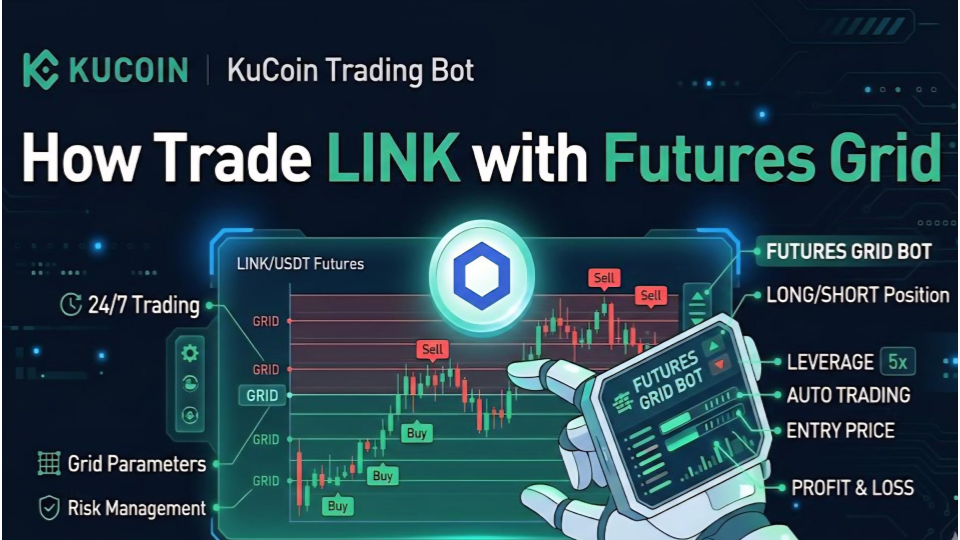
That strategy is Futures Grid trading. Instead of taking a single directional position on LINK, the bot places a series of buy and sell orders across a price range you set. Every time LINK drops a level, it buys. Every time it climbs a level, it sells. The profit comes from the spread between each buy and sell cycle, repeated automatically over time.
This article is built around what makes LINK specifically interesting for this approach, not just that it is volatile, but why it is volatile, how that volatility behaves, and how to build a grid bot configuration around those patterns. It also covers what the numbers actually look like, what risks are particular to LINK rather than generic to crypto, and a complete walkthrough of setting up your first LINK Futures Grid bot on KuCoin.
Why LINK Behaves Differently From Most Grid-Tradeable Assets
The starting point for any grid strategy is understanding the asset's price structure. Not all volatility is the same, and LINK's price behavior has characteristics that are worth understanding before you configure a single parameter.
LINK's price is sensitive to the health and growth of the DeFi ecosystem in a way that few other assets are. When DeFi activity expands, more protocols launching, more total value locked, more demand for reliable price feeds, Chainlink's utility grows, and that eventually gets priced in. When DeFi contracts during bear markets or when a major protocol suffers an exploit, LINK often moves before the broader market reacts, because sophisticated participants understand the relationship.
This creates something distinct from both meme-coin volatility and Bitcoin-correlated altcoin movement. LINK tends to have a baseline level of oscillation that persists even in relatively quiet market conditions, because the underlying DeFi activity it serves never fully stops. That baseline oscillation is the raw material that a grid bot converts into recurring profit.
On top of that baseline, LINK experiences sharper moves when protocol integration announcements land, when major DeFi expansions happen, or when the broader altcoin market runs. These events are not random. They follow a recognizable sequence: buildup in community and developer channels, announcement, price spike, partial retracement, and then a new baseline. A well-configured grid captures profit on both the spike and the retracement without you needing to time either.
On top of that baseline, LINK experiences sharper moves when protocol integration announcements land, when major DeFi expansions happen, or when the broader altcoin market runs. These events are not random. They follow a recognizable sequence: buildup in community and developer channels, announcement, price spike, partial retracement, and then a new baseline. A well-configured grid captures profit on both the spike and the retracement without you needing to time either.
Why Futures Grid Trading Works Better for LINK Than Spot or Perpetuals
Trading LINK does not require a futures grid bot. You could hold it in spot, take directional bets with perpetuals, or use a spot grid instead. Each approach has a different payoff profile, and understanding those differences helps you choose the right tool for the conditions you are actually trading in.
Spot holding is the simplest approach and the one most retail traders default to. You buy LINK, you hold it, and you profit or lose based on where the price goes over time. The problem is that LINK, like most altcoins, spends significant stretches of time oscillating within a range without trending meaningfully in either direction. Holding through those periods generates no return while locking up capital. A grid strategy converts that same sideways period into active profit.
Perpetual futures allow you to trade LINK with leverage, going long or short depending on your directional view. This works when LINK is in a clear, sustained trend, but LINK's DeFi-driven catalysts tend to create sharp spikes rather than long, manageable trends. A perpetual position in LINK requires you to time entries and exits during moves that can reverse faster than most traders can react. Funding rates also cut into returns during extended holds.
Spot grid trading is available on KuCoin and does remove the directional requirement. But without leverage, the return from each grid cycle is smaller, and you cannot profit from downward moves in Short mode. The Futures Grid provides access to leverage and to both long and short positioning, making it more capital-efficient when configured carefully.
The Futures Grid is not superior in all conditions. If LINK is in the early stages of a genuine sustained breakout, holding spot or running a simple long perpetual will outperform a range-bound grid. The grid earns from oscillation, not from catching the full magnitude of a trending move. The honest assessment is that LINK is in a clear trend less often than it is ranging, which tilts the balance toward grid strategies for most traders, most of the time.
How LINK's Oracle Cycles and DeFi Correlation Create Grid Opportunities
Understanding the specific catalysts that move LINK's price allows you to anticipate grid opportunities rather than simply react to them.
Protocol Integration Announcements
When a new DeFi protocol integrates Chainlink as its price feed provider, the announcement typically generates a price reaction. These integrations are announced through official channels and are generally predictable in structure if not in timing.
The price spike that follows integration news is often sharp and short-lived, with retracements that can erase a large share of the move within 24 to 72 hours, sometimes exceeding half of the initial rally. That spike-and-retrace pattern generates multiple grid cycles on both the upswing and the pullback.
DeFi TVL Expansion Phases
Chainlink's revenue and utility are tied to how much capital is actively deployed across DeFi protocols. When DeFi total value locked (TVL) rises, as it does during bull market phases or when new yield opportunities attract capital, LINK tends to outperform the broader altcoin market.
During these periods of TVL expansion, LINK often establishes new support levels above its previous range. This means a grid configured to adjust within a rising price band is likely to perform better than one set to a fixed historical range.
Broad Crypto Market Correlation
LINK is not immune to Bitcoin dominance. During broad crypto rallies and selloffs, LINK moves with the market. What makes LINK distinct is its tendency to recover its own range faster than lower-utility assets after a broad market decline. This means a grid bot that survives a sharp drawdown by having sufficient margin buffer is positioned to capture the recovery cycles that follow.
Oracle Update Cadence
This is a more subtle factor that many traders overlook. Chainlink’s oracle networks update prices on-chain at regular intervals, and the activity around these updates shows how much the network is being used.
When updates happen more frequently, it usually means DeFi activity is high, which tends to support LINK’s price. Watching this network data gives you extra insight that you cannot get from price charts alone.
Long, Short, and Neutral Mode: Reading LINK's Market Phases
KuCoin's Futures Grid bot offers three directional modes, and the right choice depends entirely on what LINK is doing in the current market environment. With LINK, mode selection deserves more thought than with a coin that simply oscillates randomly, because LINK's price drivers are specific and sometimes directional.
Neutral Mode
Neutral mode runs both long and short orders simultaneously across your grid range. It is the default starting point for most LINK traders and the most appropriate mode when LINK is trading sideways without a clear directional catalyst. During quiet DeFi market periods, when no major integration announcements are pending and the broader crypto market is range-bound, Neutral mode extracts profit from every oscillation without requiring you to take a view on direction.
This mode is also the right choice when you are uncertain about LINK's near-term direction. Uncertainty is not a reason to avoid trading, it is a reason to use a mode that does not require directional accuracy.
Long Mode
Long mode focuses the bot on taking long positions within your grid range. Use this when LINK has a clear upward catalyst, such as a confirmed major integration, ongoing growth in DeFi total value locked, or a broad crypto bull run pushing altcoins higher. In Long mode, the bot avoids placing short orders that could reduce returns during an uptrend. Instead, it follows the trend while still capturing smaller price movements along the way.
The main risk with Long mode is staying in it for too long after the catalyst fades. LINK’s rallies driven by integrations often do not last indefinitely. A practical approach is to switch back to Neutral mode once the initial price reaction has settled.
Short Mode
Short mode makes the bot focus on taking short positions within your set price range. Use it when the DeFi market is clearly declining, with total value locked falling across protocols and LINK following that downward trend. In this setup, the bot aims to profit as the price drops instead of holding through losses and waiting for a recovery.
The key is knowing when to use it. Avoid switching to Short mode during temporary dips. LINK often recovers quickly after short-term pullbacks, which can limit the number of profitable trades the bot can complete. It works best in sustained downtrends where there are clear and ongoing reasons for the market to keep moving lower.
LINK Futures Grid Trading: Realistic Profit Calculation Example
To understand potential returns, you need real numbers. This section walks through a realistic LINK Futures Grid example.
Futures Grid Configuration
Assume LINK is trading at $14.50. Based on recent price movement and no clear catalyst, you expect it to move between $12.00 and $17.00 over the next three to four weeks. This creates a $5.00 range, or about 34.5% of the midpoint price.
You allocate $300 USDT to a Neutral mode Futures Grid with 12 grid levels and 2x leverage. With leverage, your effective trading capital becomes $600 USDT.
Dividing the $5.00 range into 11 intervals (12 grid levels create 11 price gaps) gives a grid spacing of about $0.45 per level, which is roughly 3.1% of the midpoint price per grid.
Futures Grid Cycle Calculation
Each completed buy and sell cycle captures the price difference within one grid interval, minus trading fees. KuCoin applies maker and taker fees on grid bot trades, so the actual profit per cycle is lower than the raw grid spacing.
Using a conservative estimate of about $0.70 to $0.90 USDT net profit per completed cycle on a $600 effective position, and assuming LINK completes an average of two full cycles per day across the grid, the daily return is approximately $1.40 to $1.80 USDT. This estimate is conservative and reflects typical intraday movement.
Over a 28-day period, this projects to roughly $39 to $50 USDT in total returns on an initial $300 investment, representing about 13% to 17% of deployed capital. These figures are conservative. When LINK experiences higher volatility driven by DeFi activity or broader market events, the number of completed cycles can increase, which in turn raises potential returns.
The Effect of Leverage on Futures Grid
Increasing to 3x leverage raises your effective position to $900 USDT. Under the same market conditions, projected 28-day returns increase to approximately $58 to $75 USDT, which is about 19% to 25% of the initial $300 capital. The trade-off is a closer liquidation price, which becomes especially important during broader market selloffs affecting LINK. This is discussed in more detail in the risk section below.
These projections assume LINK remains within your defined price range throughout the period. If the price moves significantly above $17.00 or below $12.00, the bot will stop completing cycles and your position will remain open at one end of the grid. For this reason, choosing the correct price range is the most important decision when setting up a LINK Futures Grid.
LINK Futures Grid Trading Risks
Every trading strategy carries risk. The risks worth discussing here are the ones specific to LINK's price behavior and the Futures Grid structure, not the generic warnings that apply to all crypto trading.
DeFi Contagion Risk in LINK Futures Grid Trading
LINK’s value is closely tied to the overall health of the DeFi sector. A major exploit affecting a leading DeFi protocol, even one that does not directly use Chainlink, can trigger widespread outflows from DeFi. When this happens, risk appetite across the sector drops, and LINK’s price can fall quickly as a result. These events are not predictable through chart analysis alone and can cause sharp moves of 10% to 20% within hours.
If your grid range and liquidation buffer are designed only for normal price fluctuations, a DeFi contagion event can push LINK below your lower range and move your position closer to liquidation before the bot has time to recover through completed cycles.
To manage this risk, use a price range that extends well below your expected low and ensure your liquidation price is far below stress-level scenarios. Adding extra margin to an active bot when there are signs of broader DeFi stress in the market can also help reduce the risk of liquidation.
Smart Contract and Oracle Failure Events
Chainlink’s core product is data reliability. In the rare event of an oracle malfunction or a data feed error, even if it affects another project that relies on Chainlink, the reputational impact can quickly translate into price pressure on LINK. These events are uncommon, but their tail risk should not be ignored.
Unlike a meme coin where price declines are mostly driven by sentiment, a Chainlink-specific incident carries fundamental implications. This can extend a downward move beyond what typical range-based recovery would suggest and keep price suppressed for longer periods.
Leverage and Liquidation Distance
Futures Grid trading uses leverage, which introduces a liquidation price where your margin can be automatically lost if the market moves against your position. LINK can experience 15% to 25% moves during periods of DeFi market stress, so the distance to your liquidation price needs to be set carefully.
Starting with 2x leverage and calculating your exact liquidation price before launching the bot is essential. This should be treated as a required step, not an optional one. A liquidation price that sits at least 20% to 30% below your lower grid boundary provides a buffer that helps protect against temporary spikes in volatility.
Range Breakout From Sustained Trends
If LINK enters a sustained uptrend driven by major DeFi growth or a broader crypto bull cycle, a Neutral mode grid with a fixed range can become less effective. Once the price moves outside your defined range, the bot stops executing trades, and you miss the continued upward movement. This is not a direct loss, but it results in missed opportunities.
To manage this, monitor how often your bot completes cycles. If the number of daily cycles drops significantly because the price has moved to one end of your range and remains there, it is a signal to review your setup and adjust either the range or the trading mode.
Step-by-Step: Setting Up Your LINK Futures Grid Bot on KuCoin
The setup process is accessible within the KuCoin mobile app and takes less than ten minutes once you know what each parameter does.
Step 1: Access the Bot
Open the KuCoin mobile app and log in. From the home screen, tap Trade (at the bottom), then select Trading Bot at the top from the top then select Futures Grid.
Step 2: Choose Auto or Customize
KuCoin offers two setup modes. Auto mode allows the built-in AI to determine the price range, number of grid levels, and intervals based on LINK’s historical price data. This is the recommended starting point for users who are new to grid trading. Customize mode gives you full control over every parameter.
For your first LINK bot, Auto mode removes the guesswork and provides a sensible starting configuration based on recent market behavior.
Step 3: Set Your Parameters
Select the LINK/USDT perpetual pair. If using Customize mode, enter your price range, number of grids, leverage level, and total investment. Review the estimated grid profit per cycle and the liquidation price before confirming. Ensure the liquidation price is well below your lower range boundary.
Step 5: Fund Your Account and Launch
If your USDT is in your main KuCoin account rather than your futures trading account, use the transfer function within the interface to move funds. Once funded, review all parameters one final time and start the bot. It appears immediately under the Running tab.
Step 4: Monitor and Adjust
Once the bot is running, you can track performance under the Running tab. If LINK’s price moves significantly, consider adding margin to avoid approaching the liquidation threshold. You can exit the bot at any time, at which point all positions are closed and funds are returned to your trading account.
Conclusion
Chainlink’s price behavior is not random. It reflects DeFi activity cycles, protocol integrations, and broader market conditions, which together create recurring periods of range-bound movement and volatility. Futures Grid trading is designed to take advantage of these conditions by systematically capturing small price movements across a defined range rather than relying on directional prediction.
When configured with a realistic price range, appropriate leverage, and proper risk management, a LINK Futures Grid bot can turn LINK’s natural oscillations into consistent cycle-based returns. However, its effectiveness depends on staying within range, maintaining sufficient liquidation buffers, and adjusting to changing market phases.
Ultimately, LINK is most suitable for grid strategies during periods of consolidation and moderate volatility, while strong trending environments require reassessment of both grid parameters and trading mode.
Frequently Asked Questions
What is Futures Grid trading for LINK?
Futures Grid trading automates buy and sell orders across a defined price range for LINK. It profits from repeated price oscillations rather than predicting direction.
Why is LINK suitable for Futures Grid trading?
LINK often trades in ranges due to its link to DeFi activity and protocol integrations. These recurring oscillations create multiple opportunities for grid cycles.
What is the best market condition for LINK grid trading?
LINK performs best in sideways or moderately volatile markets without a strong trend. Trending markets can reduce grid efficiency or stop cycles if price exits the range.
What risks should I consider when grid trading LINK?
Key risks include liquidation from leverage, range breakouts during strong trends, and DeFi-related market shocks. These can push price outside your grid and interrupt trading cycles.
How do I choose the right grid range for LINK?
Choose a range that reflects recent price behavior and allows room for volatility on both sides. A wider range reduces liquidation risk but lowers cycle frequency, while a tighter range increases activity but adds risk.
Disclaimer: This content is for informational and educational purposes only and does not constitute financial or investment advice. Trading cryptocurrencies, including Futures Grid strategies on KuCoin, involves significant risk and may result in the loss of your entire capital. Always conduct your own research and assess your risk tolerance before engaging in any trading activity.