

XRPL vs XRP: What’s the Real Difference?
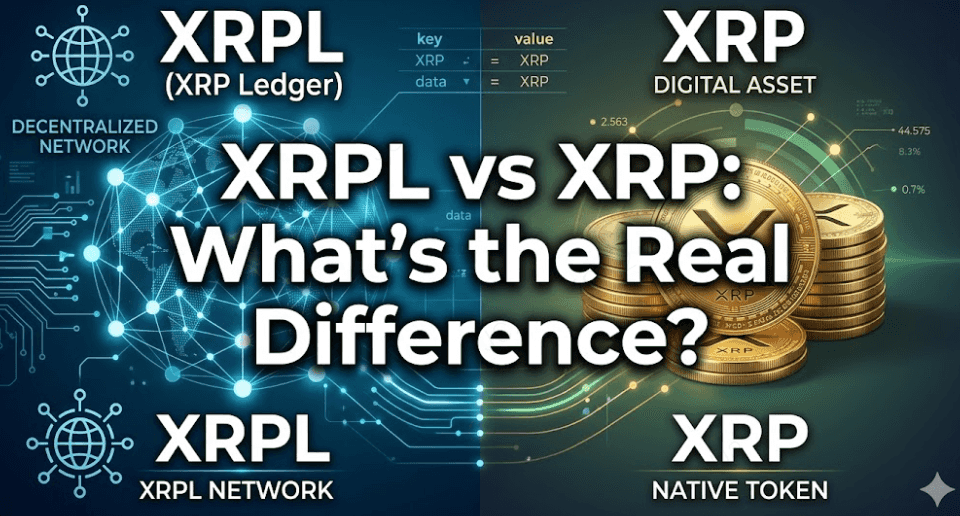
When newcomers enter the market, they often mistakenly believe they are buying shares in a software company, or they use the name of the blockchain interchangeably with the digital asset itself. If you are planning to invest in this ecosystem in 2026, relying on these misconceptions can lead to fundamentally flawed trading strategies. To make informed decisions, you must clearly understand the mechanics behind the asset you hold. The debate of xrpl vs xrp is not a competition between two different coins, but rather a distinction between a powerful underlying technology and its native digital currency.
In this comprehensive guide, we will break down the exact differences between the network, the token, and the corporate entity, exploring how they work together to disrupt the global financial system.
Key Takeaways
-
The XRP Ledger (XRPL) is an open-source, decentralized Layer-1 blockchain technology. It was built specifically to handle massive volumes of transactions with near-instant settlement times and negligible fees.
-
XRP is the native digital asset (cryptocurrency) that lives on the XRP Ledger. It was designed to act as a highly efficient, neutral bridge currency for global value transfers.
-
Ripple is a private, for-profit software company that builds enterprise-grade payment solutions. It utilizes the open-source XRPL and the XRP token for its commercial products, but it does not control the network.
-
In the simplest terms, analyzing xrpl vs xrp is like comparing an infrastructure to its utility. The XRPL is the high-speed digital highway, and XRP is both the vehicle transferring the value and the fuel required to use the road.
-
While the XRPL can issue and process other tokenized assets (like stablecoins or fiat currencies), the native XRP token is fundamentally hardcoded into the network to pay for transaction fees and prevent network spam.
Ripple, XRP, and XRPL Explained
In the early days of cryptocurrency, the lines between the company, the network, and the token were heavily blurred, partly because the token traded under the ticker "XRP" but was often colloquially referred to as "Ripple" on early exchanges.
Today, the ecosystem has matured, and the distinctions are legally and technically absolute. The easiest way to understand this relationship is through a simple real-world analogy:
Imagine the global financial system is a sprawling continent.
The XRP Ledger (XRPL) is a newly built, ultra-fast digital highway connecting cities.
XRP is the specific high-speed vehicle designed to travel on that highway, as well as the fuel required to pay the toll.
Ripple is a private logistics company that uses this highway and these vehicles to offer premium cross-border delivery services to its clients.
Here is the technical breakdown of that analogy:
Ripple is a privately held, for-profit financial technology (FinTech) company headquartered in the United States. Its primary business is developing enterprise-grade software solutions that help banks and financial institutions move money globally. Ripple did not create the XRPL, but it is a major contributor to its open-source development and holds a large amount of XRP.
The XRPL is an open-source, decentralized blockchain. It is a piece of public infrastructure, meaning no single entity, not even Ripple, owns or controls it. Anyone in the world can build applications on it, run a validator node, or use it to transfer data.
XRP is the native cryptocurrency of the XRP Ledger. It is an independent digital asset that exists solely on the XRPL. While Ripple uses XRP for its corporate software products, XRP exists completely independent of the company. If Ripple were to hypothetically go bankrupt tomorrow, the XRPL and the XRP token would continue to function normally.
What is XRPL(XRP Ledger)?
The XRP Ledger is the foundational technology at the heart of this ecosystem. Launched in 2012, it is a public, open-source, and decentralized Layer-1 blockchain. Unlike networks built primarily for retail speculation, the XRPL was engineered from day one to handle the massive scale and rigorous demands of global enterprise finance.
To understand why the XRPL is considered a powerhouse in the institutional world, we must look at its underlying technical architecture:
The Consensus Protocol (No Mining)
This is where the XRPL fundamentally differs from legacy blockchains like Bitcoin. It does not rely on energy-intensive Proof-of-Work (PoW) mining. Instead, it uses a unique Federated Consensus mechanism. A decentralized network of trusted validator nodes (organized in Unique Node Lists, or UNLs) works together to verify transactions and agree on the state of the ledger. This eliminates the need for expensive mining hardware and makes the network incredibly eco-friendly.
Enterprise-Grade Speed
Because validators do not need to solve complex cryptographic puzzles to secure the network, the XRPL is blazing fast. Transactions on the ledger are fully confirmed and settled in just 3 to 5 seconds.
High Throughput
The network is built for institutional volume, capable of consistently processing up to 1,500 transactions per second (TPS). This massive scalability allows it to process real-world financial data without suffering from the heavy network congestion seen on other Layer-1 chains.
Near-Zero Fees
The cost to process a transaction on the XRPL is virtually free, typically costing a tiny fraction of a single cent (around $0.0002). This low-friction environment is essential for facilitating high-frequency micro-payments and global remittance.
What is XRP?
While the XRPL provides the underlying infrastructure, XRP is the native cryptocurrency that operates on top of it. If the ledger is the digital highway, XRP is both the vehicle transferring the value and the toll paid to use the road.
XRP was engineered with a highly specific, enterprise-focused utility in mind. To fully grasp its value proposition, we need to look at its tokenomics and its two primary functions within the ecosystem:
The Tokenomics: 100% Pre-Mined
Unlike Bitcoin, which slowly issues new coins through a continuous mining process, the entire supply of XRP was created at the inception of the XRP Ledger. The protocol dictates a hard-capped maximum supply of exactly 100 billion XRP tokens. Because no new XRP can ever be mined or created, it does not suffer from the inflationary pressures associated with PoW mining rewards.
Function 1: Bridge Currency
In traditional global finance, cross-border payments require banks to hold pre-funded accounts in various foreign currencies. This traps trillions of dollars in dormant capital.
If a financial institution wants to send US Dollars to Mexico, they do not need to hold Mexican Pesos. They can instantly convert USD into XRP, send the XRP across the ledger in 3 seconds, and immediately convert it into Pesos on the other side. XRP eliminates the need for pre-funded accounts, freeing up massive amounts of global capital.
Function 2: Network Fuel and Anti-Spam Mechanism
Beyond its role in cross-border settlements, XRP serves a critical technical function to protect the integrity of the XRPL itself.
To prevent malicious actors from spamming the network with millions of fake transactions and overloading the system, the XRPL requires a tiny transaction fee. Crucially, this fee is not paid to a miner or validator; it is permanently destroyed. This brilliant anti-spam mechanism means that attacking the network would quickly become prohibitively expensive, and it introduces a slight deflationary aspect to the XRP token supply over time.
XRPL vs XRP: The Core Differences
| Feature | The XRP Ledger (XRPL) | XRP (The Token) |
| Definition | An open-source, decentralized Layer-1 blockchain network. | The native digital cryptocurrency operating on the ledger. |
| Primary Role | Processes, validates, and permanently records all transactions. | Acts as a bridge currency and pays network transaction fees. |
| Supply/Availability | A continuously running software protocol (No supply limit). | A hard-capped maximum supply of exactly 100 billion tokens. |
| Mechanics | Relies on a Federated Consensus of validator nodes (No mining). | Cannot be mined; it is completely pre-mined. |
| Dependency | Can process other tokenized assets (like stablecoins or fiat). | Relies entirely on the XRPL to exist and be transferred. |
How Ripple Uses Both: The ODL Connection
While we have established that Ripple does not own or control the XRP Ledger, the company is undeniably the network's most prominent developer and commercial champion. Ripple recognized early on that the XRPL’s blazing speed and XRP’s neutral liquidity were the perfect tools to solve the multi-trillion-dollar inefficiencies of the global remittance market.
To bridge the gap between traditional banking and blockchain technology, Ripple built a flagship enterprise product historically known as On-Demand Liquidity (ODL).
This commercial software seamlessly integrates both the network (XRPL) and the token (XRP) to serve global financial institutions. Here is exactly how the three components work together in the real world:
Step 1: The Fiat Conversion: A financial institution in the United States needs to send money to a partner in Mexico. Instead of relying on the slow, expensive SWIFT network and pre-funded Nostro accounts, the institution uses Ripple’s software to instantly convert US Dollars (USD) into XRP.
Step 2: The XRPL Highway: That XRP is immediately transmitted across the open-source XRP Ledger. Because the network relies on validator nodes rather than miners, this cross-border transaction is fully confirmed and settled in just 3 seconds, costing a fraction of a cent.
Step 3: Local Settlement: The moment the XRP arrives at its destination, Ripple's system automatically converts it into Mexican Pesos (MXN) via a local exchange partner, and the funds are deposited into the receiver's account.
In this powerful synergy, Ripple provides the enterprise software interface, the XRPL serves as the immutable, high-speed settlement highway, and XRP acts as the frictionless bridge currency that eliminates the need for trapped capital.
This real-world institutional utility is exactly why XRP is viewed as far more than just a retail speculation token.
The Future Ecosystem of XRPL
For its first decade of existence, the XRP Ledger was almost exclusively known as a high-speed rail for cross-border payments. However, as the Web3 landscape has rapidly matured into 2026, the XRPL has evolved far beyond simple value transfers.
Following the definitive resolution of long-standing regulatory hurdles, massive waves of institutional capital and developer activity have flooded the network. Today, the XRPL is a comprehensive financial ecosystem competing directly with other major Layer-1 blockchains.
Here are the three massive developments reshaping the future of the XRPL:
Real-World Asset (RWA) Tokenization
This is the most explosive growth sector for the ledger in 2026. Because the XRPL features built-in compliance tools, multi-level custody permissions, and instant settlement, traditional financial giants are using it to tokenize Real-World Assets, such as government bonds, real estate, and institutional lending protocols. The XRPL is actively bridging the gap between TradFi and Web3.
Native DeFi and AMMs
With the historic XLS-30 upgrade, the XRPL integrated native Automated Market Makers directly into its core protocol. This means users no longer need complex, hack-prone smart contracts to provide liquidity. Anyone can now deposit assets into XRPL liquidity pools to earn yield and facilitate decentralized trading (DEX) directly on the ledger.
Smart Contract Programmability & Sidechains
Historically, the XRPL intentionally avoided smart contracts to prioritize sheer speed and security. Now, through EVM-compatible sidechains and native "Smart Escrow" developments rolling out in 2026, developers can build complex decentralized applications (dApps) without compromising the efficiency of the main ledger.
How to Get Involved
If you believe in the future of this institutional network and want to invest in its native asset, you can instantly purchase XRP with deep liquidity and low fees via KuCoin Spot Trading.
If you are an advanced user looking to interact directly with the XRP Ledger to provide AMM liquidity or trade tokenized assets, you can securely connect to the ecosystem using the KuCoin Web3 Wallet.
Conclusion
Ripple is a visionary software company driving enterprise adoption. The XRP Ledger (XRPL) is the open-source, lightning-fast digital highway that operates entirely independent of any single corporation. Finally, XRP is the native digital currency, the vehicle that moves frictionless value across that highway and the fuel that keeps the network secure from spam. By separating these three concepts, investors can stop relying on outdated misconceptions and start making highly informed decisions. Whether you are trading XRP for its cross-border utility or exploring the XRPL's booming DeFi and RWA ecosystem, you are looking at one of the most battle-tested technologies in the entire cryptocurrency space.
FAQs
Does Ripple own the XRPL
No, Ripple does not own the XRP Ledger. The XRPL is an open-source, decentralized public blockchain. While Ripple contributes to the codebase and uses the network for its enterprise products, it operates only a tiny fraction of the network's validator nodes. If Ripple ceased to exist, the XRPL would continue to operate normally.
Can XRPL work without XRP
No, the XRP Ledger inherently requires the XRP token to function. While the XRPL can issue and track other custom assets, XRP is hardcoded into the protocol to act as a spam-prevention mechanism. Every transaction on the ledger must burn a microscopic amount of XRP to be processed.
Is XRP a token or a coin?
Technically, XRP is a "coin" because it operates on its own independent, native blockchain. In the crypto industry, the term "coin" is reserved for native assets of a Layer-1 network (like Bitcoin or Ethereum), whereas a "token" is typically an asset created on top of an existing blockchain (like an ERC-20 token). However, the terms are often used interchangeably in casual conversation.
Can more XRP be created in the future?
No, it is mathematically impossible to create more XRP. The protocol rules of the XRP Ledger dictate a strict, hard-capped maximum supply of exactly 100 billion XRP. All of these coins were pre-mined at the genesis of the network in 2012, meaning no new XRP will ever enter existence.
Why is XRP so cheap compared to Bitcoin?
The price per coin is entirely dictated by tokenomics and maximum supply, not necessarily its underlying value. Bitcoin has a tiny maximum supply of 21 million coins, which makes each individual coin scarce and expensive. XRP has a massive maximum supply of 100 billion coins. Therefore, even if XRP had the exact same market capitalization as Bitcoin, its price per coin would mathematically be significantly lower.
Disclaimer This content is for informational purposes only and does not constitute investment advice. Cryptocurrency investments carry risk. Please do your own research (DYOR).