

Why Are Layer 2 Blockchains Important for Ethereum Scalability, and What Problems Do They Solve?
2026/04/27 11:45:02
Introduction
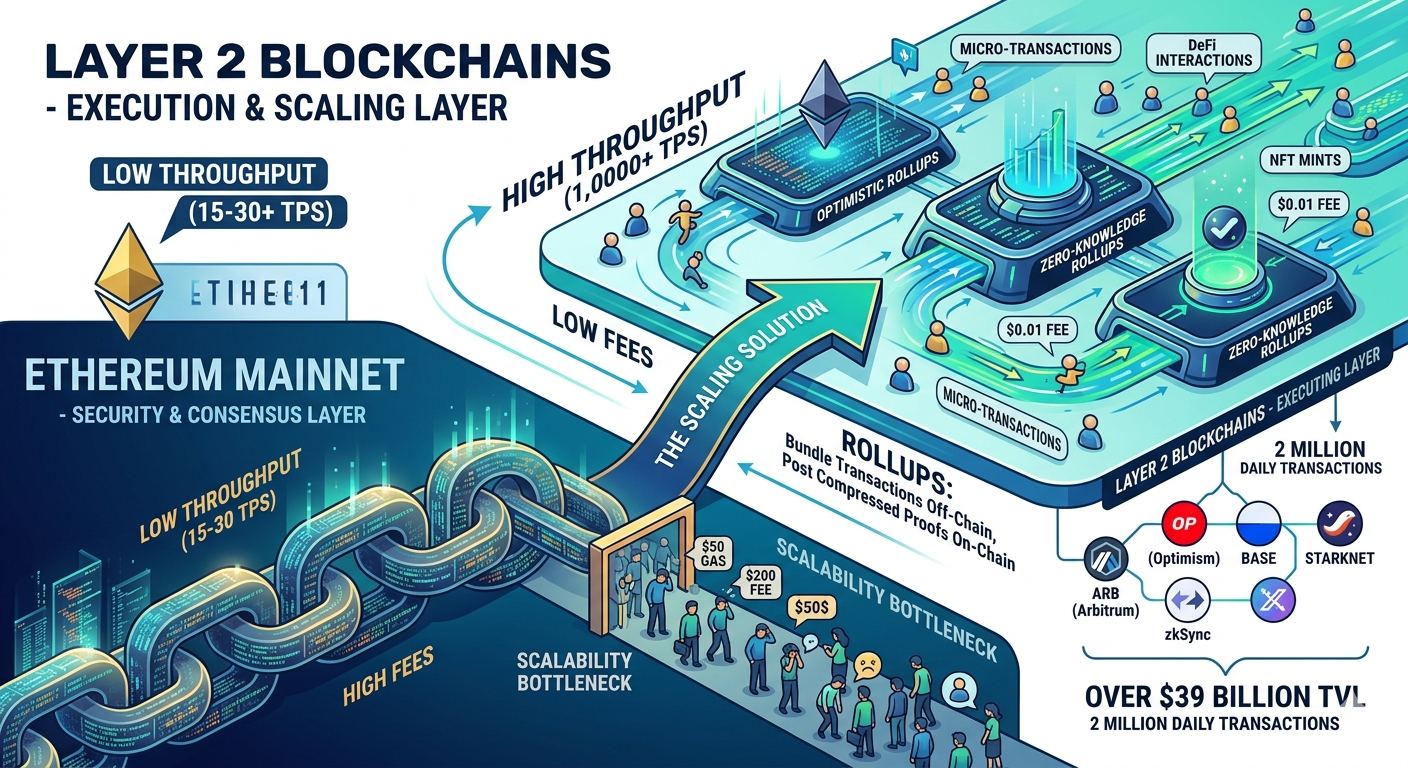
Ethereum processes roughly 1 million transactions daily on its mainnet, yet Layer 2 networks now handle approximately 2 million transactions per day — nearly double the base layer’s volume. Layer 2 blockchains solve Ethereum’s fundamental scalability problem by processing transactions off-chain while inheriting the mainnet’s security guarantees, reducing costs by over 90% and increasing throughput by orders of magnitude. Without these scaling solutions, Ethereum would remain a settlement layer for the wealthy, unable to support global decentralized finance, gaming, or payments at scale.
The Ethereum Scalability Bottleneck — What Layer 2s Were Built to Fix
Ethereum mainnet cannot scale to global demand because its base layer processes only 15-30 transactions per second, forcing users to compete for limited block space through escalating gas fees. This constraint is not a temporary bug — it is an intentional design trade-off. Ethereum prioritizes decentralization and security over raw speed, meaning every node must validate every transaction. While this creates an extremely secure and censorship-resistant foundation, it also creates a hard ceiling on throughput that becomes painfully visible whenever demand spikes.
Network Congestion and Prohibitive Gas Fees
During periods of high demand, Ethereum mainnet gas fees have historically spiked above $50 per transaction, making micro-transactions, DeFi interactions, and NFT mints economically unviable for average users. In extreme cases — such as during major NFT drops or DeFi liquidations — fees have temporarily exceeded $200 for a single swap or token transfer. These costs do not reflect malicious price gouging. They reflect pure supply and demand: 15-30 transactions per second is trivial compared to Visa’s 65,000+ transactions per second capacity. When millions of users want to interact simultaneously, the auction mechanism for block space prices out everyone except high-value transactions.
The result is a network that works beautifully for moving millions of dollars but fails for everyday use cases. A user wanting to send $20 to a friend, claim a small DeFi reward, or mint an inexpensive NFT faces fees that consume the entire value of their transaction. This dynamic creates an exclusionary ecosystem where only whales and institutions can afford to interact directly with the base layer. It also stifles innovation — developers building consumer applications cannot reasonably ask users to pay $20 in gas for a $5 in-game purchase or a social media tip.
The Blockchain Trilemma
Ethereum’s design prioritizes decentralization and security at the expense of scalability, creating a structural bottleneck that no base-layer upgrade alone can resolve without compromising its core values. This challenge — often called the blockchain trilemma — states that a network can optimize for only two of three properties: decentralization, security, and scalability. Ethereum chose decentralization and security, which is why it remains the most trusted smart contract platform but also why it struggles with congestion.
Base-layer solutions like sharding (splitting the blockchain into parallel chains) help, but they introduce coordination complexity and cannot alone achieve the throughput needed for billions of users. Ethereum’s Dencun upgrade, which introduced proto-danksharding, reduced Layer 2 data costs significantly — but it did not eliminate the need for Layer 2s. The base layer remains a global settlement and consensus mechanism, not a high-frequency execution environment. Layer 2 blockchains exist specifically to preserve Ethereum’s decentralization and security while offloading execution to specialized environments designed for speed and low cost.
How Layer 2 Blockchains Solve Ethereum’s Scaling Problem
Layer 2 solutions solve Ethereum’s throughput crisis by executing transactions outside the main chain, batching them into compressed proofs, and settling only the final state on Ethereum Layer 1. This architecture allows Layer 2s to process thousands of transactions per second while paying Ethereum mainnet only for the periodic submission of compressed data. Users get the security of Ethereum — because the mainnet ultimately validates the integrity of the Layer 2 — but pay fees that are typically 10x to 100x lower than mainnet costs.
The key insight behind Layer 2 scaling is that not every transaction needs to be executed and stored by every node in the network. Instead, transactions can be executed on a separate layer, with Ethereum serving as the ultimate arbiter of truth. If a Layer 2 operator tries to cheat or submit invalid data, Ethereum’s smart contracts can detect and penalize the fraud. This creates a trust-minimized bridge between the fast, cheap Layer 2 environment and the slow, expensive but highly secure Layer 1 foundation.
Rollups — The Dominant Scaling Architecture
Rollups have emerged as the definitive Layer 2 scaling solution, bundling thousands of off-chain transactions into a single on-chain submission that inherits Ethereum’s security while reducing per-transaction costs to fractions of a cent. A rollup takes transaction data, executes it off-chain, and then posts a compressed summary — along with cryptographic proof of validity — to Ethereum mainnet. This summary is small enough to fit within a single mainnet transaction, yet it represents the final state of thousands of individual user actions.
There are two primary rollup architectures, each with distinct trade-offs. Optimistic rollups assume transactions are valid by default and use a challenge period to catch fraud. Zero-knowledge rollups generate cryptographic proofs that verify transaction validity instantly. Both approaches achieve dramatic cost reductions because the expensive computation happens off-chain, while Ethereum only stores the compressed data and handles dispute resolution or proof verification. According to L2BEAT data from February 2026, the leading rollups now secure tens of billions of dollars in value, proving that the market has voted decisively in favor of this architecture.
Optimistic Rollups
Optimistic rollups, including Arbitrum and Optimism, assume transactions are valid by default and only run fraud proofs when challenged, achieving Ethereum Virtual Machine compatibility with minimal changes to existing smart contracts. This design choice makes optimistic rollups exceptionally developer-friendly — a Solidity contract written for Ethereum mainnet can typically be deployed to Arbitrum or Optimism with little or no modification. The “optimistic” assumption means the network processes transactions immediately and only reverses them if someone submits a valid fraud proof during the challenge window, which typically lasts seven days.
Arbitrum leads the optimistic rollup category with approximately $16.84 billion in Total Value Secured as of February 2026, making it the largest general-purpose Ethereum Layer 2 by capital deployment. Its Nitro upgrade improved calldata compression and throughput, while the Stylus initiative allows developers to write high-performance contracts in Rust and other languages beyond Solidity. Optimism, with roughly $8 billion in TVL, differentiates itself through the Superchain model — a vision of interconnected Layer 2 networks built on the OP Stack that share infrastructure and security standards. Base, Coinbase’s Layer 2 built on the OP Stack, has grown to $10.72 billion in TVS, demonstrating the power of distribution through a major exchange’s user base.
The primary trade-off with optimistic rollups is the seven-day withdrawal period. Because the system assumes validity by default, users must wait for the fraud-proof window to close before withdrawing funds to Ethereum mainnet. This creates friction for users who need immediate liquidity. However, for most trading, DeFi, and gaming use cases, users rarely need to exit back to mainnet — they simply stay within the Layer 2 ecosystem where transactions are instant and fees are negligible.
Zero-Knowledge Rollups
Zero-knowledge rollups use cryptographic validity proofs to verify transaction batches instantly, offering faster finality and stronger security guarantees than optimistic alternatives but requiring more complex proof generation infrastructure. ZK-rollups do not rely on a challenge period. Instead, every batch of transactions includes a mathematical proof — generated using zero-knowledge cryptography — that proves the batch is valid according to Ethereum’s rules. This proof can be verified on Ethereum mainnet in minutes rather than days, enabling near-instant withdrawals and stronger cryptographic guarantees.
zkSync Era and Starknet represent the leading ZK-rollup implementations. zkSync Era holds approximately $404 million in Total Value Secured and emphasizes EVM compatibility through its zkEVM, allowing developers to port Solidity contracts with minimal changes. Starknet uses STARK proofs — a distinct cryptographic approach — and targets compute-heavy applications where verification efficiency matters most. While ZK-rollups currently trail optimistic rollups in total value locked, they are gaining traction as proof-generation costs decline and developer tooling improves. The technology is particularly attractive for applications requiring fast finality, such as high-frequency trading, cross-chain bridges, and institutional settlement systems.
The trade-off for ZK-rollups is complexity. Generating validity proofs requires specialized hardware and significant computational resources, which can centralize proof production among well-capitalized operators. However, the verification of these proofs remains cheap and decentralized — anyone can verify a proof on Ethereum mainnet — so the security model still ultimately rests on Ethereum’s consensus. As proof systems become more efficient and hardware costs fall, ZK-rollups are expected to capture growing market share, particularly for use cases where the seven-day optimistic withdrawal period is unacceptable.
Layer 2 Adoption Metrics — The Numbers Behind the Migration
Layer 2 networks have shifted from experimental infrastructure to the primary venue for Ethereum activity, with combined Total Value Locked exceeding $39 billion and daily transaction volumes consistently outpacing mainnet. This is not speculative hype — it is measurable capital deployment and user behavior. In 2025, Layer 2 networks processed over 1.9 million daily transactions on average, with stablecoins constituting over 70% of that volume. These numbers reveal that Layer 2s have become practical payment rails, not just theoretical scaling experiments.
TVL Concentration and Market Leaders
Arbitrum dominates the Layer 2 landscape with approximately $16.84 billion in Total Value Secured as of February 2026, followed by Base at $10.72 billion and Optimism at $8 billion, demonstrating where capital and users have actually migrated. These three networks alone account for the majority of all Layer 2 value, creating deep liquidity pools that attract further DeFi activity. Arbitrum’s strength lies in its composability — major protocols like Uniswap, Aave, and GMX operate significant pools there, creating network effects that make it the default choice for DeFi builders. Base’s growth, meanwhile, is driven by Coinbase’s distribution power, funneling millions of retail users directly into on-chain applications with minimal onboarding friction.
The concentration of TVL matters because liquidity begets liquidity. Traders want to operate where order books are deepest. Developers want to build where users already are. This creates a self-reinforcing cycle that benefits established Layer 2s while making it harder for newer entrants to compete. However, the overall pie is growing — cumulative Layer 2 TVL reached $39.39 billion for the 12 months up to November 2025, representing a 4.63% year-on-year growth rate across the sector. Even as individual networks compete, the aggregate scaling layer is absorbing an increasing share of Ethereum’s total economic activity.
Developer Migration and Smart Contract Deployment
Over 65% of new smart contracts deployed in 2025 launched directly on Layer 2 networks rather than Ethereum mainnet, signaling that developers now treat scaling layers as the default deployment environment. This shift represents a fundamental change in how the Ethereum ecosystem operates. For the first several years of Ethereum’s existence, mainnet was the only viable platform. Today, launching on mainnet without a Layer 2 strategy is considered economically irresponsible for most applications — the gas costs alone would price out the majority of potential users.
This developer migration creates a flywheel effect. More applications on Layer 2 attract more users. More users attract more liquidity. More liquidity attracts more developers. The result is that Layer 2 ecosystems are now where innovation happens fastest. Gaming platforms, social applications, and consumer DeFi products — categories that would be impossible on mainnet due to cost constraints — are thriving on Arbitrum, Base, and Optimism. Arbitrum alone hosted over 1.37 million daily active addresses in late 2025, demonstrating that these are not ghost chains but active economic environments.
Stablecoin and Payment Adoption
Stablecoin transactions on Layer 2 networks surged 54% year-over-year through 2025, with over 70% of all Layer 2 payments now settled in stablecoins rather than ETH, proving these networks have become practical payment rails. This is perhaps the most important adoption signal of all. Speculative trading and DeFi yield farming can inflate metrics temporarily. But stablecoin payments represent genuine economic utility — people using Layer 2s to send money, pay for goods and services, and settle invoices.
The shift toward stablecoin dominance also reveals who is actually using Layer 2s. It is not just crypto-native traders speculating on token prices. It is remittance senders looking for cheaper cross-border transfers. It is freelancers invoicing clients in USDC. It is merchants accepting payments without paying 3% credit card processing fees. Layer 2 networks have reduced the cost of stablecoin transfers to fractions of a cent, making them competitive with — and in many cases superior to — traditional payment infrastructure for international transactions.
Should You Trade Layer 2 Tokens on KuCoin?
KuCoin lists the leading Layer 2 ecosystem tokens — including ARB, OP, and STRK — giving traders direct exposure to the infrastructure powering Ethereum’s scalability revolution. As Layer 2 networks continue to absorb the majority of Ethereum transaction volume and developer activity, the tokens governing these ecosystems represent a bet on the future of blockchain scaling itself. Arbitrum’s ARB token governs the largest Layer 2 by TVL. Optimism’s OP token coordinates the Superchain vision. Starknet’s STRK token underpins one of the most advanced ZK-rollup implementations.
Trading these tokens on KuCoin provides access to deep liquidity, advanced charting tools, and competitive fee structures. Whether you are looking to speculate on short-term price movements or build a long-term position in Ethereum’s scaling infrastructure, KuCoin offers the trading pairs and order types needed to execute your strategy. Before trading, conduct your own research on each project’s roadmap, tokenomics, and competitive positioning — Layer 2 is a rapidly evolving sector where technical advantages can shift quickly.
Conclusion
Layer 2 blockchains have solved Ethereum’s scalability crisis by moving execution off the main chain while preserving the security and decentralization that make Ethereum valuable in the first place. Without Layer 2s, Ethereum would remain a premium settlement layer for high-value transactions, incapable of supporting the global user base that decentralized applications require. With Layer 2s, Ethereum has become a scalable foundation for DeFi, gaming, payments, and social applications — processing roughly 2 million daily transactions across rollups while mainnet focuses on what it does best: providing ultimate security and consensus.
The numbers tell the story clearly. Over $39 billion in combined TVL. More than 65% of new smart contracts deploying on Layer 2 rather than mainnet. Stablecoin payment volume growing 54% year-over-year. These are not projections — they are current realities. Arbitrum, Base, and Optimism have already built thriving ecosystems with billions in capital and millions of active users. The blockchain trilemma has not been eliminated, but Layer 2s have provided an elegant solution: let Ethereum handle security and decentralization, while specialized execution layers handle speed and cost. For traders, developers, and everyday users, this architecture means blockchain technology is finally ready for mainstream adoption.
FAQs
What is the main problem that Layer 2 blockchains solve for Ethereum?
Layer 2 blockchains solve Ethereum’s throughput bottleneck. Ethereum mainnet processes only 15-30 transactions per second, which creates network congestion and drives gas fees to levels that exclude average users. Layer 2s process transactions off-chain and settle compressed proofs on mainnet, increasing throughput to thousands of transactions per second while reducing costs by over 90%.
How do optimistic rollups differ from zero-knowledge rollups?
Optimistic rollups assume transactions are valid by default and use a seven-day challenge period for fraud proofs, making them highly EVM-compatible but slower for withdrawals. Zero-knowledge rollups generate cryptographic validity proofs for every batch, enabling near-instant finality and faster withdrawals but requiring more complex infrastructure for proof generation.
Why do most developers now deploy on Layer 2 instead of Ethereum mainnet?
Over 65% of new smart contracts deployed in 2025 launched on Layer 2 networks because mainnet gas fees make consumer applications economically unviable. A simple token swap on mainnet can cost $20-$50 during congestion, while the same transaction on Layer 2 costs less than a cent. Developers follow users, and users follow low fees.
Are Layer 2 networks as secure as Ethereum mainnet?
Layer 2 networks inherit security from Ethereum mainnet because all transaction data is ultimately posted to and validated by the base layer. Rollups cannot steal funds or falsify transactions without breaking Ethereum’s cryptographic guarantees. However, some Layer 2s currently use centralized sequencers, which creates temporary censorship risks that the industry is actively working to decentralize.
Can I use Layer 2 networks without ever touching Ethereum mainnet?
Yes. Many users now onboard directly to Layer 2 networks through exchanges and fiat on-ramps that bypass mainnet entirely. You can trade, use DeFi protocols, make payments, and interact with dApps on Arbitrum, Base, or Optimism without ever paying mainnet gas fees. Withdrawals to mainnet are only necessary if you specifically need to move funds to a Layer 1 wallet or contract.