

US 10-Year Treasury Yield Hits Highest Level Since 2007 Amid Broad Market Repricing
2026/07/31 17:36:00
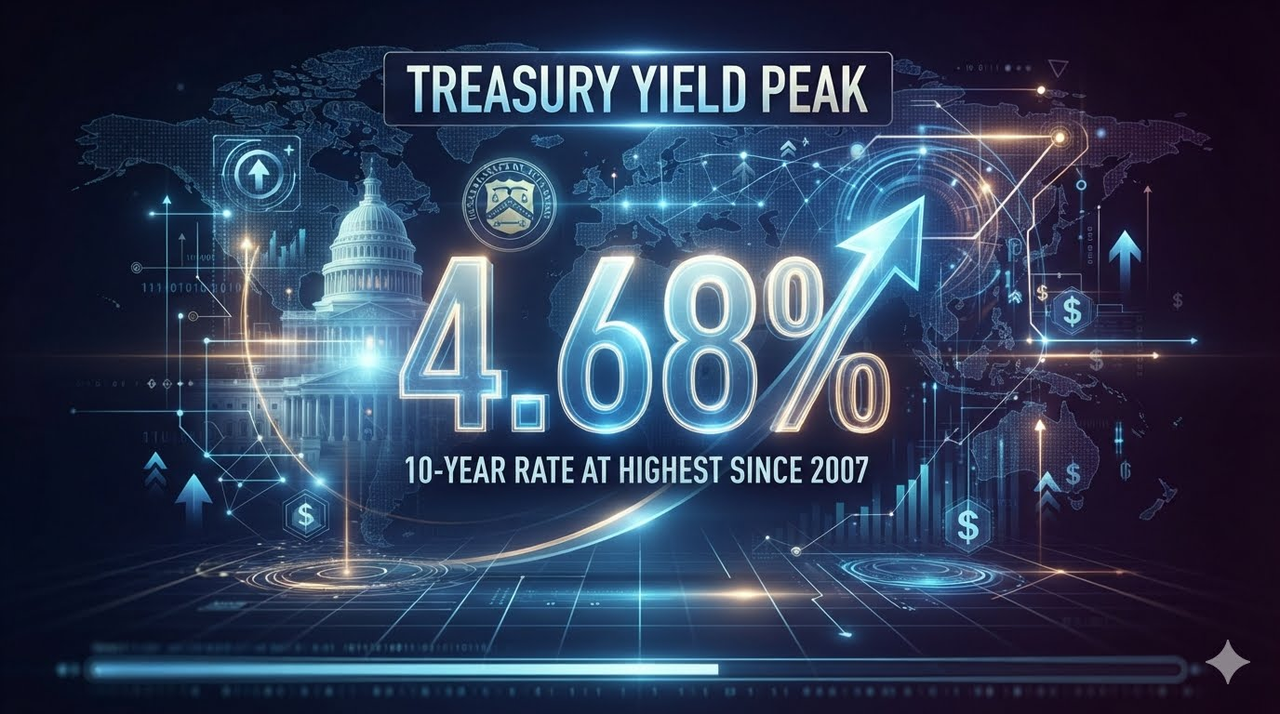
The global financial landscape is experiencing a significant and sustained structural shift as fixed-income markets undergo a major repricing phase. The yield on the benchmark US 10-Year Treasury note has steadily climbed to its highest level since 2007, moving past 4.67% and consolidating within the volatile 4.68% to 4.71% range. Concurrently, the 30-year US Treasury yield has breached the 5.2% mark, a level not witnessed since the onset of the Global Financial Crisis. Because bond yields and prices move inversely, fixed-income prices have declined notably. This movement is far from an isolated event contained within traditional Wall Street banking institutions; it represents an adjustment in the global cost of capital after more than a decade of near-zero interest rate policies.
The US 10-Year Treasury yield is widely recognized as the primary anchor for global asset pricing, serving as the baseline risk-free rate used in institutional valuation models. When this anchor moves rapidly upward, it alters the risk-reward calculus across the financial spectrum. Every risk asset—including Bitcoin (BTC), Ethereum (ETH), and high-market-cap altcoins—often feels the impact of shifting liquidity conditions. Understanding the core drivers behind this bond market transition is crucial for protecting capital and managing portfolio volatility.
Key Drivers Behind the Fixed-Income Repricing
The recent adjustment in US sovereign debt is not the result of a single isolated event, but rather the convergence of three powerful macroeconomic forces: persistent geopolitical tensions affecting global energy markets, monetary policy shifts within the Federal Reserve, and a structural supply imbalance related to the expanding US fiscal deficit.
Geopolitical Tensions and Energy Price Transmission
A notable catalyst for recent bond market volatility stems from ongoing geopolitical instability in the Middle East. Tensions surrounding the strategic trade routes of the Strait of Hormuz have intermittently disrupted global shipping lanes and critical energy supply chains, leading to price fluctuations in the global energy complex.
West Texas Intermediate (WTI) crude oil prices surged past $84 per barrel, following previous market spikes that pushed Brent crude over the $110 threshold. Because energy costs serve as a foundational input for the broader economy—affecting everything from manufacturing and agricultural fertilizers to logistics and consumer goods—this oil dynamic has directly impacted domestic inflation metrics. Both the Producer Price Index (PPI) and Consumer Price Index (CPI) have experienced renewed upward momentum, complicating Wall Street’s expectations of a smooth, linear return to the central bank's 2% inflation target.
As inflation erodes the long-term purchasing power of fixed-income assets, investors tend to sell off long-duration Treasuries to avoid negative real returns, inherently pushing yields upward.
Federal Reserve Policy and Market Uncertainty
The internal dynamics of the Federal Reserve have further contributed to market adjustments. During its recent monetary policy meeting, the central bank chose to hold the benchmark federal funds rate steady at the 3.50% to 3.75% range. However, this decision came with notable internal dissent that caught the market off guard. Three voting members of the Federal Open Market Committee (FOMC) openly voted against the pause, advocating for an immediate interest rate hike to combat underlying structural inflation.
Adding to the market's complexity is the communication style of Federal Reserve Chairman Kevin Warsh. Moving away from the highly predictable forward guidance favored in previous years, Warsh clarified that the current policy stance is a strictly data-dependent holding pattern where further rate hikes remain a distinct possibility. This data-dependency has introduced significant policy uncertainty. Unable to accurately model the future path of interest rates with confidence, institutional funds have adjusted their Treasury holdings to limit duration risk, accelerating the upward trajectory of yields.
US Fiscal Deficit and Debt Supply Imbalances
Beyond temporary inflation metrics and central bank communication lies a deeper, structural shift within US public finance. The total US national debt is expanding toward $39 trillion, outpacing nominal GDP growth by a wide margin. Analysts at major global institutions, including Barclays, have noted a lack of political momentum in Washington to implement meaningful fiscal reforms or curb persistent deficit spending.
To fund these massive fiscal shortfalls, the US Department of the Treasury has steadily issued an increasing volume of new government bonds. This elevated supply of debt securities has heavily saturated natural buyer demand, especially as foreign central banks reduce their Treasury purchases. Consequently, institutional investors are requiring a significantly higher term premium—the extra compensation demanded for holding long-term government debt versus short-term paper. As the supply continues to increase, the global investment community is actively reassessing sovereign fiat debt allocations and demanding higher yields to clear the market.
Financial Market Spillovers Detailed
Because the 10-Year Treasury yield underpins valuation models across the global financial system, its ascent has prompted a reallocation of capital across multiple asset classes and international borders.
Equities and the Equity Risk Premium
In equity markets, the 10-year yield crossing 4.5% and the 30-year yield breaching 5.0% served as critical technical signals for quantitative and institutional trading desks. High-growth sectors, particularly technology stocks within the S&P 500 and the Nasdaq Composite, have experienced severe selling pressure.
The mathematical reason for this is foundational to finance: stock valuations are based on the discounted present value of future cash flows. When the risk-free rate of return rises above 5%, the discount rate applied to corporate earnings increases accordingly. This mathematically compresses price-to-earnings (P/E) ratios and makes future earnings appear less attractive in present-day terms. As a result, institutional capital often rotates out of speculative risk assets and into short-duration cash equivalents that offer guaranteed, high yields.
Global Fixed-Income Contagion
The adjustments in the US Treasury market have rapidly spilled over into international fixed-income ecosystems, contributing to a synchronized global bond repricing. As capital shifts toward the US to capture higher nominal yields, international central banks have faced pressure to keep pace.
| Sovereign Bond Asset | Yield Level Reached | Historical Context |
| US 10-Year Treasury | 4.68% - 4.71% | Highest level since 2007 |
| US 30-Year Treasury | 5.20% | Breached key psychological resistance |
| UK 30-Year Gilt | 5.75% | Multi-decade high |
| German 10-Year Bund | Multi-Year Highs | Highest yield environment since 2011 |
| Japan 30-Year JGB | Significant Surge | Highest yield since records began in 1999 |
Impact on Consumer and Corporate Credit
The rapid rise in Treasury yields has translated directly to consumer and corporate credit markets. Because consumer debts are priced off the 10-year yield curve, the real economy is facing tighter credit conditions. The average 30-year fixed home mortgage rate in the US has climbed to 6.66%, significantly cooling activity in the real estate sector. Simultaneously, borrowing costs for auto loans, corporate credit lines, and revolving credit have risen notably. Small to medium-sized enterprises (SMEs) are finding it increasingly expensive to refinance existing obligations, creating headwinds for broader macroeconomic expansion.
The Crypto Market Assessment: Liquidity Crunch vs. Long-Term Value
For digital asset participants, the macroeconomic environment presents a dual scenario: a challenging environment for short-term liquidity, balanced against the long-term fundamentals of decentralized assets.
Short-Term Liquidity Challenges
The immediate impact of surging Treasury yields on the cryptocurrency market creates capital allocation headwinds. When institutional allocators—such as pension funds and family offices—can secure a guaranteed 5.2% yield on US debt, the hurdle rate for investing in higher-volatility ecosystems rises significantly. Capital that might otherwise flow into Ethereum protocols, Layer-1 alternative ecosystems, or venture-backed Web3 applications often remains sidelined in traditional money market funds.
Additionally, this yield dynamic has supported a stronger US Dollar Index (DXY), as foreign capital buys dollars to purchase US debt. Historically, a strong dollar cycle exhibits a strong negative correlation with digital assets, generally resulting in lower trading volumes and capital outflows from global trading venues as liquidity tightens globally.
Long-Term Value Proposition
Conversely, the structural macro outlook continues to validate Bitcoin's underlying thesis. A national debt approaching $39 trillion, compounded by ongoing deficit spending, highlights the long-term vulnerabilities and inflationary pressures within the legacy fiat framework.
As sovereign fiat debt faces headwinds and governments struggle with the interest burden of their own borrowing, Bitcoin's fixed algorithmic supply of 21 million coins presents an alternative monetary model. This dynamic mirrors previous localized banking stress, where capital sought alternatives outside traditional systems. As institutional investors evaluate long-term currency debasement risks, the narrative of Bitcoin as a scarce digital commodity and an immutable safe haven remains highly prominent among macro allocators.
Capital Reallocation: DeFi and Stablecoins
The structural changes in traditional finance are directly impacting smart contract ecosystems, altering how on-chain capital is sourced and managed.
The DeFi Yield Environment
The rise of a 5.2% risk-free rate has created a challenging yield environment across decentralized finance. For years, DeFi attracted significant capital by offering yields that easily outpaced near-zero traditional bank rates. However, with native Ethereum staking rewards generally fluctuating between 3% and 4%, and mainstream lending protocols offering similar returns, on-chain base yields are currently competing directly with US government bonds on a risk-adjusted basis. This has caused some institutional capital to preference traditional, risk-free cash instruments over pure-play DeFi protocols that carry smart contract and regulatory risks.
Real World Assets (RWA) Expansion
This yield gap has aggressively accelerated the adoption of Real World Asset (RWA) tokenization. Because native on-chain yields are lower than traditional yields, protocols that bring tokenized US Treasury bills onto public blockchains are seeing significant capital inflows. Platforms that wrap yield-bearing government debt into compliant tokens allow investors to access 5%+ US bond yields natively on-chain. This convergence is making the RWA sector one of the fastest-growing components of the current crypto landscape, bridging institutional fixed-income liquidity directly into decentralized applications.
Stablecoin Economics
The high-interest-rate environment has also deeply bolstered the economics of major stablecoin issuers. Companies issuing Tether (USDT) and Circle (USDC) back their circulating token supply with massive reserves composed primarily of short-term US Treasury bills. With yields at multi-year highs, these issuers are generating billions in substantial, risk-free revenues from their reserve assets, further cementing their financial stability within the crypto ecosystem.
Conclusion and Actionable Strategies
The bond market adjustment and the sustained higher-yield environment represent a structural shift in global finance, not a brief market anomaly. As markets digest shifting geopolitical events, Federal Reserve data-dependency, and unprecedented US debt levels, volatility is expected to remain a constant across both traditional and digital asset classes. Successfully navigating this macro-driven landscape requires adopting specific, risk-adjusted trading strategies.
Actionable Strategies on KuCoin:
-
Deploy KuCoin Earn Products: Traders can utilize KuCoin Earn, participating in stablecoin staking programs or flexible savings allows users to generate competitive yields while keeping capital on-chain, avoiding the friction of off-ramping to fiat banks and keeping funds ready to deploy when market opportunities arise.
-
Utilize KuCoin Trading Bots: Macro-driven markets frequently experience sharp, news-driven price swings and high intraday volatility. By setting up automated strategies like the Spot Grid or Futures Grid bot, traders can systematically navigate this volatility, executing buy-low and sell-high orders automatically.
-
Dollar-Cost Average (DCA) into Hard Assets: Given long-term fiat inflation concerns under growing sovereign debt burdens, maintaining exposure to non-sovereign assets is a prudent portfolio approach. Utilizing automated DCA tools to regularly accumulate positions in Bitcoin helps build a long-term position in a scarce digital asset, smoothing out entry prices and serving as a hedge against global fiscal instability.
Join KuCoin 9th Anniversary Trading CampaignKuCoin is celebrating its 9th anniversary with a special platform campaign filled with exclusive rewards, trading activities, and limited-time offers. Don’t miss the chance to participate and enjoy the benefits as the exchange marks nine years of growth and innovation. Visit the official campaign page now:
 |
FAQs
Why is the 10-Year US Treasury yield called the "global asset pricing anchor"?
It represents the foundational risk-free rate used in global valuation models. When it rises, the discount rate for all future corporate earnings and investment cash flows increases, mathematically compressing the valuations of risk assets worldwide.
How do soaring energy prices impact the fixed-income bond market?
Crude oil spikes (WTI over $84) drive up broader economy-wide manufacturing and logistics costs. This reignites structural inflation expectations, eroding the long-term purchasing power of fixed-income assets and forcing institutional investors to sell off long-duration bonds.
What does the recent Federal Reserve internal voting split signal to macro traders?
The rare three-dissent voting split reveals severe internal anxiety over stubborn inflation. Combined with Chairman Kevin Warsh's strict data-dependency, this policy uncertainty forces funds to slash portfolio duration to hedge against a sudden interest rate hike.
Why are expanding US fiscal deficits driving long-term bond yields higher?
With national debt racing past $39 trillion, the Treasury must continuously flood the market with new bonds. This massive supply outpaces shrinking central bank demand, forcing investors to demand a higher "term premium" to clear the debt market.
How do stablecoin issuers benefit financially from a higher-interest-rate environment?
Issuers like Tether and Circle back their tokens with short-term US Treasury bills. As yields remain elevated, they collect billions in risk-free interest revenue while passing zero interest to stablecoin holders, vastly reinforcing their financial stability.
Disclaimer
The information provided on this page may originate from third-party sources and does not necessarily represent the views or opinions of KuCoin. This content is intended solely for general informational purposes and should not be considered financial, investment, or professional advice. KuCoin does not guarantee the accuracy, completeness, or reliability of the information, and is not responsible for any errors, omissions, or outcomes resulting from its use. Investing in digital assets carries inherent risks. Please carefully evaluate your risk tolerance and financial situation before making any investment decisions. For further details, please consult KuCoin’s Terms of Use and Risk Disclosure.