

Bitcoin Mining Difficulty Drops 14% From 2026 Peak — Second YoY Decline in Network History
2026/08/03 17:29:00
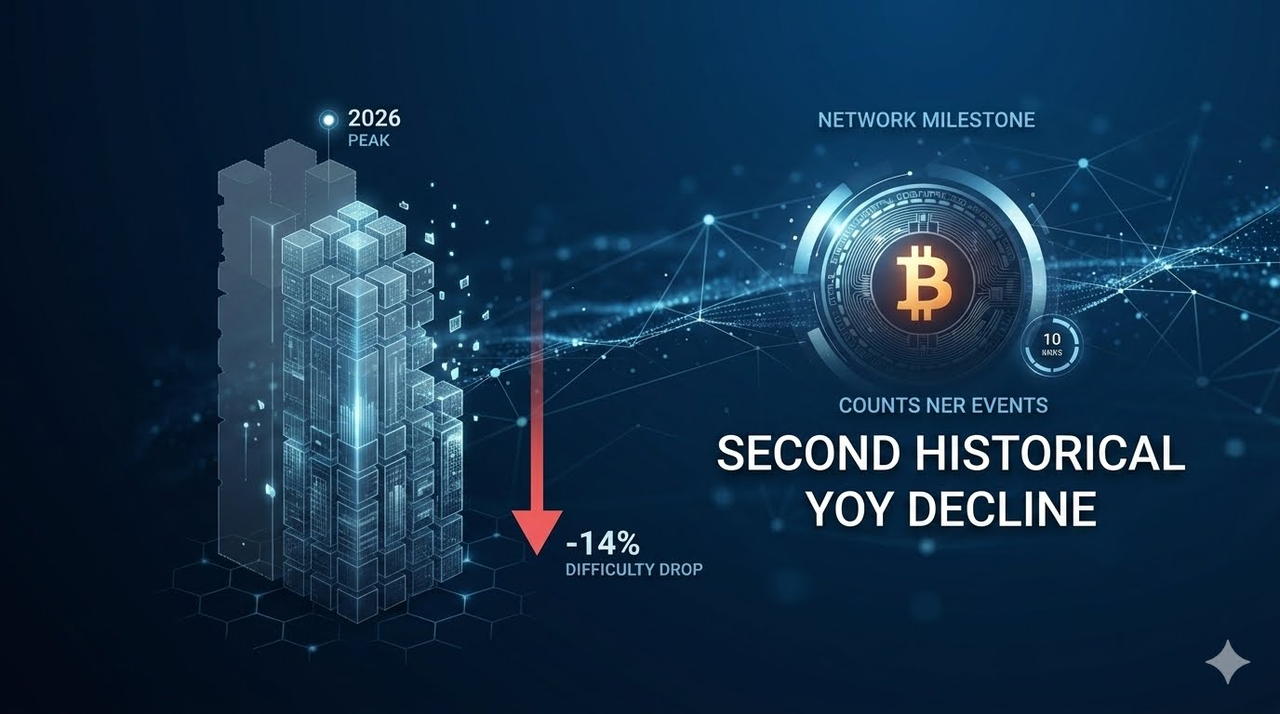
By late July 2026, the Bitcoin (BTC) network experienced a notable structural adjustment that prompted re-evaluation across the global digital asset ecosystem. The network's mining difficulty dropped by approximately 14% from its year-to-date peak, showcasing an extensive reallocation of specialized computational infrastructure. When measured against the absolute historical peak of 155.97 trillion recorded in November 2025, the drawdown highlights a total contraction of 19.1%. Today, this foundational cryptographic metric sits at approximately 126.23 trillion.
This significant shift marks only the second time in Bitcoin’s 17-year history that the network has registered a genuine year-over-year (YoY) decline in mining difficulty. For a blockchain network whose fundamental programmatic design generally trends toward an upward trajectory in security and competitive parameters, this extended contraction represents a major structural transition. It challenges previous assumptions regarding the perpetual expansion of mining infrastructure and introduces a new era of dynamic resource allocation.
Key Takeaways
-
Bitcoin’s mining difficulty dropped by 14%, marking a rare year-over-year decline driven by significant structural shifts in global computational infrastructure.
-
Post-halving economics pushed Hashprice to historic lows, forcing miners to disconnect older, inefficient hardware to avoid severe capital losses.
-
Major mining corporations are actively repurposing their massive electrical grid capacities to serve the booming Artificial Intelligence and HPC sectors instead.
-
Unlike previous temporary cycles, this hashrate migration is structural, as multi-year enterprise AI contracts permanently lock computing power away from mining.
-
The difficulty reduction acts as an economic stabilizer, allowing highly efficient, surviving miners to capture a larger share of daily block rewards.
A Structural Realignment, Not a Typical Cycle
This programmatic downward adjustment is directly tied to a sustained decline in raw computational power on the network. Bitcoin’s 7-day moving average hashrate has shrunk by approximately 12% over an extended period. The metric adjusted from its late-2025 milestone near 1 Zetta-hash per second (1,000 EH/s) to roughly 868 Exahashes per second (EH/s) by the end of July 2026.
Unlike previous macro hashrate drawdowns in the cryptocurrency sector—which were primarily triggered by abrupt regulatory policies or total market liquidations—this prolonged contraction stems from complex macroeconomic interactions. The Bitcoin network is undergoing a dual-front realignment. It is navigating the mathematical realities of post-halving miner economics while simultaneously adapting to a historic corporate migration of digital asset infrastructure toward Artificial Intelligence (AI) data centers and High-Performance Computing (HPC) environments.
The Decline in Mining Profitability (Hashprice)
The Economics of the Post-Halving Environment
The underlying fundamental factor acting upon the global crypto mining industry throughout 2026 has been a severe, multi-month compression in operating margins. Following the execution of the April 2024 halving event and a subsequent period of global macroeconomic tightening, Bitcoin's spot price has experienced a significant correction from its recent local macro highs. Because the programmatic block rewards remained fixed at 3.125 BTC per block, global mining operations have faced a compounding revenue challenge: lower individual coin production paired with asset volatility on corporate balance sheets.
To fully understand the severity of this economic environment, institutional analysts evaluate Hashprice—a comprehensive performance metric developed by Luxor that measures the expected daily fiat revenue a miner generates from a single, standardized Petahash per second (PH/s) of computational hashing power.
-
In June 2026, the global Hashprice fell to a historical low of $27.66 per PH/s/day.
-
For operational context, the average corporate breakeven threshold for standard mid-tier mining operations hovers between $30.00 and $33.00 per PH/s/day.
-
Running legacy hardware without specialized power purchase agreements (PPAs) became economically unviable for many mid-sized operations.
Hardware Upgrades and ASIC Retirements
Faced with negative cash flows and tightening operational capital reserves, mining operators globally initiated large-scale fleet optimizations. This hashrate reduction has predominantly featured the mass disconnection of legacy application-specific integrated circuit (ASIC) models that could no longer sustain their electrical overhead:
MicroBT WhatsMiner M30 series: Specifically the older M30S, M30S+, and M30S++ variants operating above the inefficient 35 Joules per Terahash (J/TH) spectrum.
Bitmain Antminer S19 series: Older 95 TH/s to 110 TH/s base models running on unhedged, variable industrial electricity rates.
Canaan AvalonMiner 1246 and 1346 series: Rigs that lacked the deep underclocking capabilities required to remain viable under margin compression.
As these inefficient rigs unclipped from regional electrical grids, individual blocks began generating at a slower pace than the network’s target. During this specific difficulty epoch, the total duration of the 2,016-block cycle stretched to 15.6 days—well above the standard 14-day design threshold, with the average block-generation time extending to approximately 11.1 minutes. This structural delay triggered Bitcoin's automated response: a mandatory 14% difficulty reduction designed explicitly to restore network equilibrium and return block times to the 10-minute programmatic rule.
The Infrastructure Shift to Artificial Intelligence
From Mining Rigs to AI Data Centers: A Strategic Pivot
A unique characteristic of the 2026 hashrate decline is that offline infrastructure is not entirely sitting idle. Instead, a structural corporate migration is occurring across public markets. Publicly traded mining companies are actively converting their high-voltage, energized power capacities to serve the expanding Artificial Intelligence and High-Performance Computing sectors.
Major institutional operators, including Riot Platforms, Core Scientific, and MARA Holdings, have recognized that their gigawatt-scale, heavily protected electrical grid connections hold immense value independent of digital currencies.
-
Enterprise AI firms require immense power capacities for specialized machine learning training and Large Language Model (LLM) inference.
-
Upgrading existing data center infrastructure to support liquid-cooled GPU architectures provides predictable, fiat-denominated revenue.
-
Long-term AI hosting contracts offer fixed-rate cash flows completely independent of digital asset market volatility.
-
Billions of dollars in institutional AI-hosting agreements have successfully reallocated megawatt capacity away from the Bitcoin network, stabilizing corporate revenues for publicly traded miners.
The Power Grid Dynamic: Texas and the 4CP Curtailment Strategy
Geography and climate factors have accelerated this infrastructure migration. In Texas, the geographic epicenter of North American Bitcoin mining, extreme summer heat waves during mid-2026 placed immense strain on the local Electric Reliability Council of Texas (ERCOT) grid system.
Under the specialized Four Coincident Peak (4CP) program, institutional miners are incentivized to curtail their power usage during peak grid stress to avoid massive transmission charges for the upcoming year. In 2026, instead of restarting their vast arrays of ASICs when immediate grid demand subsided, several multi-megawatt facility operators chose to transition their energized physical space directly to enterprise AI clients. This strategic operational choice transitioned computing power away from the blockchain, cementing the downward trend in network difficulty.
Historical Context: Comparing the YoY Difficulty Declines
To properly evaluate the scale and long-term implications of the current network realignment, it is helpful to study it alongside the only other instance of an extreme network difficulty contraction in Bitcoin history.
| Comparison Dimension | 2021 Summer Adjustment | 2026 Structural Realignment |
| Hashrate Migration Form | Complex physical logistics: physically packing and shipping millions of ASICs to North America, Europe, and Central Asia. | Infrastructure pivot: retaining the physical real estate and power lines but replacing ASICs with high-density GPU server racks. |
| Recovery Dynamic | Rapid re-entry as displaced machines found new regional power sources and resumed hashing within 6 to 9 months. | Protracted and structural; capacity leased to multi-year AI enterprise contracts is unlikely to return to BTC mining in the short term. |
| Market Outlook | Viewed globally as a regulatory risk event for digital assets, leading to localized equity liquidations. | Viewed as corporate maturity; public miners re-rated as resilient energy infrastructure tech providers. |
During the 2018 bear market, Bitcoin difficulty dropped significantly as the asset's spot price fell. Operators paused because the market value of the coins minted dropped below the raw operational cost of electricity. The 2026 event breaks this historical mold. Modern institutional miners are actively arbitrage-routing their physical power access to a different, higher-yielding computing asset class, making this difficulty drop highly structural.
Market Implications: Investors, Traders, and Surviving Miners
A Relief in Margins for Efficient Operators
For lean, highly disciplined miners who secured low-cost PPAs and proactively upgraded to next-generation hardware—such as the Bitmain Antminer S21, S21 Pro, and specialized Hydro series—the 14% difficulty drop acts as an economic stabilizer.
With fewer participants globally competing to solve the next cryptographic block, surviving miners automatically earn a proportionately larger share of the daily 450 BTC block rewards. Following the late July difficulty drop, the global spot Hashprice experienced a modest relief adjustment, bouncing from its sub-$28 floor back up to the $31.70–$32.21 per PH/s/day range. This adjustment has moved high-efficiency operations back into comfortable net-positive cash flow territory.
Forward Market Insights
Data from specialized derivatives and forward hash rate markets suggest the broader industry is preparing for a gradual recovery curve. According to the Luxor Forward Hashprice Market, contracts maturing in late December 2026 are currently pricing future hashrate conservatively around $31.85 per PH/s/day. This pricing structure demonstrates that institutional trading desks anticipate a prolonged, leaner environment where operational efficiency is paramount.
Implication for BTC Price: Market Positioning
For futures and spot traders, historical miner capitulation events have often served as reliable macro indicators for long-term trend forecasting. On-chain analysis shows that when difficulty drops significantly due to miner optimization, it frequently coincides with cyclical asset price consolidation.
When inefficient operators shut down operations, the continuous market sell-pressure from the mining sector tends to subside. Once this transition phase concludes, the drastically reduced daily selling pressure from corporate entities sets a cleaner foundation for future organic demand to influence asset prices.
Conclusion
The 14% decline in mining difficulty is not a symptom of network failure; rather, it showcases the execution of Bitcoin's automated, decentralized monetary architecture. Built-in code written over 17 years ago has successfully adjusted to massive global macroeconomic shifts and the rise of the AI industry.
The Bitcoin network is emerging from this historic 2026 adjustment leaner, highly efficient, and intrinsically tied to the global energy market. As the network sheds its inefficient participants, the foundational architecture of the decentralized economy continues to demonstrate structural resilience.
Join KuCoin 9th Anniversary Trading Campaign
KuCoin is celebrating its 9th anniversary with a special platform campaign filled with exclusive rewards, trading activities, and limited-time offers. Don’t miss the chance to participate and enjoy the benefits as the exchange marks nine years of growth and innovation. Visit the official campaign page now:

FAQs
Why did Bitcoin mining difficulty drop by 14% in 2026?
A 26% decline in BTC price compressed profit margins, driving miners' daily revenue (Hashprice) to a historic low of $27.66/PH. Inefficient operators were forced to disconnect older ASIC rigs, triggering an automated downward difficulty adjustment.
Is a 14% difficulty drop a sign of a Bitcoin "death spiral"?
No. It proves the success of Bitcoin’s programmatic design. The system automatically lowers difficulty to ensure blocks are still mined every 10 minutes, maintaining network stability despite hashrate fluctuations.
How does this event compare to the 2021 mining ban?
The 2021 drop was caused by abrupt regulatory crackdowns in China, forcing physical machine migration. The 2026 drop is driven by free-market economics, capital efficiency, and infrastructure pivots to AI data centers.
What does this difficulty drop mean for surviving miners?
Surviving miners with high-efficiency hardware (like Bitmain S21) face much less competition. They automatically capture a larger share of daily block rewards, lifting the global spot Hashprice back to $31.70–$32.21/PH.
Does miner capitulation signal a Bitcoin price bottom?
Historically, yes. Large-scale difficulty drawdowns usually coincide with cyclical price floors. Once inefficient miners finish liquidating assets and shut down, continuous sell-pressure eases, creating a cleaner foundation for future organic demand.
Will the mining hashrate bounce back by the end of 2026?
A rapid V-shaped recovery is unlikely. Luxor Forward Market data prices December 2026 hashrate at a flat $31.85/PH, indicating institutional expectations of a prolonged, lean period with capacity locked into AI.
Disclaimer
The information provided on this page may originate from third-party sources and does not necessarily represent the views or opinions of KuCoin. This content is intended solely for general informational purposes and should not be considered financial, investment, or professional advice. KuCoin does not guarantee the accuracy, completeness, or reliability of the information, and is not responsible for any errors, omissions, or outcomes resulting from its use. Investing in digital assets carries inherent risks. Please carefully evaluate your risk tolerance and financial situation before making any investment decisions. For further details, please consult KuCoin’s Terms of Use and Risk Disclosure.