

Apple MacBook & iMac Redesign 2026: M6 Chips, OLED Displays for AI
2026/07/24 14:59:00
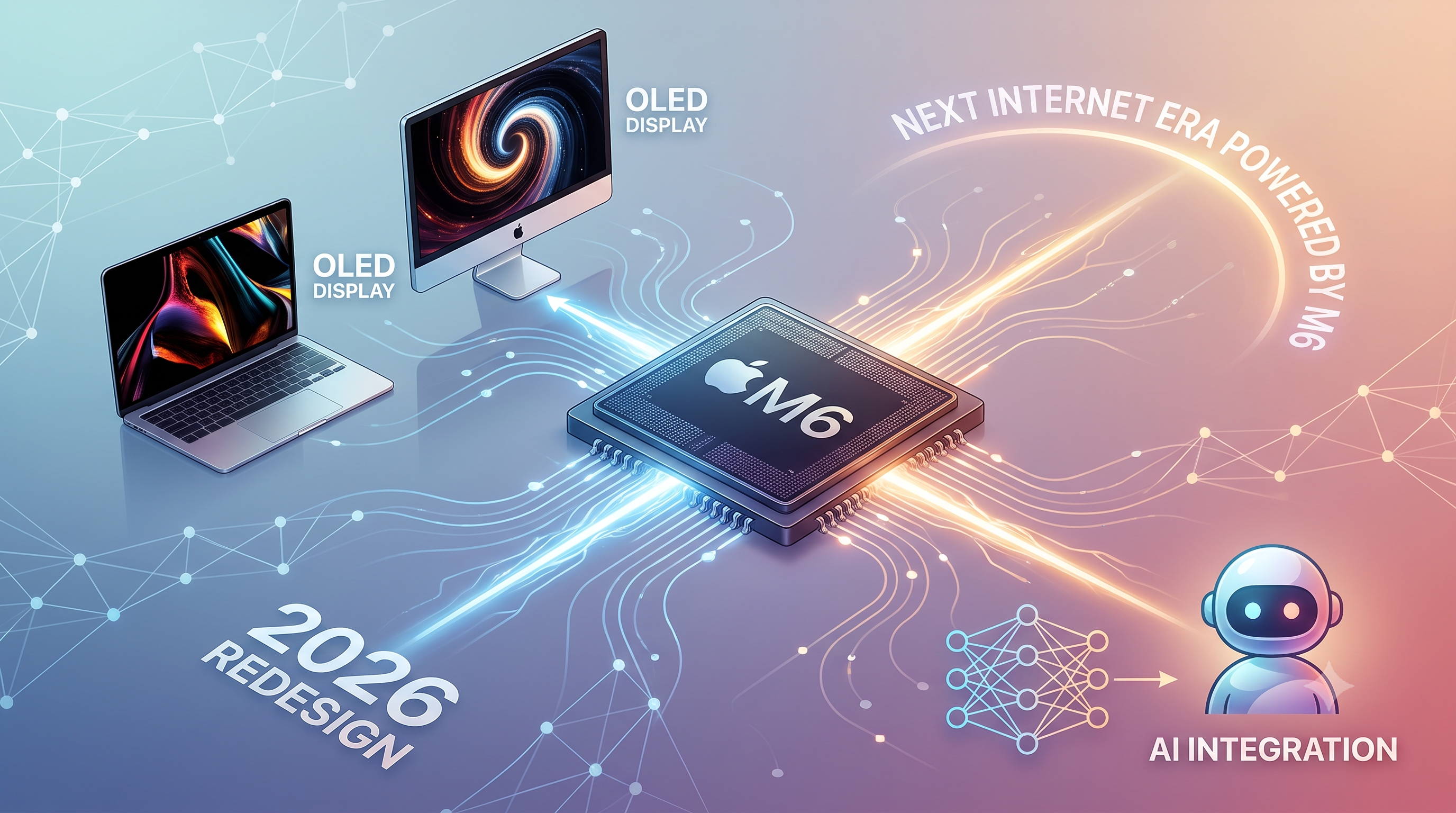
Apple’s reported Mac roadmap could bring faster processors, stronger on-device artificial intelligence and major display upgrades across several product generations. A standard 14-inch MacBook Pro with an M6 chip and an updated iMac could arrive first, focusing primarily on internal performance rather than complete redesigns. A separate premium MacBook may later introduce tandem OLED technology, touchscreen support and a thinner enclosure, while an OLED iMac appears to remain a longer-term project. Apple has not officially announced the M6 chip, OLED MacBook or future OLED iMac, so their specifications, prices and release dates should be treated as reported plans rather than confirmed products.
Apple’s 2026 Mac Refresh With M6 MacBook Pro and Updated iMac Release Plans
Apple is reportedly preparing one of its broadest Mac hardware refreshes in recent years, beginning with a new entry-level 14-inch MacBook Pro and updated iMac models expected in fall 2026. While early reports suggested that Apple’s 2026 Mac lineup would combine M6 processors, OLED displays and major design changes, the latest July 2026 Mac roadmap reporting points to a more gradual strategy. The standard M6 MacBook Pro and refreshed iMac are expected to focus on faster processing, improved power efficiency, higher memory bandwidth and stronger on-device artificial-intelligence performance while retaining designs similar to the current models. A more ambitious OLED MacBook redesign may arrive separately between late 2026 and early 2027. Apple has not officially announced the M6 chip or either new Mac, so the reported specifications, prices and release dates could still change.
M6 MacBook Pro Could Launch in Fall 2026
The entry-level 14-inch MacBook Pro, reportedly known internally as J804, could become one of Apple’s first M6-powered computers when it launches in fall 2026. This potential release window would place the new model approximately one year after the base M5 MacBook Pro debuted in October 2025, allowing Apple to maintain a relatively consistent annual chip-upgrade cycle. However, the M6 MacBook Pro is not currently expected to receive the OLED display, touchscreen support or thinner enclosure associated with Apple’s larger MacBook redesign. Reports instead suggest that it will preserve the existing 14-inch aluminum chassis, physical keyboard, Force Touch trackpad, professional port selection and Liquid Retina XDR display. The decision to retain the current design would allow Apple to introduce its next-generation processor more quickly while reserving expensive display and structural changes for a separate premium model. For buyers researching the M6 MacBook Pro release date, design and specifications, the most important distinction is that the first M6 laptop may be a performance-focused update rather than a complete visual transformation.
The expected M6 chip could nevertheless deliver meaningful improvements for professional applications, local artificial intelligence and everyday productivity. Apple is widely reported to be preparing M6 as its first Mac processor manufactured using a 2-nanometer process, potentially enabling higher transistor density, faster performance and improved energy efficiency compared with the 3nm M5 generation. Rumored specifications include approximately 200GB/s of unified-memory bandwidth, up from 153GB/s on the base M5, as well as an upgraded Neural Engine, a revised memory architecture and GPU changes designed to accelerate AI workloads. Apple is also reportedly testing configurations containing as many as 12 GPU cores, compared with the M5’s maximum of 10. Higher memory bandwidth could improve local language-model inference, AI image generation, video enhancement, code compilation and other workloads that frequently move large datasets between the CPU, GPU and unified memory. Apple may not release M6 Pro or M6 Max processors, however, because the company is reportedly accelerating development of M7 Pro and M7 Max chips with more extensive AI optimizations. The base M6 MacBook Pro may therefore occupy a short but important position between the current M5 lineup and Apple’s more advanced M7 roadmap.
Updated iMac May Retain Its 24-Inch LCD Design
Apple is also reportedly preparing two updated iMac configurations, internally identified as J833 and J834, for a possible fall 2026 launch. The new models would represent the first iMac update since Apple introduced the M4 version in October 2024, creating an approximately two-year gap between generations. Reports indicate that development may already be complete, but the processor remains less certain than the chip planned for the MacBook Pro. Some coverage has described the upcoming desktop as an M6 iMac, while other reliable reports only state that it will receive newer Apple silicon without specifying whether Apple will choose M5 or M6. Until the company confirms its plans, the most accurate description is an updated 2026 iMac with a faster processor rather than a guaranteed M6 model. Regardless of the final chip, the new iMac should deliver stronger CPU, GPU and Neural Engine performance than the existing M4 version, making it a potentially significant upgrade for users still working with Intel-based iMacs or first-generation M1 hardware.
The 2026 iMac update is expected to retain Apple’s current thin all-in-one enclosure, colorful aluminum finishes and 24-inch 4.5K Retina LCD rather than introducing an OLED panel. Apple may continue selling two primary configurations with different CPU and GPU core counts, storage capacities and port arrangements, while potential improvements could include faster wireless connectivity, stronger media engines and better Apple Intelligence performance. Support for macOS 27 could give the new iMac access to a more capable Siri AI experience, expanded Visual Intelligence, improved system search and developer tools that work with on-device and cloud-based foundation models. However, no strong evidence currently supports claims that Apple will release an OLED, touchscreen, 27-inch or 32-inch iMac in 2026. An OLED iMac is reportedly under development for a later stage of Apple’s display roadmap, but it may not arrive until OLED technology expands across additional MacBook models. Buyers waiting for a major iMac redesign should therefore separate the expected 2026 processor refresh from the longer-term OLED iMac plans.
Component Costs Could Affect Mac Release Dates and Prices
Apple’s reported 2026 Mac refresh is taking shape during an industry-wide shortage of memory and storage components that could affect product availability, base configurations and retail prices. Rapid investment in artificial-intelligence data centers has substantially increased demand for advanced memory, encouraging suppliers to allocate more manufacturing capacity to high-margin infrastructure products. This shift has tightened the supply of DRAM and NAND components used in consumer laptops and desktops, contributing to higher computer prices across the industry. Apple’s unified-memory architecture is central to Mac performance because the CPU, GPU and Neural Engine share the same memory pool, but AI agents that analyze information and perform autonomous tasks, along with other AI applications, increasingly require larger capacities to store model weights, process high-resolution media and maintain long conversational contexts. If memory costs remain elevated, Apple may need to balance the demand for AI-capable Macs against the expense of increasing standard memory configurations. Higher component prices could also make storage and unified-memory upgrades more expensive, particularly on professional MacBook Pro models.
The M6 MacBook Pro and updated iMac are believed to be further along in development than several other future Macs, making a fall 2026 release possible even if wider supply constraints continue. Nevertheless, Apple could adjust production volumes, regional availability or launch timing if memory supplies remain limited. The reported conditions also complicate the decision of whether to buy an existing M5 MacBook Pro or wait for M6. Users who need a professional laptop immediately already have access to strong AI, graphics and creative performance through the M5 family, while those who prioritize 2nm efficiency, higher memory bandwidth and an upgraded Neural Engine may find the M6 model more attractive. The updated iMac could provide a substantial performance improvement for owners of older systems, but it is unlikely to satisfy consumers specifically waiting for OLED or a larger display. Final purchasing decisions should be based on Apple’s confirmed processor specifications, unified-memory capacities, storage options, regional prices and release dates rather than assumptions that every new Mac arriving in 2026 will receive both M6 and OLED technology.
OLED MacBook Redesign and Future iMac Display Upgrades
Apple’s transition to OLED could become one of the most significant display changes in the Mac’s history. Reports indicate that the company is developing a premium MacBook with tandem OLED technology, integrated touch support and a thinner screen assembly while also evaluating OLED for a future iMac. The shift could improve contrast, brightness, color reproduction and power efficiency while giving Apple more flexibility over Mac hardware design and macOS interaction. The roadmap remains unofficial, but current panel-industry developments suggest Apple will introduce OLED gradually across selected premium Macs rather than replace LCD and mini-LED technology throughout the entire lineup at once.
Tandem OLED MacBook Display Could Improve HDR, Color and Efficiency
The redesigned MacBook is expected to use a tandem two-stack OLED panel, which is more advanced than the single-layer OLED screens found in many consumer laptops. OLED pixels generate their own light and can switch off independently, producing true blacks without the blooming that can appear around bright objects on backlit displays. A tandem structure adds a second light-emitting layer, spreading brightness across two OLED stacks instead of forcing one layer to operate at a higher electrical current. This can improve sustained brightness, energy efficiency and panel longevity, making tandem OLED better suited to professional MacBook users who work for extended periods. It could also deliver stronger HDR performance while using less power for dark interfaces, mixed images and video content.
Photography, video editing, animation, visual effects and digital design could benefit from more precise highlights, cleaner shadow detail, wider viewing angles and better contrast in dark scenes. Display-industry research suggests that future Apple OLED panels could target approximately 95% of the BT.2020 color gamut, which is considerably wider than the DCI-P3 standard used by many current premium displays. Achieving that level would require improved red, green and blue OLED materials without reducing efficiency or lifespan, and Apple has not confirmed that its first OLED MacBook will reach the target. The company would also need to manage image retention, full-screen brightness limits and uneven wear from static menus or application controls through adaptive brightness, pixel compensation and display-maintenance systems. Official brightness, color accuracy and durability specifications will therefore be essential for determining the panel’s value to professional users.
Touchscreen OLED MacBook Could Bring a Thinner Premium Design
The OLED MacBook could become Apple’s first touchscreen Mac, allowing touch to complement the keyboard and Force Touch trackpad rather than replace them. Users could scroll through documents, select controls, move objects, scrub editing timelines or adjust creative tools directly on the screen while continuing to use the trackpad for precise input. Apple may adopt on-cell touch technology that integrates the touch-sensitive layer more closely with the OLED panel, improving responsiveness and helping reduce display thickness. However, macOS menus and application interfaces were designed primarily for pointer input, so Apple may need to enlarge certain controls, strengthen the hinge and limit the arm fatigue associated with prolonged use of an upright touchscreen. Apple Pencil support remains unconfirmed and should not be assumed from touchscreen capability alone.
Reports have also suggested that Apple could replace the current notch with a smaller hole-punch camera area surrounded by a Dynamic Island-style interface for media controls, system alerts, background activities or Siri AI information, although the branding and functions remain speculative. Because OLED does not require the backlight assembly used by LCD and mini-LED panels, Apple could build a thinner lid, narrower bezels and a lighter notebook. A possible hybrid OLED design may combine a rigid glass substrate with thin-film encapsulation, while an oxide transistor backplane could improve pixel-level energy control and support efficient variable refresh rates. Apple would still need to balance thinness against structural strength, cooling, battery capacity, speakers, keyboard quality and professional ports, particularly during sustained creative or AI workloads.
Future OLED iMac Plans and Apple’s Long-Term Mac Display Strategy
A future OLED iMac could bring deeper blacks, precise pixel-level lighting, wider color coverage and stronger viewing-angle consistency to a larger desktop workspace. These improvements would benefit photographers, filmmakers and designers working with HDR footage, night scenes and dark interface elements where LCD blooming can reduce visual accuracy. Better black uniformity and off-angle color consistency could also help several people evaluate the same project from different positions. However, a large OLED desktop panel must sustain consistent brightness over a wider area and frequently display static menu bars, editing timelines, browser controls and application tool panels for many hours, increasing the importance of image-retention protection, durable emissive materials and effective compensation systems.
Apple may therefore wait for stronger panel yields, lower manufacturing costs and improved OLED longevity before moving the iMac away from LCD. The final screen size remains unknown, and reports involving 24-inch, 27-inch, 30-inch or 32-inch models remain speculative. Apple could update the consumer iMac or introduce a more expensive version aimed at creative professionals, but no dependable evidence establishes which strategy it will follow. A gradual rollout would allow standard Macs to retain high-quality LCD or mini-LED panels while premium products offer tandem OLED, touch support, wider color coverage and thinner designs. The OLED MacBook would emphasize portability, battery efficiency and direct interaction, whereas an OLED iMac would prioritize a larger workspace, sustained brightness and professional image quality. Apple’s final brightness, color, refresh-rate, battery and longevity specifications will determine whether these products deliver transformative upgrades or primarily visual improvements.
How M6 Chips and macOS 27 Could Improve On-Device AI Performance
Apple’s expected M6 chips could improve on-device AI performance by combining a more efficient processor with faster unified memory, an upgraded Neural Engine and GPU changes optimized for artificial-intelligence workloads. Although Apple has not officially announced M6, reports suggest it could become the company’s first Mac chip manufactured using a 2-nanometer process. Higher memory bandwidth would allow the CPU, GPU and Neural Engine to access large datasets more quickly through Apple’s shared unified-memory architecture. This could improve local language-model processing, AI image generation, video enhancement, transcription, code assistance, document analysis and AI systems that process large market datasets and automate trading workflows while reducing the delays associated with transferring data between separate memory systems. Running more AI tasks directly on a Mac could also provide faster responses, better offline functionality and stronger privacy because sensitive files would not always need to be uploaded to external servers.
macOS 27 could support these hardware improvements through a new generation of Apple Intelligence, including Siri AI, Visual Intelligence and expanded Foundation Models tools for developers. Applications could use Apple’s on-device models for smaller or privacy-sensitive requests while sending more demanding tasks to Private Cloud Compute or compatible third-party services. This hybrid approach would allow future Macs to balance speed, privacy and computing power instead of relying entirely on either local hardware or cloud infrastructure. However, actual performance will depend on unified-memory capacity, model size and application optimization, and many macOS 27 AI features will also work on existing Apple-silicon Macs. The M6 generation is therefore more likely to make on-device AI on Mac faster and more efficient rather than making current M-series systems immediately obsolete.
Conclusion
Apple’s Mac roadmap is best understood as a staged transition rather than a single 2026 redesign. The first phase could bring an entry-level 14-inch M6 MacBook Pro and updated iMac models in fall 2026. A separate high-end MacBook redesign may follow between late 2026 and early 2027 with OLED touchscreens and M5 Pro or M5 Max chips, while an OLED iMac remains a longer-term possibility. M6 could strengthen local AI performance, but its process technology, memory bandwidth and benchmark results remain unconfirmed. Buyers should therefore separate official macOS 27 and Apple Intelligence announcements from hardware reports and wait for Apple’s final specifications before making conclusions about performance, pricing or release dates.
🔥 Join KuCoin 9th Anniversary Trading CampaignKuCoin is celebrating its 9th anniversary with a special platform campaign filled with exclusive rewards, trading activities, and limited-time offers. Don’t miss the chance to participate and enjoy the benefits as the exchange marks nine years of growth and innovation. Visit the official campaign page now:
|

Frequently Asked Questions
How much unified memory is best for AI workloads on a future MacBook Pro?
The ideal amount depends on the size of the AI models and applications being used. A base memory configuration may handle Apple Intelligence and light AI tasks, while 24GB or 32GB should provide more flexibility for local language models, video editing and multitasking. Professionals working with large models or complex creative projects may benefit from 64GB or more. Because unified memory cannot be upgraded later, buyers should choose enough capacity for future needs.
Can current Apple silicon Macs run local AI without an M6 chip?
Yes. Existing M-series Macs can already run many local AI applications that support Apple’s Metal, Core ML and Neural Engine technologies. They can also support some forms of AI-powered automation used by crypto trading bots, although many trading platforms process part of their data in the cloud. An M6 Mac could complete compatible local tasks faster or more efficiently, but software optimization and available unified memory can be just as important as the processor generation.
Can an M6 Mac run AI models without an internet connection?
An M6 Mac should be able to run compatible AI models offline once the required application and model files have been downloaded. However, some macOS features may still use online services for current information or more demanding requests. Users concerned about privacy should check whether an application processes data locally or sends it to a cloud server.
How should buyers compare M6 AI performance?
Peak AI performance figures do not tell the complete story. Buyers should compare real-world results such as response speed, tokens generated per second, time to produce the first response, memory consumption, battery use and sustained performance. Tests should also identify the AI model, context size and data precision used because different settings can produce very different results.
Could OLED burn-in be a concern on a MacBook?
OLED panels can develop image retention after displaying static interface elements for extended periods, although modern display technologies include protections designed to reduce the risk. Mac users should review Apple’s warranty terms, brightness controls and independent long-term testing before purchasing. This may be particularly important for people who keep menus, timelines or application panels visible throughout the working day.
Disclaimer: This article is for informational purposes only and does not constitute financial, legal or investment advice. Tokenized assets involve market, regulatory, custody and smart-contract risks. Always conduct your own research.