

Kenya Anchors 15 Million Academic Records on Avalanche Blockchain to Combat Certificate Forgery
2026/08/06 10:07:00
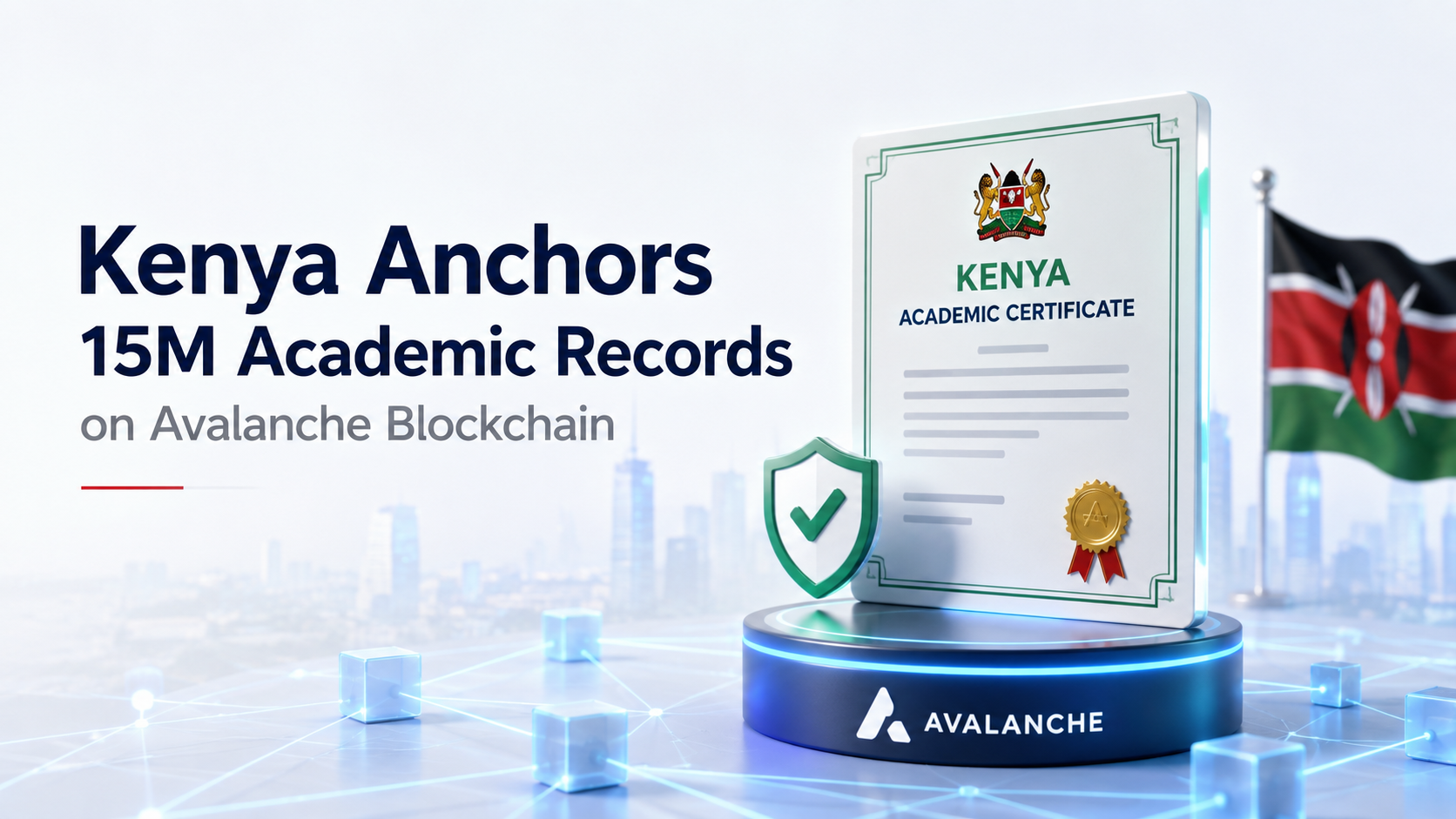
Out of 148 Direct Entry university applications submitted to Bayero University Kano in Nigeria during a single admissions cycle, only six certificates were genuine—highlighting a fraud crisis that Kenya is now solving with decentralized technology. Kenya’s National Examinations Council (KNEC) anchored over 15 million academic records dating back to 1989 onto the Avalanche C-Chain in August 2026 to eliminate fake credentials and streamline verification. Developed alongside local technology partner LegitDoc, this public-sector initiative shifts academic verification from months-long paper checks to sub-second cryptographic lookups. Certificates for nearly 1 million candidates from the 2025 Kenya Certificate of Secondary Education (KCSE) cohort are now issued exclusively through this tamper-evident digital portal. By converting physical diplomas into immutable on-chain records, Kenya has established one of the largest government blockchain infrastructure deployments globally.
Why Did Kenya Transition 15 Million Academic Records to the Avalanche Blockchain?
Kenya transitioned 15 million academic records to the Avalanche blockchain because traditional paper-based verification mechanisms were chronically vulnerable to forgery, corruption, and multi-month operational delays. Physical documentation forced employers and foreign universities to wait extended periods to confirm basic qualifications. By deploying an immutable ledger, the Kenyan government established an automated verification layer that replaces administrative bureaucracy with instant mathematical proof.
How Big Was Kenya's Credential Verification Delay?
Verifying a single Kenyan academic certificate previously required between 30 and 180 days under the legacy paper verification system. According to an industry report published by Cryptopolitan in August 2026, background screening firms conducting bulk credential checks for international employers routinely experienced six-month backlogs due to manual record retrieval within centralized government archives. This systemic latency disrupted employment pipelines, delayed university matriculations, and created administrative overhead for the Kenya National Examinations Council.
Why Were Traditional QR Codes and Databases Insufficient?
Traditional QR codes and centralized databases failed to stop academic forgery because bad actors easily cloned verification web pages and compromised internal administrative credentials. Based on analysis from Technext in August 2026, static QR codes printed on physical paper certificates frequently directed verifiers to lookalike domains hosted by counterfeiters. Furthermore, centralized database architectures remained inherently vulnerable to unauthorized database modifications by corrupt insiders, making physical paper documents and traditional digital portals unsafe single points of failure.
How Does Blockchain Technology Eliminate Academic Certificate Forgery?
Blockchain technology eliminates academic certificate forgery by converting student educational achievements into unique cryptographic hashes that are immutably anchored to a public decentralized ledger. Instead of relying on physical paper or trusting centralized web servers, verifiers check candidate document data directly against a public blockchain contract. Any unauthorized modification to grades, names, or issuance dates breaks the cryptographic hash signature, flagging the certificate as counterfeit immediately.
What Role Do Cryptographic Hashes and Merkle Trees Play in Verification?
Cryptographic hashes and Merkle tree structures enable instant credential verification without storing sensitive private student information directly on the public blockchain. Under the architecture deployed by KNEC and LegitDoc, individual examination results are transformed into cryptographic hashes—unique string values generated by mathematical algorithms—and grouped into Merkle trees. Based on technical documentation released by Ava Labs in August 2026, only the root hash of these datasets is anchored on the Avalanche C-Chain, allowing verifiers to confirm document authenticity in milliseconds while maintaining full compliance with data privacy regulations.
How Does Decentralized Anchoring Shift the Burden of Proof?
Decentralized anchoring shifts the burden of credential proof from the graduate to the public network by making academic records independently queryable without administrative intermediaries. Historically, job applicants carried physical paper certificates and relied on issuing institutions to validate their legitimacy when questioned by recruiters. With Avalanche-anchored e-certificates, the valid record exists continuously on-chain, rendering physical documents secondary and transferring authentication responsibilities to automated cryptographic verifiers.
What Is the Scope and Technical Infrastructure of Kenya's On-Chain Registry?
Kenya’s on-chain academic registry encompasses over 35 million projected records across all major tiers of the national educational system operating on the Avalanche C-Chain. The system integrates historical examinations dating back to 1989 alongside current graduation cohorts. Designed to handle high transaction volumes at near-zero gas costs, the technical implementation utilizes specialized smart contracts to anchor e-certificates seamlessly.
Which Educational Credentials Are Included in the Avalanche Rollout?
The Avalanche rollout includes primary education, secondary examination results, advanced tertiary diplomas, and national teaching certifications. Based on official disclosures from the Kenya National Examinations Council in August 2026, the initial deployment secured 15 million historical records, covering:
-
Primary Level Milestones: Kenya Certificate of Primary Education (KCPE) Grade 8 examination results.
-
Secondary Level Credentials: Kenya Certificate of Secondary Education (KCSE) Grade 12 examination records—including the entire 2025 graduating class of nearly 1 million students.
-
Professional Qualifications: Post-secondary advanced diploma certifications and official Government Teaching Faculty credentials.
Why Did KNEC Select the Avalanche C-Chain and LegitDoc Infrastructure?
KNEC selected the Avalanche C-Chain and the LegitDoc platform due to Avalanche's high transaction throughput, low execution costs, and proven track record in enterprise public-sector infrastructure. According to real-world asset (RWA) deployment data tracked by KuCoin in August 2026, Avalanche previously hosted large-scale record registries, including 42 million vehicle titles for the California Department of Motor Vehicles and 700,000 land deeds in India's Dantewada district. The platform's EVM compatibility allowed local developer teams to deploy scalable verification portals rapidly without building custom enterprise blockchains from scratch.
| Credential Feature | Traditional Credential Verification System | Kenya Avalanche On-Chain Verification Registry |
| Average Verification Time | 30 to 180 business days | Sub-second (instantaneous lookup) |
| Data Architecture | Centralized database subject to internal tampering | Immutable, append-only public ledger (Avalanche C-Chain) |
| Vulnerability to Spoofing | High—fake sites easily mirror static QR codes | Zero—verification checks against cryptographic on-chain hashes |
| Document Delivery | Physical paper certificates subject to loss/damage | Tamper-evident digital e-certificates backed by Merkle proofs |
| Privacy Protection | Plaintext personal data stored on central servers | Privacy-preserving hashes anchored on-chain; private data off-chain |
How Does Kenya's Blockchain Model Address Africa's Broader Certificate Fraud Crisis?
Kenya’s blockchain model provides a replicable, enterprise-ready blueprint for African nations seeking to eliminate endemic academic fraud and restore international trust in domestic credentials. Academic certificate forgery is a widespread structural problem across the continent that damages domestic labor markets and slows international university admissions. Kenya’s successful deployment on Avalanche demonstrates that national examination bodies can modernize legacy infrastructure without massive capital outlays.
What Lessons Can Nigeria's Exam Bodies Learn From KNEC's Deployment?
Nigeria’s examination bodies can learn that fragmented verification portals are inferior to a unified, blockchain-anchored national credential layer. According to admissions data released by Nigeria’s Joint Admissions and Matriculation Board (JAMB) and reported by Technext in August 2026, JAMB flagged 1,665 fake A-Level certificates in a single admissions cycle, with specific universities uncovering fake candidate rates exceeding 95%. While Nigerian agencies like WAEC and NECO operate separate digital verification portals, their reliance on siloed centralized databases leaves them vulnerable to credential fraud that a shared, tamper-evident ledger would prevent.
What Regulatory and Administrative Hurdles Block Regional Blockchain Integration?
Administrative siloes and a lack of cross-agency political willpower represent the primary hurdles blocking regional blockchain adoption across African examination bodies. Implementing a unified multi-agency registry requires harmonization between primary education boards, university regulatory commissions, and national data protection authorities. Based on policy analysis from Technext in August 2026, while academic researchers in West Africa have designed prototypes on EVM-compatible networks, inter-agency rivalries and legacy procurement contracts continue to delay wide-scale government implementation.
What Does Kenya's Government Rollout Mean for Real-World Asset (RWA) Adoption on Avalanche?
Kenya’s national rollout signals a fundamental shift in real-world asset (RWA) adoption, expanding blockchain utility beyond financial tokenization into sovereign identity and record management. Public-sector deployments provide long-term utility to smart contract platforms by generating consistent network transactions that are decoupled from speculative trading cycles. As governments digitize essential public services, enterprise-grade blockchains are becoming critical civil infrastructure.
How Does Enterprise Government Adoption Impact Avalanche Network Fundamentals?
Enterprise government adoption strengthens Avalanche network fundamentals by increasing contract interactions, driving validator revenue, and accelerating AVAX token burns through base transaction fees. Based on network parameter data from Ava Labs in August 2026, every credential batch anchored by LegitDoc requires gas paid in AVAX—100% of which is permanently burned according to Avalanche’s core protocol mechanics. As KNEC expands the registry from 15 million to 35 million records, ongoing minting and updating of credentials creates continuous burn pressure on the AVAX circulating supply.
Why Is AVAX Market Valuation Decoupled From Real-World Enterprise Deployments?
AVAX market valuation remains temporarily decoupled from real-world enterprise deployments because macro cryptocurrency liquidity conditions and broader altcoin market trends exert stronger short-term price influence than institutional utility news. Market metrics from KuCoin in August 2026 show AVAX trading in the $6.00 to $6.60 range, down significantly from historical highs despite major public-sector integrations in Kenya, California, and New Jersey. Experienced market participants recognize that public infrastructure integration builds foundational long-term value, even while crypto markets experience cyclical repricing.
| Institutional RWA Project | Sector / Use Case | Scale of On-Chain Deployment | Primary Blockchain Architecture |
| Kenya KNEC (LegitDoc) | Academic Credentials & Sovereign Registry | 15M records live (scaling to 35M) | Avalanche C-Chain |
| California DMV | Vehicle Titles & Digital Ownership | 42 Million Vehicle Titles | Avalanche Enterprise Subnet / L1 |
| Dantewada District (India) | Public Land & Property Registry | 700,000+ Land Deeds | Avalanche C-Chain |
| Bergen County (New Jersey) | Real Estate Title Tokenization | 370,000 Properties ($240B Value) | Avalanche Custom Subnet |
How to Buy and Trade Avalanche (AVAX) on KuCoin?
Trading Avalanche (AVAX) on KuCoin gives crypto investors direct access to one of the leading Layer-1 blockchains powering enterprise public-sector adoption and real-world asset digitization. Traders looking to capitalize on network milestones like Kenya's government deployment can also maximize their returns by participating in the exclusive KuCoin Trading Competition, which offers massive prize pools, fee rebates, and reward bonuses for both spot and futures market participants.
Executing an AVAX trade and unlocking trading rewards on KuCoin requires a simple, streamlined process:
-
Create and Secure Your Account: Register a free account on the official KuCoin website or mobile app. Complete standard Identity Verification (KYC) and enable mandatory security protocols, including Two-Factor Authentication (2FA) and trading passwords.
-
Join the Active Trading Competition: Visit the official KuCoin Platform Proof Event Page to confirm your participation in the ongoing campaign and unlock tiered promotional prizes.
-
Deposit Funds: Navigate to your KuCoin Asset Overview and deposit funds using credit/debit cards, peer-to-peer (P2P) fiat gateways, or by transferring stablecoins like USDT or USDC from an external wallet.
-
Navigate to the AVAX Spot or Futures Market: Enter the Trading terminal and search for the AVAX/USDT or AVAX/BTC trading pair.
-
Analyze and Place Your Order: Review live order book depth, price charts, and technical indicators. Choose between a Market Order for instant execution at current market prices or a Limit Order to specify your preferred entry price.
-
Manage Your Position and Collect Rewards: Once your trade executes, monitor your competition leaderboard standing directly on the event page, store your AVAX securely in KuCoin Earn to generate yield, or transfer your tokens to a self-custodial wallet to stake on-chain.
Conclusion
Kenya’s decision to anchor 15 million academic records on the Avalanche C-Chain represents a milestone achievement in public-sector blockchain implementation. By partnering with LegitDoc to transition physical KCSE certificates and historic credentials into cryptographically secured e-certificates, the Kenya National Examinations Council has solved a persistent regional verification crisis. Verification timelines that once stretched up to six months have been compressed to seconds, completely insulating academic credentials against paper forgery, bad actors, and centralized database vulnerabilities.
This enterprise deployment demonstrates that public blockchains offer utility far beyond financial speculation. As the registry scales toward 35 million records, Avalanche solidifies its position as a leading institutional Layer-1 platform for real-world asset digitization and state-level data registries. For neighboring nations battling similar academic fraud challenges, Kenya’s transparent, tamper-proof system serves as a powerful model for regional digital transformation. For crypto market participants, tracking real-world integrations like KNEC’s provides critical insight into the tangible, long-term technological adoption of decentralized blockchain networks.
FAQs
How does Avalanche store 15 million student certificates without violating data privacy laws?
Avalanche stores only non-sensitive cryptographic hashes on-chain, keeping all personal student identity details in secure off-chain databases. This architecture ensures full compliance with global privacy regulations, including the Nigeria Data Protection Act (NDPA) and international data privacy frameworks, because raw personal data is never publicly exposed on the blockchain.
Do students need a crypto wallet or AVAX tokens to access their digital certificates?
No, students do not need a crypto wallet, native blockchain apps, or AVAX tokens to access their academic credentials. The Kenya National Examinations Council provides a user-friendly e-certificate web portal where candidates authenticate their identity using standard login credentials, while the underlying blockchain verification layer functions invisibly in the background.
What happens to a student's on-chain academic verification if the Avalanche network experiences downtime?
On-chain academic verification checks remain permanently accessible across thousands of independent global validator nodes that continuously preserve the state of the Avalanche network. Because public blockchains operate without a centralized single point of failure, academic verification hashes remain queryable 24/7 without risk of administrative server shutdowns.
How does Avalanche's transaction throughput compare to other public blockchains for high-volume enterprise registries?
Avalanche offers sub-second finality and can process over 4,500 transactions per second per chain, significantly outperforming legacy networks like Ethereum in throughput and cost-efficiency. This scalability allows government institutions to anchor millions of batch records simultaneously without causing network congestion or incurring exorbitant gas fees.
Can employers verify Kenyan academic certificates on mobile devices without specialized software?
Yes, employers can instantly verify authentic certificates on any mobile device or web browser by uploading the digital e-certificate PDF or scanning its embedded verification link on the official KNEC portal. The portal checks the document’s cryptographic hash against the Avalanche C-Chain automatically, displaying a definitive binary result—authentic or altered—in seconds.