

June ETF Market Sees Frenzied Performance: Capital Inflows and New Launches Exceed Expectations
2026/07/07 16:56:00
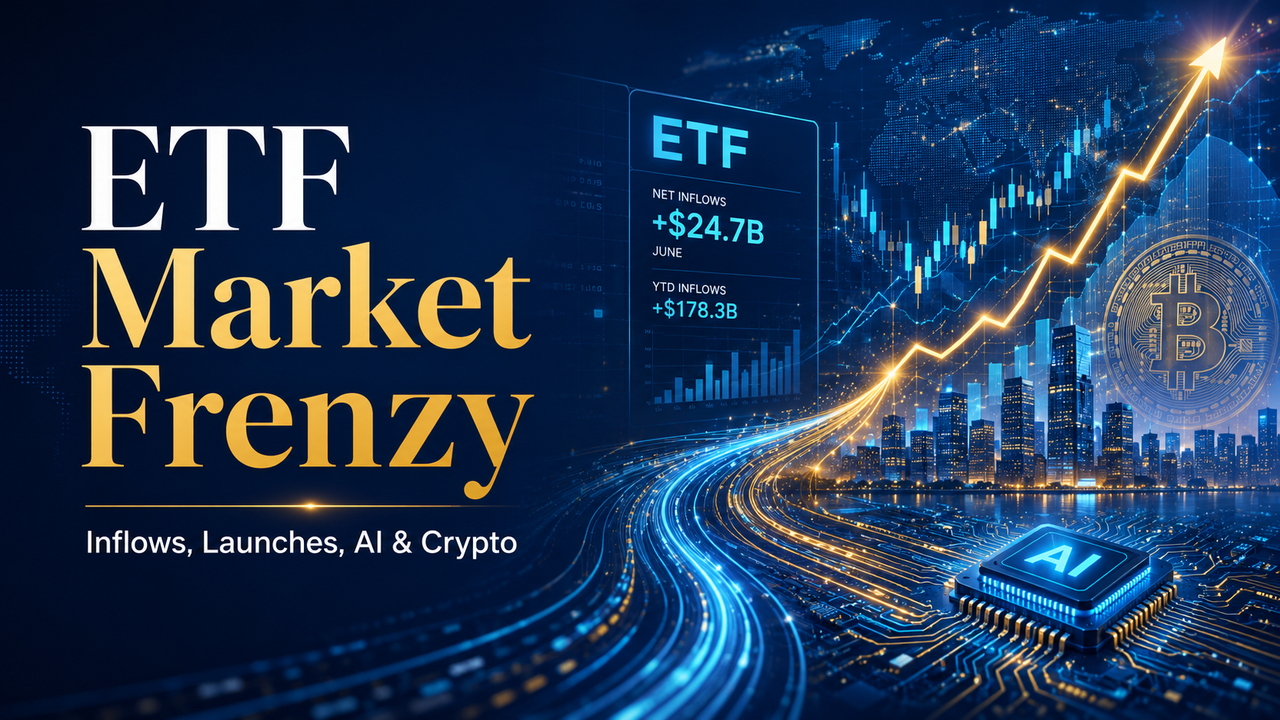 June became one of the strongest months in ETF market history, showing how quickly capital can rotate when investors regain confidence in risk assets. Reports citing Bloomberg ETF analyst Eric Balchunas described the month as “JUNE-SANITY,” as ETF net inflows reached about $191 billion, trading volume climbed to around $7 trillion, and 214 new ETFs launched during the month. ETF.com reported an even higher June inflow figure for U.S.-listed ETFs at about $210 billion, helping push total 2026 ETF inflows above $1 trillion by midyear. The exact number may vary by data provider, but the broader message is clear: investors are using ETFs more actively to gain exposure to equities, artificial intelligence, technology, global markets, crypto-linked products, and specialized investment strategies.
This ETF market frenzy is not only about passive investing. It reflects a deeper shift in how investors allocate capital and respond to changing market conditions. ETFs are now being used for broad market exposure, short-term trading, sector rotation, active strategies, options income, crypto access, and thematic investing, while crypto investors can also compare ETF-driven sentiment with real-time crypto market data. That makes June’s ETF data important for both traditional markets and digital assets, because ETF flows can reveal where investor appetite is moving before that rotation becomes fully visible in headline prices.
June ETF Inflows Show Strong Capital Rotation Into Risk Assets
June ETF inflows suggest that investors were not simply seeking safety or parking cash in defensive products. Capital moved strongly into equity ETFs, international stock funds, technology-linked products, and leveraged strategies. This pattern points to a clear risk-on rotation, where investors became more willing to accept market volatility as U.S. equities recovered, AI demand remained strong, and global growth themes attracted renewed attention.
-
U.S. Equity ETFs Led the Risk-On Rotation
U.S. equity ETFs attracted the largest share of June inflows, showing that investors were willing to increase stock-market exposure instead of remaining fully defensive. ETF.com reported that U.S. equity ETFs brought in about $103 billion in June, making them the strongest ETF category of the month. Fixed-income ETFs also gained demand, but the scale of equity ETF inflows suggests that many investors were rotating toward growth and market upside rather than focusing only on income or capital protection.
This matters because ETF flows often act as a real-time signal of investor positioning. When money moves into broad equity ETFs, large-cap stock funds, and growth-focused products, it usually reflects stronger confidence in risk assets. Investors may still be watching inflation, interest rates, earnings, and geopolitical uncertainty, but June’s ETF data shows that many were willing to participate in market momentum rather than wait on the sidelines.
-
International Equity ETFs Show Broader Global Risk Appetite
The capital rotation was not limited to U.S. stocks. International equity ETFs also attracted meaningful inflows, suggesting that investors were looking for growth opportunities outside the domestic market. ETF.com reported around $37 billion in June inflows for international equity ETFs, while MarketWatch noted that emerging-market ETFs had already pulled in about $38 billion in 2026, which could mark a record if the trend continues.
This global rotation is important because international and emerging-market ETFs usually carry additional risks, including currency exposure, regional policy uncertainty, and geopolitical sensitivity. When investors allocate more capital to these products, it often signals broader confidence in global growth conditions. In June, that demand showed that investors were not only buying U.S. mega-cap stocks; they were also searching for growth across Japan, South Korea, emerging markets, and regions linked to technology, manufacturing, and AI supply chains.
-
Leveraged ETFs Point to More Aggressive Positioning
Leveraged ETF inflows also show that some investors were taking more aggressive short-term positions. These products are designed to amplify daily market moves, making them attractive to traders during strong market trends. June’s demand for leveraged strategies suggests that part of the market was not just cautiously reallocating into equities, but actively positioning for continued upside.
However, leveraged ETFs carry higher risk than traditional index ETFs, similar to how amplified exposure in crypto futures trading can increase both potential gains and potential losses. Their daily reset structure can create compounding effects, especially during volatile markets, and losses can grow quickly when prices move against the trade. For that reason, strong leveraged ETF demand sends a mixed signal: it reflects confidence and momentum, but it also suggests that risk-taking may be rising faster than some investors realize.
Key signs of risk-on rotation in June included:
-
Strong inflows into U.S. equity ETFs
-
Rising demand for international and emerging-market exposure
-
Continued interest in AI and technology-linked funds
-
Increased use of leveraged and specialized ETF strategies
-
Outflows from some defensive or non-growth categories
New ETF Launches Reflect Rising Demand for Specialized Investment Products
The June ETF launch boom shows that investors are looking beyond traditional broad-market index funds. ETFs are becoming more specialized, with issuers creating products for AI infrastructure, semiconductors, options income, active management, crypto-linked exposure, single-stock strategies, and other targeted themes. This reflects a more mature but also more complex ETF market, where investors want precision, speed, and flexibility.
-
Investors Want More Targeted ETF Exposure
The ETF market was once dominated by simple products tracking broad indexes such as the S&P 500, Nasdaq-100, or major bond benchmarks. Those products still matter, but the fastest-growing part of the market is now more specialized. Investors increasingly want ETFs that target specific sectors, strategies, or asset classes instead of only holding broad passive exposure.
This explains why ETF issuers are moving quickly to launch funds tied to artificial intelligence, robotics, defense technology, cybersecurity, short-term income, crypto themes, and options-based strategies. For investors, these products can make portfolio construction more flexible. A trader can react quickly to a market theme, while a long-term investor can build exposure to a specific industry without buying individual stocks.
-
Active ETFs Are Becoming a Bigger Part of the Market
Active ETFs are also helping drive new product growth. Unlike traditional passive ETFs, active ETFs give portfolio managers more flexibility to adjust holdings, manage risk, rotate between sectors, or use systematic strategies. Morningstar has noted that ETF product development has increasingly moved toward active, options-based, single-stock, and crypto-related products, showing that active management is becoming more important inside the ETF structure.
This shift gives investors more choice, but it also makes ETF research more important. Two active ETFs can have very different objectives, fees, holdings, turnover, and risk controls. Investors cannot judge them only by the fund name. They need to understand the strategy behind the ETF and whether it is designed for long-term allocation, income generation, tactical trading, or short-term speculation.
-
Options Income and Single-Stock ETFs Reflect Product Innovation
Options income ETFs and single-stock ETFs show how far the ETF market has moved beyond simple indexing. Covered-call and premium-income strategies have become popular because investors want yield in addition to market exposure. Single-stock ETFs, meanwhile, allow investors to gain amplified, inverse, or income-based exposure to individual companies through an ETF wrapper.
These products can be useful for experienced investors, but they are not the same as owning a simple equity ETF. Options strategies can limit upside during strong rallies, while leveraged or inverse single-stock products can produce large losses if the underlying stock moves sharply in the wrong direction. The growth of these products shows strong demand for customized exposure, but it also increases the need for clearer risk education.
-
The ETF’s underlying holdings or exposure method
-
Expense ratio and trading costs
-
Liquidity and bid-ask spreads
-
Use of leverage, options, futures, or derivatives
-
Rebalancing rules and downside risk
-
Whether the ETF is built for long-term holding or short-term trading
-
Regulators Are Watching the ETF Product Boom
The rapid growth of specialized ETFs has also attracted regulatory attention. On June 30, 2026, the U.S. Securities and Exchange Commission requested public comment on “novel” ETFs that invest in innovative asset classes or use new investment strategies. The SEC said the goal is to support innovation while protecting investors and maintaining fair, orderly, and efficient markets.
This is especially relevant for ETFs tied to leverage, options, crypto, prediction markets, and other complex strategies. Reuters reported that the SEC’s review comes as product issuers push into more complex ETF structures, including leveraged funds, covered-call strategies, and crypto-linked products. The key issue is not whether ETF innovation should continue, but whether investors fully understand the risks behind these new products.
ETF Market Frenzy Signals Growing Investor Interest in Crypto, AI, and Thematic Funds
The ETF market frenzy is important because it shows where investor attention is concentrated. Crypto, AI, and thematic funds are becoming major parts of the ETF conversation because they give investors access to fast-growing narratives through familiar market structures. Instead of building direct exposure one asset at a time, investors can use ETFs to gain access to entire themes.
-
Crypto ETFs Are Becoming a Bridge Between Digital Assets and Traditional Markets
Crypto ETFs are one of the clearest examples of how ETFs are connecting traditional finance with digital assets. Many investors want exposure to Bitcoin, Ethereum, or blockchain-related themes, but they may not want to manage wallets, private keys, on-chain transfers, or direct custody. ETFs provide a familiar route through brokerage accounts and regulated market infrastructure, and readers who want more background can review how a Bitcoin ETF works.
This does not remove crypto risk. Crypto ETFs can still experience sharp inflows and outflows depending on Bitcoin price action, liquidity conditions, regulation, and market sentiment. The ETF wrapper makes digital asset exposure easier to access, but it does not make the underlying asset stable. For crypto investors, the bigger takeaway is structural: ETFs are becoming one of the main gateways through which traditional capital enters and exits digital asset markets.
-
AI ETFs Are Capturing the Strongest Market Narrative
AI remains one of the strongest investment themes in 2026, and ETF flows reflect that demand. MarketWatch reported that technology ETFs captured about 69% of all sector ETF flows in the first half of 2026, with investor interest linked to artificial intelligence, robotics, semiconductors, and memory-chip demand.
The AI theme is broad because it is not limited to software companies. Investors are also targeting semiconductors, memory chips, cloud infrastructure, data centers, power demand, robotics, automation, and cybersecurity. ETF.com reported that AI-linked hardware and semiconductor products were among the strongest flow stories in June, including large inflows into memory-chip and semiconductor ETFs.
Major AI-related ETF themes include:
-
Semiconductor and memory-chip ETFs
-
Robotics and automation funds
-
Cloud computing and data center exposure
-
AI infrastructure and power-demand themes
-
Broad technology and growth-stock ETFs
-
Thematic Funds Show Investors Want a Clearer Market Story
The rise of thematic ETFs shows that investors increasingly want products built around clear market narratives. Instead of buying a broad fund and accepting whatever exposure comes with it, investors can now choose ETFs tied to specific ideas such as AI, crypto, clean energy, defense technology, cybersecurity, emerging markets, or options income. This gives investors more control over portfolio themes, but it can also increase concentration risk.
Thematic ETFs often perform best when their story is popular and capital is flowing into the sector. But if valuations become stretched, earnings disappoint, or market leadership rotates elsewhere, narrow thematic funds can fall quickly. That is why investors need to look beyond the headline theme and study the fund’s holdings, weighting method, liquidity, fees, and risk profile.
-
What the ETF Frenzy Means for the Broader Market
June’s ETF activity suggests that ETFs are becoming the preferred wrapper for modern investing. They are liquid, easy to trade, transparent, and flexible enough to package almost any market idea. That is powerful for investors, but it also means the ETF market is becoming more crowded and more complex.
For the broader market, the ETF frenzy points to stronger risk appetite, faster capital rotation, and growing demand for specialized exposure. For crypto and AI, it shows that investors are increasingly willing to access high-growth themes through regulated financial products. However, strong flows should not be confused with guaranteed returns. ETF demand can support momentum, but it can also reverse quickly when macro conditions, liquidity, or investor sentiment changes.
Conclusion
June’s ETF market performance was more than a strong month of inflows. It showed how modern investors are using ETFs to rotate into risk assets, access specialized strategies, and participate in major themes such as crypto, AI, technology, and global equities. The combination of heavy inflows, record product launches, and rising trading volume suggests that ETFs are now one of the most important vehicles for capital movement across financial markets.
At the same time, the ETF boom comes with a clear warning. More products do not always mean better products. As ETFs become more specialized, investors need to understand what they are buying, how each fund is structured, and what risks sit behind the headline theme. The strongest ETF market opportunities will likely be those that combine investor demand with transparency, liquidity, reasonable costs, and a clear long-term investment case.
FAQs
What does strong ETF inflow mean?
Strong ETF inflow means more money is entering exchange-traded funds than leaving them. This can show investor confidence, but it does not always mean the market will continue rising. ETF inflows may reflect long-term allocation, short-term trading, portfolio rebalancing, or demand for specific sectors such as technology, bonds, crypto, or international stocks.
Why are ETF inflows important for market analysis?
ETF inflows are important because they show where capital is moving across the market. Analysts use ETF flow data to understand investor behavior, risk appetite, sector rotation, and demand for different asset classes. However, ETF flows should be viewed together with price action, earnings data, interest rates, liquidity, and macroeconomic conditions.
Are high ETF inflows always bullish?
High ETF inflows can be bullish, but they are not a guaranteed positive signal. Inflows may support market momentum when investors are buying growth assets, but they can also happen near crowded market conditions. If too much capital enters the same theme too quickly, valuations may become stretched and downside risk may increase.
What is the difference between a broad-market ETF and a thematic ETF?
A broad-market ETF usually tracks a large index, such as a major stock or bond benchmark, giving investors diversified exposure across many companies or securities. A thematic ETF focuses on a specific idea, sector, or trend, such as artificial intelligence, robotics, crypto, cybersecurity, or clean energy. Thematic ETFs can offer stronger targeted exposure, but they usually carry higher concentration risk.
Why are new ETF launches increasing?
New ETF launches are increasing because investors want more specific products for different market strategies. Asset managers are creating ETFs for active management, options income, single-stock exposure, crypto themes, AI infrastructure, global equities, and short-term trading. The ETF structure is popular because it offers liquidity, transparency, and easy access through traditional brokerage accounts.
Are specialized ETFs suitable for beginner investors?
Specialized ETFs may not always be suitable for beginner investors because some use leverage, options, futures, or narrow sector exposure. These products can behave very differently from simple index ETFs. Beginners should understand the fund’s holdings, strategy, fees, liquidity, and downside risk before investing in specialized ETFs.
Can ETF flows predict crypto market direction?
ETF flows can help show demand for crypto exposure, but they cannot predict crypto prices with certainty. Crypto markets are affected by many factors, including Bitcoin price trends, liquidity, regulation, interest-rate expectations, investor sentiment, and on-chain activity. Strong crypto ETF inflows may support confidence, while outflows can signal weaker demand, but neither guarantees the next price move.
What should investors check before buying a new ETF?
Before buying a new ETF, investors should review the fund’s objective, holdings, expense ratio, trading volume, bid-ask spread, issuer reputation, tax structure, and use of derivatives. They should also check whether the ETF is designed for long-term investing or short-term trading. A new ETF may sound attractive, but the structure matters more than the headline theme.
Why does ETF liquidity matter?
ETF liquidity matters because it affects how easily investors can buy or sell shares without large price differences. A liquid ETF usually has stronger trading volume, tighter bid-ask spreads, and better execution. Low-liquidity ETFs may be harder to trade efficiently, especially during volatile market conditions.
What are the main risks of chasing hot ETF themes?
The main risks include buying after a theme has already become crowded, paying high fees, taking on hidden concentration risk, and misunderstanding the fund’s strategy. Hot themes can rise quickly, but they can also reverse when investor attention shifts. Investors should avoid judging an ETF only by its name and should study what the fund actually owns.
Disclaimer
The information provided on this page may originate from third-party sources and does not necessarily represent the views or opinions of KuCoin. This content is intended solely for general informational purposes and should not be considered financial, investment, or professional advice. KuCoin does not guarantee the accuracy, completeness, or reliability of the information, and is not responsible for any errors, omissions, or outcomes resulting from its use. Investing in digital assets carries inherent risks. Please carefully evaluate your risk tolerance and financial situation before making any investment decisions. For further details, please consult KuCoin’s Terms of Use and Risk Disclosure.