

Why Are More Companies Adding Bitcoin to Their Balance Sheets in 2026?
Introduction
In August 2020, MicroStrategy made a decision that most CFOs considered reckless: the company converted its treasury reserves from cash into Bitcoin. The stock market shrugged. Analysts dismissed it as eccentricity. Shareholders filed complaints. The company's software business continued declining.
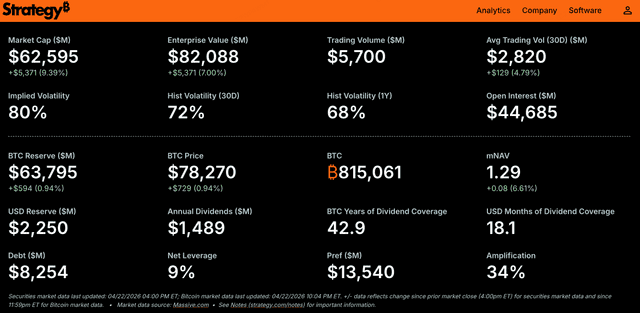
Four years later, that decision transformed MicroStrategy from a mid-cap software company into the world's largest institutional Bitcoin holder, with over 815,000 BTC worth approximately $64 billion at current prices. Michael Saylor, once mocked as the "Bitcoin guy," had rewritten the playbook for corporate capital allocation.
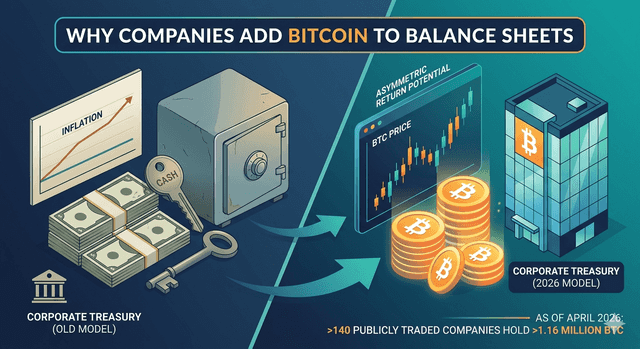
As of April 2026, more than 140 publicly traded companies hold Bitcoin on their balance sheets, collectively controlling approximately 1.16 million BTC. Corporate treasuries added roughly 62,000 Bitcoin during the first quarter of 2026 alone. The trend has moved from novelty to mainstream adoption.
Understanding why this wave of corporate Bitcoin adoption is accelerating helps investors evaluate whether the trend represents genuine value creation or speculative excess.
The Corporate Treasury Problem: Why Cash Is No Longer King
The Inflation Case for Bitcoin Over Cash
For most of corporate history, treasury reserves sat in cash and government bonds. The rationale was simple: preserve liquidity, avoid risk, maintain flexibility. When inflation ran at 2-3%, the opportunity cost of holding cash remained manageable.
2021 changed the calculus. US inflation hit 9.1%, the highest in four decades. Companies holding billions in cash watched real purchasing power erode while their treasury investments earned below-market yields. A company holding $500 million in cash earning 0.5% interest while inflation ran at 8% effectively lost $37.5 million in real value annually.
Bitcoin's fixed supply of 21 million coins offers a structural hedge against this erosion. Unlike cash, which governments can print without limit, Bitcoin's monetary policy is hardcoded. No central bank can increase Bitcoin supply to fund spending. No treasury department can debase Bitcoin's units to repay debts.
The implication for corporate balance sheets is straightforward: holding Bitcoin preserves purchasing power when monetary policy favors expansion. This argument has resonated particularly strongly during periods of elevated inflation expectations or currency volatility.
The Zero-Risk Asset Myth
Treasury bonds carry "no risk" only in nominal terms. Adjust for inflation, currency depreciation, and counterparty exposure, and the risk-adjusted returns look considerably less attractive. The US national debt exceeds $36 trillion as of 2026, raising questions about long-term dollar stability that treasury managers cannot ignore.
A growing number of CFOs have concluded that the "risk-free" label on cash and government bonds represents a dangerous oversimplification. The real risk is not price volatility but purchasing power erosion over time. Bitcoin's volatility makes headlines, but the steadier erosion of cash purchasing power often goes unmentioned.
Corporate treasury adoption of Bitcoin reflects this reframing. Instead of asking "why take Bitcoin risk?", CFOs increasingly ask "why bear the hidden risk of currency debasement?" The answer to the second question justifies the first.
The MicroStrategy Effect: How One Company Changed Everything
Proof of Concept
Michael Saylor did not invent the idea of holding Bitcoin on corporate balance sheets, but MicroStrategy provided the most visible proof of concept. The company's methodical accumulation strategy demonstrated that a corporation could hold Bitcoin at scale without operational disruption.
The results speak for themselves. MicroStrategy stockholders who held shares from August 2020 earned returns that dwarfed virtually every other equity investment during the same period. The strategy worked precisely because the company treated Bitcoin as a permanent reserve asset rather than a trading position.
Critically, Saylor's approach emphasized accumulation over analysis. He did not time markets or reduce positions during drawdowns. He bought Bitcoin continuously, financed through debt instruments and equity raises, and held without selling. This discipline created the foundation for the outsized returns that attracted competitors.
The Saylor Playbook
The MicroStrategy playbook consists of several replicable mechanisms:
-
Purchase Bitcoin through convertible debt instruments rather than operating cash flow
-
Issue bonds at low interest rates, using proceeds for Bitcoin acquisition
-
Treat Bitcoin as a permanent capital reserve, never sold
-
Access public capital markets through equity raises to fund additional accumulation
This framework lowers the barrier to entry for other companies. A CFO need not understand Bitcoin's technology or price mechanics. The structure handles the financial engineering. The strategy's success has provided a template that companies without MicroStrategy's Bitcoin expertise can follow.
As of 2026, the playbook has been replicated across multiple continents. Metaplanet in Japan adopted a similar strategy, accumulating over 7,000 BTC. Semler Scientific in the United States followed with smaller but consistent purchases. Twenty One Capital emerged from a SPAC structure with significant Bitcoin reserves. The replication confirms the model's accessibility.
Five Reasons Companies Are Accelerating Bitcoin Adoption
Reason 1: Preserving Purchasing Power
The original thesis remains the strongest driver. Companies holding significant cash reserves face a binary choice: accept currency depreciation or seek alternatives. Bitcoin offers a mathematically defensible alternative to cash with a fixed supply and transparent issuance schedule.
Survey data from January 2026 showed that finance executives increasingly view Bitcoin as a treasury reserve alongside government bonds rather than as a speculative asset. This shift in framing matters. When Bitcoin is compared to cash rather than to technology stocks, the volatility concern diminishes and the purchasing power preservation thesis strengthens.
Reason 2: Competitive Differentiation
For consumer-facing companies, Bitcoin treasury adoption creates marketing value. Announcing Bitcoin holdings signals technological sophistication, forward-thinking leadership, and alignment with demographic trends. The PR value of being the "Bitcoin company" in your industry often exceeds the financial returns for smaller companies.
Metaplanet's Bitcoin strategy generated significant media coverage in Japan, positioning the company as a fintech innovator. Semler Scientific's Bitcoin treasury attracted investor attention disproportionate to the company's size. The reputational returns from Bitcoin adoption create competitive advantages that do not appear on balance sheets but influence stock valuations.
Reason 3: Attracting Talent
Engineering and product talent increasingly evaluate potential employers through a technology alignment lens. Companies with Bitcoin on their balance sheets attract attention from candidates interested in digital assets, decentralized systems, and alternative financial structures.
This talent acquisition effect operates alongside stock compensation and cultural initiatives. Bitcoin-holding companies signal philosophical alignment with employees who see digital assets as the future of finance. The competitive advantage in recruiting adds non-financial value to treasury adoption.
Reason 4: Demonstrating Digital Asset Expertise
Companies planning to integrate blockchain technology, offer crypto services, or participate in Web3 ecosystems benefit from demonstrating Bitcoin competence internally. A company that cannot manage its own treasury effectively cannot credibly claim to serve digital asset markets.
Bitcoin treasury adoption functions as an internal proof of capability. The operational learning from custody setup, accounting treatment, and compliance frameworks transfers directly to customer-facing digital asset services. Companies like MicroStrategy have leveraged this internal expertise into advisory and services businesses.
Reason 5: Asymmetric Return Potential
The financial case remains compelling. Bitcoin's historical returns exceed virtually every other asset class over equivalent time horizons. While past performance does not guarantee future results, the asymmetric return profile attracts CFOs and boards willing to accept volatility in exchange for appreciation potential.
The mathematics favor long holding periods. During Bitcoin's 2020-2025 bull market, companies that accumulated and held outperformed those that waited for lower volatility before buying. The cost of waiting often exceeded the cost of Bitcoin's drawdowns. This pattern has reinforced the accumulation mindset among early adopters.
The Competitive Landscape in 2026
Who's Buying and Who's Holding Back
Corporate Bitcoin adoption in 2026 reveals a bifurcated market. Strategy continues accelerating purchases, having added 90,000 BTC in early 2026 while all other treasury companies combined added just 4,000 BTC. The concentration reflects both Strategy's unique position and competitors' hesitation following the 2025 drawdown.
The 2025 market correction tested Bitcoin treasury companies severely. Bitcoin fell more than 50% from its peak, forcing companies with leveraged structures or limited cash reserves to reconsider their positions. Those that survived emerged stronger, having demonstrated operational resilience. Companies that panicked sold at losses and abandoned the strategy.
Forbes analysis from March 2026 noted that smaller treasury companies traded between 10% and 75% below the Bitcoin value on their balance sheets during the drawdown. The discount reflected market skepticism about smaller companies' ability to maintain Bitcoin holdings through volatility cycles.
The survivors cluster into distinct categories:
|
Company Type
|
Examples
|
Strategy
|
Scale
|
|
Pure-play Bitcoin treasury
|
Strategy (MSTR)
|
Maximum allocation, leveraged structure
|
815,000+ BTC
|
|
Mining companies
|
MARA Holdings
|
Revenue-financed accumulation
|
20,000+ BTC
|
|
Fintech firms
|
Block, PayPal
|
Service-driven exposure
|
5,000-10,000 BTC
|
|
Copycat adopters
|
Metaplanet, Semler Scientific
|
Saylor playbook replication
|
1,000-10,000 BTC
|
The Consolidation Pattern
Market dynamics in 2026 suggest consolidation among Bitcoin treasury companies. Companies with strong operating businesses and disciplined Bitcoin accumulation strategies are positioned to acquire weaker competitors. The pattern mirrors natural selection: survival favors entities with diversified revenue and committed Bitcoin strategies.
Analysts expect merger and acquisition activity among smaller treasury companies as the market matures. Companies unable to raise capital at reasonable costs or lacking operational resilience will likely seek combination with stronger partners. The consolidation will create fewer but more significant Bitcoin treasury entities.
How to Trade Bitcoin on KuCoin
Step 1: Create Your KuCoin Account
If you are ready to invest in Bitcoin, the first step is creating your KuCoin account. New users can register at KuCoin and Get Up to 11,000 USDT in New User Rewards - a substantial bonus that can boost your initial trading capital. Simply visit the KuCoin website or download the mobile app, complete the registration process with your email or phone number, and verify your identity to unlock these rewards.

Step 2: Execute Your Trade
Once your account is set up, search for Bitcoin trading pairs in KuCoin’s trading interface. KuCoin offers strong liquidity for BTC trading pairs, like BTC/USDT. Consider using limit orders during high volatility periods to manage slippage effectively.
Step 3: Position Management
For Bitcoin investment, establish clear profit targets and stop-loss levels before entering a position. Monitor developments around quantum computing and Bitcoin’s post-quantum security roadmap. Adjust your position based on ongoing assessment rather than emotional responses to short-term price movements.
Conclusion
The wave of corporate Bitcoin adoption in 2026 reflects multiple converging forces: inflation concerns about cash purchasing power, the proven success of MicroStrategy's template, competitive pressures for differentiation, talent acquisition advantages, and asymmetric return potential.
As of April 2026, over 140 publicly traded companies hold Bitcoin, with collective holdings exceeding 1.16 million BTC worth roughly $120 billion. Corporate treasuries added 62,000 Bitcoin in Q1 2026 alone, confirming that the trend continues accelerating despite market volatility.
The critical distinction lies in execution discipline. Companies that accumulated and held through the 2025 drawdown emerged stronger than those that sold or never entered. Strategy's dominance, having added 90,000 BTC in 2026 while competitors added just 4,000 BTC combined, illustrates how commitment separates successful Bitcoin treasury strategies from opportunistic entries.
For individual investors, the corporate adoption trend validates Bitcoin's evolution from speculative asset to treasury reserve. Understanding why companies choose Bitcoin over cash helps frame the investment thesis beyond price charts and social media sentiment.
FAQs
Q: How many companies hold Bitcoin on their balance sheets as of 2026?
A: As of April 2026, more than 140 publicly traded companies hold Bitcoin on their balance sheets, collectively controlling approximately 1.16 million BTC worth roughly $120 billion. The number has grown from fewer than 50 companies in 2023.
Q: Why is MicroStrategy buying Bitcoin faster than other companies?
A: Strategy's aggressive accumulation reflects its unique position as a dedicated Bitcoin treasury company without a competing operating business. Competitors with diverse operations face pressure to maintain cash reserves for operations, limiting Bitcoin allocation. Strategy raises capital specifically for Bitcoin purchases and has the infrastructure to execute at scale.
Q: What happens to Bitcoin treasury companies during market downturns?
A: The 2025 correction provided a real-world test. Companies with leveraged structures or limited cash reserves faced existential pressure when Bitcoin fell more than 50%. Companies with diverse revenue streams and disciplined accumulation survived and often continued buying during weakness. The survivors emerged stronger with reduced competition and lower entry prices.
Q: Is corporate Bitcoin adoption sustainable?
A: The sustainability depends on Bitcoin's long-term performance and companies' ability to raise capital for continued accumulation. Strategy has committed to reaching 1 million BTC, requiring approximately $18 billion in additional purchases. Smaller companies face capital constraints that limit scalability. The trend will likely concentrate among well-capitalized entities rather than expanding indefinitely across all corporate types.
Q: Can retail investors replicate corporate Bitcoin treasury strategies?
A: Retail investors can apply the same principles through direct Bitcoin purchases and disciplined holding. The key discipline is accumulation regardless of price, avoiding leverage that forces selling during drawdowns, and treating Bitcoin as a long-term reserve rather than a trading position. Systematic dollar-cost averaging through KuCoin's spot market provides a practical implementation of corporate treasury principles without the capital requirements of institutional-scale accumulation.