

Bitcoin Mining Energy Consumption: How BTC Mining Compares to Global Power Demand in 2026
Introduction
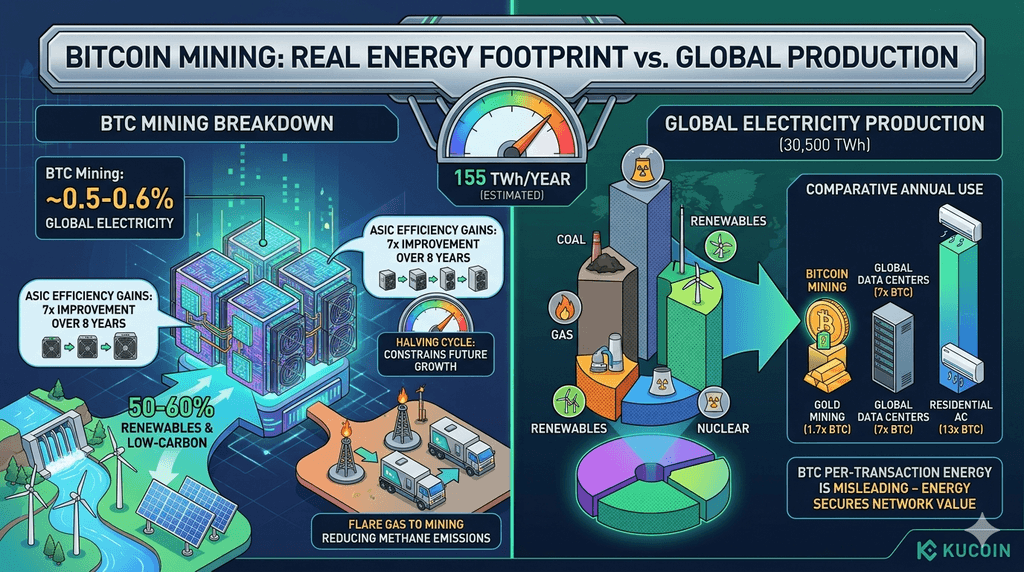
Bitcoin mining now consumes roughly 155 TWh of electricity per year — comparable to the annual energy usage of entire countries like Poland or Egypt, according to the Digiconomist Bitcoin Energy Consumption Index. Yet that figure represents less than 0.6% of total global electricity production, which exceeded 30,000 TWh in 2025. So is Bitcoin an energy crisis or a rounding error on the world's power bill?
The answer depends on context — and context is exactly what most headlines strip away. This article breaks down Bitcoin's real energy footprint, compares it against global power demand, and examines whether the network's consumption trajectory is sustainable as adoption scales.
To understand the full context:
-
Bitcoin Mining Guide walks you through how BTC mining actually works and whether it remains profitable.
-
Proof-of-Intelligence Mining explores how AI-powered consensus models aim to reduce energy waste.
-
Earning BTC on KuCoin offers practical strategies to gain Bitcoin exposure without running a single mining rig.
How Much Energy Does Bitcoin Mining Actually Use?
Bitcoin mining consumes an estimated 155 TWh annually as of early 2026, according to the Digiconomist Bitcoin Energy Consumption Index. That places the Bitcoin network's electricity draw somewhere between the national consumption of Poland and Thailand on a country-by-country ranking.
Where Does the Estimate Come From?
The most widely cited figures originate from two models: the Digiconomist index and the Cambridge Bitcoin Electricity Consumption Index (CBECI). Both use miner revenue, hardware efficiency assumptions, and network hashrate to estimate total consumption. They frequently diverge by 10–20 TWh because of differing assumptions about the average efficiency of active mining hardware.
Digiconomist's model focuses on the economic upper bound — what miners can afford to spend on electricity given current block rewards and transaction fees. CBECI provides a range with lower, best-guess, and upper-bound estimates. Neither model has direct metering access to every mining facility worldwide, so all published numbers are informed estimates, not precise measurements.
Hashrate Growth and Energy Trends
Bitcoin's network hashrate surpassed 800 EH/s in Q1 2026, based on data from Glassnode. Despite this roughly 35% year-over-year hashrate increase, energy consumption grew by only an estimated 10–15%. The gap is explained by the rapid deployment of next-generation ASIC miners — machines like the Bitmain Antminer S21 Pro and MicroBT WhatsMiner M60S that deliver significantly more hashes per watt than their predecessors.
This efficiency trend is critical. Each new generation of mining hardware typically delivers 20–40% better energy efficiency (measured in joules per terahash). The result is a network that grows in computational power faster than it grows in energy demand.
How Does Bitcoin's Energy Use Compare to Global Electricity Production?
Bitcoin's 155 TWh represents approximately 0.5% of the world's total electricity generation, which reached an estimated 30,500 TWh in 2025 according to the International Energy Agency's (IEA) Global Energy Review. In absolute terms, the number is large. In relative terms, it is a fraction of what many single industries consume.
Bitcoin vs. Other Industries
|
Industry / Use Case
|
Estimated Annual Electricity (TWh)
|
Comparison to Bitcoin
|
|
Global data centers (non-crypto)
|
~1,000–1,200 TWh
|
~7x Bitcoin
|
|
Gold mining and refining
|
~240–270 TWh
|
~1.7x Bitcoin
|
|
Global residential air conditioning
|
~2,000 TWh
|
~13x Bitcoin
|
|
Bitcoin mining
|
~155 TWh
|
Baseline
|
|
Global electric vehicle charging
|
~110–130 TWh
|
~0.8x Bitcoin
|
The comparison to gold mining is particularly relevant because both assets serve a store-of-value function. Gold's energy footprint — spanning extraction, transportation, refining, and vault storage — is estimated to exceed Bitcoin's by a meaningful margin, yet it rarely attracts the same level of energy criticism.
Per-Transaction Energy: A Misleading Metric
Many headlines divide Bitcoin's total energy consumption by the number of on-chain transactions to produce a shocking per-transaction figure — often cited as 700+ kWh per transaction. This framing is fundamentally misleading.
Bitcoin's energy expenditure secures the entire network and all the value stored on it, not individual transactions. A single on-chain transaction can settle billions of dollars, batch hundreds of payments, or anchor thousands of Lightning Network transactions. Dividing total energy by raw transaction count ignores the economic value secured and the off-chain activity the base layer supports.
A more honest framing would measure energy per dollar of value secured. By that metric, Bitcoin's efficiency has improved dramatically as the network's total value and transaction throughput have grown.
What Percentage of Bitcoin Mining Uses Renewable Energy?
An estimated 50–60% of Bitcoin mining's electricity now comes from renewable or low-carbon sources, according to data compiled by the Bitcoin Mining Council (BMC) in its Q4 2025 survey. This makes Bitcoin mining one of the more renewables-heavy industries globally, though the exact figure remains debated.
Why Miners Gravitate Toward Renewables
The explanation is economic, not ideological. Bitcoin miners are uniquely flexible energy consumers — they can operate anywhere with an internet connection and can ramp consumption up or down within seconds. This makes them natural buyers of stranded, curtailed, or surplus renewable energy that would otherwise go to waste.
Hydroelectric power in regions like Sichuan (China), Quebec (Canada), British Columbia, and Scandinavia has historically powered large mining operations because it offers some of the cheapest electricity on Earth. In Texas and other deregulated markets, miners increasingly co-locate with wind and solar farms, purchasing power during periods of oversupply when spot prices drop to zero or even go negative.
The Methane Flaring Opportunity
One of the most compelling environmental arguments for Bitcoin mining involves natural gas flaring. Oil extraction sites routinely burn off (flare) or vent associated natural gas because it is uneconomical to capture and transport. Flaring converts methane to CO2, but venting releases methane directly — a greenhouse gas roughly 80 times more potent than CO2 over a 20-year horizon.
Companies like Crusoe Energy and Giga Energy have deployed mobile mining containers at flaring sites, converting waste gas into electricity to power Bitcoin miners. This approach does not eliminate emissions, but it converts high-impact methane into lower-impact CO2 while generating revenue. According to the World Bank's Global Gas Flaring Tracker, over 140 billion cubic meters of gas were flared globally in 2024 — an enormous untapped energy source.
Is Bitcoin Mining Making Climate Change Worse?
Bitcoin mining's carbon footprint is real but frequently overstated when stripped of context. The network's estimated annual CO2 emissions range from 50 to 80 million metric tons, depending on the energy mix assumptions used. For reference, global CO2 emissions from energy exceeded 37 billion metric tons in 2025, according to the IEA — meaning Bitcoin accounts for roughly 0.15–0.22% of global energy-related emissions.
The Carbon Intensity Debate
Carbon intensity — emissions per unit of energy consumed — varies enormously depending on where miners operate. A mining farm powered by Icelandic geothermal energy has near-zero carbon emissions. A facility running on coal-fired electricity in Kazakhstan has a dramatically higher footprint.
The geographic distribution of mining has shifted significantly since China's mining ban in mid-2021. The United States, Canada, and Nordic countries now host a larger share of global hashrate, and these regions generally have cleaner energy grids than the coal-heavy Chinese provinces that previously dominated. This geographic shift has likely reduced Bitcoin's average carbon intensity, though precise measurement remains challenging.
Comparing to the Legacy Financial System
The traditional financial system — including bank branches, ATM networks, data centers, office buildings, armored transport vehicles, and the energy consumed by central bank operations — has a substantial but poorly quantified energy footprint. Estimates vary widely, but multiple analyses suggest the global banking system consumes 500–700 TWh annually when all components are included.
Bitcoin does not yet serve the same breadth of functions as the traditional financial system, so a direct one-to-one comparison is imperfect. However, it is worth noting that Bitcoin provides global, permissionless, 24/7 settlement with no physical branch infrastructure — a fundamentally different efficiency model.
Will Bitcoin's Energy Consumption Keep Growing?
Bitcoin's energy consumption is unlikely to grow linearly with adoption due to three structural forces: hardware efficiency gains, the halving cycle, and the emergence of Layer 2 solutions.
The Halving Effect
Every four years, Bitcoin's block reward is cut in half. The most recent halving in April 2024 reduced the reward from 6.25 BTC to 3.125 BTC per block. This directly reduces the revenue available to miners, which in turn constrains how much they can economically spend on electricity.
Unless Bitcoin's price doubles between each halving cycle — which becomes progressively harder as market capitalization grows — the halving creates a natural ceiling on mining energy expenditure. Miners operating older, less efficient hardware are forced offline after each halving, and only the most energy-efficient operations survive.
Hardware Efficiency Improvements
ASIC mining hardware has improved from roughly 100 joules per terahash (J/TH) in 2018 to under 15 J/TH in the latest 2026-generation machines. This represents a nearly 7x improvement in energy efficiency over eight years.
|
ASIC Generation
|
Approximate Release
|
Efficiency (J/TH)
|
|
Antminer S9
|
2017
|
~98
|
|
Antminer S19 Pro
|
2020
|
~29.5
|
|
Antminer S19 XP
|
2022
|
~21.5
|
|
Antminer S21
|
2024
|
~17.5
|
|
Antminer S21 Pro (Hydro)
|
2025–2026
|
~13–15
|
While theoretical limits exist (semiconductor physics imposes a floor on energy per computation), meaningful efficiency gains are expected to continue for at least the next several hardware generations.
Layer 2 Scaling Reduces Per-Transaction Energy
The Lightning Network and other Layer 2 protocols allow millions of transactions to occur off-chain, settling back to the Bitcoin base layer in batched transactions. This means Bitcoin's on-chain energy expenditure can support a vastly larger number of economic transactions than the base layer alone would suggest.
As Lightning Network adoption grows — with channel capacity exceeding 6,000 BTC in early 2026 according to Mempool.space data — the effective energy cost per economic transaction continues to decline, even if base-layer energy consumption remains stable.
How Are Governments Responding to Bitcoin Mining Energy Use?
Regulatory responses to Bitcoin mining's energy consumption vary dramatically by jurisdiction, ranging from outright bans to active encouragement.
Restrictive Approaches
China banned Bitcoin mining in 2021, citing energy consumption and carbon goals. Kazakhstan initially absorbed displaced Chinese miners but later imposed electricity surcharges and capacity limits on mining operations. The European Union considered restrictions during the MiCA regulatory process but ultimately stopped short of banning proof-of-work mining, instead mandating sustainability disclosures.
In the United States, the Biden administration proposed a 30% excise tax on mining electricity (the DAME tax) in 2023–2024, though it was never enacted. Several U.S. states have imposed temporary moratoriums on new mining operations connected to fossil fuel power plants.
Supportive Approaches
Conversely, countries like El Salvador, Oman, the UAE, Bhutan, and several U.S. states (Texas, Wyoming, Georgia) have actively courted Bitcoin miners. Texas, in particular, has integrated large-scale miners into its grid management strategy — miners participate in demand response programs, curtailing operations during peak demand periods and effectively acting as a flexible load that stabilizes the grid.
This grid-balancing function is increasingly recognized by energy economists. Bitcoin miners can absorb excess renewable generation during off-peak hours and shut down during demand spikes, providing a service that improves grid economics and can accelerate renewable energy buildout by guaranteeing a buyer for surplus power.
Does Bitcoin Mining Incentivize Renewable Energy Development?
Yes — Bitcoin mining is increasingly functioning as a subsidy mechanism for renewable energy projects. By providing a guaranteed buyer for electricity that would otherwise be curtailed or wasted, miners improve the economics of building new wind, solar, and hydroelectric capacity.
The "Buyer of Last Resort" Model
Renewable energy projects face a fundamental challenge: their output is intermittent and does not always align with demand. A solar farm generates maximum power at midday, but peak demand often occurs in the evening. Wind farms produce power based on weather patterns, not consumption schedules. This mismatch leads to curtailment — perfectly good electricity that is generated but never used.
Bitcoin miners can absorb this curtailed energy. Because mining is location-agnostic and interruptible, miners can co-locate with renewable installations and purchase power only when it would otherwise go to waste. This additional revenue stream can make marginal renewable projects financially viable, effectively subsidizing the buildout of clean energy infrastructure.
Real-World Examples
In West Texas, ERCOT grid data shows that wind energy curtailment has decreased in areas where large-scale Bitcoin mining operations have been established. In Kenya and Ethiopia, small-scale mining operations have been deployed alongside off-grid solar and geothermal installations, providing revenue that supports local energy infrastructure development.
Marathon Digital Holdings, one of the largest publicly traded miners, reported in its Q1 2026 earnings that over 70% of its energy consumption came from carbon-free sources. Riot Platforms has similarly emphasized its demand-response participation in the Texas grid, earning significant revenue by curtailing mining during peak demand events.
Should I Invest in Bitcoin Through KuCoin Instead of Mining?
For most individuals, buying Bitcoin on a cryptocurrency exchange like KuCoin is far more practical and cost-effective than setting up a mining operation. Mining requires substantial upfront capital for hardware, ongoing electricity costs, technical expertise, and facility management. The breakeven period for a new mining rig can exceed 12–18 months depending on Bitcoin's price and local electricity rates.
KuCoin offers multiple ways to gain Bitcoin exposure without the complexity of mining. You can spot trade BTC/USDT with deep liquidity, use dollar-cost averaging through recurring purchases, or explore KuCoin Earn products that generate yield on Bitcoin holdings. For traders seeking leveraged exposure, KuCoin's futures markets provide BTC contracts with competitive fees.
Getting started takes minutes: create a KuCoin account, complete identity verification, deposit funds, and begin purchasing Bitcoin. The platform supports over 900 cryptocurrencies and serves more than 30 million users globally, offering a streamlined alternative to the capital-intensive mining route. New users can now register at KuCoin and Get Up to 11,000 USDT in New User Rewards.

Conclusion
Bitcoin mining's energy consumption is substantial in absolute terms — approximately 155 TWh annually — but represents less than 0.6% of global electricity production. When compared to industries like gold mining, global data centers, or residential air conditioning, Bitcoin's energy footprint is significant but not exceptional.
The narrative around Bitcoin's energy use is evolving. An estimated 50–60% of mining electricity now comes from renewable or low-carbon sources, and structural forces — including the halving cycle, rapid ASIC efficiency improvements, and Layer 2 scaling — create natural constraints on future energy growth. Bitcoin miners are increasingly recognized as flexible grid participants that can absorb surplus renewable energy, reduce methane flaring, and support demand-response programs.
The energy debate ultimately comes down to a value judgment: is the utility Bitcoin provides — censorship-resistant, globally accessible, permissionless money — worth its energy cost? Reasonable people disagree, but the conversation should be grounded in accurate data and honest comparisons rather than context-free headlines. As the network matures, its energy efficiency per unit of economic value secured continues to improve, and its relationship with renewable energy is becoming increasingly symbiotic rather than parasitic.
FAQs
How much does it cost in electricity to mine one Bitcoin in 2026?
The average electricity cost to mine one Bitcoin is approximately $40,000–$60,000 at typical U.S. industrial electricity rates of $0.06–$0.08 per kWh, based on current network difficulty and next-generation ASIC efficiency. Costs vary dramatically by location — miners with access to $0.03/kWh power can mine at roughly half that cost, while those paying $0.10/kWh or more often operate at a loss unless Bitcoin's price is elevated.
Can Bitcoin switch to proof-of-stake to reduce energy consumption?
No — there is virtually no chance Bitcoin will transition to proof-of-stake. Bitcoin's proof-of-work consensus mechanism is considered a core feature, not a bug, by its developer community and user base. Unlike Ethereum, which transitioned to proof-of-stake in 2022, Bitcoin's governance culture prioritizes stability and resistance to fundamental protocol changes. Any such proposal would require overwhelming consensus among node operators, miners, and developers, which does not exist.
Does Bitcoin mining cause local electricity prices to increase?
The impact on local electricity prices depends on grid capacity and regulatory structure. In regions with surplus generation capacity, large-scale mining can actually reduce electricity costs for other consumers by increasing overall demand and improving the utilization rate of existing infrastructure. However, in areas with constrained supply, significant mining load can contribute to price increases. Texas and other deregulated markets have generally managed this through demand-response agreements that require miners to curtail during peak periods.
How much e-waste does Bitcoin mining generate?
Bitcoin mining generates an estimated 30,000–40,000 metric tons of electronic waste annually, according to Digiconomist estimates. ASIC miners have a functional lifespan of roughly 3–5 years before they become unprofitable due to efficiency improvements in newer hardware. This e-waste concern is legitimate, though it is modest compared to the 50+ million metric tons of global e-waste generated annually from consumer electronics, according to the UN Global E-waste Monitor.
What happens to Bitcoin's energy consumption when all 21 million BTC are mined?
When the last Bitcoin is mined — projected around the year 2140 — miners will be compensated entirely through transaction fees rather than block rewards. Energy consumption at that point will be determined by whether transaction fees alone provide sufficient revenue to sustain mining operations. Most analysts expect energy consumption to decline significantly from current levels as block rewards approach zero over the coming decades, with the network's security increasingly relying on fee revenue from high-value settlement transactions.