

Kevin Warsh: Fed Has No Intention of Bailing Out Crypto or Stablecoins
2026/07/17 14:33:00
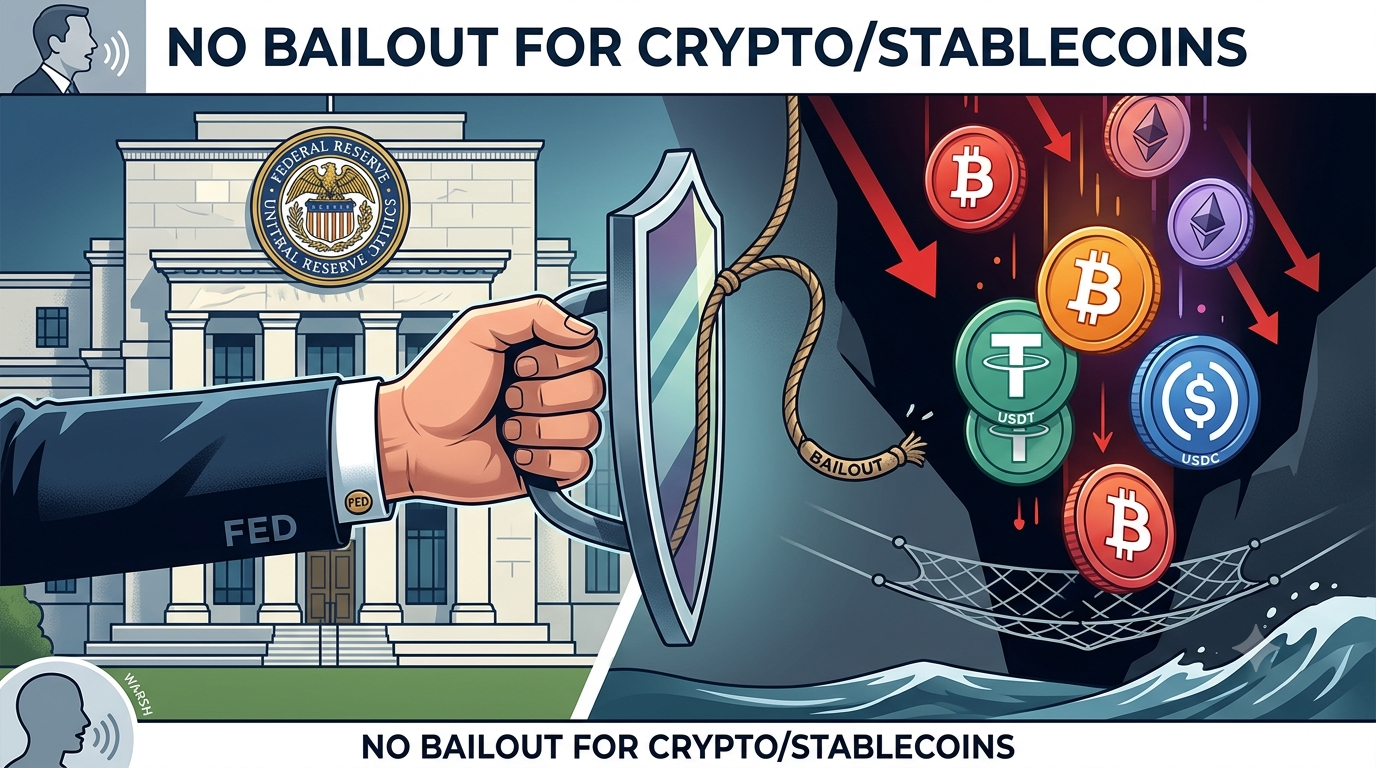
Federal Reserve Rejects Crypto Bailout Expectations
Federal Reserve Chair Kevin Warsh delivered a clear message during his July 14, 2026, testimony before the House Financial Services Committee. When questioned about potential support for stablecoins or crypto firms during a market run, Warsh responded decisively that the Fed does not want to enter the bailout business. He referenced scars from the 2008 financial crisis, underscoring a commitment to avoiding repeated extraordinary interventions. This position comes as crypto assets and stablecoins integrate deeper into traditional finance, with stablecoin transaction volumes reaching record levels and increasing participation from banks, payment providers, and institutional investors.
Warsh's remarks reinforce a policy of market discipline over public backstops for the crypto sector, pushing participants toward stronger risk management while the industry continues rapid expansion in payments, DeFi, and institutional adoption. His comments also signal that firms operating in the digital asset space should not assume emergency support from the central bank during periods of financial stress. Instead, companies are expected to maintain adequate liquidity, strengthen governance frameworks, and manage operational and market risks responsibly. The testimony aligns with broader regulatory efforts to encourage resilience within the financial system while allowing innovation to develop under established supervisory standards.
Warsh's Congressional Testimony and Direct Rejection of Crypto Rescue Plans
During the hearing, Representative Brad Sherman pressed Warsh on whether the Fed would establish liquidity facilities for stablecoins similar to those provided for money market funds in past crises. Warsh replied that the Fed seeks to mitigate extreme risks but aims to position itself where it is not bailing out anybody, including crypto. His comments reflect a deliberate shift from reactive crisis management to proactive prevention of systemic vulnerabilities. This approach aligns with broader efforts to maintain price stability, as the Fed kept rates steady in its June meeting amid cooling inflation data. Market observers noted Bitcoin's price movement around $64,000 to $65,000 following related economic releases, demonstrating that crypto often trades on multiple factors beyond Fed rhetoric.
The statement carries weight given Warsh's background as a former Fed governor during the 2008 period. By invoking those experiences, he signals continuity in caution against moral hazard. Stablecoins, which facilitate trillions in annual volume primarily for trading and cross-border transfers, now represent a significant on-ramp for institutional capital. Tether's USDT and Circle's USDC dominate the roughly $310 billion total stablecoin market capitalization as of mid-July 2026. A potential run without a backstop could test redemption mechanisms and reserve transparency, areas where issuers have improved disclosures but still face scrutiny. Warsh's stance encourages the sector to build robust operational resilience rather than rely on implicit guarantees.
Historical Context of Fed Interventions and Lessons Applied to Digital Assets
The 2008 financial crisis remains a pivotal reference point for current Fed leadership. Extraordinary measures, including liquidity support for various market segments, stabilized the system but created precedents that subsequent chairs have sought to avoid repeating. Warsh, who served on the Board of Governors from 2006 to 2011, has direct insight into those decisions. His July 2026 testimony explicitly connects that history to contemporary crypto questions, stating a preference against repeating large-scale rescues. In the crypto context, this translates to heightened emphasis on self-regulation and robust contingency planning. Stablecoin issuers maintain reserves in cash, Treasuries, and other liquid assets, but rapid redemptions in stressed scenarios could strain even well-managed portfolios.
The GENIUS Act provides a resolution framework prioritizing stablecoin holders, offering a structured wind-down path without direct Fed intervention. Warsh's comments suggest confidence in such mechanisms to handle failures without central bank liquidity injections. Industry growth since the previous cycle demonstrates adaptation. Stablecoin volumes surged 125% year-over-year in June 2026, reaching $1.79 trillion in adjusted activity, driven by efficient payments and DeFi applications. This expansion occurs alongside traditional finance integration, as institutions explore tokenized assets and on-chain settlements. Without bailout expectations, participants face stronger incentives to demand transparency and diversify counterparties.
Current Scale and Economic Role of Stablecoins in Global Finance
Stablecoins have evolved into essential infrastructure, with total market capitalization hovering near $310 billion in July 2026. USDT leads at approximately $184 billion, followed by USDC at around $73 billion. These assets power trading, remittances, and yield opportunities, offering speed and low costs compared to traditional rails. June 2026 data showed significant volume growth, underscoring utility beyond speculation. Their integration with traditional systems raises legitimate questions about interconnected risks. Banks and payment providers increasingly interact with stablecoin flows, yet Warsh's testimony affirms that the Fed prioritizes containing rather than absorbing losses from private digital asset failures. This encourages issuers to maintain high reserve quality and operational standards, potentially accelerating professionalization across the sector.
In payments, stablecoins enable near-instant cross-border transfers, benefiting businesses and individuals in emerging markets. Institutional interest grows through tokenized funds and settlement experiments. However, the absence of a safety net means users and platforms must prioritize due diligence on issuer reserves and redemption processes. The economic footprint extends to DeFi, where stablecoins serve as collateral and liquidity bases. Growth projections from firms like Standard Chartered point toward multi-trillion potential by 2028, contingent on regulatory clarity and risk management. Warsh's remarks provide a timely reminder that such expansion should rest on sound foundations rather than expectations of official rescue. Market data post-testimony showed resilience, with crypto prices rallying on broader economic positives, illustrating the sector's capacity to absorb policy signals.
Indications for Crypto Market Participants and Risk Management Practices
Warsh's clear stance prompts a reevaluation of contingency planning across trading firms, exchanges, and DeFi protocols. Without anticipated liquidity backstops, emphasis shifts to stress testing, collateral quality, and diversified liquidity sources. Major platforms have already enhanced safeguards, including proof-of-reserves and insurance funds, partly in response to past events. Investors benefit from greater transparency expectations. Stablecoin runs, though rare, could materialize from issuer-specific issues or macro shocks. Participants increasingly scrutinize reserve compositions and audit frequency. This dynamic fosters competition among issuers to demonstrate superior governance, potentially benefiting users through improved standards.
Exchanges play a central role by offering tools for risk mitigation. Features like isolated margin help contain exposure, complementing the broader push toward disciplined trading. Monitoring the differences between isolated and cross margins aids traders in aligning strategies with personal risk tolerance. As the Fed signals limited involvement, private sector solutions gain prominence. Broader adoption continues despite the rhetoric. Corporate treasuries and payment providers cite efficiency gains, while retail users value accessibility. The policy environment encourages innovation in areas like real-world asset tokenization, where stablecoins provide stable entry points. Long-term, this may lead to a more mature ecosystem less prone to boom-bust cycles driven by implicit guarantees.
Market Reaction and Price Movements Following the Testimony
Crypto markets displayed resilience immediately after Warsh's comments. Bitcoin advanced amid cooling inflation data, with the total crypto market capitalization reflecting positive sentiment surrounding improving economic indicators and expectations that financial conditions may become more supportive over time. Market participants continued to assess both macroeconomic developments and blockchain-specific fundamentals rather than reacting solely to policy commentary. This response underscores that policy statements interact with multiple variables, including economic growth prospects, institutional participation, network activity, and long-term adoption metrics when shaping investor sentiment.
Stablecoin volumes remained robust, indicating sustained utility even as overall stablecoin capitalization experienced modest recent adjustments. Their continued use across trading, payments, decentralized finance, and cross-border transactions suggests that demand for blockchain-based settlement remains active despite changing market conditions. Analysts generally view these pullbacks as periods of consolidation rather than evidence of structural weakness, citing consistent transaction activity and continued on-chain usage as supporting factors. The sector's ability to absorb relatively hawkish policy signals without experiencing broad market disruption highlights increasing market maturity, improved liquidity, and a more measured approach by investors when evaluating macroeconomic developments alongside digital asset fundamentals.
Institutional Adoption Trends Despite Policy Clarity
Institutions continue allocating to digital assets through regulated channels, focusing on custody solutions, exchange-traded funds (ETFs), and tokenized financial products. Stablecoins serve as efficient bridges between traditional finance and blockchain-based systems, enabling faster settlement, improved liquidity management, and reduced counterparty risk in certain transactions. Warsh's position does not appear to deter this interest, as many market participants continue prioritizing regulatory compliance, robust governance, and risk-adjusted returns when evaluating digital asset exposure.
Asset managers are also exploring on-chain opportunities while maintaining established investment processes and traditional risk management frameworks. Rather than replacing conventional financial infrastructure, many institutions are assessing how blockchain technology can complement existing operations through greater efficiency and transparency. The Federal Reserve's emphasis on prevention over rescue aligns with institutional demands for stronger operational controls, accountability, and reliable market infrastructure. Since regulatory clarity gradually develops; this convergence between traditional finance and digital assets could support the continued development of hybrid financial products that integrate blockchain technology with established financial systems while meeting institutional standards for security and compliance.
Technological Innovations Supporting Resilience in Crypto Infrastructure
Blockchain advancements continue to improve transparency, auditability, and data integrity, making it easier for market participants, developers, and regulators to verify on-chain activity. Public ledgers provide immutable transaction records that support compliance efforts while increasing confidence in the accuracy of financial reporting and asset movements. Layer-2 scaling solutions and improved cross-chain bridging mechanisms help reduce transaction costs, improve processing speeds, and enhance interoperability between blockchain ecosystems. These technical improvements support broader adoption by making decentralized applications more practical for everyday use while helping networks manage higher levels of activity. Together, these developments complement evolving policy signals by strengthening the underlying infrastructure and improving resilience under periods of increased demand or market stress.
Decentralized protocols also continue to experiment with governance structures, treasury management frameworks, and risk-sharing mechanisms that distribute decision-making across communities rather than concentrating authority within a single organization. Many projects are refining on-chain voting systems, transparent proposal processes, and community oversight to improve accountability while adapting to changing market conditions. Although these models vary in effectiveness across ecosystems, they provide alternatives to centralized points of failure and encourage broader stakeholder participation. In an environment where expectations increasingly emphasize market discipline over government intervention, such decentralized approaches align with the broader objective of reducing reliance on bailouts while promoting greater operational resilience.
Challenges for Smaller Issuers and Market Concentration
Dominance by leading stablecoins creates concentration risks, yet it also helps establish operational, liquidity, and transparency standards that smaller issuers can seek to match. As the market matures, newer entrants increasingly focus on specialized use cases, regional payment solutions, institutional services, or enhanced compliance frameworks to differentiate themselves from established competitors. Some projects also prioritize greater transparency, improved reserve reporting, or interoperability across multiple blockchain networks to attract users. Others are investing in faster settlement capabilities, improved integration with decentralized finance applications, and partnerships with payment providers to strengthen adoption across both retail and enterprise markets. These approaches allow smaller issuers to compete without directly challenging the scale and liquidity advantages held by the largest stablecoin providers.
Kevin Warsh's comments may accelerate consolidation toward well-resourced issuers that possess stronger regulatory readiness, broader financial partnerships, and sufficient capital to adapt to evolving oversight. Companies with established banking relationships, robust compliance infrastructure, and the ability to meet stricter reporting requirements could be better positioned as regulatory expectations continue to develop. At the same time, competition is likely to persist as innovative providers continue exploring underserved market segments and developing products tailored to specific user and business needs. The long-term market structure will likely reflect a balance between large issuers benefiting from scale and trust and smaller firms competing through specialization, technological innovation, and targeted financial services rather than market size alone.
Global Perspectives and Cross-Border Implications
International regulators continue to monitor U.S. monetary and financial policy closely, particularly as stablecoins become increasingly integrated into cross-border payments and digital asset markets. Because many leading stablecoins are denominated in U.S. dollars, guidance and policy signals from the Federal Reserve can influence market practices well beyond the United States. Financial institutions, payment providers, and digital asset firms operating across multiple jurisdictions also pay close attention to U.S. policy developments, as changes to oversight or supervisory expectations can affect compliance strategies and operational planning. These developments often encourage regulators in other jurisdictions to consider comparable approaches to reserve management, disclosure requirements, and redemption standards.
In several regions, policymakers are evaluating how stablecoin issuers should demonstrate the quality and liquidity of reserve assets, disclose operational risks, and maintain adequate governance arrangements. Although implementation varies according to local legal and financial systems, these discussions reflect a broader effort to establish clearer expectations for market participants while preserving financial stability and protecting consumers. At the same time, international organizations and standard-setting bodies continue to promote dialogue on digital asset regulation, recognizing the cross-border nature of stablecoin activity. While regulatory frameworks differ across countries, greater coordination on these issues may help improve transparency, strengthen consumer confidence, reduce regulatory fragmentation, and support interoperability within the evolving global stablecoin ecosystem.
Perception for Monetary Policy and Digital Asset Integration
Warsh's emphasis on controlling inflation and maintaining a firm stance against government bailouts suggests a preference for disciplined monetary policy and greater market accountability. Such an approach could contribute to a more stable macroeconomic environment by reinforcing confidence in long-term policy consistency. A policy framework centered on inflation management and fiscal discipline may also strengthen confidence among businesses, consumers, and financial institutions by providing a clearer outlook for long-term economic planning. Although monetary policy cannot eliminate market volatility, consistency in policy direction is often viewed as an important factor in reducing uncertainty across financial markets.
For digital assets, predictable economic conditions often reduce uncertainty for investors and institutions evaluating exposure to cryptocurrencies and blockchain-related markets.
Institutional participants typically assess macroeconomic conditions alongside regulatory developments, liquidity, and risk management before allocating capital to digital assets. Greater clarity around m do onetary policy can therefore complement broader investment decisions, even if it is not the primary driver of market performance. A stable economic backdrop may also encourage companies involved in blockchain infrastructure, digital payments, and tokenized financial services to pursue longer-term growth strategies with greater confidence. While monetary policy is only one of many factors influencing digital asset performance, greater policy clarity can support investment planning and encourage broader participation over time. Market outcomes, however, would still depend on inflation trends, interest rate decisions, global economic developments, investor sentiment, technological innovation, and evolving regulatory frameworks.
Conclusion
Kevin Warsh's July 2026 testimony establishes a firm boundary on Federal Reserve involvement in potential crypto bailouts, reinforcing the principle that market participants should bear responsibility for managing risk. This position provides greater clarity around the role of policymakers as digital assets become more integrated into the broader financial system. While the absence of bailout expectations may encourage stronger risk management practices, it also places greater emphasis on transparency, governance, and prudent capital allocation across the industry.
As stablecoins and digital assets continue expanding their economic footprint, this policy clarity supports sustainable development grounded in market discipline rather than reliance on extraordinary intervention. Market participants are increasingly focusing on improving liquidity management, reserve transparency, security standards, and regulatory compliance to strengthen confidence among users and institutional participants. The industry has also demonstrated an ability to adapt to evolving regulatory expectations while continuing to develop infrastructure and real-world applications.
FAQs
What exactly did Kevin Warsh say about stablecoins during his testimony?
Federal Reserve Chair Kevin Warsh stated unequivocally during the House Financial Services Committee hearing on July 14, 2026, that the central bank does not want to be in the bailout business, explicitly including cryptocurrency and stablecoins. When asked about potential liquidity support similar to past interventions for money market funds, he emphasized mitigation of risks but had a clear preference against rescuing firms or issuers.
How might Warsh's position affect stablecoin issuers and their operations?
Warsh's no-bailout signal incentivizes stablecoin issuers to maintain conservative reserve management, frequent audits, and strong redemption capabilities. With the market near $310 billion, leading players like Tether and Circle already publish attestations, but the policy reinforces expectations for operational excellence. Issuers may accelerate diversification of reserves and technology investments to handle potential stress scenarios independently. This could lead to higher standards industry-wide, benefiting users through increased confidence while potentially pressuring less-prepared entrants.
Does this mean crypto prices will decline significantly?
Warsh's comments did not trigger sustained negative price action, as Bitcoin and other assets rallied alongside positive inflation data. Crypto markets price in multiple factors, including adoption trends, technological progress, and macroeconomic conditions. The statement reinforces expectations of self-reliance, which many view as healthy for maturation. Historical patterns show policy clarity often contributes to more sustainable growth phases rather than immediate downturns. Traders should focus on fundamentals and risk management rather than isolated headlines.
How does this policy align with existing stablecoin regulations?
The GENIUS Act and ongoing rulemaking provide resolution frameworks that prioritize holders without requiring Fed liquidity. Warsh's testimony complements these by signaling limited central bank involvement, encouraging private solutions and inter-agency coordination. This alignment aims for consistent oversight that addresses risks while allowing innovation, reducing fragmentation that could hinder growth.
What should retail investors do in response to these developments?
Retail investors benefit from diversifying across assets, using reputable platforms, and understanding the mechanics of stablecoins they hold. Due diligence on issuers, awareness of leverage risks, and viewing crypto as part of a broader portfolio remain sound practices. Resources on exchanges help educate users on tools for effective participation.
Disclaimer: This content is for informational purposes only and does not constitute investment advice. Cryptocurrency investments carry risk. Please do your own research (DYOR).