

What is the difference between ERC-20 and ERC-7943 for RWAs?
2026/06/06 14:00:00
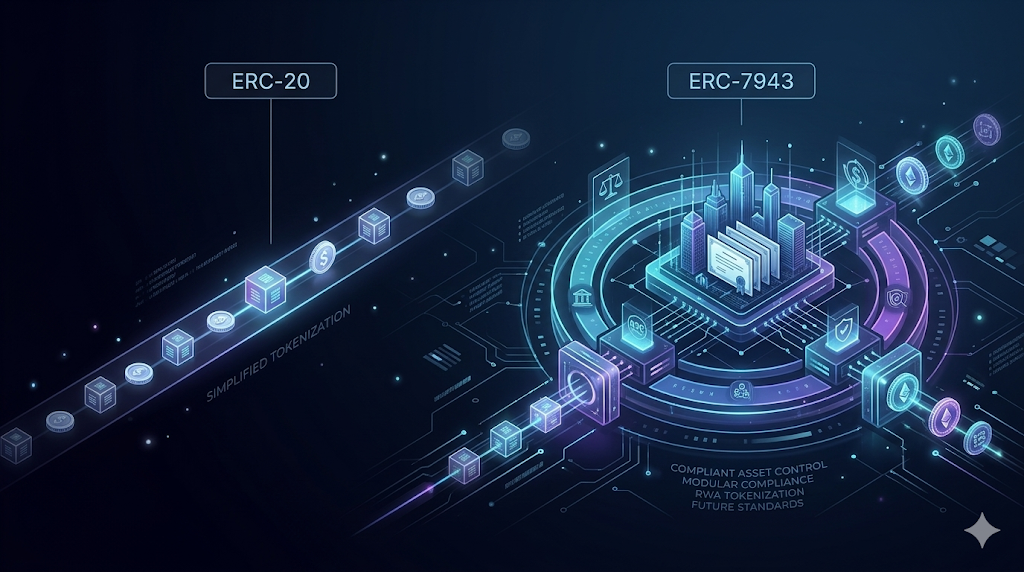
As institutions aggressively move traditional financial instruments on-chain, the difference between token standards has become critical. The main difference is that ERC-20 offers permissionless digital transfers, while the finalized ERC-7943 standard provides a modular, programmable compliance interface built specifically to allow flexible regulatory enforcement without technical vendor lock-in.
By utilizing ERC-7943, developers can ensure strict regulatory compliance without sacrificing the seamless interoperability that decentralized networks offer. This universally compatible infrastructure effectively solves the institutional challenges that older standards completely ignored.
The Core Difference Between ERC-20 and ERC-7943
The absolute core difference lies in regulatory enforcement capabilities. ERC-7943 integrates mandatory compliance checks directly into the asset transfer process, whereas ERC-20 allows unrestricted, anonymous transactions globally. Institutions utilizing ERC-7943 can actively block illicit transfers, verify investor identities, and maintain strict legal oversight over their digital securities.
Conversely, the ERC-20 framework completely lacks native logic for regulatory intervention. Once an ERC-20 token is minted, the issuer permanently loses control over who holds or trades the asset. This fundamental architectural gap forces institutions to adopt newer, heavily regulated frameworks to satisfy governmental financial watchdogs.
Permissionless Transfers versus Modular Compliance
ERC-20 relies entirely on permissionless transfers, meaning anyone with a digital wallet can receive the asset instantly. This open-access model built the modern cryptocurrency ecosystem, but it severely violates the strict anti-money laundering regulations governing traditional finance. Unrestricted token flows make tracking institutional ownership mathematically impossible for corporate auditors.
ERC-7943 solves this by introducing a modular compliance layer that actively interrogates every proposed transaction before execution. The smart contract utilizes extensible view functions, such as canTransfer, to evaluate the validity of a transaction against customizable regulatory modules or oracles before execution. If the receiver fails the compliance check, the blockchain automatically rejects the transfer, ensuring pristine regulatory adherence.
Enforcing Identity Validation and Rules
Conditional enforcement is the standard cornerstone of the ERC-7943 framework. Unlike older, restrictive frameworks like ERC-3643 that force a specific on-chain identity registry, ERC-7943 remains strictly vendor-neutral. It requires compliance interfaces to be implemented before transactions occur, but leaves the underlying implementation open. Issuers can plug in any external Know Your Customer (KYC) providers, regional jurisdictions, or legal accreditation logic.
By providing standardized control hooks without technical lock-in, the new standard successfully bridges the divide between decentralized tech and traditional banking compliance.
Asset Freezing and Issuer Control Mechanisms
Asset freezing mechanisms allow ERC-7943 token issuers to forcibly halt trading during legal disputes or severe security breaches. The smart contract grants the originating institution unilateral administrative authority to lock specific wallets or pause the entire asset supply. This intervention capability is an absolute legal requirement for digitizing corporate debt or private equity.
Legacy token standards permanently lack these vital administrative override functions. A stolen ERC-20 token cannot be recovered or frozen by the original issuer under any circumstances. This immutable nature, while celebrated by decentralized purists, represents an unacceptable financial risk for regulated global banking institutions.
Understanding the ERC-20 Token Framework
The ERC-20 framework operates as a purely functional standard for creating fungible tokens without any underlying legal attachments. It defines simple rules for transferring digital value, checking wallet balances, and approving third-party decentralized applications to move funds. This streamlined simplicity allowed developers to launch thousands of digital currencies rapidly.
However, this simplicity inherently means the standard cannot support complex financial regulations natively. Developers attempting to force regulated assets into this framework must build cumbersome, proprietary code around the token. According to a May 2026 report by Cointelegraph, these makeshift solutions severely compromise the interoperability of the broader blockchain network.
The Foundational Layer of Decentralized Finance
ERC-20 undeniably serves as the foundational architectural layer for the entire decentralized finance ecosystem. It allows decentralized exchanges, lending protocols, and liquidity pools to interact seamlessly with any newly created digital asset. Because every token follows the exact same basic transfer rules, smart contracts can process them automatically.
This universal compatibility created a massive explosion of decentralized financial innovation. Developers never need to rewrite their platform code to support a new cryptocurrency. Unfortunately, this permissionless environment was designed explicitly to circumvent traditional financial gatekeepers, rendering it entirely unsuitable for compliant institutional operations.
Why ERC-20 Fails Institutional Requirements
The legacy standard fails institutional requirements because it cannot natively restrict token ownership to legally eligible investors. Institutions digitizing real estate or private equity face massive fines if unaccredited retail traders acquire their restricted digital securities. They require absolute certainty regarding asset custody and shareholder registration.
Because the legacy framework permits anyone to trade assets freely, it entirely violates strict global securities laws. Financial institutions simply cannot utilize infrastructure that allows their regulated products to flow into anonymous, sanctioned digital wallets. This massive compliance vulnerability drove the aggressive development of heavily restricted, institution-focused token alternatives.
The Fragmentation of Custom Compliance
Attempting to retrofit compliance onto the legacy standard creates massive industry fragmentation and isolated liquidity pools. When institutions modify the base code to add custom transfer restrictions, they accidentally destroy the token universal compatibility. Decentralized exchanges and custodial wallets can no longer interact with these heavily modified assets automatically.
This fragmentation forces every infrastructure provider to build expensive, ad-hoc integrations for each specific tokenized asset. Engineering teams waste millions of dollars continuously solving the exact same eligibility and validation problems independently. Without a unified framework, the entire tokenized asset sector remains severely siloed and highly inefficient.
How ERC-7943 Solves Institutional RWA Challenges
The new standard successfully solves institutional challenges by creating a universal, minimal interface specifically for compliance checks. It allows developers to standardize asset information while keeping the underlying compliance logic entirely modular. According to Dario Lo Buglio in late May 2026, the standard ensures tokenized assets can move across interconnected blockchain environments seamlessly.
This architecture drastically reduces integration costs for custodians, exchanges, and financial applications. Because compliance hooks are universally standardized, secondary markets can query transfer eligibility using a single consistent method. This unified approach aggressively accelerates the widespread adoption of regulated digital assets across traditional financial markets.
Achieving Universal Interoperability
Universal interoperability ensures that regulated assets can seamlessly interface with existing decentralized infrastructure without breaking compliance rules. The new framework standardizes exactly how a token communicates its specific transfer restrictions to third-party applications. This means an institutional bond can successfully utilize decentralized lending markets while remaining fully compliant.
By establishing a common language for regulatory checks, the standard heavily streamlines the entire institutional onboarding process. Decentralized finance protocols simply query the standardized interface to determine if a specific user can legally interact with the asset. This seamless communication actively prevents illicit transactions without requiring massive protocol upgrades.
Eliminating Vendor Lock-in for Asset Issuers
Eliminating vendor lock-in allows asset issuers to effortlessly migrate their digital securities between different compliance providers. Under older models, committing to a specific tokenization platform meant permanently entangling the asset with proprietary identity frameworks. If the platform failed, the institutional issuer was completely trapped.
The new framework structurally separates the token contract from the specific identity layer and compliance logic. Issuers retain the ultimate freedom to swap their compliance vendors or update jurisdictional rules without redeploying the underlying asset token. This absolute operational flexibility remains highly attractive to massive multinational banking corporations.
The Principle of Minimalist Neutrality
Minimalist neutrality means the standard strictly defines only the primitives that all regulated assets share, avoiding unnecessary complexity. It does not dictate which specific identity provider or legal jurisdiction an issuer must utilize. This agnostic design explicitly prevents the framework from becoming obsolete when regional regulatory frameworks inevitably evolve.
By remaining entirely unopinionated regarding the underlying compliance stack, the standard actively encourages broad industry adoption. It simply provides the necessary tools to make compliance programmable and completely interoperable across the network. This philosophical approach directly contributed to the standard reaching Final status in the Ethereum improvement process.
The 2026 Expansion of Tokenized Real-World Assets
The explosive expansion of tokenized real-world assets validates the urgent necessity for robust, institutional-grade digital infrastructure. Traditional asset managers are aggressively digitizing government treasuries, corporate debt, and commercial real estate to capture profound operational efficiencies. This massive institutional migration requires technical standards capable of handling complex legal obligations reliably.
By utilizing advanced frameworks, financial institutions successfully merge the instantaneous settlement of blockchain technology with the strict security of legacy banking. This hybrid approach significantly lowers capital costs while drastically expanding global market accessibility. Consequently, tokenized assets represent the fastest-growing sector within the broader digital economy today.
Market Capitalization Surges Past 34 Billion Dollars
The market capitalization of tokenized real-world assets surged dramatically to approximately 34 billion dollars by late May 2026. According to industry data published by RWA.xyz, this represents a massive acceleration from the 6.4 billion dollars recorded in early 2025. This spectacular growth explicitly highlights the relentless institutional appetite for compliant digital financial products.
This immense capital influx directly forces infrastructure developers to rapidly finalize robust standards capable of protecting institutional wealth. The market completely outgrew the experimental phase of decentralized finance and now demands rigorous, enterprise-ready solutions. Finalizing new standards provides the vital foundation required to support the next trillion dollars of institutional capital.
Traditional Finance Demands Predictable Yield
Traditional financial institutions strictly demand assets that generate predictable cash flows and feature established legal structures. They heavily prioritize tokenizing instruments that naturally benefit from programmable collateral and drastically lower operational friction. Government bonds and high-grade corporate debt perfectly fit this specific institutional investment thesis.
The legacy decentralized ecosystem previously relied entirely on highly volatile, speculative capital flows to generate yield. Traditional finance aggressively rejects this chaotic model, preferring the stability of legally enforceable real-world returns. Modern tokenization standards mathematically guarantee that these stable, yield-bearing assets remain perfectly aligned with strict corporate compliance mandates.
Moving Beyond the Pirate Game of DeFi
Institutional capital can no longer operate within the unregulated, highly experimental boundaries of traditional decentralized finance. As Dario Lo Buglio noted in May 2026, institutions simply cannot escape global regulations when bringing real-world assets on-chain. They strictly require infrastructure that respects jurisdictional boundaries and enforces corporate governance.
The era of anonymous, permissionless liquidity mining is rapidly giving way to a highly structured, heavily regulated digital economy. Banks are aggressively building interconnected environments that synchronize settlement data while keeping sensitive institutional information entirely private. This massive shift permanently redefines how value fundamentally moves across modern global blockchain networks.
Comparing Ethereum Token Standards for RWAs
Comparing the various token standards reveals a clear evolutionary path from permissionless experimentation to rigorous institutional compliance. While older frameworks prioritized absolute freedom, modern standards meticulously balance decentralized architecture with necessary regulatory oversight. Selecting the correct technical standard remains the most critical decision for any institution deploying tokenized assets globally.
| Feature | ERC-20 Standard | ERC-7943 Standard |
| Primary Design Focus | Permissionless, fungible digital currency | Compliant, regulated real-world asset tokenization |
| Identity Validation | Completely anonymous transactions | Mandatory KYC and identity verification hooks |
| Issuer Intervention | No administrative control or asset freezing | Native mechanisms for freezing and forced transfers |
| Regulatory Compliance | Inherently lacks built-in compliance logic | Modular, highly programmable regulatory enforcement |
The Limitations of the ERC-3643 Standard
The ERC-3643 standard paved the way for tokenized securities but ultimately failed to accommodate the complete spectrum of real-world assets. Designed primarily around traditional equities, its rigid framework does not seamlessly translate to tokenized commodities or private credit. This architectural rigidity heavily restricted its widespread adoption across diverse institutional sectors.
Furthermore, its highly opinionated design frequently locked issuers into specific identity registries and compliance protocols. The industry rapidly recognized that a more flexible, generalized approach was strictly necessary to standardize the broader market. This specific realization directly catalyzed the aggressive development of highly modular alternatives.
ERC-7943 Composability with Legacy Standards
The new institutional standard achieves perfect composability by operating seamlessly on top of existing legacy frameworks like ERC-20. It strategically integrates with established token infrastructure rather than attempting to completely replace it from scratch. This intelligent design immediately allows new regulated assets to utilize existing decentralized exchange liquidity securely.
By building upon established foundations, developers dramatically reduce the technical friction associated with adopting new asset standards. Custodians and wallet providers can support the new compliant assets with minimal necessary code modifications. This backwards compatibility absolutely guarantees a smooth, rapid transition for massive institutional infrastructure providers.
The Limitations of the ERC-3643 Standard
The ERC-3643 standard paved the way for tokenized securities but ultimately failed to accommodate the complete spectrum of real-world assets. Designed primarily around traditional equities, its rigid framework does not seamlessly translate to tokenized commodities or private credit. This architectural rigidity heavily restricted its widespread adoption across diverse institutional sectors.
Furthermore, its highly opinionated design frequently locked issuers into specific identity registries and compliance protocols. The industry rapidly recognized that a more flexible, generalized approach was strictly necessary to standardize the broader market. This specific realization directly catalyzed the aggressive development of highly modular alternatives.
ERC-7943 Composability with Legacy Standards
The new institutional standard achieves perfect composability by operating seamlessly on top of existing legacy frameworks like ERC-20. It strategically integrates with established token infrastructure rather than attempting to completely replace it from scratch. This intelligent design immediately allows new regulated assets to utilize existing decentralized exchange liquidity securely.
By building upon established foundations, developers dramatically reduce the technical friction associated with adopting new asset standards. Custodians and wallet providers can support the new compliant assets with minimal necessary code modifications. This backwards compatibility absolutely guarantees a smooth, rapid transition for massive institutional infrastructure providers.
Integrating RWAs with Autonomous Agents
Integrating regulated assets with autonomous agents allows corporations to execute incredibly complex trading strategies automatically. These software agents continuously analyze global market data and instantly rebalance institutional portfolios based on real-time macroeconomic indicators. However, they strictly require interoperable, standardized tokens to execute these trades without triggering massive compliance violations.
Without universal asset standards, automated systems simply cannot differentiate between a legally tradable bond and a severely restricted private equity share. By utilizing modern infrastructure, these intelligent agents can independently verify transfer eligibility before executing any financial maneuver. This perfect synergy unlocks unprecedented operational efficiency for massive multinational banking institutions.
Cross-Chain Asset Portability
Cross-chain asset portability remains the ultimate technical goal for the rapidly expanding tokenized asset ecosystem. Institutions desperately want their regulated assets to move freely across various interconnected blockchain environments without losing their compliance wrappers. Standardizing the core token interface heavily simplifies the complex cryptographic bridging process required to achieve this vision.
When multiple disparate networks adopt identical compliance hooks, routing assets between them becomes mathematically trivial for developers. This universal standardization actively prevents the creation of isolated, illiquid institutional silos. Ultimately, true asset portability ensures that global capital flows efficiently toward the absolute most productive decentralized financial applications.
Conclusion
The profound difference between the legacy ERC-20 standard and the newly finalized ERC-7943 standard strictly defines the future of digital finance. While ERC-20 successfully launched the decentralized ecosystem through permissionless transfers, it fundamentally lacks the rigorous controls necessary for traditional banking. Conversely, ERC-7943 introduces a modular, programmable compliance layer specifically designed to allow flexible regulatory enforcement and satisfy strict legal compliance requirements globally without sacrificing open network compatibility.
As the tokenization market rapidly surges past 34 billion dollars in 2026, institutional capital absolutely requires this highly standardized infrastructure. By separating the underlying token logic from the specific compliance provider, the new standard entirely eliminates restrictive vendor lock-in. This incredible architectural flexibility ensures that tokenized corporate debt and private equity can effortlessly navigate evolving jurisdictional rules without extensive code modifications.
Establishing a universal interface for compliant token transfers aggressively accelerates the integration of traditional assets with decentralized financial networks. Institutions can now actively participate in the digital economy without engaging in the unregulated, highly experimental fringes of blockchain technology. Investors who intelligently utilize advanced platforms to access these compliant real-world assets will capture unprecedented long-term value.
FAQs
What exactly is an ERC-20 token?
An ERC-20 token is the foundational technical standard utilized to create fungible digital currencies on the Ethereum blockchain network. It defines a very specific set of rules that allow tokens to interact seamlessly with decentralized exchanges and various smart contracts. However, it was designed entirely without native compliance features, meaning anyone can trade the assets anonymously without passing any identity verification.
Why do institutions need a new token standard?
Institutions strictly require a new token standard because they must aggressively comply with international anti-money laundering and securities laws. Legacy standards permit anonymous transfers, which completely violates corporate regulations regarding verified asset custody and registered shareholder tracking. The new standard provides the exact programmable tools necessary to automatically block illegal transactions and enforce strict corporate compliance mandates.
Can an ERC-7943 token interact with existing decentralized finance protocols?
An ERC-7943 token can seamlessly interact with existing decentralized finance protocols because it is structurally built on top of older legacy standards. It perfectly maintains backwards compatibility, allowing custodial wallets and decentralized exchanges to recognize the asset immediately without requiring massive software upgrades. The protocol simply executes its necessary compliance checks before finalizing the requested decentralized transaction.
What happens if an issuer needs to freeze a tokenized asset?
If an issuer needs to freeze a tokenized asset due to a severe security breach or direct legal mandate, ERC-7943 provides native administrative tools. The originating institution can trigger specific smart contract functions to immediately lock individual wallets or completely halt the entire asset supply globally. This mandatory intervention capability completely protects institutions against catastrophic digital theft and complex legal disputes.
Disclaimer:This content is for informational purposes only and does not constitute investment advice. Cryptocurrency investments carry risk. Please do your own research (DYOR).