

Visa Launches Stablecoin Platform: Enterprise Tool for Banks, Fintechs, and Stablecoin Minting with OUSD
2026/07/19 12:13:00
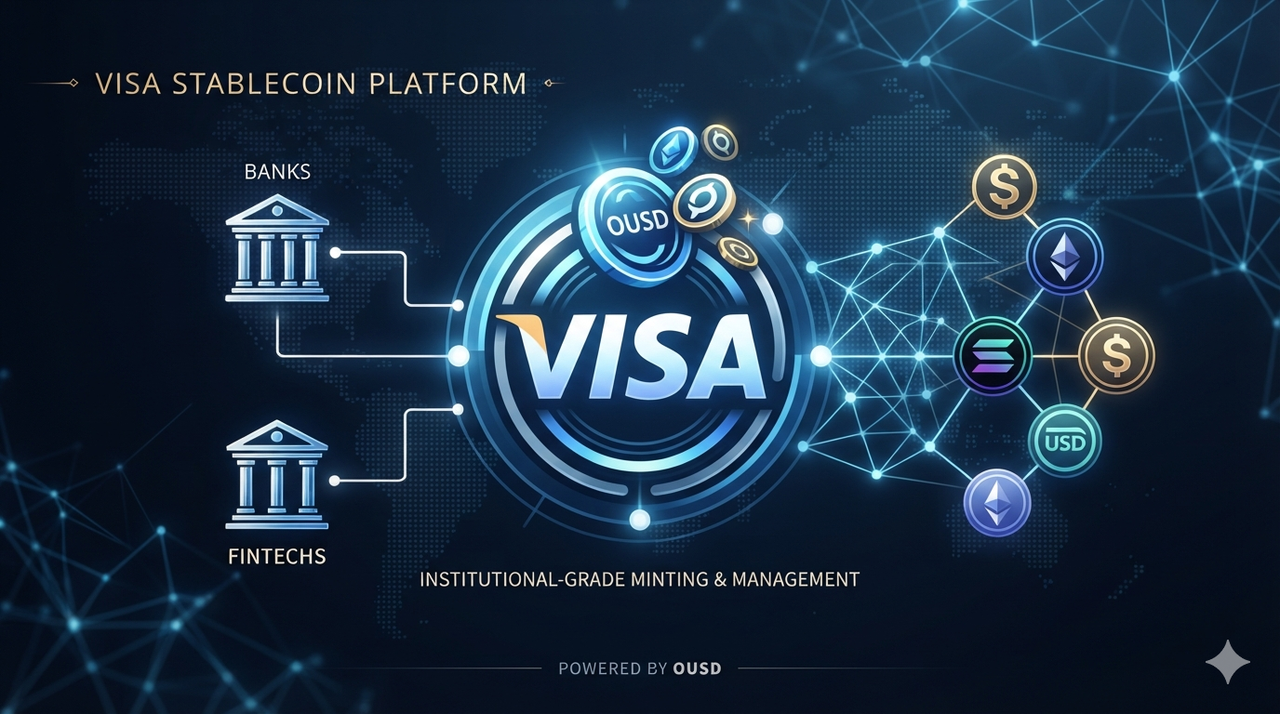
The convergence between legacy payment systems and programmable cryptographic infrastructure is rapidly accelerating. In a significant structural shift for the digital asset economy, global payments titan Visa has officially launched its commercial ecosystem: the Visa Stablecoin Platform (VSP).
Designed as an enterprise tool for commercial banks, regional financial institutions, and global fintech corporations, the platform streamlines the issuing, tokenizing, and moving of fiat collateral on supported public and private blockchains. Crucially, the launch features native infrastructure integrations for Open USD (OUSD), the compliance-focused enterprise stablecoin backed by a broad industry alliance of over 140 corporations, including BlackRock, Stripe, and Visa itself.
For institutional market participants, Web3 developers, and digital asset investors, Visa’s transition from pilot blockchain testing to deploying an active minting architecture represents a key milestone in corporate financial infrastructure.
Key Takeaways
-
Visa officially launched its Stablecoin Platform (VSP) to help banks and fintechs securely mint, transfer, and manage fiat-backed assets.
-
The platform features native integration for Open USD (OUSD), a compliance-focused enterprise stablecoin backed by over 140 corporations.
-
Unlike legacy stablecoins, OUSD disrupts the market by sharing short-term U.S. Treasury reserve yields directly with distributing financial institutions.
-
VSP utilizes a multi-chain architecture, natively supporting Ethereum, Solana, and Tempo for optimized transaction velocity and liquidity routing.
-
Institutions can utilize Visa's turnkey Wallet-as-a-Service infrastructure or seamlessly integrate their existing preferred custody providers via BYOW.
What Is the Visa Stablecoin Platform (VSP)?
The Visa Stablecoin Platform is an institutional-grade financial technology stack engineered to abstract away the immense technical, cryptographic, and regulatory complexities associated with managing digital assets. Rather than requiring traditional banks to spend years and millions of dollars building proprietary blockchain networks, Visa provides an end-to-end cloud environment that connects a bank’s internal core ledger directly to audited, enterprise-ready smart contracts.
Through the platform, commercial banks and regulated fintech companies gain the ability to easily mint, custody, burn, and transfer fiat-backed stablecoins. The entire framework operates within Visa's globally recognized, high-security compliance standard, ensuring that every financial transaction satisfies rigorous anti-money laundering (AML), know-your-customer (KYC), and jurisdictional regulatory baselines. By functioning as a secure technological intermediary, Visa allows legacy financial firms to safely experiment with programmable money without exposing their core treasury assets to protocol vulnerabilities.
Core Technical Features of Visa’s Enterprise Tool
The Visa Stablecoin Platform (VSP) provides a robust, institutional-grade financial technology stack engineered to address the operational and control realities of enterprise stablecoin management.
The architecture delivers its capabilities through four foundational modules:
Onchain Minting & Redemption Routing: Instead of requiring institutions to develop custom blockchain protocols, VSP enables commercial banks and regulated fintechs to securely route fiat treasury deposits to mint, hold, or burn compliant digital assets—starting natively with Open USD (OUSD).
Centralized Treasury Dashboard: The platform provides a unified console for real-time visibility into stablecoin operations. Enterprise users can monitor tokenized balances, cross-network transaction speeds, and on-ramp/off-ramp volumes across supported public and private ledgers from a single interface.
Enterprise Compliance & Fraud Monitoring: VSP directly leverages Visa’s global risk and security infrastructure. This module incorporates built-in policy configuration, sanctions screening, and automated tools designed to detect and flag anomalous on-chain wallet movements or policy violations.
Turnkey Bank & Workflow Interoperability: Institutions can connect traditional bank accounts for automated wire or ACH conversion without replacing their core software stacks. VSP bridges the gap using modern banking APIs, enabling digital assets to interface smoothly with existing corporate accounting and settlement workflows.
The Strategic Synergy with Open USD (OUSD)
A core milestone of Visa’s platform deployment is its native integration with Open USD (OUSD). Developed by the Open Standard consortium, OUSD introduces an institutional distribution model designed to share nearly all of its reserve yields (generated from short-term U.S. Treasuries) directly with corporations and financial institutions driving its adoption.
By embedding OUSD as a foundational asset within the Visa Stablecoin Platform (VSP), Visa lowers the operational and structural barriers that typically hinder enterprise token initiatives. Instead of undertaking the lengthy legal and technical processes of engineering and collateralizing proprietary standalone stablecoins, participating institutions can prepare to route into the OUSD framework.
This integration allows regional banks and fintech corporations to provide their clients with an institutionally backed digital asset that offers yield-sharing benefits, rapid settlement, and direct alignment with major global payment networks.
| Operational Feature | Legacy Banking Networks (Fedwire / SWIFT) | Visa Stablecoin Platform (OUSD Integration) |
| Settlement Velocity | Hours to multiple business days | Near-instant (Network dependent; e.g., seconds on Solana/Tempo) |
| Transaction Windows | Restricted to standard banking hours | 24/7/365 Continuous Availability |
| Cost Infrastructure | High per-wire fees and intermediary costs | Scaled network fees (Sub-penny on high-throughput rails) |
| Programmability | None (Static manual ledger entries) | Smart-contract automated logic |
| Primary Collateral | Uncollateralized commercial deposits | 1:1 Backed by Cash & US Treasuries |
Target Audience: Empowering Banks, Fintechs, and Neo-Market Makers
Visa has strategically engineered the Visa Stablecoin Platform (VSP) to serve three distinct segments within the modern financial ecosystem, aiming to clear away critical operational bottlenecks for each:
Commercial Banks Adapting to Programmable Liquidity
Traditional banks face intensifying demand from corporate clients for faster, real-time, 24/7 cross-border cash management solutions. The Visa Stablecoin Platform enables these institutions to safely interface with regulated stablecoin networks, helping them match the speed and efficiency of digital payment rails while maintaining their core corporate deposit relationships.
High-Growth Fintechs and Neobanks
For fast-moving digital-first platforms, building standalone cryptocurrency custody architectures and navigating fragmented compliance frameworks is cost-prohibitive. By utilizing Visa's turnkey tool and Wallet-as-a-Service (WaaS) capabilities, fintechs can seamlessly embed domestic and cross-border stablecoin remittance, automated B2B supplier payments, and corporate treasury features directly into their existing applications under Visa’s robust compliance baseline.
Institutional Stablecoin Issuers and Asset Managers
Large-scale financial entities looking to mint compliant stablecoins at scale can leverage Visa's infrastructure as a primary, secure issuance portal. This framework streamlines the operational flow, enabling capital channeled through the platform to interact efficiently with the OUSD ecosystem, where underlying fiat reserves are backed by institutional short-term money market funds managed by industry leaders like BlackRock.
Multi-Chain Architecture and High-Throughput Infrastructure
Visa’s Stablecoin Platform (VSP) leverages a multi-chain approach to connect traditional finance with public blockchains, focusing on supported networks for tokenized asset movement.
High-Performance Rails
To ensure efficient, high-velocity transactions, the platform utilizes high-performance networks like Solana, allowing institutions to manage transactions while avoiding the high costs and congestion of traditional chains.
System Compatibility and Compliance
The infrastructure supports major ecosystems, including Ethereum and Tempo. It provides secure, compliant tools for transmitting enterprise-managed stablecoins, specifically mentioning OUSD, through authorized on/off-ramps and institutional wallets, operating within a strict compliance framework.
Historically, major payment processors minimized exposure to public token issuance due to prolonged regulatory ambiguity. Visa's transition to an active enterprise stablecoin framework is closely aligned with the recent stabilization of the U.S. regulatory landscape, catalyzed by the enactment of the GENIUS Act.
Enacted as the first comprehensive federal framework for "payment stablecoins," the GENIUS Act provides the legal certainty required by traditional financial institutions. The statute enforces a mandatory 1:1 reserve ratio comprised of cash and short-term U.S. Treasuries. It provides a structured path for enterprise-level deployment, enabling Visa to offer compliant digital asset services.
The Systemic Impact on Market Leaders USDC and USDT
Visa’s commercial platform rollout, combined with the structural distribution network behind Open USD (OUSD), introduces fresh institutional dynamics for incumbent stablecoin issuers, specifically Circle (USDC) and Tether (USDT).
The Challenge to Circle’s USDC
Circle has long established USDC as a preferred compliant asset for enterprise Web3 and payment applications. However, the Visa Stablecoin Platform (VSP) introduces direct alternative pressure. By offering regulated financial institutions a turn-key framework to interface with OUSD, which natively incorporates a reserve yield-sharing model, Visa alters the economic incentives for corporate treasury and banking participants who distribute stablecoins. While VSP continues to support USDC alongside OUSD, the underlying economic advantages of the Open Standard model present a long-term challenge to Circle's institutional market share.
The Offshore Dominance of Tether (USDT)
Tether’s USDT remains a primary asset within non-U.S. cryptocurrency trading venues and emerging market retail use cases where local fiat access is constrained. Because Tether operates largely outside of direct U.S. banking infrastructure, its retail and offshore trading volumes are less exposed to onshore banking products like VSP. However, as Visa’s framework drives regulated enterprise capital into public multi-chain ecosystems, a growing portion of institutional settlement, B2B cross-border payments, and compliant banking books is projected to gravitate toward regulated alternatives like OUSD over the long term.
As Visa’s Stablecoin Platform begins anchoring the distribution infrastructure for next-generation assets like Open USD, the broader digital asset markets are anticipated to experience structural realignments in trading volume, liquidity routing, and cross-stablecoin arbitrage. Discerning market participants tracking these developments early can utilize premier digital asset platforms to position themselves for this upcoming liquidity migration.
As a global cryptocurrency exchange, KuCoin provides a robust digital asset ecosystem designed to capture market shifts and optimize stablecoin management. Next-generation assets like OUSD progress toward broad commercial circulation, KuCoin delivers an advanced suite of infrastructure to prepare your portfolio:
Deep Stablecoin Spot Markets: KuCoin hosts deep liquidity and high-volume trading pairs across leading regulated and fiat-backed assets, including USDT and USDC, enabling seamless, low-slippage capital reallocations as market weightings shift.
Yield Optimization via KuCoin Earn: Keep your foundational asset base highly productive by leveraging the KuCoin Earn platform. Access flexible savings, structured financial products, and secure institutional lending channels tailored to preserve and compound capital.
Automated Strategy Deployment: Prepare for the market volatility and peg variations introduced by corporate stablecoin competition by utilizing KuCoin’s programmable Grid Trading and DCA (Dollar-Cost Averaging) bots to capture short-term arbitrage opportunities systematically.
By managing your digital asset portfolio through KuCoin, you maintain immediate, 24/7 access to institutionally aligned spot markets and wealth management utilities, ensuring you are strategically position
Conclusion
The launch of the Visa Stablecoin Platform (VSP) represents a defining milestone in the convergence of legacy banking and digital financial architecture. By delivering a secure, regulated, and automated framework for commercial banks and fintech corporations to manage compliance-focused assets like Open USD, Visa has established a bridge for tokenized liquidity to enter mainstream commercial finance.
The narrative surrounding stablecoins is fundamentally expanding; they are no longer viewed merely as temporary liquidity havens for cryptocurrency trading, but rather as an emerging structural architecture for corporate treasury and cross-border settlement. Driven by the federal prudential guidelines of the GENIUS Act and optimized by high-performance blockchains like Solana, tokenized fiat assets are scaling into institutional-grade financial instruments. As enterprise capital continues to integrate with tokenized ledgers, maintaining a proactive approach to liquidity management remains vital. Navigating these shifts ensures that market participants remain strategically positioned to capture the capabilities of next-generation global digital finance.
FAQs
What is the Visa Stablecoin Platform (VSP)?
The Visa Stablecoin Platform is an institutional-grade financial technology stack that enables commercial banks and fintech corporations to securely mint, burn, transfer, and manage fiat-backed stablecoins within a single, compliant, Visa-managed cloud environment.
How does OUSD’s economic model differ from traditional stablecoins?
Unlike legacy issuers that retain all interest, the Open Standard consortium shares nearly all reserve yields (generated from short-term U.S. Treasuries) directly with the financial institutions and corporations driving OUSD's distribution and network adoption.
Which blockchain networks are supported by Visa's platform?
To optimize both liquidity and velocity, VSP leverages multi-chain architecture. The platform currently supports three major public and enterprise ecosystems for tokenized asset movement: Ethereum, Solana, and Tempo.
How does VSP impact incumbent market leaders like USDC and USDT?
OUSD's yield-sharing structure directly challenges Circle's USDC institutional market share by shifting channel incentives. Meanwhile, Tether's USDT remains dominant offshore, but long-term compliant B2B cross-border settlement is projected to gravitate toward regulated alternatives like OUSD.
How can participants manage upcoming stablecoin liquidity shifts?
Discerning market participants can utilize digital asset platforms like KuCoin. KuCoin offers deep stablecoin spot markets, wealth management via KuCoin Earn, and automated trading bots to capture structural realignments and cross-stablecoin arbitrage opportunities.
Disclaimer
The information provided on this page may originate from third-party sources and does not necessarily represent the views or opinions of KuCoin. This content is intended solely for general informational purposes and should not be considered financial, investment, or professional advice. KuCoin does not guarantee the accuracy, completeness, or reliability of the information, and is not responsible for any errors, omissions, or outcomes resulting from its use. Investing in digital assets carries inherent risks. Please carefully evaluate your risk tolerance and financial situation before making any investment decisions. For further details, please consult KuCoin’s Terms of Use and Risk Disclosure.