

Trading 101: Most Profitable Volume Crypto Trading Strategies in 2026

Introduction
In cryptocurrency trading, price alone rarely tells the full story. Professional traders increasingly rely on volume analysis to understand the conviction behind market movements, especially in highly volatile markets such as Bitcoin, Ethereum, Solana, and emerging altcoins. Trading volume reflects the total amount of an asset traded within a given timeframe and serves as one of the most important indicators of market participation, liquidity, and momentum.
As the crypto market matures in 2026 with rising institutional participation, AI-powered trading systems, and growing derivatives activity, volume analysis has become even more relevant for identifying trend strength, breakout confirmation, and potential reversals. Whether traders are analyzing spot markets or crypto futures, understanding volume behavior can help filter out false breakouts and improve trade timing.
Most crypto exchanges display trading volume as vertical bars beneath the price chart. Green bars generally indicate buying pressure, while red bars represent selling pressure. By studying how volume interacts with price action, traders can gain deeper insight into market sentiment and identify high-probability trading opportunities.
The Basic Principles of Volume Trading Strategies
Through volume analysis, a trader can recognize the stability and weakness of a trend. A trend is when the price of a crypto has taken a certain direction for a longer period.
The color of the volume bar on a chart is either red or green. The red bars indicate the volume being sold, while the green bars indicate the volume being bought. Typically, large volumes are shown when the bars are significantly higher than the rest. Here are some of the key points to consider when analyzing the volume:
- At the beginning of a trend, regardless of whether it is an upward or downward trend, the volume increases. Likewise, the volume increases when the price breaches support and resistance levels.
- Volume analysis can be used to determine the strength of a trend. If the price trend reaches a new high without the volume also reaching a new high, it is a weak trend indicating a potential bearish reversal. Similarly, if the market is in a bearish trend and the price records lower lows, but the volume doesn’t, it is an indicator of a weakening bearish trend. It also signals a potential bullish reversal.
- A sudden spike in volume indicates a high level of trading among market participants. The volume peaks have a short-term stopping effect on the price movement. Here it may make sense to trade the respective correction contrary to the current price development. For sentimental analysis, this marks the beginning of a new trend or a reversal of the existing trend.
- Minimal price changes, or when the market is trending sideways accompanied by low volume, indicate a lack of interest by the traders and investors. In this case, there may be rapid reversal movements. Typically, this represents a moment of price consolidation. That means that traders can anticipate either a trend reversal or continuation. New impetus is needed to attract more market participants. However, you should always be prepared to catch the new trend, often signaled by a sudden spike in volume.
Profitable volume Trading Strategies
There is the basic rule that the price cannot rise far without the volume confirming the direction. Beginners should always focus on trading in liquid markets with a high trading volume, as this results in lower trading fees and fast execution of orders. With this in mind, here are some of the volume trading strategies:
Trend Confirmation
As we’ve noted earlier, volume can be used to confirm the existing market trends or signal their reversal. The volume increases with movements in the direction of an actual trend. If a decline in volume occurs, it is a sign that the trend could flatten out while the market enters a period of consolidation.
The increasing volume illustrates the belief of sellers and buyers to steer the price either down or up. The volume should preferably be lower if the price changes in the trend direction and larger if it shifts against the patterns
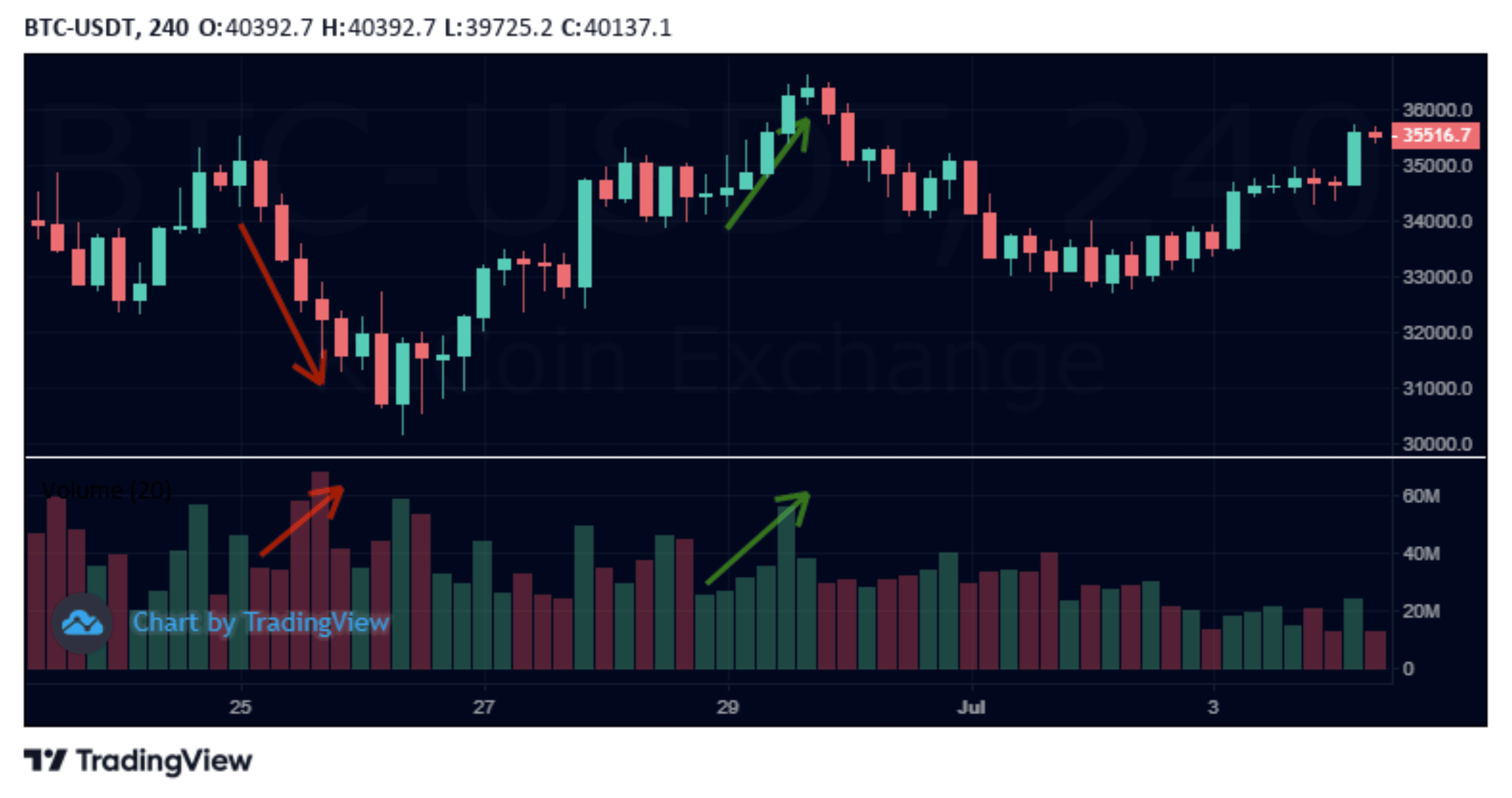
The Impact of Volume On Bitcoin Price Action | Source: BTC/USDT
Identifying Price Reversals
A declining volume can represent a potential price reversal. This means that a decline in volume over the course of a downtrend or uptrend indicates a possible reversal. A trend can continue over a longer period in terms of decreasing size. Still, a decreasing volume can usually mean that the trend is getting worse.
In an uptrend, a decrease in the volume means that fewer traders are bullish. This indicates that the bullish trend is weakening. Remember that the market is driven by demand and supply. When demand increases, so does the price. Similarly, when an asset in a bearish trend experiences a drop in volume, sellers in the market are dropping – indicating that the momentum is weakening.
The occurrence of volume spikes within a trend often precedes a trend reversal. If the market is in a bullish trend and there’s a sudden spike in sell volume, it should signal the beginning of a bearish trend. That’s because volume spikes are often a result of changes in market sentiment. Traders should pay attention to the volume in the next price recovery. In cases where the rally volume is lower than the volume peak are good signs that the price will continue to fall.
Volume Breakout Trading in Modern Crypto Markets
One of the most widely used volume-based strategies in today's crypto market is breakout confirmation trading. In highly liquid assets such as Bitcoin and Ethereum, significant price movements are often accompanied by sudden increases in trading volume. When price breaks above a major resistance level with strong volume support, it usually signals genuine buying interest rather than a temporary price spike.
This strategy became particularly popular during the crypto market recovery cycles of late 2025 and early 2026, where institutional inflows and Bitcoin ETF-related activity created large volume surges across major exchanges. Traders increasingly monitor whether breakout volume exceeds the recent average volume. If the breakout occurs on weak volume, there is a higher probability of a fake breakout or short-term rejection.
Similarly, during bearish conditions, a sharp increase in sell volume after support levels break may indicate panic selling and the continuation of downward momentum. Combining support and resistance analysis with volume indicators such as Volume Profile, On-Balance Volume (OBV), or VWAP can significantly improve trade accuracy.
How AI Trading and Algorithms Use Volume Data
In today's algorithm-driven crypto market, volume analysis is no longer limited to manual chart reading. Many quantitative trading systems and AI-powered trading bots actively incorporate real-time volume metrics to detect momentum shifts, liquidity imbalances, and abnormal market behavior.
Large trading firms and high-frequency trading systems often monitor volume spikes across multiple exchanges simultaneously. For example, when sudden buy volume appears on Bitcoin perpetual futures markets alongside rising spot market demand, trading algorithms may interpret this as confirmation of bullish momentum.
Retail traders can also benefit from this approach by watching for unusual volume activity before major price movements occur. In many cases, volume increases before volatility expands, making volume one of the earliest indicators of potential market shifts.
Why Volume Matters More During High Volatility Events
The cryptocurrency market has experienced several periods of extreme volatility in recent years, including leveraged liquidations, meme coin rallies, and macroeconomic-driven market swings. During these events, trading volume becomes especially important because it reflects the intensity of market participation.
For example, when Bitcoin experiences rapid price declines triggered by liquidation cascades, extremely high sell volume may indicate capitulation. Historically, capitulation phases are often followed by short-term rebounds once selling pressure begins to weaken.
On the other hand, sustained bullish rallies supported by increasing volume tend to be healthier and more sustainable than rallies occurring on declining volume. This is why professional traders often avoid chasing low-volume price pumps, especially in smaller-cap altcoins where liquidity risks are significantly higher.
Conclusion
Volume analysis remains one of the most effective tools for understanding crypto market behavior. While price charts show where the market is moving, volume helps traders understand the strength and conviction behind those movements. From confirming trends and identifying reversals to spotting breakout opportunities, volume plays a critical role in both short-term trading and long-term market analysis.
As crypto markets continue evolving with institutional adoption, AI-driven trading systems, and increasingly sophisticated trading strategies, understanding volume dynamics has become more important than ever. Traders who combine price action with volume analysis are often better positioned to avoid false signals and manage market volatility more effectively.
For traders who prefer automated strategies, KuCoin offers advanced trading tools and Trading Bots that can help simplify execution in fast-moving market conditions. KuCoin also provides premium TradingView integration, allowing users to analyze real-time volume changes directly on professional-grade charts.
Whether you are a beginner or an experienced trader, mastering volume analysis can significantly improve your ability to navigate the crypto market with greater confidence and discipline.
FAQs
What is trading volume in cryptocurrency?
Trading volume refers to the total amount of a cryptocurrency traded during a specific period. It helps traders measure market activity, liquidity, and the strength of price movements.
Why is volume important in crypto trading?
Volume helps confirm whether a price trend is strong or weak. High volume usually indicates strong market participation, while low volume may signal uncertainty or weak momentum.
Can volume predict trend reversals?
Volume alone cannot guarantee a reversal, but declining volume during an ongoing trend often suggests weakening momentum. Sudden volume spikes may also indicate a potential market reversal or breakout.
Which indicators are commonly used with volume analysis?
Popular volume-based indicators include On-Balance Volume (OBV), Volume Profile, VWAP, and the Volume Oscillator. Many traders combine these tools with support and resistance analysis.
Is volume analysis useful for beginners?
Yes. Volume analysis is considered one of the most beginner-friendly trading concepts because it helps traders better understand market sentiment and avoid false breakouts or weak trends.