

CryptoQuant CEO: The Era of Issuing Coins for Easy Money Is Over — These 3 Types of Altcoins Will Survive
2026/06/22 08:00:00
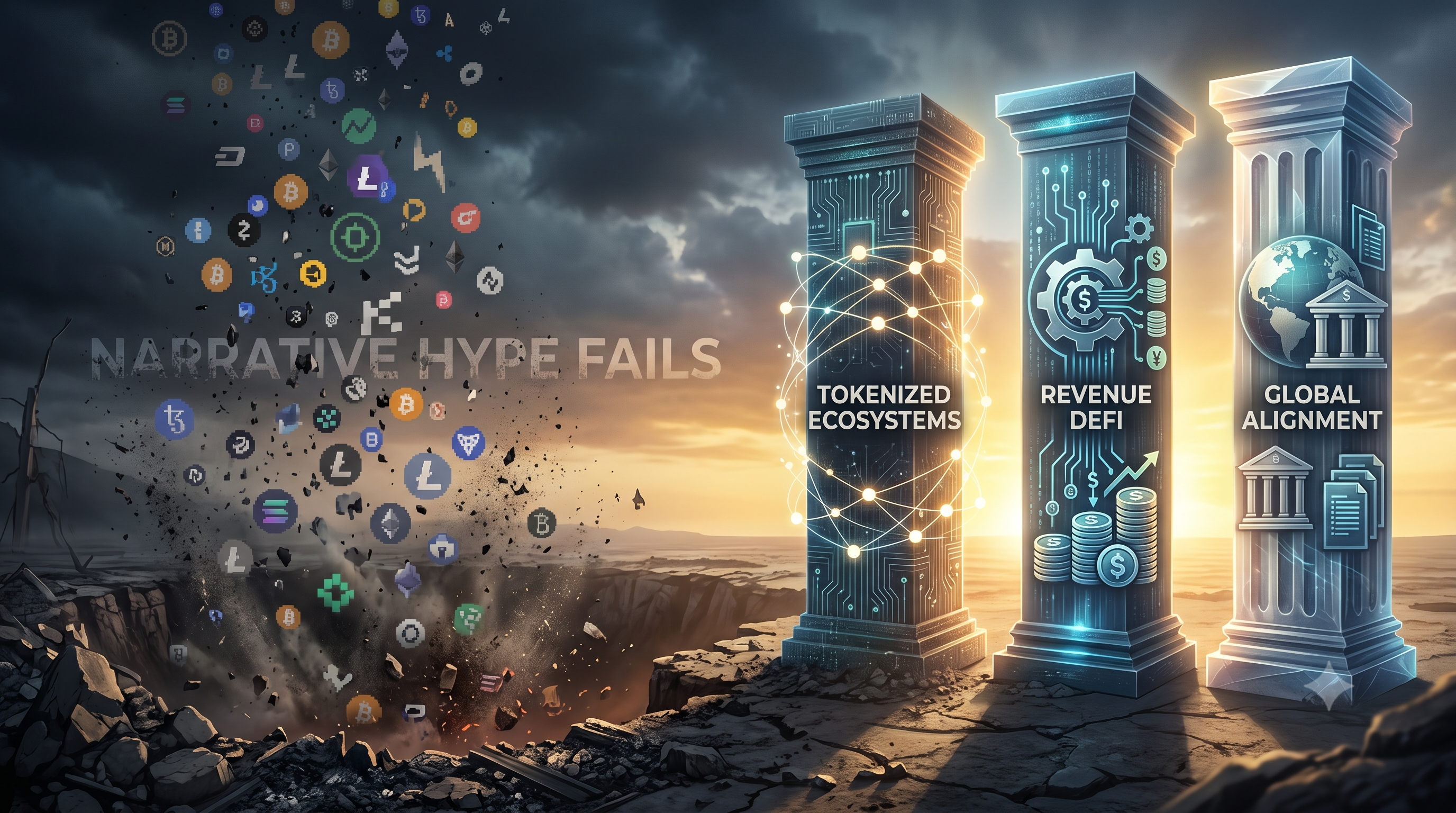
The era of launching a token and reaping millions overnight is definitively over. In June 2026, the cryptocurrency landscape is undergoing a brutal, yet necessary, cleansing. CryptoQuant CEO Ki Young Ju recently dropped a bombshell on the industry, asserting that an astounding 99.9% of altcoins currently saturating the market should be filtered out. The days of purely narrative-driven projects profiting from mere hype and speculative "easy money" have vanished. Instead, the market is maturing, mirroring the aftermath of the early 2000s dot-com bubble. Ju boldly stated that only three specific types of altcoins possess the fundamental strength to survive this natural selection process. As institutional capital tightens and retail investors grow weary of empty promises, the market demands real utility, revenue, and global financial alignment. This article breaks down these three surviving categories and explores what they mean for the future of crypto investing.
Key Takeaways
-
Narrative-Driven Coins Are Dead: The speculative frenzy where mere whitepapers and marketing could pump a token's price is officially over, replaced by a demand for tangible utility.
-
The 99.9% Filtration: CryptoQuant CEO Ki Young Ju estimates that 99.9% of current altcoins lack the fundamentals to survive the current market cycle.
-
Survivor Type 1: Tokenized Market Layers: Global internet companies issuing tokens (like BNB and GRAM/TON) instead of traditional equity will dominate.
-
Survivor Type 2: Revenue-Generating DeFi: Decentralized Finance services that produce actual, sustainable revenue, rather than relying on token inflation (e.g., Hyperliquid), will thrive.
-
Survivor Type 3: Global Financial Integration: Altcoins that align with macro-financial trends, regulatory standards, and institutional frameworks will secure long-term capital.
-
The Dot-Com Bubble Parallel: The current altcoin purge closely resembles the internet stock crash, promising the emergence of true Web3 giants from the ashes.
The End of "Easy Money" and the "PvP" Market Reality of 2026
Why Purely Narrative-Driven Altcoins Are Dead
For years, the cryptocurrency industry operated on a simple, deeply flawed premise: a strong narrative, paired with aggressive marketing, was enough to secure millions in funding and drive a token to astronomical valuations. However, the data from mid-2026 paints a drastically different picture. According to recent insights from CryptoQuant CEO Ki Young Ju, purely narrative-driven altcoins are effectively dead. Investors who thrived on the "easy money" of previous cycles, where liquidity flowed indiscriminately into micro-cap tokens, are now facing a harsh reality check. The institutionalization of the crypto space, led by Bitcoin and Ethereum ETFs, has raised the barrier to entry for what constitutes a viable digital asset.
The underlying mechanism of previous altcoin seasons relied heavily on capital rotation. Bitcoin would surge, investors would take profits, and that capital would trickle down into large-cap altcoins, eventually cascading into speculative meme coins and narrative plays. Today, this capital flow has been severely disrupted. Institutional investors, who now command a significant portion of market liquidity, do not participate in speculative trickle-down economics. They demand clear value propositions, regulatory compliance, and sustainable business models. Consequently, the era of issuing coins merely as a mechanism for founders to cash out on hype is obsolete. Projects that fail to offer anything beyond a whitepaper and a catchy ticker symbol are being aggressively priced out of the market. This paradigm shift is not a temporary bearish trend; it is a permanent structural change in how digital assets are valued and traded globally.
Furthermore, regulatory clarity has acted as a massive catalyst for this filtration. With agencies worldwide cracking down on unregistered securities and fraudulent token offerings, the legal risk associated with launching and promoting narrative-driven tokens has skyrocketed. Founders can no longer hide behind anonymous profiles and decentralized autonomous organization (DAO) structures to escape accountability. This regulatory pressure has suffocated the launch rate of low-quality tokens and accelerated the capital flight from existing ones, cementing the death of the easy money era.
The 2.7x Volume Shift and Liquidity Struggles
While the broader market sentiment might appear stable on the surface, beneath it lies a fiercely competitive environment. Data from CryptoQuant highlights that while altcoin trading volume has reached 2.7 times that of Bitcoin, this metric does not indicate a healthy, broad-based altcoin season. Instead, Ju describes the current market dynamics as a "PvP (Player vs. Player) fight over a fixed pie." Because there is a lack of fresh retail and institutional liquidity entering the lower echelons of the market, traders are essentially cannibalizing each other's capital within existing assets.
In this zero-sum game, capital is ruthlessly efficient. It quickly abandons underperforming or purely speculative tokens in favor of assets that demonstrate resilience and utility. The heightened volume ratio indicates volatility and fierce rotation among a very select few altcoins, rather than the "rising tide lifts all boats" phenomenon seen in 2021. This hyper-competitive environment accelerates the demise of the 99.9% of altcoins that Ju warns against. Without new fiat inflows to prop up artificially inflated market caps, only the most fundamentally sound projects can absorb the trading volume and maintain their price floors. This environment naturally filters out the weak, setting the stage for the three distinct types of altcoins that are fundamentally equipped to survive and capture market share in the years to come. The liquidity drought forces a survival-of-the-fittest scenario where only tokens with intrinsic value can maintain a bid.
The First Survivor Category: Global Internet Companies with Tokenized Market Layers
Tokenized Ecosystems Replacing Traditional Equity (BNB & TON)
The first category of altcoins destined to survive, according to CryptoQuant's analysis, consists of tokens issued by global internet companies that act as tokenized market layers. In certain strategic scenarios, issuing a utility or governance token is far more practical, efficient, and community-aligned than undergoing a traditional Initial Public Offering (IPO) and issuing equity. Examples cited by Ki Young Ju include Binance Coin (BNB) and the Telegram-affiliated GRAM/TON network. These are not speculative startups; they are established, global internet behemoths with massive, active user bases and proven product-market fit.
By issuing a token, these companies create an integrated digital economy within their existing platforms. The token serves as the lifeblood of the ecosystem, utilized for transaction fees, governance, staking rewards, and accessing premium features. Unlike traditional equity, which merely represents ownership and a claim on future dividends, these tokens possess intrinsic utility that scales directly with network adoption. For a company like Telegram, which boasts hundreds of millions of active users, integrating a token like TON allows for instant monetization, peer-to-peer payments, and decentralized application (dApp) interaction natively within the messaging app. This immediate access to a captive audience bypasses the steepest hurdle for most crypto projects: user acquisition.
Because these tokens are tethered to real-world companies with significant operational revenue and massive user bases, their floor price is inherently protected by actual platform usage. Even in a severe bear market, users still need BNB to pay for discounted trading fees on Binance, and they still need TON to execute smart contracts on the Telegram network. This constant, non-speculative demand is the defining characteristic that separates these survivor altcoins from the thousands of doomed narrative-driven projects.
Bridging Web2 Users to Web3 Infrastructure
The power of this specific altcoin category lies in its ability to act as a seamless bridge between Web2 and Web3. The vast majority of the global population still finds the user experience of self-custody wallets, seed phrases, and decentralized exchanges incredibly daunting. Global internet companies with tokenized layers abstract away this complexity. They leverage their familiar, user-friendly Web2 interfaces to silently onboard users into Web3 infrastructure.
This frictionless onboarding is the holy grail of cryptocurrency adoption. When a user sends a stablecoin via a messaging app, they may not even realize they are utilizing a blockchain network and paying gas fees in a native altcoin. This invisible utility ensures sustained transaction volume and consistent demand for the underlying token. Furthermore, these companies possess the capital, developer resources, and legal firepower to navigate the complex regulatory landscapes across different jurisdictions, ensuring their tokenized ecosystems remain compliant and operational. As the "PvP" market wipes out smaller competitors, these giant tokenized ecosystems will naturally absorb the displaced capital, solidifying their dominance and guaranteeing their survival in the post-2026 crypto market.
| Feature | Purely Narrative-Driven Altcoins | Tokenized Market Layers (e.g., BNB, TON) |
| User Base | Speculators, airdrop hunters (low retention) | Hundreds of millions of active platform users |
| Value Proposition | Hype, marketing, future promises | Immediate utility, fee discounts, ecosystem access |
| Revenue Model | Token inflation, selling treasury tokens | Platform fees, transaction volume, advertising |
| Survival Probability | Extremely Low (0.1%) | Extremely High (Proven utility) |
The Second Survivor Category: DeFi Services Generating Real Revenue
Fundamentals Matter: Protocols Leading the Charge
The second class of survivors identified by the CryptoQuant CEO comprises Decentralized Finance (DeFi) services that generate real, verifiable revenue. In the earlier days of DeFi, the sector was plagued by unsustainable "yield farming" mechanics. Protocols would artificially inflate their Total Value Locked (TVL) by rewarding users with highly inflationary governance tokens. This created a facade of profitability that inevitably collapsed once the token emissions ceased or the price crashed. In 2026, that model is entirely extinct. The market now strictly demands "Real Yield"—yield derived from actual economic activity rather than token printing.
Ki Young Ju explicitly highlighted platforms like Hyperliquid and other premium DeFi protocols as prime examples of this survivor category. These platforms function as decentralized businesses. They offer genuine financial services, such as perpetual futures trading, decentralized lending, or efficient stablecoin swapping, and they charge a fee for these services. The revenue generated from these fees is then either distributed to token holders, used to buy back and burn the native token, or reinvested into protocol development. This creates a sustainable, fundamental valuation model akin to traditional finance metrics like the Price-to-Earnings (P/E) ratio.
When a protocol generates millions of dollars in monthly fee revenue, its native token transcends the realm of speculation. It becomes a productive asset. Institutional investors and sophisticated capital allocators are increasingly rotating their portfolios out of "vaporware" and into these cash-flowing DeFi tokens. In a market starved for fresh liquidity, protocols that can generate their own internal liquidity through genuine business operations will not only survive but will fundamentally redefine the valuation standards of the entire cryptocurrency sector.
The Shift from Token Inflation to Real Yield
The transition from inflationary tokenomics to real yield represents a massive maturation point for the cryptocurrency industry. It signifies a move away from Ponzi-like structures toward sustainable digital economies. For an altcoin to survive in this category, it must demonstrate a clear path to profitability without relying on continuous venture capital injections or retail dumping.
This requires building highly efficient, secure, and user-centric products that people are actually willing to pay to use. For instance, decentralized perpetual exchanges must offer low latency, deep liquidity, and competitive fees to draw traders away from centralized counterparts. If they succeed, the trading volume generates substantial fee revenue. When this revenue is transparently distributed to stakers of the protocol's native token, it creates a powerful incentive for long-term holding, dramatically reducing sell pressure.
Moreover, this shift allows traditional financial analysts to accurately value these tokens using established discounted cash flow (DCF) models. By analyzing the daily active users, trading volume, and fee generation, analysts can determine the intrinsic value of the DeFi protocol. When the 99.9% of fundamentally worthless altcoins are finally flushed out of the system, the capital looking for high-growth digital assets will inevitably concentrate in these revenue-generating DeFi powerhouses, providing them with immense upward price momentum and long-term stability.
The Third Survivor Category: Projects Aligning with Broader Global Financial Trends
Institutional Capital Demands Real-World Integration
The third and final category of altcoins that will weather the current market storm are those that strategically align with broader global financial trends. The cryptocurrency market no longer operates in a silo; it is deeply intertwined with global macroeconomics, traditional banking infrastructure, and international regulatory frameworks. Altcoins that attempt to exist entirely outside of, or in direct opposition to, the established financial system will struggle to secure the institutional capital necessary for long-term survival. Conversely, projects that act as a bridge between traditional finance (TradFi) and decentralized finance will thrive.
This alignment takes several forms. It includes projects focused on Real World Asset (RWA) tokenization, which seek to bring trillions of dollars of traditional assets—such as real estate, government bonds, and corporate debt—onto the blockchain. It also encompasses protocols developing institutional-grade compliance tools, decentralized identity solutions (DID) that satisfy Anti-Money Laundering (AML) and Know Your Customer (KYC) requirements, and interoperability networks that allow disparate banking ledgers to communicate seamlessly with public blockchains.
These projects are solving massive, multi-billion dollar inefficiencies within the global financial system. By aligning with the goals of major financial institutions—which are actively seeking ways to leverage blockchain technology for faster settlement times and reduced operational costs—these altcoins position themselves as essential infrastructure rather than speculative commodities. When a major Wall Street bank decides to tokenize a portion of its treasury, it will utilize a blockchain network that is secure, compliant, and deeply integrated with global financial standards. The native tokens of these networks will capture immense value as they become the settlement layer for the world's traditional financial assets.
ETF Approvals and the Maturation of Select Altcoins
A critical component of this global financial alignment is the increasing viability of altcoin Exchange-Traded Funds (ETFs). Following the massive success of Bitcoin and Ethereum spot ETFs, institutional appetite for diversified digital asset exposure has grown. However, regulatory bodies like the SEC remain highly selective. Only altcoins that demonstrate immense liquidity, profound decentralization, and clear utility are even considered for ETF wrappers.
As we progress through 2026, analysts remain optimistic about the eventual approval of ETFs for select, highly established altcoins such as Solana, XRP, and Litecoin. The approval of an ETF acts as the ultimate seal of institutional approval, opening the floodgates for trillions of dollars of retirement and pension fund capital to flow into the asset. This dynamic creates a stark divide in the altcoin market. The select few tokens that achieve ETF status or deep institutional integration will experience massive liquidity injections, while the rest of the market starves.
This reinforces CryptoQuant's assertion that the era of a universal "altseason" is dead. Capital will no longer flow blindly into the thousands of lower-tier coins. Instead, it will be surgically allocated to the very few altcoins that meet the stringent requirements of traditional high finance. Investors must look beyond the crypto-native echo chamber and evaluate whether a token has the potential to be integrated into the portfolio of a traditional wealth manager. If the answer is no, the token's chances of long-term survival are statistically negligible.
| Feature | Traditional Speculative Crypto | Global Financial Trend-Aligned Crypto |
| Target Audience | Retail day traders, crypto-natives | Institutional allocators, global banks |
| Core Utility | Speculation, isolated ecosystem use | Real World Asset (RWA) tokenization, compliance |
| Capital Inflows | Retail FOMO, venture capital | Pension funds, ETFs, institutional treasuries |
| Regulatory Stance | Often evasive or combative | Fully compliant, AML/KYC integrated |
Market Outlook: The Dot-Com Bubble Parallel and Survival of the Fittest
How the 2026 Altseason Differs from Previous Cycles
To truly grasp the magnitude of the shift occurring in June 2026, one must compare the current environment to the historical cycles of the cryptocurrency market. In 2017 and 2021, an "altseason" was characterized by indiscriminate euphoria. When Bitcoin stabilized, nearly every alternative cryptocurrency, regardless of its underlying technology or team, experienced exponential price appreciation. A rising tide lifted all boats, and fortunes were made purely by throwing capital at random tickers.
Ki Young Ju's analysis confirms that this old cycle is entirely obsolete. The current market is undergoing a profound contraction in speculative breadth. It is not that capital has left the crypto ecosystem; rather, it has become hyper-concentrated. Institutional investors and battle-tested retail traders are hoarding quality assets and mercilessly dumping speculative ones. The 2026 altseason is a "selective drizzle" rather than a torrential downpour.
This dynamic is exactly what occurred during the aftermath of the dot-com bubble in the early 2000s. During the height of the internet mania, any company with a ".com" suffix could secure millions in funding, regardless of whether they had a viable business model. When the bubble burst, 99% of those companies were wiped out. However, the internet itself did not die. Instead, the capital re-consolidated into fundamentally sound companies like Amazon, Google, and Apple, creating the technological titans that rule the world today. CryptoQuant's thesis is that the cryptocurrency market is currently experiencing its own dot-com crash moment. The 99.9% of useless tokens are being purged to make way for the true Web3 giants.
What Investors Need to Look For
Navigating this new, unforgiving market reality requires a complete overhaul of traditional crypto investment strategies. Buying a token simply because its price is low, or because a prominent influencer is promoting it, is a guaranteed path to financial ruin in a PvP market. Investors must adopt the mindset of a traditional venture capitalist or a value investor.
The survival of the fittest dictates that capital should only be deployed into the three categories outlined by Ki Young Ju. Investors must scrutinize an altcoin's fundamentals with extreme prejudice. Does the token belong to a global internet company with millions of active users? Does the decentralized protocol generate real, verifiable fee revenue that exceeds its token emissions? Is the project actively integrating with traditional financial institutions and aligning with global macro trends?
If an altcoin cannot answer "yes" to at least one of these questions, it belongs to the 99.9% that will inevitably go to zero. The era of issuing coins for easy money is over, but the era of investing in legitimate, paradigm-shifting digital enterprises is just beginning. Those who can accurately identify and hold these fundamentally sound assets through the current market consolidation will position themselves to reap the massive rewards of the true Web3 revolution that will emerge from the ashes of the purely narrative-driven altcoins.
Conclusion
The cryptocurrency landscape of 2026 is defined by a ruthless, yet ultimately healthy, market filtration. As CryptoQuant CEO Ki Young Ju astutely pointed out, the speculative era of generating easy money simply by launching a narrative-driven token is permanently closed. We are witnessing the extinction of 99.9% of altcoins that lack fundamental utility, as the market transitions from a retail-driven casino into an institutionally dominated financial sector. The survival of an altcoin now depends entirely on its ability to generate tangible value.
The future belongs exclusively to three distinct categories: global internet giants bridging Web2 users to Web3 through tokenized ecosystems (like BNB and TON), DeFi protocols operating as true digital businesses with real revenue generation (like Hyperliquid), and projects that seamlessly integrate with and solve problems for the broader global financial system. By mirroring the catastrophic yet necessary purge of the dot-com bubble, the current market contraction is clearing the stage for the true titans of the decentralized web to emerge. For investors, the mandate is clear: abandon speculative hype, demand rigorous fundamentals, and align your capital with the select few digital assets that are building the infrastructure of tomorrow's financial world.
FAQs
What exactly is an "altcoin" in the context of the 2026 market?
An altcoin (alternative coin) refers to any cryptocurrency other than Bitcoin. In the 2026 context, the term encompasses a vastly diverse range of assets, from massive smart contract platforms like Ethereum and Solana to utility tokens, DeFi governance tokens, and highly speculative meme coins. The current market is sharply differentiating between altcoins with actual utility and those that exist solely for speculation.
Why are institutional investors avoiding 99.9% of altcoins?
Institutional investors operate under strict risk management, fiduciary duties, and regulatory compliance frameworks. They require assets with deep liquidity, transparent governance, and a sustainable business model. The vast majority of altcoins are highly illiquid, lack regulatory clarity, and rely on inflationary tokenomics rather than real revenue, making them untouchable for professional capital allocators managing billions of dollars.
What is the difference between inflationary yield and "Real Yield" in DeFi?
Inflationary yield occurs when a protocol pays users by simply minting new tokens out of thin air, which constantly devalues the asset. "Real Yield" refers to profits generated from actual economic activity on the platform—such as trading fees, borrowing interest, or swap fees—which are then distributed to token holders. Real yield is sustainable, whereas inflationary yield inevitably leads to a price collapse.
How does a tokenized market layer differ from a traditional stock?
Traditional stock (equity) represents legal ownership in a company and a right to its future dividends. A tokenized market layer (like BNB) is a utility asset embedded within a company's product ecosystem. It is used to pay for services, secure discounts, and participate in network governance. While its value can appreciate based on platform growth, it offers direct functional utility rather than just a financial claim.
Can a meme coin survive the current market purge?
While highly unlikely for the vast majority, a meme coin can only survive if it transcends its initial narrative and develops actual utility or deep institutional integration. For example, if a meme coin becomes the primary currency for a massive decentralized application or secures an ETF approval due to overwhelming cultural adoption and liquidity, it may survive. However, purely speculative meme coins without these developments are destined to fail.
Disclaimer: This article is for informational purposes only and does not constitute financial or investment advice. Cryptocurrency investments carry significant risk, including the total loss of capital. The market is highly volatile, and past performance is not indicative of future results. Always conduct your own thorough research and consult with a qualified financial advisor before trading.