

TENDIES Price Surges 64% as Robinhood Chain Meme Coin Tops $20M
2026/08/05 14:45:00
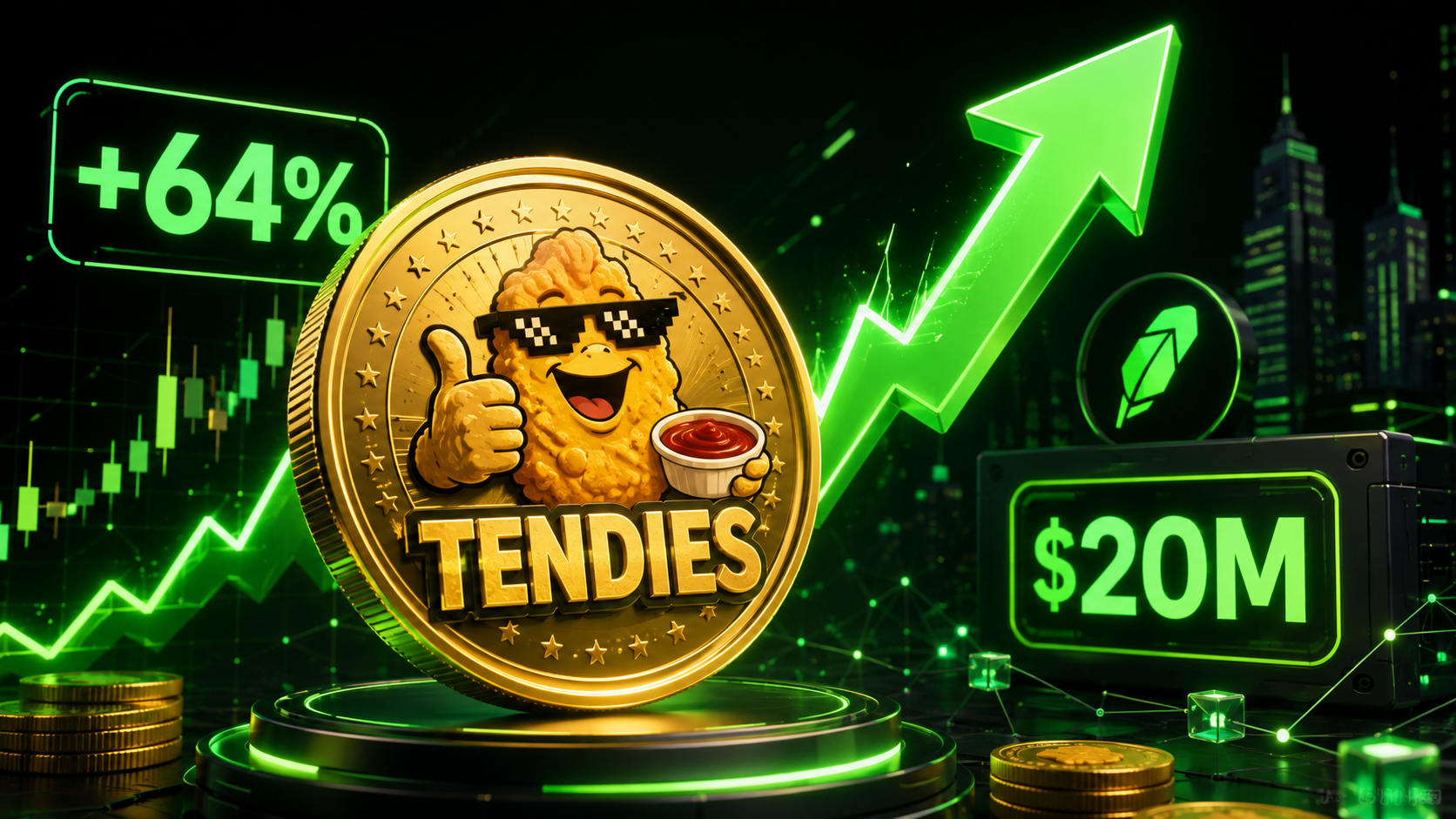
TENDIES Emerges as Robinhood Chain's Fastest-Rising Meme Coin
Robinhood Chain, the Ethereum Layer-2 network launched by the retail brokerage on July 1, 2026, continues to draw intense speculative interest through meme coins rather than its original focus on tokenized stocks. Among the tokens gaining traction, TENDIES has emerged as a notable performer, recording a roughly 64% price increase over 24 hours and lifting its market capitalization above the $20 million threshold. Data from CoinGecko shows the token trading near $0.0205 with a fully circulating supply of 1 billion tokens, a 24-hour trading volume exceeding $2.2 million, and ranking around #776 by market cap. The move aligns with broader activity on the chain, where decentralized exchange volumes and total value locked have expanded quickly since mainnet launch, driven largely by community-driven tokens referencing retail trading culture.
The recent performance of TENDIES illustrates how meme-driven narratives can still generate substantial short-term liquidity and attention on new blockchain networks, even as the underlying platform emphasizes regulated real-world assets. This article examines the token’s price action, the structural features of Robinhood Chain that enabled the surge, on-chain metrics, community dynamics, comparative positioning against other native meme tokens, liquidity conditions, risk factors, and the wider market context surrounding speculative activity in mid-2026.
Robinhood Chain Launch Timeline and Early Liquidity Buildup
Robinhood Chain entered public mainnet operation on July 1, 2026, as a permissionless Ethereum Layer-2 constructed on the Arbitrum Orbit stack. The network advertises approximately 100-millisecond block times and was positioned to support continuous trading of tokenized securities alongside decentralized finance primitives. Early integrations with Uniswap, Morpho for lending, and Chainlink oracles went live at launch, creating immediate infrastructure for both asset tokenization and speculative trading. Within the first week, total value locked climbed past $100 million according to contemporaneous reports, and by late July estimates placed DeFi TVL in the $300 million to $430 million range, with some August figures approaching $410 million. Decentralized exchange volume on the chain expanded from modest daily levels in the tens of millions to peaks exceeding $500 million on high-activity days.
While the platform’s stated design prioritizes real-world assets, on-chain data consistently show that meme tokens and stablecoins have accounted for the majority of early trading activity and value locked. Tokenized equities and other regulated products remain a smaller fraction of overall network usage. This pattern of speculative capital arriving first has been observed on several recent Layer-2 launches, and it has provided the liquidity environment in which tokens such as TENDIES can experience rapid price discovery. Holders and traders interact primarily through Uniswap V3 and V4 deployments on the chain, with bridging of ETH from other networks serving as the primary on-ramp. The combination of low latency, existing retail brokerage brand recognition, and open permissionless token deployment has therefore concentrated attention on community tokens in the network’s initial phase.
TENDIES Tokenomics and Supply Structure Explained
TENDIES operates with a fixed maximum supply of 1 billion tokens, all of which are already in circulation according to CoinGecko and supporting explorers. There is no staged emission schedule, team allocation, or locked vesting reported in available market data, a structure typical of many pure meme tokens. The contract address 0x45242320dbb855eea8fd36804c6487e10e97fcf9 is listed on CoinGecko and verified on the Robinhood Chain Blockscout explorer. Because the entire supply is circulating, market capitalization and fully diluted valuation remain identical at the current price level near $0.0205, producing a valuation of approximately $20.5 million.
Trading occurs almost exclusively on decentralized exchanges native to Robinhood Chain, with the primary pair against WETH on Uniswap V3 accounting for the majority of observed volume. Secondary pairs on Uniswap V4 and smaller venues contribute additional liquidity, though depth remains concentrated. The absence of a large pre-mined or reserved supply reduces certain forms of insider selling pressure in the short term, yet it also means that price discovery depends entirely on continuous buying and selling interest. Holders can verify the contract and token metadata directly on the chain’s explorer before interacting. This transparent, fully circulating design has facilitated rapid listing on aggregators and data platforms shortly after deployment, contributing to the visibility that accompanied the recent price advance.
24-Hour Price Action and Volume Confirmation
In the 24 hours preceding the latest data snapshot, TENDIES advanced approximately 64% to 66%, moving from a low near $0.0123 to a high of roughly $0.0225 before consolidating around $0.0205. CoinGecko records a corresponding market capitalization of about $20.5 million and 24-hour trading volume in the $2.2 million to $2.6 million range, representing a substantial increase from the prior day. The volume expansion confirms that the price move was accompanied by meaningful participation rather than isolated low-liquidity prints. Order book depth on the primary Uniswap V3 WETH pair shows two-sided liquidity in the low tens of thousands of dollars at the 2% level, sufficient to absorb moderate order flow but still thin relative to larger meme tokens on more established chains.
Intraday range data indicate that the advance occurred across multiple sessions rather than a single vertical spike, with successive higher lows visible on short-term charts. Seven-day performance stands near 60%, while the token remains substantially below its recorded all-time high of approximately $0.0337 reached in mid-July. The combination of percentage gain, absolute volume, and market-cap threshold crossing has elevated TENDIES into the broader conversation around Robinhood Chain activity. Traders monitoring DEX screeners and on-chain analytics platforms have noted the volume-to-market-cap ratio as evidence of active two-way interest at the current capitalization level.
WallStreetBets Cultural Roots and Naming Origin
The name TENDIES derives from the long-standing WallStreetBets slang term for trading profits, popularized during the 2021 retail trading episodes involving GameStop and other heavily shorted equities. In that community lexicon, “tendies” referred to gains realized by retail participants challenging institutional positions, often facilitated through commission-free brokerage platforms. The token’s branding therefore taps directly into nostalgia for that period of elevated retail engagement. Community discussion surrounding TENDIES frequently references the same cultural markers, Reddit-style language, references to “degenerates,” and the broader retail-versus-institution framing, without claiming any formal affiliation with the original WallStreetBets subreddit or with Robinhood Markets itself.
This cultural positioning has helped the token attract attention from participants who already associate the Robinhood brand with accessible equity trading. On-chain and social metrics show concentrated discussion during periods of price strength, consistent with other narrative-driven meme assets. The absence of a formal team or roadmap beyond the meme itself places the entire value proposition on continued community recognition of the cultural reference. As a result, price movements tend to correlate more closely with shifts in social attention and chain-wide meme activity than with fundamental protocol developments. The naming choice has proven effective in generating initial visibility on a network whose corporate parent is itself closely identified with the retail trading wave of earlier years.
Performance Against Other Robinhood Chain Meme Tokens
Cash Cat (CASHCAT), the largest meme token by market capitalization on Robinhood Chain in its early weeks, previously reached valuations near $150 million to $156 million and continues to dominate absolute size rankings. Other tokens such as Wen Lambo, Hoodrat, and various smaller community deployments have also recorded sharp percentage moves, though most remain well below the capitalization levels of the leaders. TENDIES currently occupies a mid-tier position among the more visible native meme assets, having crossed the $20 million threshold while still trailing the top performers by a wide margin. Relative volume rankings on DEX screeners place TENDIES among the more actively traded tokens on the chain during its recent advance.
Liquidity depth and holder distribution vary considerably across these assets; larger tokens generally exhibit deeper pools and broader holder bases, while smaller ones remain more sensitive to individual large trades. The overall pattern across Robinhood Chain meme tokens shows that early attention clustered around a handful of high-visibility names before dispersing into a longer tail of secondary tokens. TENDIES has benefited from this second-wave interest, registering percentage gains that outpaced many peers in the latest 24-hour window even as absolute capitalization remains modest by comparison. Monitoring relative performance across the set of native meme tokens provides a useful gauge of where speculative capital is concentrating at any given moment on the network.
On-Chain Liquidity Pools and DEX Dominance
Nearly all observed trading in TENDIES occurs on decentralized exchanges deployed on Robinhood Chain, with Uniswap V3 hosting the dominant TENDIES/WETH pair. Recent volume figures attribute more than half of total 24-hour turnover to this single pool, with additional activity distributed across Uniswap V4 pairs, smaller venues, and occasional secondary markets. Liquidity in the primary pool has expanded alongside price, yet absolute depth remains limited when measured against tokens of similar capitalization on more mature chains. Slippage on larger market orders can therefore become material, a structural characteristic of many early-stage meme assets.
The concentration of volume on a small number of pools also means that temporary liquidity withdrawals or large concentrated sells can produce outsized price impact. Aggregators and routing protocols help mitigate some fragmentation by splitting orders across available venues, but the underlying pool sizes still constrain efficient execution at scale. Blockscout and GeckoTerminal data allow continuous monitoring of pool balances, fee generation, and holder movements. The reliance on native-chain DEX infrastructure keeps transaction costs low relative to mainnet Ethereum while tying the token’s liquidity profile tightly to overall activity levels on Robinhood Chain. Any sustained expansion in chain-wide DEX volume would be expected to support deeper pools for active tokens such as TENDIES, though the reverse also holds if speculative interest migrates elsewhere.
Holder Distribution and Concentration Metrics
Public explorer data indicate that TENDIES has accumulated a growing set of unique holders since deployment, though exact current counts fluctuate with price action and new entrants. Concentration among the largest wallets remains a standard risk factor for tokens of this capitalization. In the absence of published team or foundation allocations, the primary sources of potential concentration are early buyers and market makers providing liquidity. Large percentage holdings by a small number of addresses can amplify volatility when those wallets decide to rebalance. Conversely, a progressive broadening of the holder base during periods of rising price often accompanies more stable secondary market conditions.
Traders routinely examine the top-holder list on Blockscout before committing capital, looking for sudden changes in the largest positions. Transfer activity and exchange inflows or outflows, where visible, provide additional signals about whether accumulation or distribution is occurring at the margin. Because the token is fully circulating and lacks vesting cliffs, any large-holder selling appears immediately in circulating supply dynamics rather than through unlock events. Ongoing monitoring of distribution metrics therefore forms an essential part of risk assessment for participants in TENDIES and similar assets.
Volatility Profile and Drawdown Characteristics
From its recorded all-time low near $0.0022 in mid-July to the recent local high above $0.022, TENDIES has already demonstrated the multi-hundred-percent swings characteristic of early meme tokens. The current price sits substantially below the mid-July peak of approximately $0.0337, illustrating that sharp retracements have already occurred within the token’s short history. Intraday ranges during the latest advance exceeded 80% from low to high, underscoring the speed with which sentiment can shift. Historical volatility measures on short time frames remain elevated relative to larger-capitalization assets, a direct consequence of thinner liquidity and narrative-driven order flow.
Participants who entered near prior peaks have experienced meaningful mark-to-market losses, while those who timed local bottoms have recorded outsized percentage gains. The absence of fundamental cash-flow or utility metrics means that price is determined almost exclusively by the balance of speculative buying and selling pressure. Risk management practices such as position sizing relative to portfolio volatility tolerance and the use of limit orders become particularly relevant under these conditions. The observed drawdown and recovery pattern is consistent with other high-attention meme tokens that have appeared on newly launched chains in recent cycles.
Broader Meme Coin Market Context in Mid-2026
Across the wider cryptocurrency market, meme tokens continue to capture a meaningful share of retail trading volume even as overall market capitalization fluctuates. New chain launches frequently experience an initial wave of speculative token creation, followed by consolidation among a smaller set of survivors. Robinhood Chain’s experience mirrors this sequence: rapid proliferation of community tokens in the first weeks after mainnet, followed by concentration of volume and attention into the higher-visibility names. Data platforms show that meme-category performance has been mixed on a longer horizon, with many tokens experiencing steep declines after initial hype cycles.
The presence of a recognizable corporate brand behind the underlying chain has differentiated the Robinhood Chain meme season from purely organic deployments on other networks, attracting participants who already associate the brand with accessible trading. At the same time, the lack of formal endorsement or product integration between the brokerage and any specific meme token keeps the assets firmly in the speculative category. Comparative analysis of volume, holder growth, and longevity across multiple recent chain launches provides context for evaluating whether current activity levels on Robinhood Chain are sustainable or typical of early-phase exuberance.
Trading Infrastructure and Access Pathways
Access to TENDIES requires a wallet compatible with Robinhood Chain, typically achieved by bridging ETH from Ethereum mainnet or other supported networks and then swapping on a native DEX. Popular interfaces include Uniswap’s Robinhood Chain deployment and secondary routers that aggregate liquidity. Gas costs remain low relative to mainnet because of the Layer-2 architecture, reducing the friction of frequent trading. Verification of the correct contract address remains the single most important safeguard against interacting with fraudulent tokens that may share similar names or tickers. Data aggregators such as CoinGecko and GeckoTerminal surface the verified contract and current pool statistics, while the chain’s own Blockscout explorer provides raw on-chain confirmation.
Centralized exchange listings have not yet become a primary venue for the token, keeping price discovery and liquidity predominantly on-chain. Participants must therefore manage private keys, bridging risks, and smart-contract interaction risks themselves. The infrastructure is functional for active traders already familiar with Layer-2 environments, yet it presents a higher technical barrier than simple brokerage app purchases of traditional equities.
Risk Factors Specific to Early-Stage Meme Tokens
Meme tokens of TENDIES’ size and age carry elevated risks of rapid and permanent capital loss. Liquidity can disappear quickly if large holders exit or if broader attention shifts to other narratives. Smart-contract risk, while mitigated by the relative simplicity of a standard ERC-20-style token, cannot be eliminated entirely. Regulatory uncertainty surrounding pure speculative tokens remains an ongoing background factor, although the token itself makes no claim to utility or investment contract status. Social media amplification can reverse direction abruptly, converting earlier gains into steep losses within hours.
The fully circulating supply eliminates unlock-related overhangs but simultaneously removes any structured support from vested long-term holders. Participants who treat the asset as a short-term trading vehicle rather than a long-term holding tend to align expectations more closely with observed volatility. Diversification across multiple positions and strict risk limits form the practical response to these structural characteristics. Historical patterns from earlier meme cycles show that only a small minority of tokens retain meaningful value after the initial attention window closes.
Market Reactions for Robinhood Chain Development
The concentration of early activity in meme tokens has generated substantial on-chain metrics for Robinhood Chain, including elevated transaction counts, DEX volume, and TVL growth. These numbers demonstrate that the technical infrastructure functions under load and that a user base is willing to bridge capital and interact with deployed contracts. At the same time, the disparity between meme activity and tokenized real-world asset adoption highlights the gap between the network’s stated long-term vision and its current primary use case. Sustained growth in regulated product trading would require different liquidity incentives, compliance tooling, and institutional participation than those driving the current meme season.
The chain’s ability to retain users after speculative interest moderates will determine whether the early metrics translate into durable ecosystem development. For the present, the visibility created by tokens such as TENDIES, it contributes to broader awareness of the network among crypto-native traders. Monitoring the relative share of volume between speculative and real-world asset categories over the coming months will provide clearer evidence of the platform’s trajectory beyond its first month of public operation.
|
KuCoin is celebrating its 9th anniversary with a special platform campaign filled with exclusive rewards, trading activities, and limited-time offers. Don’t miss the chance to participate and enjoy the benefits as the exchange marks nine years of growth and innovation. Visit the official campaign page now:
|
FAQs
What is the current market capitalization and circulating supply of TENDIES?
According to the most recent CoinGecko data, TENDIES maintains a market capitalization of approximately $20.5 million with a fully circulating supply of 1 billion tokens. Because the entire supply is already unlocked and circulating, the fully diluted valuation matches the market capitalization at the prevailing price near $0.0205. Trading volume over the preceding 24 hours has ranged between $2.2 million and $2.6 million, concentrated primarily on Uniswap V3 pairs on Robinhood Chain. These figures place the token in the mid-tier of native meme assets on the network and reflect the liquidity conditions that supported the recent percentage advance.
How does TENDIES relate to the original WallStreetBets community?
The token draws its name and cultural framing from the slang term “tendies,” which WallStreetBets participants historically used to describe trading profits, particularly during the 2021 retail equity episodes. Community discussion around the token frequently employs similar language and references the broader retail trading narrative associated with that period. There is no formal affiliation, endorsement, or operational link between the token and the WallStreetBets subreddit or any related organization. The connection remains purely thematic and narrative-driven, serving as a recognizable cultural hook rather than a structural partnership.
Where can TENDIES be traded, and what are the primary liquidity sources?
Trading occurs almost exclusively on decentralized exchanges deployed on Robinhood Chain. The dominant venue is the TENDIES/WETH pair on Uniswap V3, which has accounted for the majority of recent 24-hour volume. Additional pairs exist on Uniswap V4 and smaller native venues. Liquidity depth is measurable on GeckoTerminal and similar analytics platforms, with the primary pool showing two-sided depth in the low tens of thousands of dollars near the current price. Access requires a compatible wallet, bridging of base assets such as ETH, and direct interaction with the verified contract address.
What are the main risks associated with holding or trading TENDIES?
The token exhibits high volatility, thin relative liquidity, and complete dependence on continuous speculative interest. Price can move tens of percent within hours, and drawdowns from prior peaks have already exceeded 30% within the token’s short history. Holder concentration, smart-contract interaction risk, and the potential for rapid attention shifts constitute additional factors. Because the asset generates no cash flow or protocol revenue, its value rests solely on market demand. Position sizing and risk limits appropriate to high-volatility speculative instruments are essential for any participant.
How does TENDIES compare in size to other meme tokens on Robinhood Chain?
Cash Cat has historically held the largest market capitalization among native meme tokens, previously reaching levels near $150 million. TENDIES currently sits at approximately $20.5 million, placing it below the top tier but above many smaller community deployments. Relative volume rankings during periods of strength have elevated its visibility on DEX screeners. Size rankings can shift quickly as new tokens appear or as capital rotates among existing names, so comparative snapshots remain time-sensitive.
What on-chain metrics should traders monitor for TENDIES?
Key indicators include 24-hour and multi-day volume trends, liquidity pool balances on the primary Uniswap pairs, changes in the top-holder distribution on Blockscout, and the token’s share of overall Robinhood Chain DEX volume. Price relative to prior highs and lows, together with the volume-to-market-cap ratio, helps assess whether moves are accompanied by genuine participation. Sudden large transfers or liquidity withdrawals often precede increased volatility and warrant close attention.
Disclaimer: This content is for informational purposes only and does not constitute investment advice. Cryptocurrency investments carry risk. Please do your own research (DYOR).