

SPK +35%: Tracking Capital Rotation After the Kelp Incident
Thesis Statement
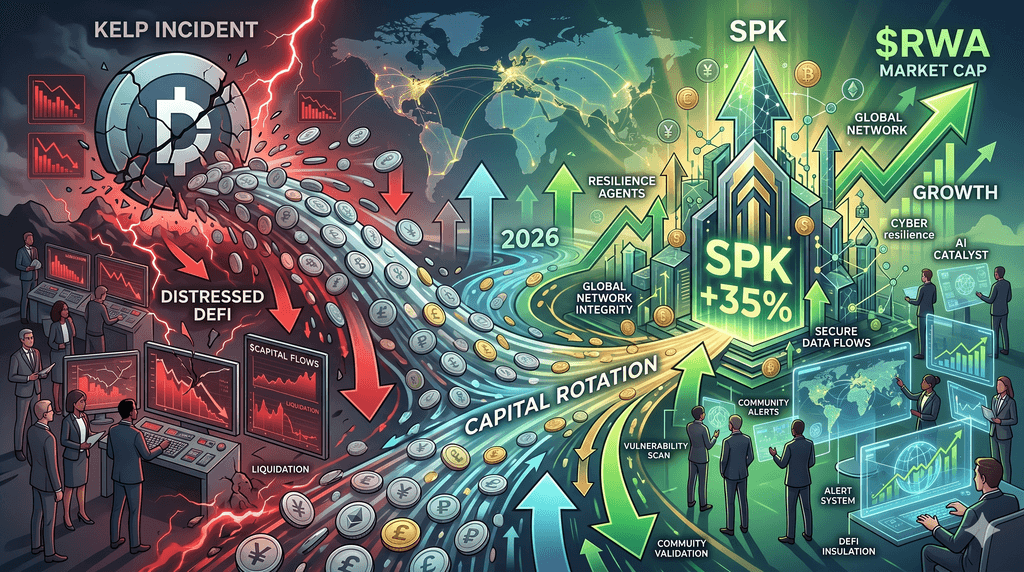
The recent Kelp DAO exploit has fundamentally shifted the DeFi ecosystem, sparking a 35% surge in the SPK token as capital rotates toward protocols with conservative risk frameworks. This migration highlights a new era of refugee trading, where security and battle-tested infrastructure dictate market value over pure yield, redefining how investors assess risk in a volatile digital economy.
Why Is the World Flocking to the SPK Token?
SPK is the native utility and governance token for Spark Protocol, a dominant decentralized finance (DeFi) engine within the Sky ecosystem (formerly MakerDAO). It functions as the primary mechanism for managing the protocol's lending and borrowing infrastructure, which currently oversees billions in liquidity. Holders of SPK exert direct influence over the platform’s risk parameters, such as determining which assets can be used as collateral and setting the savings rate for stablecoins like USDS. Unlike many speculative tokens, SPK is tied to a protocol that prioritizes real-world asset (RWA) integration and conservative lending, making it a cornerstone for institutional-grade DeFi.
Following the massive Kelp DAO bridge exploit in April 2026, SPK emerged as a primary beneficiary of refugee capital rotation. As investors fled high-risk restaking platforms, they moved over $1.2 billion into Spark’s battle-tested vaults, seeking safety and transparency. This surge in Total Value Locked (TVL) significantly increased the token's utility and market valuation, as SPK became a proxy for trust in an otherwise volatile space. Today, the token is viewed as a safety-first asset, representing the market's move toward protocols that favor infrastructure security and sustainable yields over experimental cross-chain complexity.
How $293 Million Vanished Without a Code Bug
The Kelp incident, which struck on April 18, 2026, was not a traditional smart contract hack but a surgical strike on the plumbing of the cross-chain world. Attackers linked to the Lazarus Group exploited a 1-of-1 verification setup on a LayerZero-based bridge by compromising off-chain RPC nodes and launching a simultaneous DDoS attack on external verifiers. This created an echo chamber where the bridge was tricked into believing $293 million worth of rsETH had been burned on one chain when no such transaction existed.
By feeding this falsified view of reality to the protocol, the hackers triggered the release of 116,500 rsETH on Ethereum out of thin air. This ghost collateral was then rapidly deposited into major lending markets to borrow real assets, leaving behind a massive trail of bad debt and causing a market-wide run as users scrambled for the exit. The event highlighted the terrifying fragility of single-point-of-failure infrastructure in an otherwise decentralized economy.
Why the Bridge Broke Without a Single Line of Bad Code
To understand why the Kelp incident sent shockwaves through the market, one must look at the mechanics of the failure, which was surprisingly not about faulty code. According to a post-incident analysis, the attackers targeted the off-chain infrastructure that tells the bridge when to release funds. The system relied on what is known as a Decentralized Verification Network (DVN) setup, but in this specific case, it was configured as a 1-of-1 setup. This meant there was a single point of failure. The hackers launched a dual-pronged attack, compromising internal nodes while simultaneously hitting external nodes with a Distributed Denial of Service (DDoS) attack to knock them offline.
This allowed the attackers to feed false data to the bridge, tricking it into believing that tokens had been burned on one side when they had not. The Ethereum contract, trusting this false confirmation, released the $293 million to an attacker-controlled address. This structural weakness is a haunting reminder that even the most secure smart contracts are only as strong as the data they receive from the outside world. By poisoning the plumbing of the network, the hackers bypassed the security checks that most users assumed were robust. This realization caused a massive re-evaluation of risk across the board, as investors realized that their funds were not just dependent on the protocol they deposited into but on every bridge and oracle connected to it.
Is the SPK Rally Sustainable or Just a Panic Pump?
The 35% surge in SPK's price has led many to wonder if this is the start of a long-term trend or just a panic pump that will soon deflate. While the initial move was certainly reactive, the underlying fundamentals of the Spark protocol have been significantly strengthened. With a higher TVL and a more diverse user base, the protocol is generating more revenue and has more sticky capital than ever before. However, the high volume-to-market cap ratio suggests that a lot of short-term speculative money is also in the mix.
If the market calms down and confidence returns to other platforms, we might see some of this capital rotate back out. Yet, the lessons learned from the Kelp incident are not easily forgotten. Many investors who moved to Spark did so because they realized they were overexposed to technical risks they didn't understand. A significant portion of this refugee capital will likely stay, especially as Spark continues to innovate in the real-world asset space. The sustainability of the rally will depend on whether the Spark team can continue to maintain their reputation for boring safety while integrated finance remains a chaotic and dangerous frontier. The current price action is a vote of confidence, but the real test will be how the protocol handles its newly acquired billions over the coming months.
The Secret Migration of Ten Billion in Frozen Assets
In the immediate aftermath of the Kelp exploit, fear turned into a frantic scramble for the exit. Large-scale investors, often called whales, didn't wait for official statements before they began pulling their assets out of integrated lending platforms. Data from reports suggest that over $10 billion in capital flowed out of major lending protocols like Aave as users feared that bad debt or contagion could freeze their ability to withdraw. This was not a move into cash, but rather a rotation into what the market perceived as safe havens. Many of these users were looking for a place where the risk of bridge exploits was minimized by more conservative, battle-tested designs.
This rotation was largely invisible to the casual observer at first, but the on-chain data told a story of a massive, synchronized movement of funds. People were seeking out protocols that were perceived as having boring but reliable risk parameters. The outflow from the restaking sector was particularly heavy, as the Kelp incident proved that the added layers of yield came with layers of hidden technical risk that many were no longer willing to bear. This flight to quality is a rare phenomenon in the digital asset space, where high yields usually attract the most attention, but in April 2026, the priority shifted entirely to principal protection.
Why Spark Became the New Bank of DeFi
As the dust settled on the Kelp disaster, one protocol stood out as the primary beneficiary of the chaos: Spark Protocol. Spark, which operates as a capital allocator for stablecoins and real-world assets, saw its Total Value Locked (TVL) skyrocket almost overnight. Investors viewed Spark as a fortress because of its direct integration with the Sky ecosystem and its conservative approach to collateral. While other platforms were scrambling to assess their exposure to the rsETH exploit, Spark remained stable, largely because it did not rely on the same fragile bridge configurations that had failed Kelp.
According to the analysis, Spark's TVL jumped from $3.8 billion to over $5 billion in a staggering display of capital rotation. It became the New Bank of DeFi because it offered a way for users to earn a respectable yield on stablecoins like USDS without the complexity of restaking layers. The protocol’s focus on transparency and its link to real-world assets provided a psychological cushion for investors who were shell-shocked by the bridge hack. This move was more than just a search for yield; it was an endorsement of a specific philosophy of risk management that prioritizes security over experimental cross-chain features. For many, Spark represented the adult in the room during a time of childishly dangerous experimentation.
How Refugee Trading Is Shaping the New 2026 Market
We are witnessing the birth of a new market phenomenon known as refugee trading. This refers to the large-scale movement of capital from exploited or high-risk protocols into those with a reputation for safety and reliability. In 2026, this has become the dominant strategy for preserving wealth in the digital asset space. Instead of chasing the latest 50% APR on a new bridge or restaking platform, sophisticated investors are now watching for cracks in the infrastructure and moving their funds proactively. This behavior creates rapid, extreme volatility for the tokens of both the failing and winning protocols. In the case of SPK, the token became a proxy for the entire market's desire for safety.
This strategy is driven by a deep understanding of on-chain data; traders are watching the flows in real time, waiting to see where the refugees land. When a major incident, such as the Kelp DAO hack, occurs, the first protocols to show a steady increase in TVL are the ones that traders buy into immediately. This turns capital rotation into a self-fulfilling prophecy, where the most trusted protocols get the most money, which in turn makes their tokens perform the best. This refugee mindset has replaced the degen mindset of previous years, marking a significant maturation of the investor base as they prioritize the safety of their underlying capital.
The Billion Dollar Inflow No One Saw Coming
While most analysts were focused on the falling prices of restaking tokens, few predicted the sheer scale of the inflow into Spark Protocol. In just a few days, the platform absorbed more than $1.2 billion in new deposits. This massive wave of liquidity changed the dynamics of the entire Spark ecosystem. It wasn't just a temporary spike; it was a structural shift as entire treasury management systems and high-net-worth individuals moved their operations to the platform. This inflow provided a massive moat for Spark, making it one of the most liquid and stable places to operate in the entire digital economy.
The speed of this movement caught many off guard, leading to a scramble among traders to buy the SPK token before the full extent of the TVL growth was widely recognized. This billion-dollar surge serves as a clear signal of where the market's trust currently resides. In a world where $300 million can disappear in an afternoon, the value of a platform that can safely hold a billion dollars of panicked money is immeasurable. This event has likely cemented Spark's position as a top-tier protocol for years to come, turning a moment of industry-wide crisis into a defining moment of growth for a single player.
FAQs
Why did the SPK token price jump by 35%?
The SPK token surged because investors fleeing the Kelp DAO incident moved billions of dollars into Spark Protocol, which they perceived as a safer haven. This massive capital rotation increased the protocol's utility and total value locked (TVL), driving up demand for the SPK governance token.
Is my money safe in a lending protocol like Spark?
While Spark is perceived as a safer alternative due to its conservative risk parameters and link to real-world assets, no protocol is 100% risk-free. The recent exploit shows that even the best systems can have hidden infrastructure risks, so always diversify your holdings.
What happened to Kelp DAO in April 2026?
Kelp DAO suffered a massive $293 million exploit when attackers targeted a LayerZero bridge adapter. The hackers used a sophisticated attack on off-chain RPC nodes to forge cross-chain messages, tricking the system into releasing funds without a corresponding burn of tokens.
What is refugee trading in the context of this event?
Refugee trading is a strategy where investors move their capital from high-risk or exploited protocols into more established, secure platforms during times of market crisis. This creates rapid capital rotation and can cause significant price surges in the winning tokens, like SPK.
How did the hackers bypass the bridge's security?
The hackers did not find a bug in the code; instead, they targeted the verification network (DVN) that the bridge used to read data from other chains. By knocking some nodes offline and compromising others, they were able to feed the bridge false information about asset movements.
Should I expect the SPK token rally to continue?
The sustainability of the rally depends on whether Spark can retain the $1.2 billion in new capital it absorbed. While the fundamentals are currently very strong, the high trading volume suggests significant short-term speculation, which could lead to volatility in the coming weeks.
Disclaimer: This content is for informational purposes only and does not constitute investment advice. Cryptocurrency investments carry risk. Please do your own research (DYOR).