

Ray Dalio’s AI Bubble Warning Explained: How Market Bubbles Form, Burst, and What Investors Should Do
2026/08/03 17:12:00
Introduction
Legendary investor Ray Dalio, founder of Bridgewater Associates, recently confirmed classic bubble signs in the AI market during a July 30, 2026 interview on The Diary of a CEO podcast. He agreed with warnings from figures like Jeremy Grantham that the current AI boom shows patterns seen before major collapses, including 1929 and the 2000 dot-com era.
AI technology itself remains transformative and worth excitement, yet prices have detached from fundamentals as investors pile in with leverage and ignore valuations. This article breaks down how such bubbles form, the mechanics of their burst, historical parallels, current indicators, and practical steps investors can take to protect capital while still participating in the innovation wave.
What Did Ray Dalio Actually Say About the AI Bubble?
Ray Dalio stated that Jeremy Grantham is right about the presence of bubble conditions in AI. He emphasized explaining cause-and-effect relationships rather than simply predicting a crash. A bubble occurs when prices rise sharply, companies report strong results, excitement spreads widely, and then the structure collapses with broad economic effects.
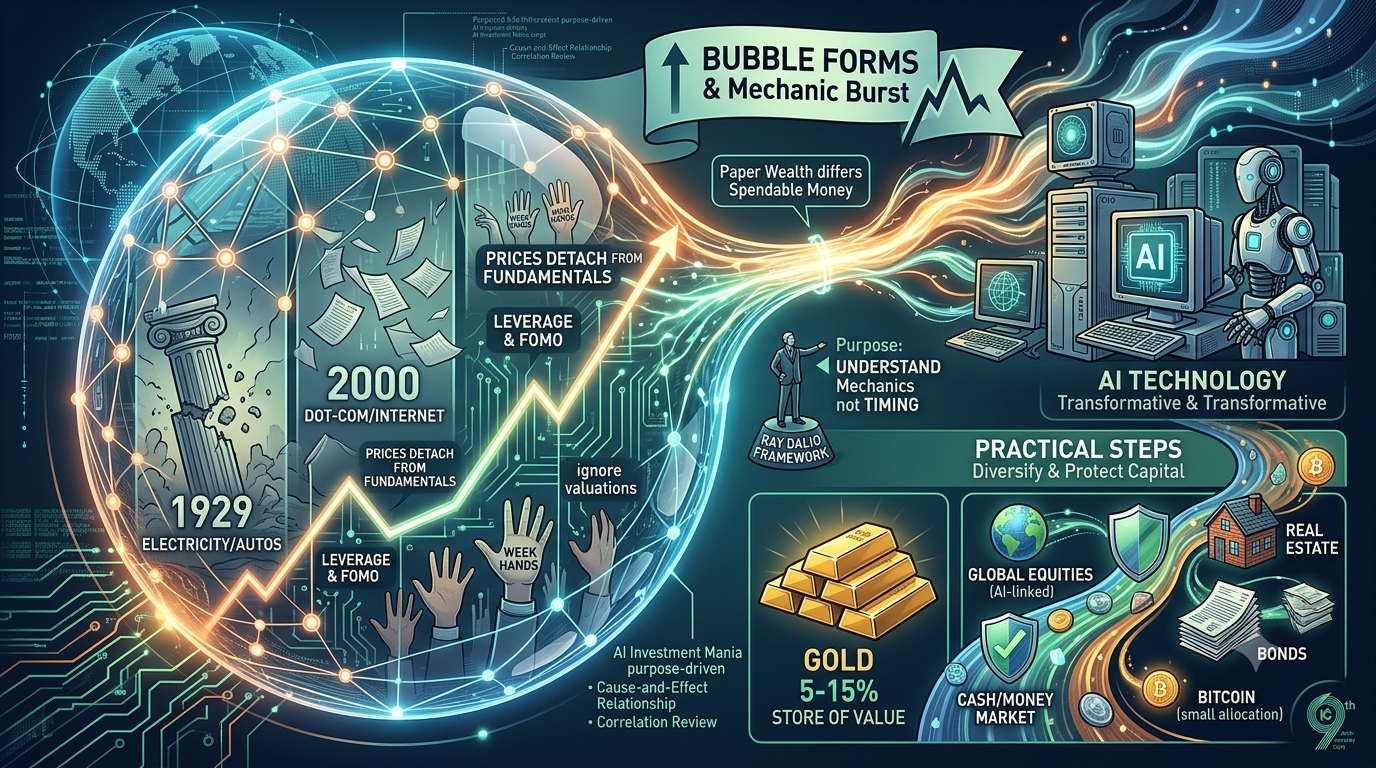
Dalio highlighted that every major technological revolution—electricity, automobiles, radio, and the internet—produces similar dynamics. People recognize the long-term potential, rush to invest, often with borrowed money, and lose focus on the price they pay. Wealth on paper grows, yet that wealth differs from spendable money. When holders need cash for debt service, taxes, or other reasons, selling begins and the process reverses.
In the interview, he stressed that AI will drive revolutionary change, but the investment mania surrounding it follows the same historical script. Bridgewater’s track record, including positive returns during the 2008 crisis while markets fell sharply, gives weight to his framework of understanding mechanics over timing exact peaks.
How Do Investment Bubbles Form According to Ray Dalio?
Bubbles form when a powerful new technology arrives, generates genuine excitement, and attracts capital that ignores valuation discipline. Investors project future success onto current prices, borrow to amplify positions, and create a self-reinforcing rise in asset values and collateral.
New technologies appear miraculous. In the late 1920s, electricity, cars, airplanes, and radio transformed daily life. In 2000, the internet promised similar transformation. Today, AI delivers comparable promise. People correctly anticipate long-term benefits yet bid prices higher without sufficient regard for earnings delivery timelines.
Leverage accelerates the process. Rising prices increase collateral value, allowing more borrowing, which fuels further buying. Paper wealth expands rapidly. Companies raise capital easily because demand for their shares is strong. Retail and less sophisticated investors—often called “weak hands”—enter late, frequently using leverage or leveraged products.
Supply of shares also expands. Firms issue stock to fund growth or simply because the market will absorb it. The combination of rising demand driven by FOMO and increasing supply sets the stage for vulnerability. Concentration grows: according to recent analyses in mid-2026, the top 10 stocks, many AI-linked, have accounted for roughly 40% or more of the S&P 500’s market capitalization, exceeding levels seen at the dot-com peak.
Dalio notes that bubbles are matters of degree, not binary states. Classic signs include high valuations relative to fundamentals, widespread participation by less experienced investors, and heavy use of leverage.
What Causes a Bubble to Burst?
A bubble bursts when the need to convert paper wealth into actual money collides with falling prices and rising debt obligations. The same leverage that amplified gains on the way up accelerates losses on the way down.
Wealth is not money. An investor may feel rich from rising share prices but can only spend cash. Triggers such as higher interest rates, tax changes, or external shocks force selling. As prices drop, collateral values shrink. Borrowers face margin calls or must repay loans, prompting more sales. Demand falls as people who lost money cut spending, which reduces others’ incomes in a feedback loop.
Dalio illustrated the mechanics with a simple example. Suppose an investor buys AI-related shares at $100 and borrows $50 against them. A shock drives the price to $25. The loan remains $50, creating a shortfall that forces further liquidation. Selling pressure spreads, asset prices decline more broadly, and economic activity slows.
On the supply side, the earlier wave of share issuance meets reduced demand. Companies that raised capital at high valuations may struggle if growth fails to match expectations. Historical precedents show that the underlying technology often continues to improve after the bubble deflates—the internet after 2000, electricity after 1929—yet investors who paid peak prices suffer lasting losses.
How Does the Current AI Boom Compare to Past Bubbles?
The current AI boom mirrors past technology-driven bubbles in enthusiasm, concentration, and leverage patterns while differing in the strength of underlying earnings at leading companies.
In 1929, transformative technologies created widespread optimism that ended in the Great Depression after leverage and valuation excesses reversed. The 2000 dot-com bubble featured companies with little revenue trading at extreme multiples; many failed, yet survivors built lasting value.
Today’s AI environment shows similar public excitement and capital inflows. AI-related stocks have driven a large share of market gains. Concentration has reached elevated levels, with AI-linked names representing a substantial portion of major indices according to 2026 market analyses. Some valuations, measured by price-to-sales or forward earnings multiples, remain elevated relative to historical norms, though leading firms such as Nvidia have seen trailing P/E ratios compress into the 30s range by mid-2026 as earnings grew.
Key differences exist. Many current AI leaders generate substantial profits and cash flow, unlike numerous dot-com names. Capital spending on AI infrastructure continues at high levels, supporting near-term demand for chips, data centers, and related services. Still, Dalio’s framework focuses less on whether the technology succeeds and more on whether prices have outrun the ability of profits to justify them when financing conditions tighten.
His bubble indicators have previously flagged levels approaching those of 1929 and 2000. The risk is not that AI fails, but that the financial structure around it becomes fragile.
What Are the Key Risks for Investors in an AI Bubble Environment?
The primary risks include sharp price declines when leverage unwinds, reduced economic spending from wealth effects, and opportunity costs from over-concentration in one theme.
Leverage amplifies losses. Investors using borrowed funds or leveraged products face forced selling that can drive prices well below fundamental values temporarily. Concentration risk is elevated: heavy index weighting in a handful of AI-related names means broad market declines if those leaders correct.
Secondary effects matter. Falling asset values reduce household and corporate spending, slowing growth. Job disruption from AI and robotics may widen inequality, as capital owners benefit while some labor categories face displacement—another point Dalio raised. Geopolitical tensions, higher rates, or policy shifts can serve as the catalyst that converts paper wealth into forced sales.
Not every AI company will survive or deliver expected returns. Capital will flow to winners, but timing and selection remain difficult. Holding cash as a perceived safe haven carries its own risk: inflation of 3.5–4% erodes purchasing power, and interest is often taxed.
What Should Investors Do to Prepare According to Dalio’s Framework?
Investors should prioritize diversification across uncorrelated assets rather than attempting to time the exact peak or exit entirely.
Dalio stresses that the future is inherently uncertain even for sophisticated participants. The practical response is balanced exposure. He lists major asset classes that respond to different drivers: stocks, cash or money-market instruments, gold, bonds, real estate, and a small allocation to Bitcoin.
Cash provides liquidity but delivers the lowest long-term real returns after inflation and taxes. Gold functions as a diversifier and store of value that historically performs well when traditional financial assets struggle; Dalio has recommended 5–15% in hard assets that cannot be printed and personally prefers gold over Bitcoin for that role. Bitcoin appears in his portfolio at a modest level (around 1%), yet he notes technological and regulatory risks that limit its suitability as a central bank reserve asset.
Real estate can offer forced savings and tax advantages for some. Bonds provide income and ballast in certain rate environments. Equity exposure, including selective AI-related holdings, remains appropriate because the technology will create winners, but position sizing and diversification reduce the impact of any single sector correction.
Avoid excessive leverage. Maintain emergency reserves measured in months of living expenses. Review portfolio correlations regularly. The goal is not to avoid AI entirely—Dalio’s own firm has held significant AI-related positions—but to ensure that a potential unwind does not impair overall financial resilience.
Should You Invest or Trade AI-Related Opportunities on KuCoin?
KuCoin provides access to a wide range of crypto assets, AI-themed tokens, and trading tools that allow investors to express views on the broader technology cycle with flexibility and risk controls. Spot trading, futures with adjustable leverage, and copy-trading features enable both long-term holders and active traders to participate while managing exposure.
Users can diversify across established cryptocurrencies, emerging AI and compute-related projects, and stablecoin pairs for liquidity management. Advanced order types, portfolio tracking, and educational resources support disciplined approaches aligned with principles of diversification and position sizing. Registration on KuCoin opens these markets with competitive fees and a user-friendly interface suitable for navigating periods of high volatility. Whether building a core holding or hedging traditional equity exposure, the platform offers practical instruments to implement balanced strategies during technology-driven market phases.
Join KuCoin 9th Anniversary Trading Campaign
Now you can trade such semiconductor assets on KuCoin, including AI-related stocks like Microsoft, SK Hynix, MU, SNDK, and others.
KuCoin is celebrating its 9th anniversary with a special platform campaign filled with exclusive rewards, trading activities, and limited-time offers. Don’t miss the chance to participate and enjoy the benefits as the exchange marks nine years of growth and innovation. Visit the official campaign page now:

Conclusion
Ray Dalio’s recent comments confirm that the AI investment boom displays classic bubble characteristics: rapid price appreciation, widespread enthusiasm, leverage, and growing concentration. The technology itself is revolutionary and will likely deliver lasting productivity gains, just as electricity and the internet did after their own speculative episodes. Bubbles form when prices detach from the timeline of fundamental delivery and reverse when the need for cash collides with falling collateral values.
Investors cannot reliably time the exact moment of any correction. The practical response centers on diversification across assets that behave differently under stress, limited use of leverage, adequate liquidity reserves, and realistic expectations for returns in a high-valuation environment. Gold and other hard assets can serve as portfolio stabilizers, while selective equity and crypto exposure preserves participation in genuine innovation.
Understanding the mechanical process—rather than reacting to headlines—equips market participants to protect capital and remain positioned for the opportunities that survive any excess. History shows that transformative technologies endure; the investors who thrive are those who respect the difference between wealth on paper and durable purchasing power.
FAQs
Is Ray Dalio predicting an immediate AI market crash?
No. He describes classic bubble signs and mechanics without assigning a precise date, focusing instead on cause-and-effect relationships that have repeated across history.
Should investors sell all AI-related holdings because of the warning?
Dalio has advised against selling solely because a bubble exists. Diversification and position sizing matter more than complete exit.
How much of a portfolio does Dalio suggest allocating to gold?
He has recommended roughly 5–15% in hard assets that cannot be printed, with a personal preference for gold in that role.