

MetaMask Agent Wallet Launches: Self-Custodial AI Agents for Automated Onchain Trading
2026/08/07 16:06:00
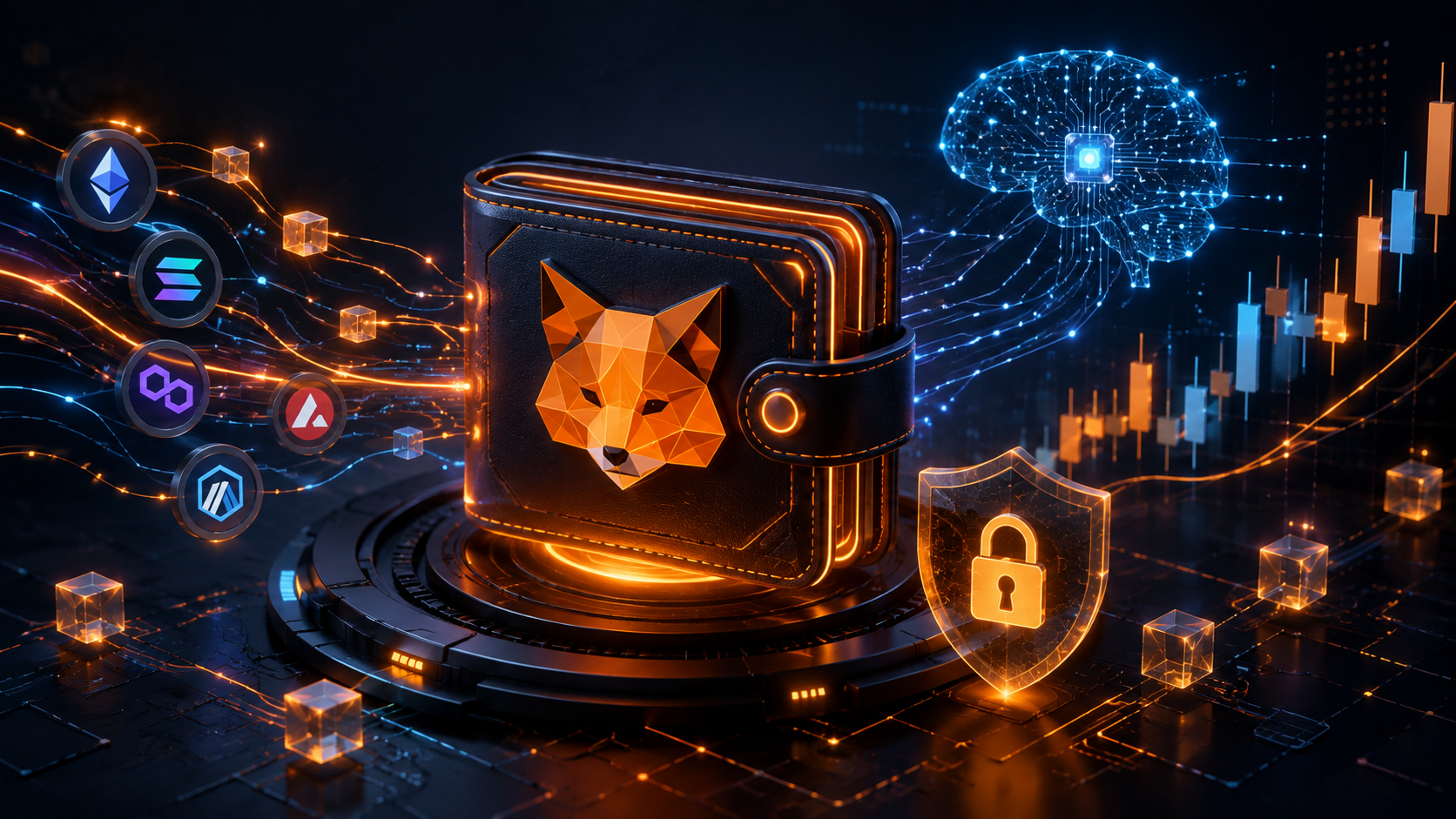
Artificial intelligence has already changed how crypto traders research markets. AI tools can scan hundreds of tokens, summarize governance proposals, analyze sentiment, monitor funding rates, and identify potential trading opportunities in seconds. But there has always been a major gap between finding a trade and actually executing it. In most cases, the human still has to open a wallet, review the transaction, sign it, and manage the risks manually.
MetaMask is now trying to close that gap. On August 6, 2026, MetaMask announced that its Agent Wallet was live, expanding on an early-access rollout that began in June. The self-custodial wallet is designed specifically for AI agents, allowing them to monitor markets, prepare transactions, and execute onchain strategies while operating inside limits set by the user. The development could represent an important shift in crypto automation: AI is moving beyond the research layer and into the execution layer, while users retain control over their keys and define how much authority the agent receives.
What Is MetaMask Agent Wallet?
MetaMask Agent Wallet is a self-custodial wallet infrastructure designed to let AI agents interact directly with crypto markets. Rather than building another chatbot that tells traders what token to buy, MetaMask is giving AI systems a controlled way to execute blockchain transactions themselves. Users can connect supported agent frameworks, fund the wallet, establish trading rules, and then allow an agent to operate inside those boundaries.
The wallet currently supports agent environments including Claude Code, Codex, Cursor, OpenClaw, Hermes, and OpenCode. Agents can interact with Hyperliquid and supported EVM networks, including networks such as Robinhood and Monad. MetaMask says Agent Wallet can support workflows involving swaps, perpetual futures, prediction markets, liquidity provision, and other DeFi activity.
The key distinction is that the agent does not simply inherit unlimited control over the user's assets. Traders can specify spending limits, approve particular protocols, choose a risk profile, and determine how aggressively transactions should be allowed to execute. This turns the wallet into a policy layer between the AI model and the blockchain.
That difference matters. A traditional MetaMask transaction usually begins with a human decision and ends with a human signature. With Agent Wallet, the human can instead define an objective and a set of restrictions before allowing software to monitor conditions and act. The wallet therefore becomes less of a passive storage interface and more of an execution environment for autonomous financial software.
How Automated Onchain Trading Actually Works
The easiest way to understand Agent Wallet is to imagine a trader asking an AI agent to monitor ETH perpetual futures and enter a position only when a particular combination of funding rates, momentum, and liquidity conditions appears. The agent can continuously analyze the market instead of waiting for the trader to return to a screen.
Once its conditions are satisfied, the agent can prepare the required blockchain transaction. MetaMask then checks that action against the user's wallet-level policies. If the transaction stays within the permitted spending amount, protocol access, and risk settings, it can proceed through the wallet's security pipeline before execution. If the action is suspicious or falls outside the configured policy, human approval can be required instead.
The important point is that different parts of the process remain separated. The AI handles reasoning and strategy execution, while MetaMask controls financial authority. The blockchain remains the settlement layer. In practical terms, this creates a workflow that looks more like user objective → AI decision → wallet policy check → security screening → onchain execution.
MetaMask is also introducing execution features aimed specifically at autonomous agents. Agent Wallet can prepare one-shot trades and support ERC-7821 batch swaps, while gas abstraction can allow agents to transfer or swap supported assets without first holding the network's native token solely to pay gas. MetaMask instead settles eligible network fees using the asset being moved. That removes one of the small but persistent operational problems that can interrupt automated multi-chain strategies.
Why Self-Custody Matters
Automated crypto trading is not new. Traders have used exchange APIs, algorithmic bots, copy-trading systems, and automated DeFi strategies for years. The difficult part has always been determining how much control a piece of software should receive over real assets.
On centralized exchanges, automation commonly relies on API credentials and assets held by the platform. Onchain bots can operate differently, but giving a program unrestricted access to a private key creates an obvious security problem. If the software is compromised, misconfigured, manipulated, or simply makes a serious mistake, a wallet could potentially lose everything accessible to that key.
MetaMask is attempting to solve this by separating decision-making authority from ownership. Agent Wallet remains self-custodial, meaning users control their keys and can export their Secret Recovery Phrase. The agent receives permission to act under specific rules rather than becoming the owner of the wallet.
This may ultimately be more important than improving the intelligence of the trading model itself. The long-term challenge in agentic finance may not be building an AI that can discover more profitable trades. It may be designing financial infrastructure that lets an AI act without giving it more power than necessary. In that sense, the future of AI trading could depend as much on permission architecture as on machine intelligence.
Guard Mode vs Beast Mode
MetaMask packages this balance between automation and control into two operating choices: Guard Mode and Beast Mode. Both allow AI agents to transact, but they differ in how much freedom the user gives the agent during execution.
| Feature | Guard Mode | Beast Mode |
| Best suited for | Users prioritizing control | Advanced, automation-focused users |
| Spending policies | Strictly enforced | More flexible |
| Protocol access | Allowlisted protocols | Broader operating freedom |
| Human intervention | More likely outside policy | Fewer interruptions |
| Security screening | Active | Active |
| Flagged transactions | Can require 2FA | Can still require 2FA |
| Main objective | Controlled automation | Faster autonomous execution |
Guard Mode is the default. A trader can establish daily spending limits, define which protocols the agent is allowed to access, and require approval when a transaction falls outside those rules. This structure is likely to make more sense for users experimenting with autonomous trading for the first time.
Beast Mode reduces some of those approval interruptions for traders willing to delegate greater authority. It does not, however, mean that MetaMask simply disables security. MetaMask says security checks continue to operate, and malicious or flagged transactions can still trigger two-factor authentication. Users can then review the action through MetaMask Mobile or an email approval flow.
The distinction highlights one of the most important questions surrounding AI finance. The debate is no longer simply whether a human or machine should make a trading decision. It is increasingly about how much financial authority humans should delegate to machines after that decision has been made.
Why Crypto Traders May Actually Use It
Crypto is unusually suited to autonomous trading because the market never closes. Bitcoin, perpetual futures, DeFi protocols, prediction markets, and decentralized exchanges remain active around the clock. A trader may sleep for eight hours while funding rates change, liquidity shifts across pools, volatility suddenly expands, and a previously attractive yield opportunity disappears.
AI agents can remain active through all of those changes. More importantly, they can potentially monitor several different markets at once. Instead of asking a trader to manually check ten dashboards, compare multiple networks, open several decentralized applications, and then execute each transaction separately, an agent can translate a higher-level financial objective into a sequence of actions.
Potential uses could include:
-
monitoring perpetual funding rates and entering trades when predefined conditions appear;
-
rotating liquidity between DeFi opportunities within a fixed risk budget;
-
executing token swaps after price, liquidity, or volatility thresholds are reached;
-
managing prediction-market positions as new information changes probabilities;
-
rebalancing a portfolio across supported networks without requiring constant manual interaction.
The key advantage may therefore be execution efficiency rather than superior prediction. AI does not need to forecast Bitcoin perfectly to become useful. Even if humans continue designing the strategy, an autonomous system can reduce the time between identifying an opportunity and acting on it. In highly fragmented onchain markets, that reduction in operational friction can be valuable by itself.
Security Is the Real Test
Giving an AI access to a real wallet also creates a new security surface. An agent may be able to reason about a transaction, but it can still interpret information incorrectly, interact with malicious content, select the wrong token address, misunderstand a user's instruction, or execute a strategy under conditions that have already changed.
From Prompt Injection to Bad Contracts
Prompt injection is particularly important for financial agents. An AI model may consume information from websites, APIs, token metadata, social feeds, or decentralized applications. If hostile information can manipulate the model's reasoning, an attacker may attempt to influence the actions the agent prepares.
Smart-contract risk creates another problem. An AI could correctly understand what a trader wants and still interact with a compromised or malicious contract. Model hallucinations add an additional layer of uncertainty because errors that are relatively harmless in a normal chatbot can become financially significant when the model is capable of moving assets.
MetaMask's answer is to enforce safeguards at the wallet rather than expecting the AI to be perfectly reliable. Supported EVM transactions can pass through transaction simulation, threat scanning powered by Blockaid, and MetaMask's MEV-protection infrastructure before being finalized. Eligible transactions that pass security checks may also qualify for MetaMask Transaction Protection coverage of up to $10,000 per month under applicable conditions.
Those systems can reduce certain security risks, but they cannot eliminate financial risk. An AI can execute a legitimate transaction securely and still lose money because the trading strategy was wrong. It can interact with a legitimate protocol that later suffers an exploit. A user can also configure permissions too broadly. For that reason, Agent Wallet should be viewed as infrastructure for controlled automation—not as a guarantee that autonomous trading will be safe or profitable.
AI Agents Could Change DeFi Trading
MetaMask Agent Wallet becomes more interesting when viewed as part of a broader transformation in how users interact with DeFi. Today, users typically navigate individual interfaces: they open one application to swap, another to trade perpetuals, another to provide liquidity, and another to monitor a portfolio. The wallet sits between those applications and signs transactions.
An agent-oriented model reverses that structure. Instead of selecting a protocol first, a user may begin with an objective such as, “Keep my stablecoin portfolio in the best risk-adjusted yield opportunities within these protocols and never allocate more than 20% to one pool.” The agent can then decide which applications to interact with, while wallet policies determine what it is actually allowed to execute.
Protocols Could Start Competing for AI Order Flow
If that model becomes widespread, DeFi protocols may eventually compete not only for human users but for agent-generated order flow. Protocols with predictable execution, machine-readable data, reliable APIs, strong liquidity, transparent risk information, and agent-friendly permissions could have an advantage when autonomous systems choose where to route transactions.
This could also change the role of wallets themselves. A wallet would no longer function primarily as the interface where users check balances and click “confirm.” It could become the permission and security layer connecting human financial intentions, AI reasoning systems, and decentralized protocols.
The long-term implication is a move from manually operated DeFi toward agentic DeFi, where humans define goals and constraints while software manages a growing portion of the execution process. That does not require eliminating humans from the market. It simply moves human decision-making to a higher level.
MetaMask Is Not Alone in the AI Wallet Race
MetaMask is entering an increasingly competitive category. Coinbase introduced Agentic Wallets in February 2026, describing infrastructure that enables AI agents to hold, spend, trade, and earn assets while operating with security guardrails. Coinbase has also integrated the x402 payment protocol, reflecting a broader vision in which autonomous software may eventually pay other machines and online services without human intervention.
MoonPay launched MoonPay Agents later in February as a non-custodial software layer that allows AI systems to access wallets and execute crypto transactions. It followed with a desktop application in June and brought MoonAgents to Telegram in July, expanding natural-language crypto execution beyond developer terminals.
These products differ in architecture and target users, but they point toward the same larger competition: who will control the wallet and transaction layer for AI agents? The winner may not simply be the company with the best consumer wallet interface. It may be the infrastructure that agents can use most safely and reliably when managing real economic activity.
That could eventually change the entry point to crypto itself. Instead of opening an exchange, navigating a DEX, or choosing a wallet function, a trader may begin with a natural-language command. The AI determines the workflow, while the wallet quietly determines what the AI is permitted to do.
What MetaMask Agent Wallet Means for Crypto
The most significant part of MetaMask Agent Wallet is not another wallet feature. It is the movement of artificial intelligence from the analysis layer toward the execution layer of crypto.
For several years, AI tools have answered questions such as “Which token has the strongest momentum?”, “What does this governance proposal mean?”, or “How has Bitcoin reacted to similar macro conditions?” Agentic wallets introduce a more consequential question: Can the AI take action after producing the answer?
MetaMask's approach suggests that the industry is moving toward bounded autonomy. Users do not necessarily need to choose between total manual control and unrestricted AI access. They can instead delegate specific actions under predefined financial policies. If this model proves reliable, self-custody and automation may no longer be opposing concepts.
The broader result could be a machine-to-protocol economy in which AI agents routinely allocate capital, trade assets, purchase services, rebalance portfolios, and interact with decentralized applications. Human traders would still define goals, capital limits, and acceptable risk, but they may spend less time clicking through individual transactions. MetaMask Agent Wallet is therefore less about replacing traders than about changing which parts of trading still need to be performed manually.
|
KuCoin is celebrating its 9th anniversary with a special platform campaign filled with exclusive rewards, trading activities, and limited-time offers. Don’t miss the chance to participate and enjoy the benefits as the exchange marks nine years of growth and innovation. Visit the official campaign page now:
|
Conclusion
MetaMask Agent Wallet arrives at an important stage in the convergence of AI and crypto. AI systems are becoming capable of doing more than generating research or trading signals; they are beginning to interact directly with financial infrastructure. MetaMask's model attempts to make that transition without forcing users to surrender self-custody, combining autonomous execution with spending limits, protocol permissions, transaction screening, and optional human approval.
Whether autonomous wallets achieve mainstream adoption will depend heavily on security. Better AI reasoning alone will not be enough. Users need reliable permission systems, safe transaction execution, strong protection against malicious contracts, and clear ways to limit the financial consequences of an AI mistake.
Still, the direction is increasingly clear. The next phase of crypto automation may not be about finding a smarter trading bot. It may be about building a safer wallet that finally allows the bot to act. If that architecture works at scale, the wallet of the future could become less of a place where users manually manage crypto and more of an operating system for AI-driven onchain finance.
FAQs
Can MetaMask Agent Wallet trade Bitcoin?
MetaMask Agent Wallet is primarily focused on Hyperliquid and supported EVM-based onchain environments at launch. Native Bitcoin operates on a different blockchain architecture, so users should not assume that every BTC transaction can be automated in the same way as EVM assets. Bitcoin-linked or wrapped assets available within supported DeFi environments may offer different possibilities, depending on the network and protocol.
Does using an AI agent guarantee better trading returns?
No. Automation can improve monitoring speed and execution efficiency, but it cannot eliminate market risk or guarantee profitable decisions. An agent may follow the user's instructions correctly and still enter a losing position because prices move unexpectedly. Security controls protect the transaction process; they do not turn a trading strategy into a profitable one.
Do AI agents still need gas to make blockchain transactions?
Blockchain transactions still incur network costs, but MetaMask is attempting to simplify how those fees are paid. For supported transfers and swaps, Agent Wallet can use gas abstraction so the agent does not always need to maintain a separate balance of the blockchain's native gas token. MetaMask can settle the network fee using the asset being transferred.
Is Agent Wallet suitable for crypto beginners?
The technology could eventually make DeFi easier to use because users may express objectives in natural language instead of manually navigating protocols. However, autonomous trading introduces additional risks involving permissions, smart contracts, strategy configuration, and AI behavior. Beginners should understand those risks before delegating meaningful amounts of capital to an agent.
Will AI agents replace traditional crypto trading bots?
Traditional bots generally follow explicitly programmed rules, while AI agents can interpret broader objectives, gather information, use multiple tools, and adapt the sequence of actions they take. The two models are therefore likely to coexist. Rule-based bots may remain preferable for highly deterministic strategies, while agents could become more useful for complex workflows that involve several protocols, data sources, and decisions.
Disclaimer: This content is for informational purposes only and does not constitute investment advice. Cryptocurrency investments carry risk. Please do your own research (DYOR).