

EBA Unveils Strict Crypto Penalty Rules Ahead of MiCA July 1 Deadline — What It Means for Binance and Compliant Exchanges Like KuCoin
2026/06/29 14:26:00
Introduction
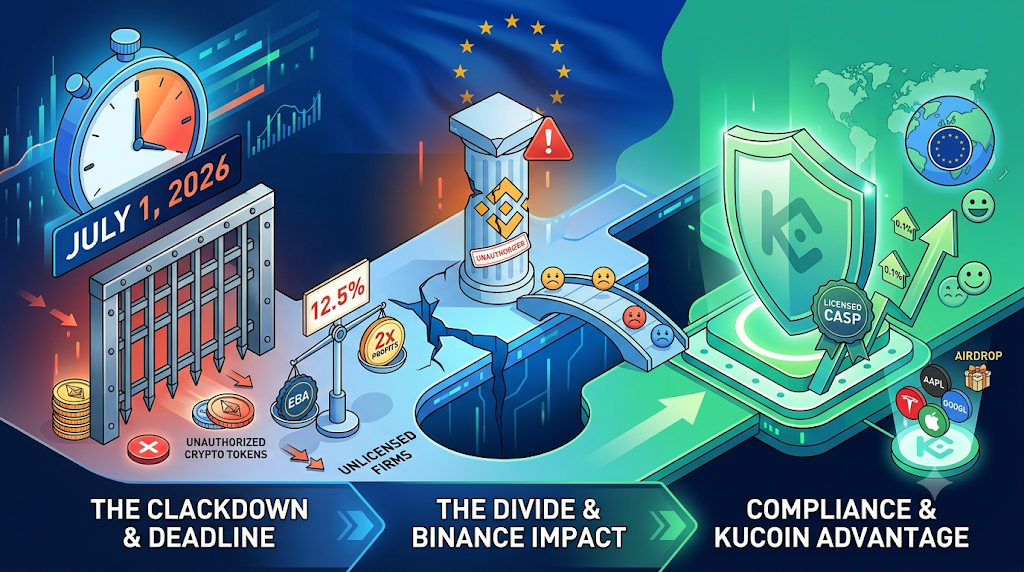
The European Banking Authority (EBA) published a landmark consultation paper on June 26, 2026, establishing a standardized methodology for imposing multi-million-euro fines on crypto firms that violate the EU's Markets in Crypto-Assets Regulation (MiCA). With the July 1, 2026 full enforcement deadline just days away, the new penalty framework signals that Europe's crypto crackdown will carry real financial teeth — and the industry's largest players are already feeling the pressure.
What Did the EBA's New Penalty Framework Establish?
The EBA's 14-page consultation introduces a strict two-step methodology for calculating fines against issuers of "significant" tokens — specifically asset-referenced tokens (ARTs) and e-money tokens (EMTs) classified as significant under MiCA.
The penalty structure is designed to be genuinely punitive. Under the proposed framework, the EBA will first assess the base severity of a violation, then apply aggravating or mitigating factors to reach a final amount. The fines can reach the statutory maximum of 12.5% of annual turnover for ART issuers and 10% for EMT issuers. Alternatively, penalties may equal up to twice the illicit profits gained from the infringement — whichever produces the higher figure.
This approach targets even the largest global operators. For a major stablecoin issuer generating €500 million in annual revenue, a maximum fine could reach €62.5 million. The double-profits provision ensures firms cannot treat penalties as a cost of doing business.
The EBA will accept public comments on the consultation until September 28, 2026, with a virtual hearing scheduled for July 16, 2026. However, the timing — released just five days before MiCA's full enforcement deadline — makes clear that regulators intend to move quickly from supervision to punishment.
Why Is the July 1, 2026 MiCA Deadline So Critical?
July 1, 2026 marks the end of all transitional grace periods for crypto asset service providers (CASPs) operating in the EU. After this date, any exchange, custodian, or crypto service firm serving EU customers without a valid MiCA license will be operating illegally.
The scale of potential disruption is substantial. According to ESMA data, approximately 1,200 crypto firms were registered under pre-MiCA national rules across the EU. Of these, only around 200 — roughly 17% — have successfully obtained full MiCA authorization. That leaves an estimated 7.6 million EU crypto users currently on platforms that lack proper licensing.
National regulators have made clear there will be no extensions. ESMA explicitly warned that CASPs operating without authorization must implement orderly wind-down plans to minimize client harm. Last-minute license applications are subject to heightened scrutiny, and firms continuing to operate without approval after their transitional period ends face enforcement action.
The transitional timeline varies by member state. France, Malta, Luxembourg, and Estonia adopted the full 18-month grandfathering period ending July 1, 2026. Other countries implemented shorter windows — the Netherlands and Poland required applications by mid-2025, while Germany, Austria, and Ireland used 12-month periods ending in late 2025. Regardless of which national timeline applied, the result is the same: after July 1, 2026, unlicensed CASPs must cease EU operations entirely.
How Will Binance Be Affected by the MiCA Deadline?
Binance will not hold a MiCA license by the July 1 deadline, and the impact on its EU operations is already visible.
Binance has formally notified customers in France, Italy, Poland, and Spain that it will restrict services starting July 1, 2026. The exchange has also halted new registrations across the bloc. While not technically "banned," the practical effect for EU users is a significant curtailment of access.
Binance's regulatory troubles in Europe trace back several years. The exchange exited the Netherlands in 2023 after failing to register and receiving a €3.3 million fine from the Dutch central bank. In 2023, former CEO Changpeng Zhao resigned and pleaded guilty to US criminal charges of failure to maintain effective anti-money laundering controls, with Binance paying over $4.3 billion in penalties. French prosecutors opened a judicial probe into allegations of money laundering and tax fraud in 2025.
For its MiCA application, Binance initially submitted through Greece but withdrew that application in 2026. The exchange now plans to seek authorization through France, though no timeline has been confirmed. Regulatory sources indicate that concerns over senior executive backgrounds, the exchange's AML record, and the complex international structure — including Zhao's continued role as ultimate beneficial owner — have created significant obstacles to approval.
The immediate consequence is clear: millions of Binance users across the EU need to find alternative platforms before July 1 or risk service disruptions, limited customer protections, and potential account restrictions.
Which Crypto Exchanges Are Already MiCA Compliant?
While Binance scrambles to secure authorization, a growing roster of major exchanges has already cleared MiCA's high bar. Licensed operators include Kraken, Coinbase, OKX, Crypto.com, Bitstamp, Bitpanda, and Bybit — each authorized through a specific EU member state.
KuCoin stands among these compliant operators. The exchange secured its MiCA license from Austria's Financial Market Authority (FMA) on November 27, 2025, with KuCoin EU Exchange GmbH approved as a fully authorized crypto-asset service provider. KuCoin now holds a MiCA license in Europe, enabling it to legally serve customers across the EU under the bloc's unified regulatory framework.
KuCoin's European positioning reflects a broader strategic pivot toward compliance. The exchange has also secured AUSTRAC registration in Australia with a dedicated Sydney office, licensing from the Thai SEC for KuCoin Thailand, and submitted applications to Turkey's Capital Markets Board. On the security front, KuCoin holds SOC 2 Type II and ISO 27001:2022 certifications, maintains an AAA rating from CER.live, and has published over 39 consecutive months of independently audited Proof of Reserves reports.
The competitive implications are significant. MiCA's single-license approach allows authorized exchanges to passport services across all 27 member states without pursuing separate approvals in each jurisdiction. For EU users displaced by Binance's restrictions, licensed alternatives like KuCoin offer immediate regulatory certainty with maximum trading fees of 0.1% — well below the 0.99% to 2.49% charged by established EU brokers like Bitpanda.
What Do the New EBA Penalty Rules Mean for the Crypto Industry?
The EBA's penalty framework represents the final piece of MiCA's enforcement architecture, and it sends an unambiguous message: regulatory compliance is not optional, and violations will carry severe financial consequences.
The two-step methodology — base severity assessment followed by aggravating factors — provides transparency while maintaining flexibility for regulators to impose proportionate penalties. Factors likely to increase fines include repeated violations, failure to cooperate with supervisory investigations, harm to consumers or market integrity, and obstruction of regulatory oversight.
For the broader industry, this framework accelerates the divergence between compliant and non-compliant operators. Firms that invested early in governance structures, AML controls, consumer protection mechanisms, and capital reserves will operate from a position of strength. Those that treated MiCA as a distant concern now face existential choices: secure licensing immediately, exit the EU market, or risk penalties that could reach double their illicit profits.
The timing is equally significant. By releasing the penalty framework days before the July 1 deadline, the EBA has eliminated any ambiguity about whether enforcement will be lenient. The message to remaining unlicensed operators is clear: the cost of non-compliance just became substantially higher than the cost of compliance.
How to Trade Crypto Safely on KuCoin Under MiCA Regulations
For European crypto traders seeking a fully regulated platform ahead of the July 1 deadline, KuCoin offers a MiCA-compliant solution with competitive fees and extensive market access.
Getting started is straightforward. EU residents can register an account on KuCoin's European platform, complete the standard KYC verification process, and begin trading immediately. As a licensed CASP, KuCoin maintains segregated client funds, robust AML controls, transparent risk disclosures, and the regulatory protections mandated by MiCA — including access to dispute resolution mechanisms and compensation schemes where applicable.
KuCoin's EU offering includes spot trading for over 50 crypto assets with fees capped at 0.1%, significantly lower than most European competitors. The platform also provides futures trading, staking products, institutional-grade custody through BitGo's Go Network with up to $250 million in insurance coverage, and KuCoin Pay for retail crypto transactions.
With Binance restricting services and millions of EU users needing to migrate funds before July 1, KuCoin's licensed status provides regulatory certainty that unlicensed platforms cannot match. Users can verify KuCoin's authorization status on ESMA's public CASP register and trade knowing their exchange meets Europe's strictest regulatory standards.
Meanwhile, KuCoin also provides access to a broad range of not only crypto markets, but also stock markets, including MU stock. Now users can also participate in KuCoin's Campaign of Trading US Stock Perps:
-
After complete simple trading missions, users may unlock 100,000 USDT prize pool rewards in TSLA, AAPL, or GOOGL.

Conclusion
The EBA's June 26, 2026 penalty framework marks the final escalation of Europe's crypto regulatory revolution. With fines reaching 12.5% of annual turnover or double illicit profits, MiCA has transformed from a compliance guideline into a genuine enforcement threat — and the July 1 deadline leaves no room for delay.
For Binance and other unlicensed operators, the consequences are already materializing through service restrictions and user migration. The exchange's failure to secure MiCA authorization ahead of the deadline exemplifies how regulatory friction — whether from AML concerns, structural complexity, or historical violations — can directly impact market access.
Conversely, exchanges that prioritized compliance are positioned to capture significant market share. KuCoin's MiCA license from Austria's FMA, obtained in November 2025, enables uninterrupted EU service at fees well below traditional brokers. As approximately 7.6 million EU users currently on unlicensed platforms seek regulated alternatives, the competitive landscape is reshuffling decisively in favor of compliant operators.
The broader lesson extends beyond Europe. MiCA's unified framework — covering 27 countries with a single license — demonstrates that comprehensive crypto regulation is not only possible but enforceable. For traders, the priority is clear: verify your exchange's CASP status on ESMA's register before July 1, migrate funds to licensed platforms, and ensure your crypto activities remain on the right side of regulatory history.
FAQs
What is the maximum fine under the EBA's new MiCA penalty framework?
The EBA's proposed penalties can reach 12.5% of annual turnover for asset-referenced token issuers and 10% for e-money token issuers. Alternatively, fines may equal up to twice the illicit profits generated from the violation. The final amount is determined through a two-step process assessing base severity and then applying aggravating or mitigating factors.
What happens to EU Binance users after July 1, 2026?
Binance has notified customers in France, Italy, Poland, and Spain that it will restrict services starting July 1, 2026, because the exchange does not hold a MiCA license. EU users should withdraw their funds to a licensed exchange before the deadline to avoid service disruptions and loss of regulatory protections. Users can check an exchange's license status on ESMA's public CASP register.
How can I verify if a crypto exchange is MiCA licensed?
The European Securities and Markets Authority (ESMA) maintains a public register of authorized crypto-asset service providers (CASPs) on its official website. Users can search for any exchange by name to confirm its authorization status, the EU member state that granted the license, and the specific services covered. Only exchanges listed on this register provide full MiCA consumer protections.
Why did Binance fail to obtain a MiCA license?
Binance withdrew its MiCA application in Greece and has not secured authorization through any other EU member state. Regulatory sources cite concerns about the exchange's anti-money laundering record, the complex international corporate structure, the background and influence of founder Changpeng Zhao as ultimate beneficial owner, and previous regulatory violations including a €3.3 million fine in the Netherlands and over $4.3 billion in US penalties.
Does KuCoin have a MiCA license in Europe?
Yes, KuCoin holds a MiCA license in Europe. KuCoin EU Exchange GmbH received authorization from Austria's Financial Market Authority (FMA) on November 27, 2025, as a fully licensed crypto-asset service provider under MiCA. This license allows KuCoin to legally offer crypto services to EU residents across all 27 member states under the bloc's passporting framework.