

Crypto-FEA 2026 in Russia: How to Legally Pay for Imports with Cryptocurrency Without Account Blocks and Fines
2026/07/10 15:58:00
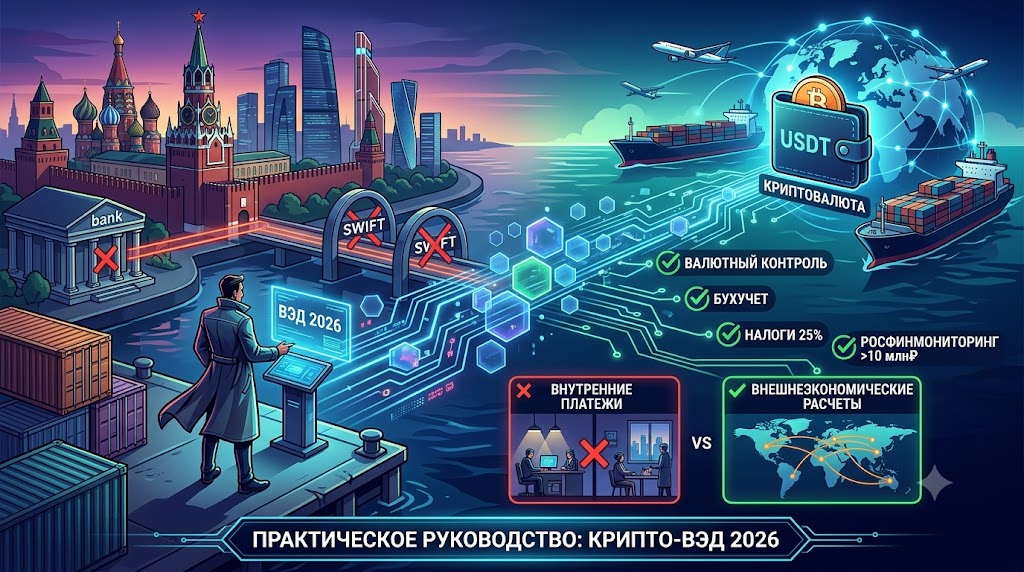
Did you know that in 2026, classical cross-border bank transfers for Russian businesses have practically ground to a halt due to sanctions pressure, forcing companies to en masse transition to alternative settlements? The use of cryptocurrency in foreign economic activity (FEA) has become the primary legal tool for saving trade flows, allowing businesses to completely bypass SWIFT blocks. Russian legislation has performed a U-turn, integrating digital currencies into the legal framework for settlements with foreign counterparties. This article contains a comprehensive, practical guide on passing currency control, correctly maintaining accounting records, minimizing tax risks, and operating safely on cryptocurrency platforms. Since you confirmed that this is a regular article, we will move directly to a standalone breakdown of the regulatory framework and step-by-step algorithms for businesses without mentioning accompanying materials.
How the Regulatory and Legal Framework of Crypto-FEA Is Structured in 2026
Legislative amendments in 2026 officially legalized the use of digital currencies for settlements under foreign economic activity (FEA) contracts, creating a dedicated legal perimeter for business. The State Duma, jointly with the Bank of Russia, launched an experimental legal regime (EPR) that extracted cryptocurrency from the gray zone exclusively for conducting cross-border payments.
According to an analytical review by IC Finam dated July 2026, the adopted normative acts split the use of digital assets in the domestic and foreign markets. While cryptocurrency still cannot serve as a means of payment inside the country, it is recognized as a fully-fledged settlement instrument within the framework of FEA. According to a publication on the Klerk.ru portal from July 2026, this step allowed importers and exporters to restore ruptured supply chains with friendly jurisdictions.
The Bank of Russia acts as the main regulatory body under the new EPR, coordinating the work of authorized banks and digital depositories. Experts from the Advolaw legal bureau note in their July press release that the regulatory framework now protects the rights of entrepreneurs as long as they operate through a licensed national infrastructure. The reform eliminated the legal vacuum that previously forced companies to use semi-legal schemes at their own peril and risk.
How to Register a Contract for Currency Control at a Bank When Paying with Cryptocurrency
Banks are required to register foreign trade contracts involving cryptocurrency settlements for currency control, provided that the payment documents originate from officially recognized operators or licensed digital depositories. The currency control procedure has changed completely compared to previous years.
Previously, banks, guided by the strict requirements of Anti-Money Laundering Law No. 115-FZ, categorically refused to recognize cryptocurrency as a lawful means of payment for goods. Any attempt by a company to execute such an operation or use a corporate account to purchase digital assets led to the immediate blocking of all accounts and the blacklisting of the legal entity. In 2026, the situation shifted: new rules allow a foreign trade contract to be integrated into the banking system of currency control.
To successfully pass the procedure and avoid sanctions, a company must perform the following steps:
-
Insert a special clause into the text of the foreign trade contract, establishing that settlements are made in digital currency and specifying the exact asset (e.g., USDT).
-
Register the contract with an authorized bank, providing a standard package of documents, including invoices and specifications.
-
Execute the purchase and transfer of cryptocurrency exclusively through digital platforms or depositories accredited by the Bank of Russia.
-
Provide the bank with an official confirmation statement from the digital platform operator containing the unique identifier-address of the transaction.
-
Submit the receiFEA statement along with the customs declaration (GTD) to close the reporting period and confirm the actual import of goods.
According to a practical guide by RBC analysts published in July 2026, end-to-end transparency is the key condition for bank approval. The bank must see that rubles from your settlement account were transformed into a digital asset within a regulated infrastructure, rather than disappearing into the accounts of dubious intermediaries.
How to Correctly Maintain Accounting Records and Pay Taxes for Cryptocurrency Operations
In Russian accounting, cryptocurrency is classified as property or unrecorded rights, which requires reflecting operations through accounts tracking other circulating assets or inventory. Organizations cannot ignore the movement of digital assets on their balance sheets.
When purchasing cryptocurrency for FEA purposes, an accountant makes a entry to the debit of Account 41 ("Goods") or Account 76 ("Settlements with various debtors and creditors") in correspondence with cash account logs. At the moment the cryptocurrency is transferred to a foreign supplier, the asset is written off while simultaneously clearing the accounts payable to the counterparty. The basis for this entry consists of an official report from the digital depository and an invoice from the foreign partner.
The taxation of these operations features clearly defined rules and hidden risks:
-
Value Added Tax (НДС): The sale and transfer of digital currencies within the territory of the Russian Federation are legally exempt from VAT. This significantly reduces the tax burden during intermediate conversion phases.
-
Corporate Income Tax (Налог на прибыль организаций): Operations with cryptocurrency directly affect the calculation of this tax. A company is obligated to account for exchange rate differences. Because the exchange rate of cryptocurrency against the ruble continuously fluctuates, any positive exchange rate difference arising while waiting for a shipment is recognized as non-operating income. This income must be included in the tax base and is taxed at the standard rate of 25%.
According to explanations by tax experts on the Klerk.ru portal, ignoring exchange rate differences is the most common violation leading to additional assessments and heavy fines from the Federal Tax Service (FNS). The accounting department must record the ruble equivalent of digital assets in transit on a daily basis.
How to Avoid Automatic Росфинмониторинг Control for Transactions over 10 Million Rubles
To conduct large cryptocurrency payments exceeding 10 million rubles, companies are required to use exclusively official "white list" channels and inform the regulator in advance about the purpose of the transaction. Financial intelligence tightly controls the movement of large capitals.
According to July publications in leading business media, Rosfinmonitoring has established an automatic control threshold for foreign trade crypto-operations. If a transaction amount exceeds the established limit, the "Transparent Blockchain" analytical system instantly blocks the payment pending investigation if it appears suspicious. Using retail P2P networks or gray over-the-counter (OTC) offices to transfer such amounts is categorically prohibited. An attempt to split a transaction and route it through the private bank cards of individuals—so-called drops (droppers)—is viewed by the regulator as intentional money laundering and entails criminal liability under Article 187 of the Criminal Code of the Russian Federation.
To legally conduct transactions above 10 million rubles, a business must follow a strict protocol:
-
Submit a notification to the Bank of Russia or the authorized body of the EPR in advance regarding the planned large payment under a specific foreign trade contract.
-
Provide a full package of documents proving the reality of the deal: an international contract, specifications, logistics documents, as well as confirmation of the legal origin of the ruble funds.
-
Use only those digital platforms for conversion that feature direct data exchange gateways with Rosfinmonitoring.
In this case, as noted by IC Finam experts, the financial intelligence system correlates the movement of digital tokens with the actual movement of goods through customs. When the economic logic is transparent, the transaction gets the green light and proceeds without delays.
Where the Absolute Red Line Between Domestic and Foreign Payments Is Drawn
An absolute legislative ban is imposed on the use of cryptocurrency for any settlements, purchases of goods, provisions of services, or salary payments within the territory of the Russian Federation. All regulatory freedom and "settlement opportunities" are designated exclusively for foreign economic activity (FEA).
If a company decides to pay for the services of a local advertising agency in cryptocurrency, buy office equipment from a local supplier, or issue bonuses to employees in tokens, this will be recognized as a gross violation of currency and tax legislation. The consequences for the business will be fatal—ranging from the forced closure of all accounts to the complete liquidation of the legal entity with confiscation of assets.
The only legal and safe scheme is structured as follows:
-
Rubles in a settlement account
-
Conversion via a licensed operator into a crypto-asset
-
Direct transfer to a non-resident abroad
What Are the Main Advantages and Risks of Using Cryptocurrency for Business
| Parameter of Comparison | Advantages for Business | Risks and Challenges for the Company |
| Payment Speed | Crediting funds to a foreign supplier's wallet takes 10 to 30 minutes, completely ruling out delays on the side of correspondent banks. | The need for immediate rate locking due to high crypto-market volatility. |
| Sanctions Resistance | Decentralized blockchain networks cannot be blocked by decisions of individual states or disconnection from SWIFT. | The risk of triggering harsh domestic reviews (115-FZ) if the asset purchase chain was non-transparent. |
| Settlement Geography | The ability to unhinderedly pay counterparties in Asia, the Middle East, and Africa without opening local accounts. | A high tax rate (25%) on non-operating profit arising from a rate surge of the asset on the balance sheet. |
How to Safely Transact with Cryptocurrency on KuCoin Under Tightening Controls
To ensure the secure operation of corporate structures and professional market participants associated with them, the KuCoin platform provides a comprehensive toolkit for conducting transparent trading in compliance with international compliance standards. Utilizing a globally renowned exchange minimizes the risks of lockouts by financial intelligence.
The KuCoin platform enforces mandatory user verification (KYC) and provides a detailed export of the history of all executed trades, orders, and asset movements. These documents are critically important for assembling a legitimate reporting package. When a bank or tax authority requests confirmation of the source of origin of digital assets, a statement from KuCoin, backed by unique transaction hashes in the blockchain, serves as official proof of the operation's cleanliness.
When withdrawing funds or preparing assets for FEA deals via the KuCoin P2P platform, companies and their authorized representatives should carefully select counterparties with high ratings and verified histories. Trading on a platform that strictly adheres to international anti-money laundering rules ensures that your wallets will not be linked to tainted addresses. This makes passing internal bank currency control quick and hassle-free.
Conclusion
The use of cryptocurrency in foreign economic activity in 2026 has definitively transformed from a risky experiment into a tightly regulated but effective survival tool for Russian business. Legislative changes opened legal gateways for companies to pay for imports bypassing the traditional banking system, locking down the rules of the game at the level of the Bank of Russia and Rosfinmonitoring. The core prerequisites for successful work have become a total rejection of anonymity, conducting large transactions over 10 million rubles via specialized "white" channels, and strict maintenance of accounting records with the payment of a 25% income tax on exchange rate differences. The red line is drawn sharply: cryptocurrency is permitted exclusively for settlements with foreign non-residents, while the domestic ruble space remains inviolable. Businesses that can adapt their financial and compliance branches to the new realities and opt for transparent international platforms like KuCoin will gain a colossal competitive advantage, ensuring the continuity of their supplies and protecting capital from sanctions blockages.
Frequently Asked Questions (FAQs)
Can the digital ruble be used to pay for import contracts instead of cryptocurrency?
No, the digital ruble is designed exclusively for domestic settlements between residents of the Russian Federation and, at this stage, cannot be used for cross-border payments under FEA contracts.
What happens if a company mistakenly pays for services within Russia using cryptocurrency?
Such an operation will be recognized as an illegal use of payment surrogates, which will entail an immediate block on corporate accounts under Law No. 115-FZ, the imposition of heavy administrative fines, and the potential forced closure of the legal entity.
Is the foreign supplier company required to have a crypto-wallet registered in the Russian Federation?
No, the foreign counterparty can use any standard cryptocurrency wallet or address on an international exchange, as Russian regulatory and reporting requirements apply only to the resident of the Russian Federation initiating the payment.
Is it taxable if cryptocurrency is simply stored on a company's balance sheet without movement?
Yes, if as of the reporting date the exchange rate of the cryptocurrency against the ruble has grown, the company is obligated to record the positive exchange rate difference as non-operating income and pay income tax on it at a 25% rate, even if no actual sale of the asset occurred.
Can high-anonymity coins (such as Monero) be used for legitimate Crypto-FEA?
No, the use of anonymous cryptocurrencies is completely prohibited under the framework of the experimental legal regime, and banks are guaranteed to refuse contract registration if such assets are chosen as the settlement unit.