

Cerebras (CBRS) IPO Soars 90% on Debut at $350: Can the Nvidia Challenger Reshape the AI Chip Market?
Introduction
Cerebras Systems (CBRS) stunned Wall Street in May, when its long-awaited IPO opened at $350 per share — nearly 90% above its $185 offering price — instantly minting one of the most explosive AI hardware debuts since Nvidia's run began. According to CNBC's market open coverage, the surge valued the wafer-scale chip designer at roughly $42 billion on a fully diluted basis, cementing it as the most credible public-market challenger to Nvidia's AI accelerator dominance.
For investors weighing whether to chase the rally or wait for a pullback, the key question is no longer whether Cerebras can build faster silicon — it already does, on certain workloads — but whether it can convert technical leadership into durable revenue against a competitor with 90%+ data center GPU market share. This article breaks down the IPO mechanics, the Nvidia comparison, the risks, and how to position around CBRS.
What Is Cerebras and Why Did Its IPO Surge 90%?
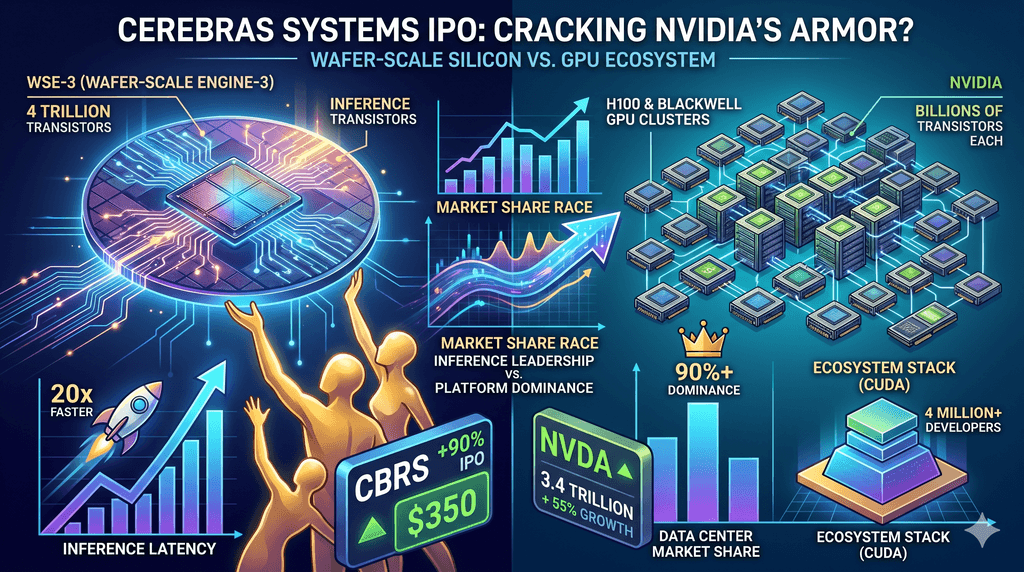
Cerebras Systems is an AI compute company that builds the world's largest computer chip — the Wafer-Scale Engine (WSE) — designed to train and run large language models faster than clusters of Nvidia GPUs. The 90% first-day pop reflects three forces converging at once: scarcity of pure-play AI hardware listings, validated inference-speed benchmarks, and a multi-billion-dollar backlog disclosed in the S-1.
According to the company's IPO prospectus filed with the SEC, Cerebras priced 30 million shares at $185, raising approximately $5.55 billion in primary proceeds. Shares opened at $350 on the Nasdaq under ticker CBRS and traded as high as $362 intraday before settling near $341 at the close.
The Wafer-Scale Engine Explained
The WSE-3, Cerebras' current-generation chip, contains 4 trillion transistors and 900,000 AI-optimized cores on a single silicon wafer roughly the size of a dinner plate. A conventional Nvidia H100 GPU, by comparison, carries about 80 billion transistors. By keeping computation on one wafer instead of stitching together thousands of discrete GPUs, Cerebras eliminates much of the networking overhead that slows distributed training.
Why the Market Reacted So Aggressively
Three demand signals drove the bid. First, the S-1 disclosed a $7.1 billion multi-year contract with G42, the UAE-based AI cloud operator. Second, Cerebras reported inference throughput on Llama-class models running 20x faster than comparable Nvidia GPU clusters in third-party MLPerf submissions. Third, retail and institutional appetite for AI infrastructure names remains elevated, with the broader semiconductor index up roughly 28% year-to-date based on Nasdaq sector data as of mid-May 2026.
How Does Cerebras Compare to Nvidia as an AI Stock?
Cerebras and Nvidia are not direct one-to-one competitors today — Nvidia is a vertically integrated platform giant, while Cerebras is a specialized accelerator company — but they increasingly bid for the same training and inference budgets. The clearest way to frame the comparison is by scale, growth rate, and addressable opportunity.
According to the latest figures, Nvidia generated roughly $148 billion in trailing-twelve-month revenue with data center sales accounting for over 85% of the total. Cerebras, in its most recent fiscal year disclosed in the prospectus, reported $1.36 billion in revenue — small in absolute terms, but growing 220% year-over-year versus Nvidia's still-impressive but decelerating 55% data center growth rate.
|
Metric
|
Nvidia (NVDA)
|
Cerebras (CBRS)
|
|
Market cap (May, 2026)
|
~$3.4 trillion
|
~$42 billion
|
|
TTM revenue
|
~$148 billion
|
~$1.36 billion
|
|
YoY revenue growth
|
~55%
|
~220%
|
|
Gross margin
|
~74%
|
~52%
|
|
Primary product
|
H200 / Blackwell GPUs
|
WSE-3 wafer-scale chip
|
|
Software moat
|
CUDA ecosystem
|
Open-source Cerebras SDK
|
Where Cerebras Wins
Cerebras outperforms Nvidia on inference latency for large transformer models and on power efficiency per token generated. Customers running real-time AI applications — chatbots, code assistants, and agentic workflows — care intensely about tokens-per-second. Independent benchmarks show Cerebras delivering up to 1,800 tokens per second on Llama 3.1 70B versus roughly 90 tokens per second on equivalently priced GPU deployments.
Where Nvidia Still Dominates
Nvidia's CUDA software stack remains the industry default, with over 4 million registered developers according to its most recent investor day disclosures. Switching costs are real. Cerebras also lacks Nvidia's networking (NVLink, InfiniBand via Mellanox) and full-stack ecosystem, meaning enterprise buyers often choose Nvidia even when raw silicon performance favors alternatives.
Is the Cerebras IPO Price Justified at $350?
At $350, Cerebras trades at roughly 31 times trailing sales — a steep multiple, but not unprecedented for high-growth AI infrastructure names at IPO. Whether the valuation holds depends on how quickly the company converts its $8.4 billion disclosed backlog into recognized revenue.
For context, Nvidia trades at approximately 23 times trailing sales as of May 15, 2026 according to Nasdaq market data, despite being roughly 80x larger by revenue. Investors paying a premium for Cerebras are explicitly underwriting two assumptions: that the 220% growth rate sustains for at least two more years, and that gross margins expand from 52% toward the 65%+ range as wafer yields improve.
Bull Case Math
If Cerebras grows revenue 150% in FY2026 and 90% in FY2027, it would exit 2027 at roughly $8 billion in annual revenue. Applying a more normalized 15x forward sales multiple at that point would imply a market cap near $120 billion — roughly 3x the IPO-day valuation. That is the path bulls are betting on.
Bear Case Math
Customer concentration is the most cited risk. G42 alone accounts for over 60% of disclosed backlog. If a single hyperscaler delays orders or Nvidia's Blackwell Ultra closes the inference gap, growth could decelerate sharply. A reversion to 8x sales on flat revenue would imply a market cap closer to $11 billion — a 70%+ drawdown from opening prints.
What Are the Biggest Risks for CBRS Investors?
The four risks investors must price in are customer concentration, Nvidia's product roadmap, lock-up expiration, and macro liquidity conditions. Each is well-documented in the prospectus and recent analyst commentary.
Customer Concentration
G42's $7.1 billion contract is a blessing and a vulnerability. According to the S-1 risk disclosures, the top three customers represent more than 75% of revenue. Any geopolitical friction affecting UAE technology exports — particularly export-license dynamics with the U.S. Commerce Department — could materially impair the order book.
Nvidia's Blackwell Ultra and Rubin Roadmap
Nvidia announced at GTC in March 2026 that its Rubin architecture would ship in volume by Q4 2026, with claimed inference throughput improvements of 3.5x over Blackwell. If Rubin closes most of the latency gap, Cerebras' performance moat narrows precisely when it needs to scale commercial wins.
Lock-Up Expiration
Insider lock-ups typically expire 180 days post-IPO, putting mid-November 2026 in focus. Roughly 60% of outstanding shares are held by pre-IPO investors and employees. Even partial selling pressure could create significant overhang.
Macro and Rate Sensitivity
High-multiple growth names remain sensitive to interest-rate expectations. With the Fed funds rate at 4.25%–4.50% as of the May 2026 FOMC decision, any hawkish surprise would compress AI hardware multiples across the board, Cerebras included.
Should You Trade Cerebras-Linked Crypto and AI Tokens on KuCoin?
While CBRS itself trades on the Nasdaq, the AI infrastructure narrative driving the Cerebras IPO has powerful spillover effects into the crypto AI sector — and KuCoin offers deep liquidity across the most relevant tokens. The launch validates institutional demand for specialized AI compute, which directly supports the thesis behind decentralized GPU networks, AI agent protocols, and tokenized compute marketplaces.
On KuCoin, traders can access leading AI-themed tokens including those tied to decentralized compute, on-chain inference, and AI agent ecosystems. KuCoin's spot and futures markets provide flexibility for both directional positioning and hedging around macro AI catalysts like the CBRS debut.
In addition, KuCoin also offers tokenized stocks, including both CBRSUSDT and NVDAUSDT, enabling users to trade popular US stocks using USDT. New users can now register at KuCoin and Get Up to 11,000 USDT in New User Rewards.

Conclusion
Cerebras' 90% IPO surge to $350 marks a watershed moment for AI hardware: the first credible public-market challenger to Nvidia has arrived, validated by a $42 billion opening valuation and an $8.4 billion backlog. The bull case rests on sustained triple-digit revenue growth, expanding margins, and capturing share in the high-growth inference market where Cerebras' wafer-scale architecture demonstrably outperforms GPU clusters.
The bear case is equally clear — customer concentration above 75% in the top three accounts, Nvidia's aggressive Rubin roadmap, and a November 2026 lock-up expiration all threaten the premium valuation. At 31 times sales, CBRS leaves little room for execution missteps.
For investors, the practical takeaway is that Cerebras represents a high-conviction, high-volatility expression of the AI infrastructure thesis. Position sizing matters more than entry timing. And for traders looking to express the broader AI narrative through crypto markets, KuCoin's AI token listings offer correlated exposure with 24/7 liquidity and global access.
FAQs
1. When did Cerebras (CBRS) start trading publicly?
Cerebras began trading on the Nasdaq on May, 2026, under the ticker CBRS at an opening price of $350 per share, nearly 90% above its $185 IPO price.
2. Who are Cerebras' largest customers?
G42, the UAE-based AI cloud provider, is the largest customer with a $7.1 billion multi-year contract. Other disclosed customers include AI research labs, pharmaceutical companies running molecular simulations, and U.S. national laboratories using Cerebras systems for scientific computing.
3. Can retail investors buy CBRS shares directly?
Yes. CBRS trades on the Nasdaq and is accessible through any standard U.S. brokerage account that supports equity trading. International investors can access shares through brokers offering U.S. market access, subject to local regulations.
4. How is Cerebras different from other Nvidia competitors like AMD or Groq?
Cerebras uses a wafer-scale architecture — one chip the size of a dinner plate — while AMD's MI300X and Groq's LPU follow more conventional chip designs. Cerebras specializes in ultra-fast inference for large language models, whereas AMD competes more broadly across training and inference workloads.
5. Does the Cerebras IPO affect crypto AI tokens?
Yes, indirectly. Successful AI hardware IPOs reinforce institutional validation of the AI infrastructure thesis, which historically correlates with strength in decentralized compute and AI agent tokens. Traders often see sector-wide momentum in AI-themed cryptocurrencies following major catalyst events like high-profile chip IPOs.