

Bitcoin's Comeback: Is a 20% Increase Enough to Make it a Top 10 Global Asset Again?
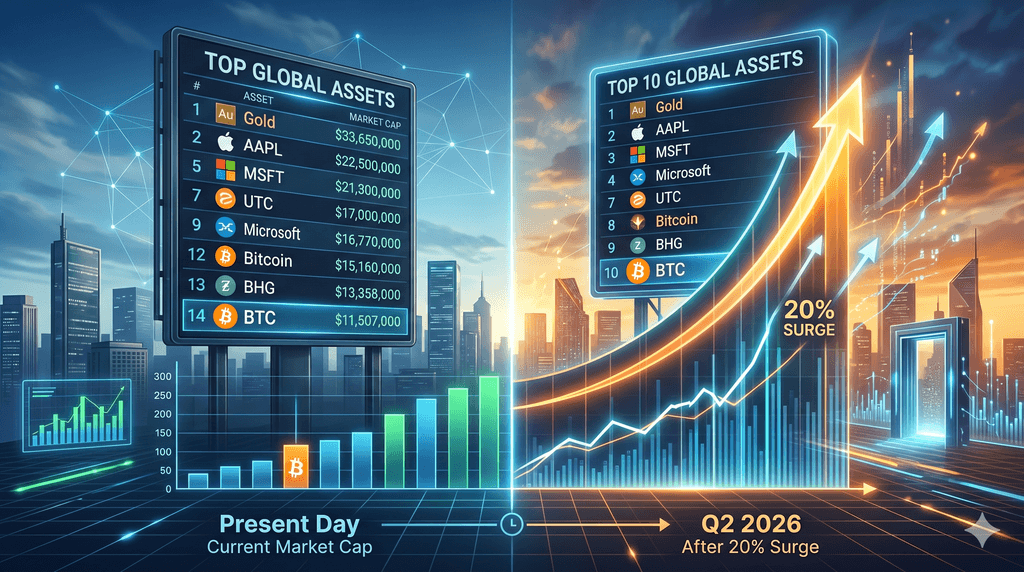
The global financial leaderboard is no longer a private club for oil giants and Silicon Valley titans. In the volatile but maturing landscape of April 2026, Bitcoin stands at a definitive crossroads. Following a period of healthy consolidation after the post-halving highs of 2025, "Digital Gold" is now aggressively knocking on the door of the Global Top 10 Assets by Market Capitalization.
As of April 17, 2026, Bitcoin is trading in a high-velocity range that keeps it just outside the elite inner circle, frequently flipping positions with value stalwarts like Berkshire Hathaway and Meta for the #10 spot. Investors are now fixated on one critical pivot point: Can a 20% surge in Q2 2026 solidify Bitcoin’s status as a permanent top-tier global asset?
In this comprehensive analysis, we dissect the quantitative math, the geopolitical macro-drivers, and the institutional liquidity shifts redefining the global financial hierarchy this quarter.
Key Takeaway
-
The Ranking Gap: Bitcoin currently sits at approximately $1.85 Trillion in market cap. To reclaim a top 10 spot, it must overtake the likes of Meta ($1.9T) or Saudi Aramco ($2.0T).
-
The 20% Target: A 20% price increase would put Bitcoin's market cap at roughly $2.22 Trillion, likely securing its place as the #8 or #9 largest asset globally, potentially surpassing Amazon.
-
Catalysts: Institutional "Strategic Reserve" talk, sustained ETF inflows, and the 2024 halving’s supply shock finally meeting peak demand are the primary engines for Q2.
-
Macro Risks: While the U.S. administration's pro-crypto stance is a tailwind, any unexpected "higher-for-longer" interest rate pivots could dampen the 20% rally goal.
The State of the Global Leaderboard in April 2026
To understand if Bitcoin can break into the Top 10, we first need to look at the giants it’s trying to slay. The 2026 market is dominated by the "Big Three" of AI—Nvidia, Apple, and Alphabet—all of which have ballooned past the $3.5 trillion mark.
Currently, the 10th spot is a revolving door between legacy value and new-age tech.
-
Nvidia (#1): ~$4.8 Trillion
-
Apple (#2): ~$3.9 Trillion
-
Microsoft (#4): ~$3.1 Trillion
-
Saudi Aramco (#9): ~$2.05 Trillion
-
Meta (#10): ~$1.95 Trillion
-
Bitcoin (#11): ~$1.85 Trillion
Bitcoin is currently roughly $100 billion away from overtaking Meta. In the world of crypto, $100 billion in market cap can be gained or lost in a single "Green God Candle" week. A 20% surge from today’s price (approximately $95,000) would propel Bitcoin to $114,000, giving it a market cap of over $2.2 Trillion.
Why Q2 2026 is the Perfect Storm for a 20% Rally
What separates the current moment from other Q2 periods in Bitcoin's history is not one factor but the convergence of three structural shifts arriving simultaneously.
The Post-Halving Sweet Spot
In April 2024, the Bitcoin block reward was cut from 6.25 BTC to 3.125 BTC. While the immediate price impact is often muted, the cumulative effect of 450 fewer Bitcoins being produced every single day begins to manifest roughly 12 to 18 months later. By April 2026, the market is feeling the full weight of this "scarcity by design." Historical halving cycles show that the second year post-halving is consistently when the most significant price discovery occurs. In 2021, the 2020 halving catalysed Bitcoin's run from under $10,000 to over $60,000. The 2024 halving's "peak impact window" falls squarely in Q2 2026 — and unlike previous cycles, this one is meeting a far more institutionally developed market.
The ETF Institutional Accumulation Machine
The Bitcoin ETF landscape in 2026 has transitioned from a market novelty into a massive institutional accumulation engine. Led by BlackRock, which captured $935 million in net inflows in Q1 alone and maintains a 50% market share, these products are absorbing supply at an unprecedented scale. Recent two-day inflows exceeding $500 million demonstrate the immense conviction of institutional players, a trend further validated by Morgan Stanley becoming the first major Wall Street bank to launch its own Bitcoin ETF, signaling a new era of democratized access across the banking sector.
This sustained institutional demand is creating a profound structural squeeze on sell-side liquidity. With ETFs frequently absorbing thousands of coins per week while the post-halving daily issuance remains capped at 450 BTC, the market is experiencing a significant supply-demand imbalance. As major financial institutions continue this patient, large-scale accumulation, the resulting reduction in available supply is establishing a powerful foundation for aggressive price discovery throughout the remainder of 2026.
The Sovereign Reserve Narrative: From Theory to Policy
The formal establishment of the U.S. Strategic Bitcoin Reserve via Executive Order 14233 in March 2025 has fundamentally reclassified Bitcoin from a speculative vehicle to a matter of national economic security. With the federal government holding over 328,000 BTC by early 2026, the "Sovereign Stack" has emerged as a critical pillar of geopolitical power, prompting nations like Switzerland to consider similar central bank integrations. This shift toward state-level accumulation provides a massive repricing catalyst, as the asset is now viewed as essential infrastructure for sovereign treasury compositions and global trade.
Beyond government reserves, the asset's utility is expanding into corporate and international trade sectors, with over 1.5 million BTC now held on private balance sheets. Experts suggest that as Bitcoin is increasingly utilized for high-stakes applications—such as sovereign trade tolls and as a hedge in high-inflation economies—it is positioned to challenge gold’s $34 trillion market cap. This dual momentum of institutional adoption and sovereign legitimacy marks the transition of Bitcoin into a permanent, top-tier global reserve asset.
Macroeconomic Tailwinds: The "Strategic Reserve" Narrative
Perhaps the most significant development of 2026 is the shift in political rhetoric. The current U.S. administration’s discussions regarding a Strategic Bitcoin Reserve have changed the asset's risk profile.
When a sovereign nation considers holding an asset, it is no longer a "speculative bubble"; it becomes a matter of national economic security. This narrative shift has encouraged other sovereign wealth funds—rumored to include Norway and the UAE—to follow MicroStrategy’s lead in aggressive accumulation. If a major legislative step toward a U.S. reserve is taken this quarter, a 20% surge would be a conservative estimate.
Technical Analysis: The Path to $114,000
From a technical standpoint, Bitcoin’s price action in Q1 2026 was defined by sideways consolidation between $80,000 and $95,000.
Support and Resistance Levels
-
Primary Support: $85,000 (The 50-day EMA)
-
Key Resistance: $100,000 (The psychological "Six Figure" barrier)
Breaking the $100k mark is the catalyst. Once Bitcoin clears $100,000, there is "blue sky" territory. Mathematical models, including the Fibonacci extension from the 2024 lows, suggest a target of $114,000 as the next major liquidity zone. This 20% jump would not just be a price milestone; it would be the definitive entry ticket back into the Global Top 10.
While the world watches Bitcoin's battle for the Top 10, the most sophisticated players in the market are looking at the infrastructure that makes these moves possible. One cannot talk about the 2026 bull run without mentioning the evolving role of global exchanges.
Have you ever wondered why some traders seem to catch the "hidden gems" before they hit the headlines? It often comes down to the tools they use. For instance, KuCoin has increasingly become a hub for those who want to look beyond the top-tier assets. Their GemSPACE dashboard and Spotlight launchpad are designed for the "discovery phase" of a bull market—identifying projects with high search volume and early liquidity before they become household names.
For those who find the volatility of a 20% Bitcoin surge daunting, the platform’s AI-driven trading bots have become a staple in 2026. These bots can automatically adjust positions based on trend analysis, allowing users to participate in the market's upside without needing to stare at charts 24/7. It’s this blend of high-end technology and early-access opportunities that keeps the community curious about what’s launching next. Whether you're tracking Bitcoin’s ascent or hunting for the next breakout token, having access to institutional-grade data and automated tools is no longer a luxury—it’s a prerequisite.
Risks to the 20% Bull Case: What Could Go Wrong?
No market analysis is complete without a healthy dose of skepticism. While the path to the Top 10 looks clear, several "black swan" or "grey swan" events could derail the Q2 rally.
-
The "Higher for Longer" Threat: If inflation proves stickier than the Fed’s 2026 targets, a delay in interest rate cuts could suck liquidity out of "risk-on" assets.
-
Regulatory Fine-Tuning: While the U.S. is more crypto-friendly, the EU’s evolving MiCA framework could introduce short-term friction for cross-border liquidity.
-
Profit Taking: After a long climb from the $50k lows of 2025, long-term holders (LTH) might view the $100k mark as the perfect exit point, creating a massive sell-wall that prevents the 20% surge.
Conclusion: Is the Top 10 Inevitable?
A 20% surge is not just a "nice to have" for Bitcoin; it is the threshold that separates a "leading cryptocurrency" from a "global reserve asset." If Bitcoin reaches $114,000 this quarter, it will likely leapfrog Meta, Saudi Aramco, and potentially Amazon, landing firmly in the #8 spot.
The convergence of institutional demand, political legitimacy, and the halving’s supply crunch makes Q2 2026 one of the most anticipated windows in financial history. Whether it happens in April or June, the trend is clear: Bitcoin is no longer fighting for relevance; it is fighting for dominance on the global balance sheet.
FAQs:
Which assets are currently in the Global Top 10?
The list is dominated by Nvidia, Apple, Alphabet (Google), Microsoft, Amazon, and Berkshire Hathaway, along with Saudi Aramco and gold.
Why is a 20% surge significant?
A 20% increase would push Bitcoin's market cap past the $2.2 Trillion mark. This would likely allow it to overtake both Saudi Aramco and Meta, making it one of the eight most valuable assets on the planet.
How does the 2024 halving affect the 2026 price?
Halvings typically create a supply-demand imbalance that peaks 12 to 24 months after the event. Q2 2026 falls right into this "peak impact" window.
Can Bitcoin flip Gold in market cap in 2026?
While a 20% surge puts Bitcoin in the Top 10, flipping Gold (which has a market cap over $14 trillion) is unlikely in 2026. Most analysts see that as a goal for the 2030s.
What price does Bitcoin need to reach to stay in the Top 10?
To remain a permanent fixture in the Top 10, Bitcoin likely needs to maintain a price floor of $110,000, assuming other tech giants do not experience massive growth simultaneously.
Disclaimer: This article is for informational purposes only and does not constitute financial advice. Cryptocurrency investments carry high risk. Always perform your own due diligence before trading.